
HomeNewsDelhi Meerut Corridor Spurs Property Surge

Delhi Meerut Corridor Spurs Property Surge

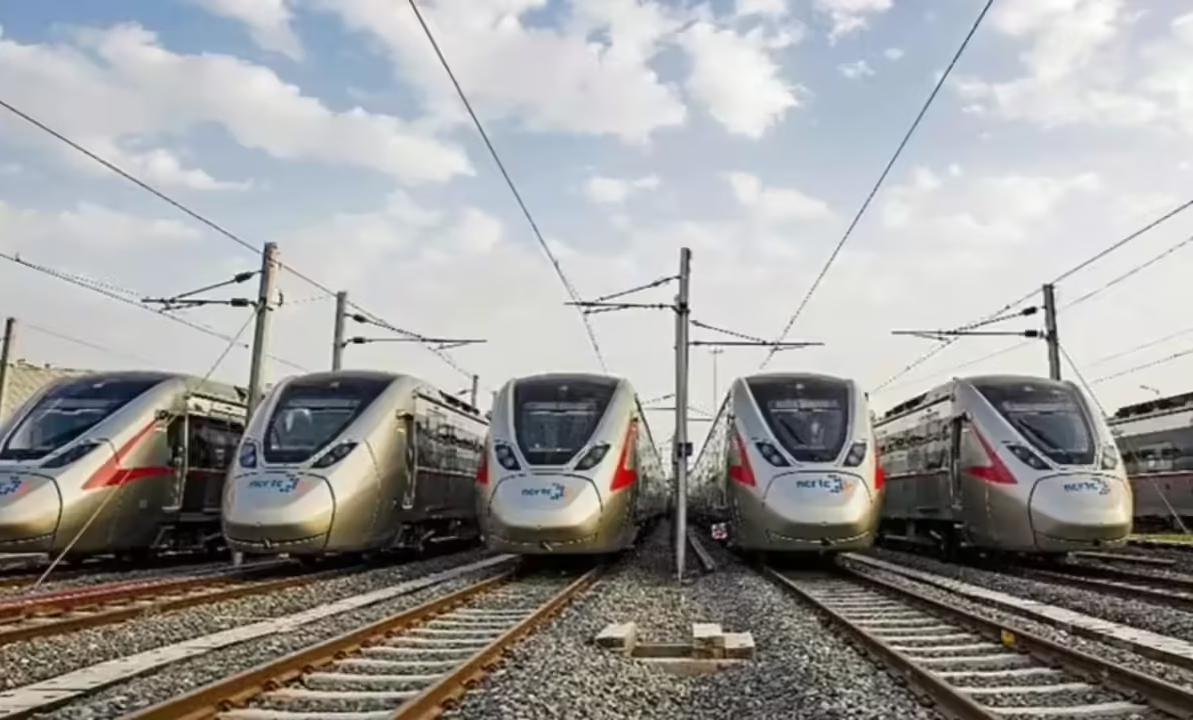
The full commissioning of the 82-kilometre high-speed rail link between Delhi and Meerut is beginning to reshape property markets across western Uttar Pradesh and the eastern edge of the National Capital Region (NCR). With travel time reduced to nearly one hour, urban economists say the operational Delhi Meerut Corridor could accelerate decentralised growth and redraw commuting patterns for thousands of households. 

The rapid rail system, implemented by the National Capital Region Transport Corporation, now connects key urban nodes including Ghaziabad, Modinagar and Muradnagar before terminating in Meerut. A parallel intra-city metro network in Meerut shares parts of the infrastructure, further tightening last-mile access.
Property consultants tracking transactions within a two-kilometre radius of stations report residential land values have already risen between 30 and 67 per cent over the past two years. In parts of Meerut, plotted developments that once traded at ₹8,000–12,000 per square yard are now changing hands at significantly higher levels, reflecting infrastructure-led speculation and end-user demand.

The Delhi Meerut Corridor is not merely a transport upgrade; planners describe it as a structural intervention designed to promote polycentric growth. By enabling faster inter-city commuting, the corridor could ease pressure on central Delhi while supporting employment and housing opportunities in peripheral towns. Urban planners note that such corridors often trigger mixed-use clusters, commercial hubs and mid-income housing projects near stations. Developers have begun aligning new projects with Uttar Pradesh’s Transit Oriented Development (TOD) framework. TOD encourages higher-density, walkable neighbourhoods around transit stations, reducing car dependency and lowering transport-related emissions. Industry observers say that if executed responsibly, this could steer the region toward more climate-efficient urban expansion rather than unchecked sprawl.

The corridor’s integration with existing metro and airport-bound routes is also expected to strengthen multi-modal connectivity. Improved regional mobility may encourage reverse commuting, where residents live in more affordable satellite towns while working in larger business districts. For cities like Meerut, this shift could expand the local services economy and formal housing supply.
However, analysts caution that infrastructure-led appreciation must be matched by civic planning. Water supply, waste management, green cover and social infrastructure will need to keep pace with rising population density. Without parallel investments in public amenities, rapid price escalation could strain affordability for lower-income households.

The Delhi Meerut Corridor also reflects a broader financing strategy in Indian urban transport. Authorities are exploring land monetisation and non-fare revenue streams around stations to sustain long-term operations. International lenders have supported such value capture models in other Asian cities, linking transit viability with planned urban development. As the corridor moves into full-scale operations, its long-term impact will depend less on headline property gains and more on how effectively cities translate connectivity into inclusive, low-carbon growth. If governance frameworks hold, the line could become a template for future regional rail investments across India’s expanding metropolitan belts.

Delhi Meerut Corridor Spurs Property Surge 
RELATED ARTICLES

LEAVE A REPLY

Please enter your comment!
Please enter your name here

- Advertisment -spot_img

Most Popular

Recent Comments

Delhi Lutyens Zone Anchors Elite Housing Market

Delhi Lutyens Zone Anchors Elite Housing Market

0
A private residence owned by a leading telecom entrepreneur in Delhi’s Lutyens’ Bungalow Zone has once again drawn attention to the extraordinary land values...
Delhi RERA Orders Relief In Dwarka Dispute

Delhi RERA Orders Relief In Dwarka Dispute

0
A recent order by the Delhi Real Estate Regulatory Authority has brought regulatory scrutiny to a high-end residential development in Dwarka, reinforcing that statutory...
Delhi Civic Body Begins Mehrauli Restoration Work

Delhi Civic Body Begins Mehrauli Restoration Work

0
The Municipal Corporation of Delhi has initiated formal steps to conserve a deteriorating pre-Independence civic structure in Mehrauli, signalling a renewed focus on protecting...
Delhi NBCC DDA Projects Expand Pipeline

Delhi NBCC DDA Projects Expand Pipeline

0
State-run construction and project management firm NBCC India Ltd has secured redevelopment contracts worth ₹775 crore from the Delhi Development Authority, reinforcing its role...
Ajmera Realty Introduces Vann Residential Enclave Mumbai

Ajmera Realty Introduces Vann Residential Enclave Mumbai

0
Ajmera Realty has entered Mumbai’s ultra-luxury residential segment with the launch of Vann By Ajmera, a premium enclave in the 7 Bungalows micro-market of...
