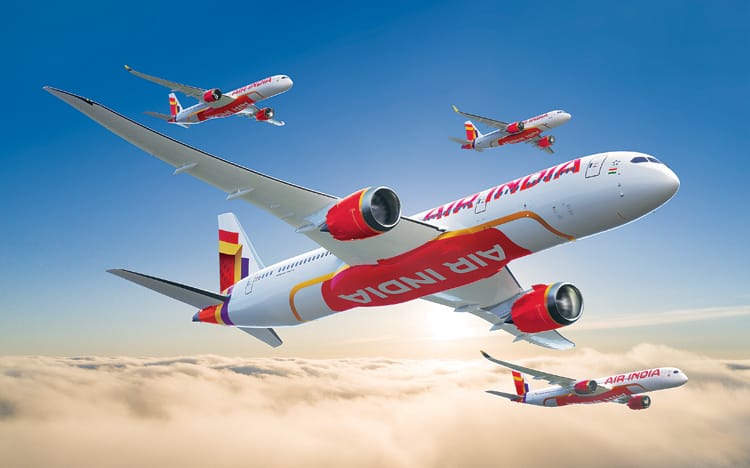
Air India Takes Off After Tata Acquisition, Expanding Globally and Strengthening Domestic Presence
Air India, the airline has made remarkable strides in reshaping its strategy, focusing on expansion, market segmentation, and reinforcing its position as a major player in both domestic and international aviation. Air India is set to challenge foreign carriers on international routes, while also addressing the domestic market with a renewed approach to its operations.
A key part of this transformation is the clear segregation of roles between Air India and its low-cost arm, Air India Express. With a combined fleet nearing 300 aircraft, Air India aims to dominate the international market and cater to premium passengers on domestic routes, while Air India Express will focus on short-haul international flights and the remaining domestic routes. This strategic realignment has already reduced route overlaps significantly, cutting the overlap from 20% to just 12%, and in the short-haul segment, this reduction is even more pronounced—from 26% to 5%. Nipun Aggarwal, Chief Commercial Officer of Air India, has emphasised the importance of focusing on the airline’s hubs in Delhi, Mumbai, and Bengaluru. These hubs will serve as central points for aggregating passengers flying from Southeast Asia, the Far East, and the SAARC region. Air India aims to connect these passengers to long-haul markets such as Europe, the United States, and Canada. This approach will allow Air India to compete directly with West Asian hubs like Dubai, Abu Dhabi, and Doha.
This hub strategy is not only aimed at enhancing convenience for passengers but also at increasing Air India’s long-haul market share. The airline has noted that the majority of international passengers—76%—opt for connecting flights rather than direct routes. With Air India currently holding a monopoly on long-haul flights to Western Europe, the US, and Canada, the airline is in a strong position to leverage this demand. Despite this, Indian carriers currently hold just 21% of the long-haul market share, contributing over 50% of Air India’s total revenue from international operations. In line with its ambitious growth plans, Air India is looking to add 570 new aircraft to its fleet over the next decade. This expansion will be powered by orders with Boeing and Airbus, following a successful addition of over 90 planes in the past three years, including narrow-body and wide-body aircraft. This marks a faster growth rate than that of Vistara during its first ten years of operation.
A major benefit of the integration between Air India and Air India Express is the rollout of a unified loyalty programme, which has already seen significant growth in enrolment—from 30,000 to 150,000 new members per month. This will help Air India further consolidate its position in the domestic market while enhancing customer loyalty across its service offerings. With upcoming greenfield airports in Noida and Navi Mumbai, Air India is also working to optimise its operations in these high-capacity regions. Aggarwal acknowledged the challenges of operating from two separate airports in the same metropolitan area but remains confident that creative strategies will be employed to balance capacity and optimise operations at Delhi and Mumbai airports. Air India’s plans for expansion under Tata Group’s leadership mark the beginning of a new era for Indian aviation. With a clear strategy for both domestic and international markets, a growing fleet, and a focus on improving passenger experience, Air India is positioning itself as a global competitor ready to take on the challenges of the future.