
HomeNewsMHADA Projects Become More Attractive for Developers with Revised Premium & FSI...

MHADA Projects Become More Attractive for Developers with Revised Premium & FSI Rules.

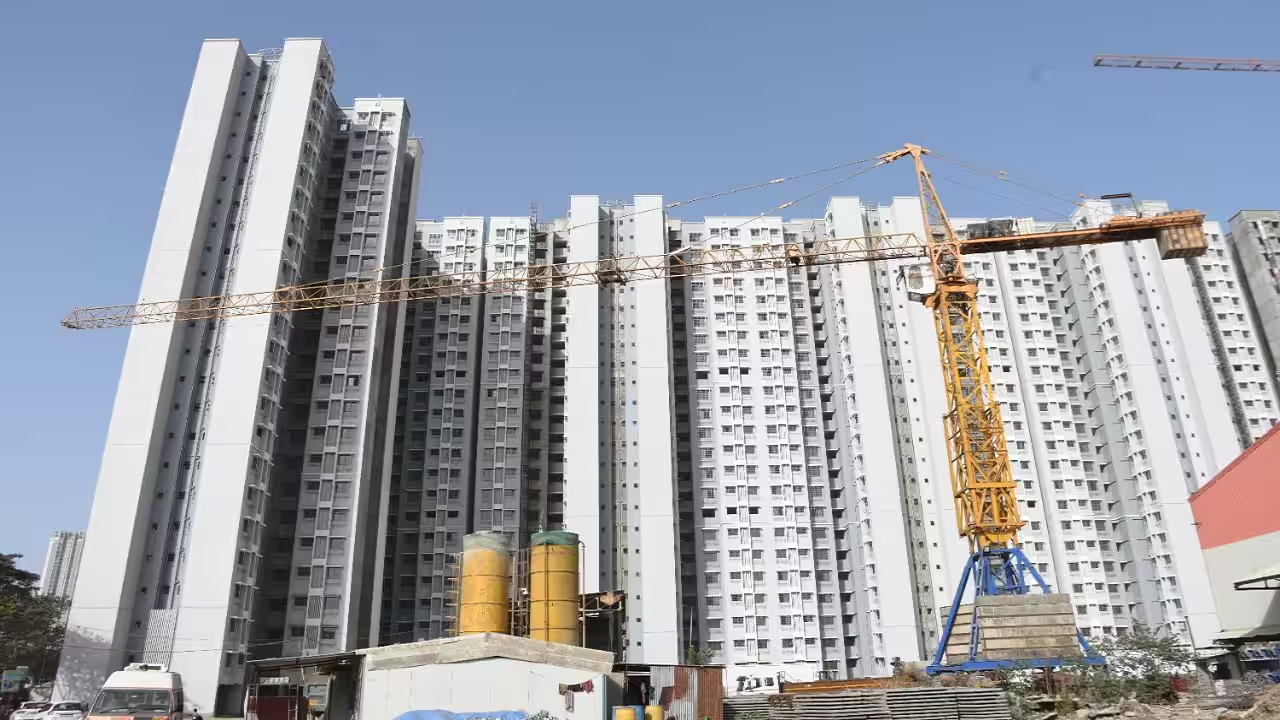
The Maharashtra government has proposed key amendments to Mumbai’s Development Control and Promotion Regulations (DCPR) 2034, aiming to make redevelopment projects under the Maharashtra Housing and Area Development Authority (MHADA) more financially viable and easier to execute. The move is expected to unlock hundreds of stalled or delayed housing projects across the city’s ageing MHADA layouts.

According to a notification issued by the Urban Development Department (UDD), the proposed modifications to Regulation 31(3) and Regulation 33(5) are designed to balance rehabilitation entitlements with construction economics, ensuring both tenant security and developer feasibility.At present, developers are permitted to receive additional “fungible” built-up area  free of premium  only on the existing built-up area of a housing project. The new proposal extends this benefit to the rehabilitation area as well. This change would allow builders to access extra construction area while rehousing existing tenants, improving project economics and making redevelopment more sustainable.

Further, under the current Regulation 33(5), MHADA allows additional construction potential up to a Floor Space Index (FSI) of 3.00 upon payment of a premium. The proposed change clarifies that this additional FSI should be calculated on the total rehabilitation entitlement rather than just the existing area. This revision would help developers manage the balance between rehabilitation and sale components more efficiently, creating a more predictable financial structure for complex redevelopment schemes.

Industry observers said the decision is a pragmatic step to revive redevelopment momentum in Mumbai’s older housing stock. “By extending fungible benefits and recalibrating FSI rules, the state is addressing the biggest bottlenecks facing MHADA colony projects  viability and clarity,” said a senior urban planner.
Redevelopment of MHADA layouts has often faced hurdles due to high construction costs, tenant density, and ambiguous regulatory provisions. Many of Mumbai’s large MHADA colonies  particularly in areas such as Bandra, Goregaon, and Kurla  are decades old, with inadequate infrastructure and poor resilience to modern safety or environmental standards.

Experts believe that making such projects viable will not only rejuvenate housing infrastructure but also align with Mumbai’s long-term goals for sustainable and inclusive urban renewal. By improving density management and leveraging existing land footprints, the amendments could contribute to more efficient use of urban land while avoiding greenfield expansion.The UDD has invited public suggestions and objections to the draft modifications under Section 37(1AA) of the Maharashtra Regional and Town Planning Act, 1966. Citizens and stakeholders have been given one month to submit feedback before the final notification is issued.

Also Read : Goregaon Set For Major Education Infrastructure Boost
MHADA Projects Become More Attractive for Developers with Revised Premium & FSI Rules.
RELATED ARTICLES

LEAVE A REPLY

Please enter your comment!
Please enter your name here

- Advertisment -spot_img

Most Popular

Recent Comments

Panattoni Hyderabad Facility Expands Industrial Infrastructure

Panattoni Hyderabad Facility Expands Industrial Infrastructure

A new manufacturing facility planned in Hyderabad is expected to strengthen Telangana’s industrial infrastructure ecosystem, reflecting the city’s growing role as a strategic centre...
Mumbai Redevelopment Project Targets Housing Infrastructure Renewal

Mumbai Redevelopment Project Targets Housing Infrastructure Renewal

A large-scale redevelopment agreement covering nearly 28 acres in Mumbai has renewed attention on the city’s accelerating urban renewal cycle, where ageing residential clusters...
AGI Greenpac Investment Signals Packaging Industry Expansion

AGI Greenpac Investment Signals Packaging Industry Expansion

A large-scale aluminium can manufacturing facility planned in Uttar Pradesh is expected to strengthen India’s industrial packaging ecosystem while reflecting rising investment in recyclable...
Toyota India Expansion Signals Manufacturing Corridor Growth

Toyota India Expansion Signals Manufacturing Corridor Growth

India’s automotive manufacturing sector could witness a major capacity expansion as reports indicate plans for multiple new vehicle assembly facilities, signalling rising confidence in...
Sanghvi Movers Expansion Supports India Infrastructure Projects

Sanghvi Movers Expansion Supports India Infrastructure Projects

India’s accelerating infrastructure pipeline is driving renewed demand for specialised heavy equipment services, as construction, energy and industrial projects increasingly depend on advanced logistics...
