Lodha Developers has secured development rights for a 17,403 square metre land parcel in Malabar Hill, marking one of the most significant land-linked transactions in South Mumbai this year. The agreement, executed in early January 2026 with the Sorabji Kanga Charity Trust, carries a stated consideration of Rs 106 crore and outlines a revenue and built-up area sharing structure between the parties.
According to property registration documents reviewed by Urban Acres, the Malabar Hill land parcel spans over four acres a rare scale in one of Mumbai’s most supply-constrained and premium residential enclaves. Under the arrangement, the developer will hold a 57.5 per cent share of the total permissible floor space, while the trust will retain 42.5 per cent. As part of its entitlement, the trust is slated to receive over 5,000 sq m of RERA-defined carpet area along with 150 car parking spaces. Based on prevailing luxury pricing benchmarks in the micro-market, the allocation earmarked for the trust has an estimated value exceeding Rs 1,400 crore. The overall development potential of the Malabar Hill land parcel is projected at approximately Rs 2,800 crore, subject to planning approvals and final design. Industry observers say such structured development-rights transactions are increasingly common in high-value urban precincts, where outright land acquisition is both capital intensive and legally complex. For legacy landowners, including trusts and institutions, partnership-led development enables value unlocking without relinquishing complete ownership control. For developers, it provides entry into marquee addresses that strengthen brand positioning.
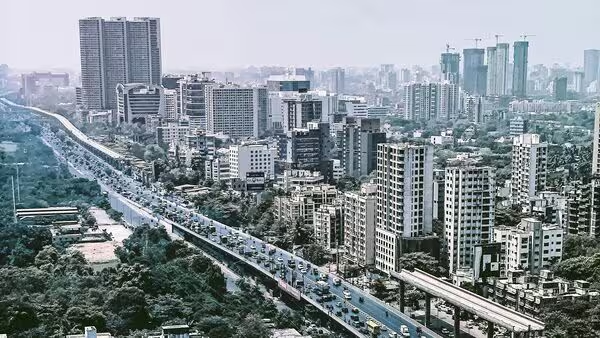
Malabar Hill remains among India’s most expensive residential districts, characterised by low-density layouts, heritage structures and proximity to administrative and commercial hubs in South Mumbai. However, redevelopment in the area must navigate stringent coastal regulation norms, heritage considerations and infrastructure capacity constraints. Urban planners note that as redevelopment gathers pace across Mumbai’s prime neighbourhoods, questions of carrying capacity, traffic management and climate resilience assume greater urgency. High-end residential towers in coastal zones must comply with evolving environmental safeguards, especially given rising sea levels and extreme rainfall patterns. Integrating energy-efficient design, water management systems and resilient building materials will be central to long-term viability. The project timeline is estimated at five years, aligning with typical luxury construction cycles in South Mumbai. The Malabar Hill land parcel acquisition also follows the company’s recent joint development initiatives in central Mumbai, signalling a strategy focused on pipeline expansion through partnership models rather than outright purchases.
As Mumbai’s land economics intensify, structured development-rights deals are likely to shape the city’s next phase of vertical growth balancing capital efficiency with the need for responsible, infrastructure-aligned urban expansion.
Also Read: Maharashtra MahaRERA recovery drive intensifies
South Mumbai Malabar Hill redevelopment push