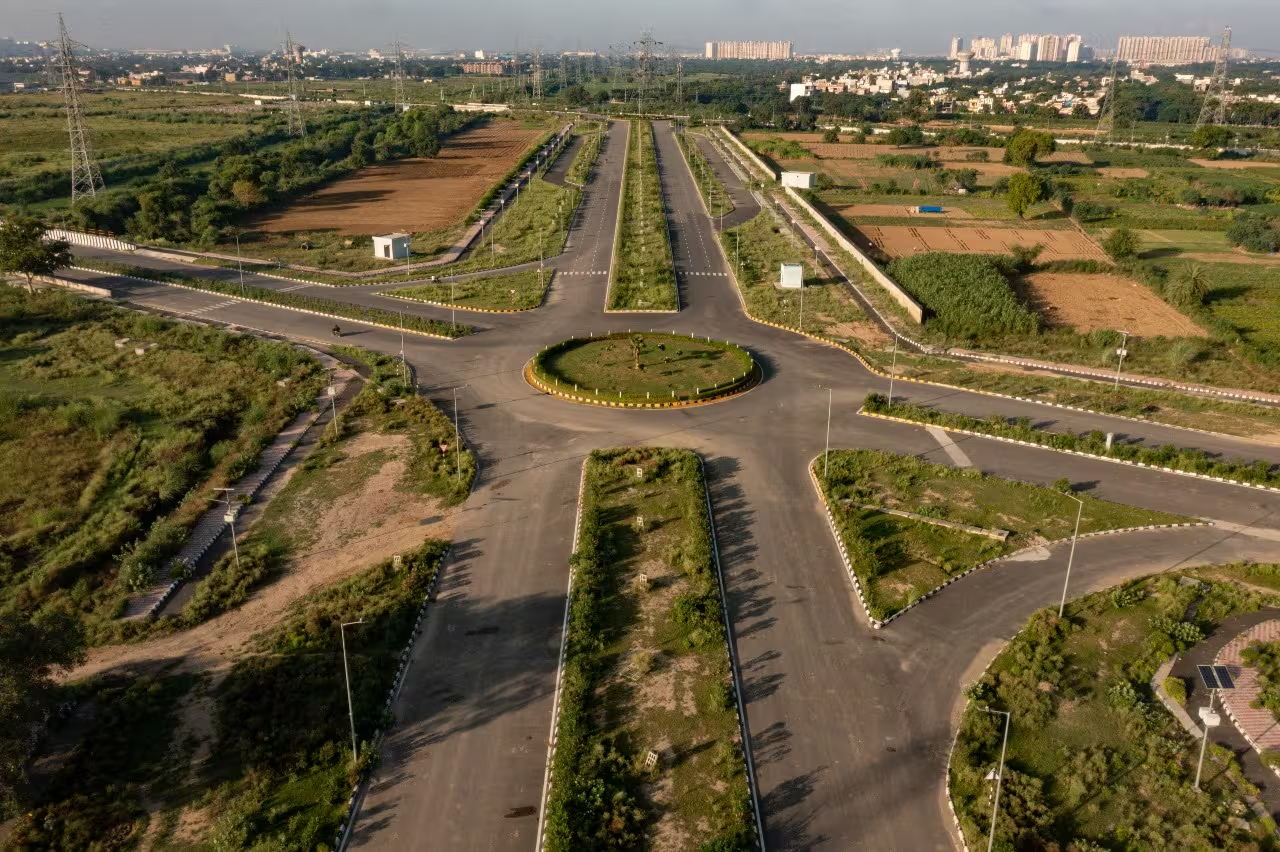
A decisive shift is underway in the National Capital Region’s housing geography. The Sonipat–Kundli belt in Haryana is witnessing accelerated residential interest, driven by transport upgrades, industrial investment and price pressures in core NCR markets. For planners and homebuyers alike, the corridor signals a broader northward rebalancing of growth beyond established hubs.
For over a decade, NCR expansion centred on Gurugram and Noida. However, rising land costs, congestion and stretched civic infrastructure in these cities have pushed both developers and households to reconsider alternatives. Sonipat–Kundli real estate is now emerging as a beneficiary of that recalibration, particularly among mid-income buyers seeking larger homes within commuting distance of Delhi. Connectivity remains the primary catalyst. The Urban Extension Road II project, designed to improve east–west movement across outer Delhi, is expected to ease travel from North-West Delhi to neighbouring Haryana districts. Metro rail expansion towards Narela and adjoining areas is also influencing residential decisions by shortening commute times. Meanwhile, the Regional Rapid Transit System network being developed by the National Capital Region Transport Corporation is reshaping expectations of inter-city mobility across NCR, including the Delhi–Panipat stretch that impacts Sonipat. Strategic highway access through the Kundli–Manesar–Palwal Expressway further integrates the area into logistics and manufacturing corridors. Industrial investments in the wider region, including large-scale automotive manufacturing facilities, are adding employment anchors that strengthen the case for live-work ecosystems rather than purely commuter suburbs.
Urban planners note that Sonipat–Kundli real estate differs from earlier peripheral expansions. Land parcels are comparatively larger, allowing for plotted developments and integrated townships with open spaces and lower density. This offers scope for climate-responsive design, improved ventilation and greener layouts critical considerations as northern India confronts worsening air quality and heat stress. Affordability remains central. Property values are significantly lower than comparable housing in Gurugram or central Delhi, enabling first-time buyers to access larger homes. According to industry experts, this price differential is encouraging genuine end-user demand rather than short-term speculation. The adjacency to Delhi is the silent enabler. As the capital faces land scarcity and rising ticket sizes, peripheral districts are becoming functional extensions of its residential ecosystem. Educational institutions such as Ashoka University and O.P. Jindal Global University further contribute to the area’s social infrastructure, attracting students, faculty and service-sector employment.
Yet challenges remain. Sustained growth will depend on timely completion of transport projects, water and waste infrastructure, and integration with regional planning frameworks. Without coordinated governance, rapid expansion risks replicating the infrastructure strain seen in earlier NCR boom cycles. For now, the evidence suggests that NCR’s next housing chapter may not be vertical densification alone, but measured geographic expansion with Sonipat–Kundli positioned at the forefront of that transition.
Also Read: NCR Namo Bharat reshapes northern housing
Sonipat Kundli corridor reshapes NCR housing