The War Against Iran Is Not Just Against the Islamic Nation. It Is a Western Pivot to Disrupt the Middle East’s Rising Urban Power. The New Battlefield Is Not Territory. It Is Trust. For the last twenty years, a quiet revolution has been underway in the Gulf. It did not involve tanks or troops or coups. It involved zoning laws, tourism infrastructure, and the most aggressive urban branding campaign the modern world has ever seen.
Dubai. Doha. Manama. Abu Dhabi.
These cities did something that Washington, London, and New York had stopped being able to do: they built places where the world’s wealthy actually wanted to live.
Not just visit. Live.
The numbers told the story. High-net-worth individuals fleeing European taxes, American gun violence, British weather. Russian oligarchs after 2022. Indian tech founders after COVID. Chinese money seeking a neutral ground between Beijing and the West. African billionaires who wanted first-world infrastructure without first-world attitude.
They all came to the Gulf. Not because they loved the politics. Because the product was better. Dubai, specifically, became the crown jewel. After London, it was the second-most attractive city on earth for the ultra-wealthy. But unlike London, it offered something the old capitals could not: security without paranoia, luxury without decay, a future that actually looked like the future.
You could walk the Marina at 2 AM. You could start a business in a week. You could buy a villa on the Palm and wake up to a view that made Saint-Tropez look like a parking lot. The police were everywhere but invisible. The taxes were nowhere. The energy was relentless.
Brand UAE became synonymous with a simple promise: Here, the dream works. The West watched this happen. At first with amusement. Then with curiosity. Then with something else.
Envy.
Because cities are the new countries. In the 21st century, nations compete through their urban centers. London vs. New York. Singapore vs. Hong Kong. And now, Dubai vs. everyone. The Gulf cities were winning. Not because they had better history or culture or democracy. But because they had better execution. Better vision. Better delivery.
And that made them dangerous.
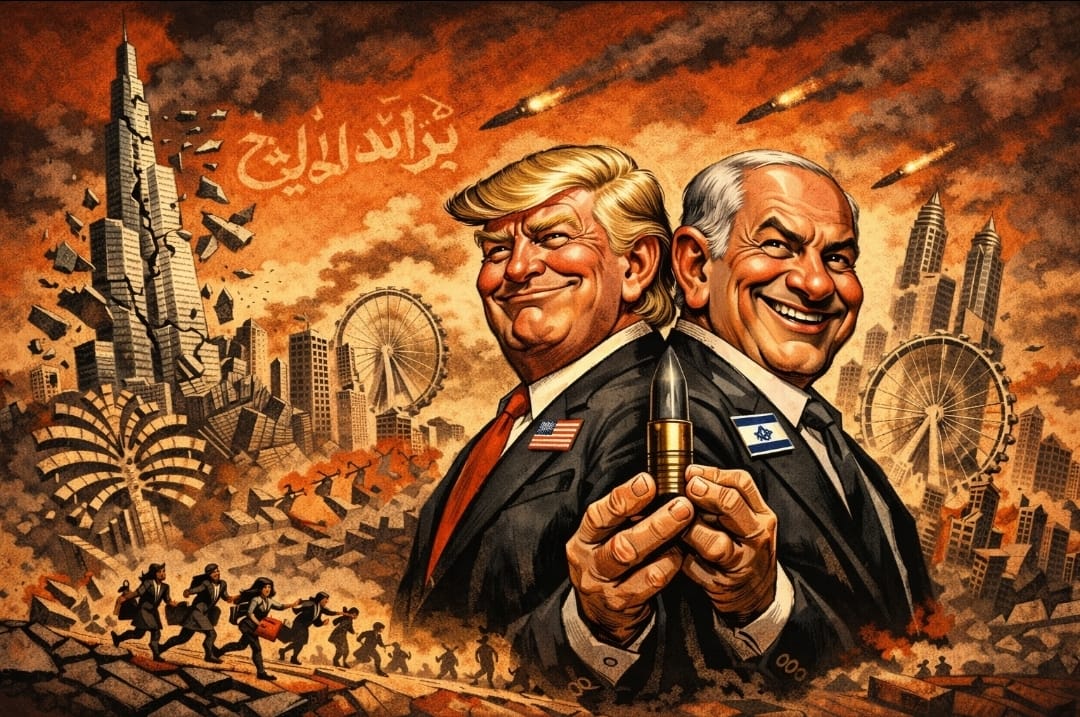
The War Against Iran Was Never Just About Iran. When the two men in Washington and Jerusalem decided to strike, they did not calculate based on centrifuges or uranium enrichment alone. They calculated based on something broader.
Iran was the excuse. The region was the target. Think about it. A strike on Iranian territory does not happen in a vacuum. It triggers retaliation. Retaliation that is predictable, almost algorithmic. Iran cannot reach Washington. It can barely reach Tel Aviv reliably. But it can reach Doha. It can reach Abu Dhabi. It can reach Bahrain, Kuwait, Dubai. And when it does, the message is sent:You are not safe. Your city is not an island.Your brand is not immune.
One bullet fired at Iran. And a dozen casualties across the Gulf’s urban miracles. Not military casualties. Brand casualties.Because the one thing a city like Dubai sells above all else is stability. The ultra-wealthy do not park their families and their money in places where missiles fly. They do not buy penthouses in cities that make evening news broadcasts. They do not build their second lives in neighborhoods that might become military targets next week.
The strikes did not have to hit Dubai to destroy Dubai. They just had to remind everyone that Dubai is in the neighborhood. And the neighborhood is on fire. The Numbers Tell the Story. In one single day, the phones stopped ringing. Not all of them. Not permanently. But enough. The off-plan launches that had been oversubscribed for years suddenly had inventory.
The villa deals that had been closing in days suddenly needed “more time.” The family offices that had been moving money into Dubai real estate like clockwork suddenly went quiet. The reason was not economic. It was not regulatory. It was perceptual. Dubai went, in 24 hours, from “the safest place on earth” to “a place where something happened nearby.” That is the difference between a global city and a regional one. That is the difference between London and Beirut. Between Singapore and Manila. Between a brand that endures and a brand that can be broken.
The two men who ordered the strikes understood this. They may not have said it aloud. They may not have even fully admitted it to themselves. But their strategists, their advisors, their planners—they knew. A strong Gulf is a competitor. A disrupted Gulf is a client.
When Dubai is booming, capital flows east. When Dubai is scared, capital flows back to New York, to London, to the old safe havens. The ones that have been losing ground for twenty years. The ones that need the wealthy to stop discovering the Palm and start rediscovering Park Avenue.
The War Is Urban Now
This is the new pivot. Not Cold War. Not Hot War. City War. Nations no longer compete primarily through armies or economies. They compete through urban ecosystems. Through the quality of life they offer the mobile global elite. Through the brand equity of their skylines.
The Gulf spent two decades building brands that rivaled the West’s. Dubai became shorthand for ambition. Doha became shorthand for culture. Abu Dhabi became shorthand for capital with taste. And the West watched. Not with admiration. With calculation. Because if you cannot beat the product, you disrupt the market. If you cannot offer better lifestyle, you make the competitor feel less safe. If you cannot build a Marina that rivals theirs, you remind the world that your Marina is farther from the missiles.
This is not conspiracy. This is geopolitical gravity. Every superpower in history has acted to protect its economic primacy. America is no different. Europe is no different. When a new pole of attraction emerges—especially one that draws capital and talent away from the old centers—the old centers will eventually push back.
The strikes on Iran were not just about nuclear programs. The war for the global elite’s attention. The war for their trust. The war for their real estate and petro dollars.
What Happens Next
In the days ahead, the diplomats will talk. The generals will posture. The news cycles will move on. But the damage to Brand Dubai is already done. Not fatal. Not irreversible. Dubai has survived worse. The fundamentals are still there: the location, the infrastructure, the leadership, the vision. The city will not disappear. The cranes will start moving again eventually.
But something has been lost that may take years to rebuild. The sense of invulnerability. The belief that Dubai existed outside the region’s conflicts, above them, beyond them. That was always a fiction, of course. But fictions matter. They are what the wealthy buy when they choose a second home. They buy the story.
The story just got rewritten. Now Dubai is part of the region again. Subject to its wars. Vulnerable to its chaos. Visible on the same maps that show missile ranges and military bases.
One Bullet, Two War Mongers: How Neo-Colonists Just Assassinated Brand Gulf and Dubai Real Estate