HomeConstructionBanjar Hospital Construction Delayed Five Years

Banjar Hospital Construction Delayed Five Years

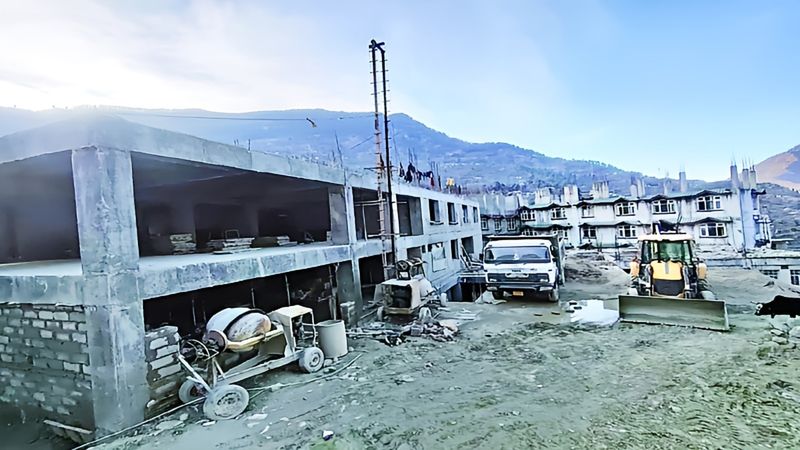
Banjar, Himachal Pradesh The construction of a new hospital building in Banjar, Kullu district, has faced delays exceeding five years, leaving residents reliant on a deteriorating facility that struggles to meet basic healthcare needs. The stalled project underscores broader challenges in delivering sustainable, inclusive health infrastructure in semi-urban and rural Indian towns, where development gaps can amplify social and economic vulnerabilities.

The original plan envisioned expanding the hospital from a 50-bed to a 100-bed facility, with modern infrastructure capable of serving surrounding villages. However, while structural work on the new building is largely completed, remaining tasks including roof installation and internal fit-outs have not progressed as scheduled. In the interim, patients continue to rely on the old, cracked, and overcrowded building, prompting many to travel 50–60 km to reach larger hospitals in Kullu or Shimla for specialist care.

Healthcare experts and urban planners note that prolonged delays in hospital infrastructure not only reduce service accessibility but also strain the wider regional health system. “When local facilities cannot provide essential services, both travel costs and time lost exacerbate inequities for rural communities,” said a senior health infrastructure official. The situation is particularly acute in the Seraj valley, where residents from multiple villages depend heavily on the Banjar hospital for primary and emergency healthcare.

The hospital’s staffing gaps compound these infrastructure challenges. A shortage of specialist doctors has left critical services unavailable locally, forcing patients to seek care in distant urban centres. Urban development analysts highlight that such gaps in rural health infrastructure reflect broader planning inefficiencies: delays in public works, fragmented project oversight, and under-resourced maintenance of existing facilities. From an economic perspective, the incomplete hospital building represents not only foregone public investment but also an opportunity cost in regional development. Reliable local healthcare is a key determinant for attracting skilled workers, promoting gender-inclusive employment, and enabling long-term settlement in semi-urban towns. Delays in infrastructure projects like the Banjar hospital can ripple into reduced economic activity and lower social resilience.

Officials report that approximately 85 per cent of construction has been completed, suggesting that accelerated execution could restore service quality within months if prioritised. Experts stress that integrating project management best practices, climate-resilient construction standards, and equitable staffing policies are crucial to prevent further delays and to ensure that healthcare infrastructure meets both present and future community needs.

Also Read : Adani Deal Reshapes NCR Real Estate Landscape
Banjar Hospital Construction Delayed Five Years
RELATED ARTICLES

LEAVE A REPLY

Please enter your comment!
Please enter your name here

- Advertisment -spot_img

Most Popular

Recent Comments

Ganga Expressway reshapes housing markets in UP

Ganga Expressway reshapes housing markets in UP

The launch of the Ganga Expressway is expected to redraw real estate dynamics across Uttar Pradesh, as improved connectivity between the National Capital Region...
Panchkula housing demand reshapes NCR growth map

Panchkula housing demand reshapes NCR growth map

A growing shift in North India’s housing market is positioning Panchkula as an emerging alternative to traditional NCR real estate hubs, driven by rising...
Mumbai real estate event spotlights channel partner role

Mumbai real estate event spotlights channel partner role

A new real estate exhibition model focused exclusively on intermediaries is set to debut in Mumbai, as CREDAI-MCHIprepares to host a dedicated property expo...
Kajaria Tiles campaign reflects evolving housing demand

Kajaria Tiles campaign reflects evolving housing demand

A recent advertising campaign by Kajaria Ceramics Limited has drawn strong consumer engagement, reflecting shifting aspirations in India’s housing and interior design market. The...
Jindal Steel results reflect infrastructure demand trends

Jindal Steel results reflect infrastructure demand trends

Jindal Steel & Power Limited has reported a consolidated net profit of ₹1,044.75 crore for the March 2026 quarter, reflecting sustained demand from infrastructure...