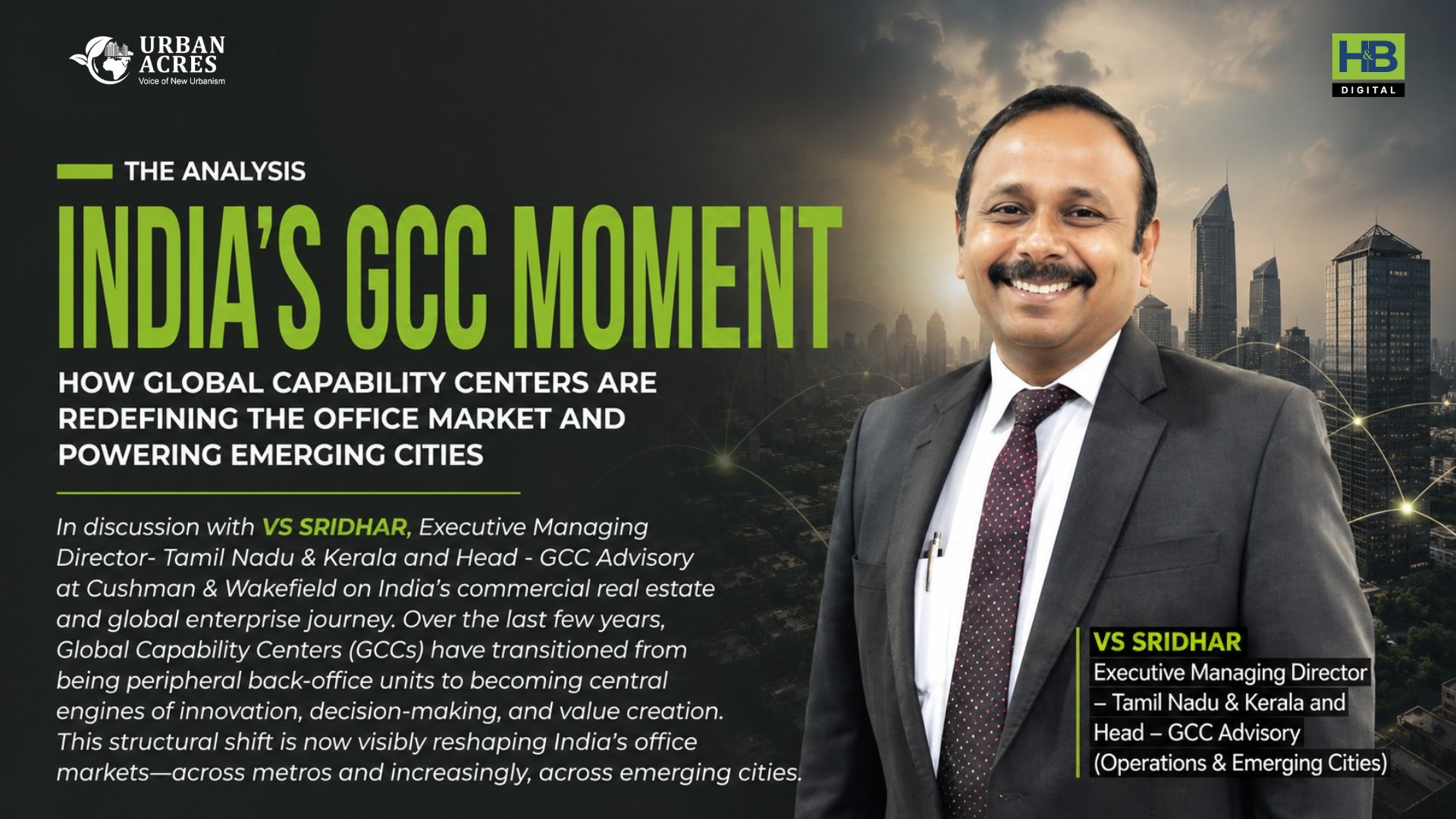
In discussion with VS Sridhar, Executive Managing Director- Tamil Nadu & Kerala and Head – GCC Advisory at Cushman & Wakefield on India’s commercial real estate and global enterprise journey. Over the last few years, Global Capability Centers (GCCs) have tr ansitioned from being peripheral back-office units to becoming central engines of innovation, decision-making, and value creation. This structural shift is now visibly reshaping India’s office markets—across metros and increasingly, across emerging cities.
GCCs as a Dominant Office Demand Driver
GCCs have emerged as one of the most significant contributors to India’s office leasing activity. Their share of total office leasing has risen sharply: from around 12 percent in 2022 to nearly 30 percent in YTD 2025 (Q1–Q3). This growth trajectory is not cyclical. It is structural and is expected to sustain over the medium term.
At the core of this momentum lies India’s enduring ‘cost plus value’ proposition. Beyond competitive operating costs, India offers a rare convergence of a deep talent pool, scalable Grade A office infrastructure, robust digital ecosystems, and increasingly sophisticated urban environments. Notably, India today hosts the world’s third-largest AI talent base, accounting for nearly 16 percent of the global AI workforce, significantly strengthening its appeal for high-value, future-ready GCC operations.
Crucially, the GCC ecosystem has matured well beyond traditional offshoring. India is now a global hub for research and development, product engineering, analytics, finance, healthcare innovation, and core business transformation functions. Sectoral participation has diversified meaningfully over the last decade, with engineering and manufacturing, BFSI, and healthcare gaining prominence alongside IT and technology services.
Policy as an Enabler: The Role of State Incentives
State-level policy frameworks have become decisive factors in GCC location strategies. Incentives play a vital role in reducing entry barriers, accelerating setup timelines, and improving long-term operational viability.
Several states—including Karnataka, Andhra Pradesh, Madhya Pradesh, Uttar Pradesh, and Gujarat—have already launched dedicated GCC policies. Haryana and Tamil Nadu have released draft frameworks, while Maharashtra and Telangana are actively developing theirs. Many more states are expected to follow.
These policies typically combine fiscal incentives—such as tax exemptions, subsidies, reimbursements, and innovation grants—with non-fiscal measures including single-window clearances, digital approval systems, talent skilling support, incentives for local hiring, and plug-and-play infrastructure. A notable strategic shift is the targeted encouragement of GCC expansion into Tier-2 cities, aimed at decentralizing growth and catalyzing technology-led employment.
That said, while incentives are powerful enablers, the next phase of competition will be defined less by subsidies and more by talent depth, infrastructure quality, and scalability.
The Rise of Tier-2 Cities Across Asset Classes
India’s Tier-2 cities are witnessing a multi-dimensional real estate upswing, driven by improved connectivity, infrastructure investments, policy support, and expanding talent ecosystems.
- Residential markets continue to be led by affordable and mid-income housing, but there is a visible rise in demand for premium and luxury homes, reflecting aspirational living and rising disposable incomes.
- Office leasing is gaining momentum, primarily supported by domestic enterprises and flexible workspace operators. Select Tier-2 cities are also beginning to attract multinational occupiers as Grade A supply improves.
- Retail real estate is emerging as a key growth segment, driven by evolving consumption patterns, lifestyle-oriented developments, and the entry of national developers, aided by lower land acquisition costs.
- Industrial and warehousing activity is expanding rapidly, propelled by infrastructure upgrades, e-commerce growth, and government-led industrial corridor and logistics hub initiatives.
Together, these trends are transforming Tier-2 cities from peripheral markets into strategic investment destinations.
Infrastructure: The Make-or-Break Factor for Tier-2 GCC Growth
While India’s top six cities still account for over 95 percent of GCC leasing, the next growth wave is expected to come from Tier-2 cities such as Coimbatore, Kochi, Thiruvananthapuram, Visakhapatnam, Bhubaneswar, Indore, and Jaipur.
For this momentum to scale, targeted infrastructure upgrades will be critical. These include:
- Expanded airport capacity and improved regional connectivity
- Reliable public transport networks
- Strong digital and data infrastructure
- Enhanced higher education quality and technical skilling ecosystems
Equally important will be the availability of competitively priced land, consistent power supply, and a steady pipeline of Grade A and A+ office developments. Given current supply constraints, many occupiers are entering Tier-2 markets through managed and flexible office solutions—a trend expected to continue in the near to medium term.
Office Market Outlook for 2026: GCCs at the Core
Despite global macroeconomic uncertainties, the outlook for India’s office market in 2026 remains robust. Gross leasing volumes are expected to exceed 80 million square feet for the third consecutive year, underscoring sustained occupier confidence.
Developers are likely to accelerate supply additions, estimated at 60–62 million square feet, yet demand is expected to outpace supply, resulting in lower vacancy levels and steady rental growth.
GCCs will remain central to this growth narrative. As global enterprises deepen their reliance on India for digital transformation, innovation, and operational resilience, demand for high-quality, sustainable, technology-enabled office spaces will continue to rise.
An important emerging trend is the increasing preference for managed office solutions, driven by benefits such as flexible lease tenures, optimized upfront costs, customized delivery, and simplified payment structures. Collectively, these dynamics will not only sustain healthy office absorption but also reinforce India’s position as the world’s most compelling GCC destination.