
HomeInfrastructureIndia Metals Sector Gains From Infrastructure Demand

India Metals Sector Gains From Infrastructure Demand

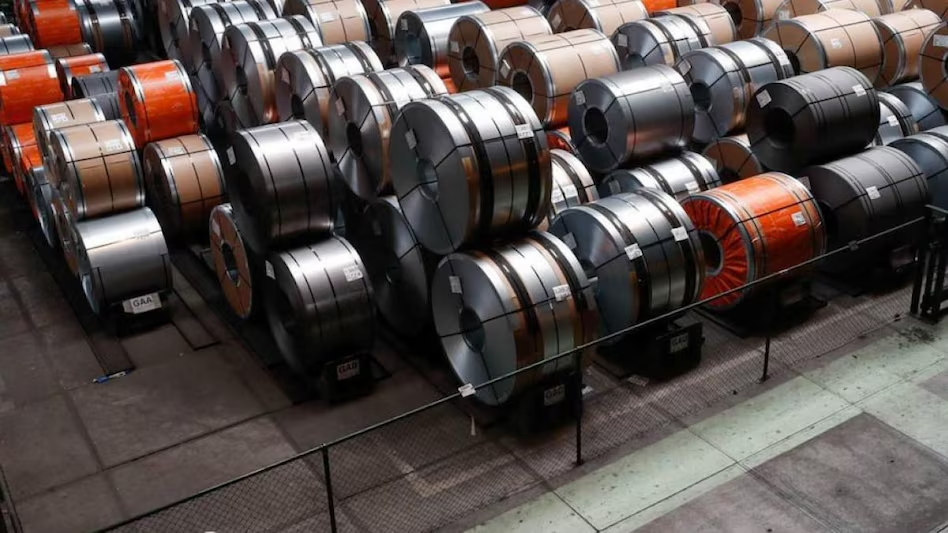
India’s metals and industrial materials sector has delivered a stronger-than-expected operational performance despite continued volatility in global commodity markets, underlining the critical role of infrastructure investment and manufacturing activity in sustaining industrial growth.

Recent financial disclosures across major metal producers suggest that elevated commodity prices, combined with steady domestic demand, have helped support profitability even as companies navigate cost pressures and economic uncertainty.The latest earnings cycle points to a sector benefiting from multiple growth drivers. Large-scale infrastructure projects, transport network expansion, renewable energy installations and urban construction activity have all contributed to robust demand for steel, aluminium and related industrial materials. These products remain fundamental to the development of housing, logistics facilities, industrial parks and public infrastructure across the country.Analysts tracking the industry note that the recent metal sector earnings performance reflects more than favourable pricing conditions. Many companies have invested heavily in operational efficiency, supply-chain optimisation and capacity improvements over recent years. As a result, manufacturers have been better positioned to absorb input cost fluctuations while maintaining production levels.The significance of these results extends beyond corporate balance sheets. Stronger metal sector earnings often serve as a leading indicator of broader economic activity because metals are deeply integrated into construction, manufacturing and infrastructure development. When demand remains healthy across these segments, it can signal continued momentum in job creation, industrial investment and urban expansion.

Urban development specialists point out that the sector’s performance is particularly relevant at a time when Indian cities are undergoing rapid transformation. Metro rail projects, renewable energy infrastructure, logistics corridors and affordable housing developments all depend on reliable supplies of steel and aluminium products. Sustained demand therefore reflects ongoing investment in the physical systems that support economic growth and urban mobility.However, industry experts caution that elevated commodity prices create a complex operating environment. While higher prices can strengthen revenues for producers, they may also increase costs for downstream sectors such as construction, real estate and infrastructure contracting. Policymakers and project developers continue to monitor these dynamics closely as they seek to balance growth ambitions with affordability concerns.Environmental considerations are also becoming increasingly important. Metals production remains energy intensive, prompting manufacturers to explore renewable power integration, recycling initiatives and lower-carbon production technologies.

Investors are paying closer attention to these efforts as sustainability metrics become a more influential factor in capital allocation decisions.The latest financial outcomes suggest that India’s metals industry is adapting to changing market conditions while benefiting from the country’s infrastructure-led growth trajectory. Yet long-term competitiveness will depend not only on commodity cycles but also on innovation, efficiency and environmental performance.As urbanisation accelerates and infrastructure investment continues, the sector’s ability to supply critical materials while reducing resource intensity will play an increasingly important role in shaping resilient, low-carbon and economically inclusive development across India’s cities and industrial regions.

Also Read : AMNS India Skill Development Model Advances
India Metals Sector Gains From Infrastructure Demand
RELATED ARTICLES

LEAVE A REPLY

Please enter your comment!
Please enter your name here

- Advertisment -spot_img

Most Popular

Recent Comments

Ladakh Farming Transition Targets Chemical Free Future

Ladakh Farming Transition Targets Chemical Free Future

Ladakh has moved to prohibit the use of chemical fertilisers across the Union Territory as part of a broader strategy to expand organic farming...
Odisha Chemical Investments Reshape Manufacturing Growth

Odisha Chemical Investments Reshape Manufacturing Growth

Odisha has emerged as one of India’s fastest growing destinations for chemical and petrochemical manufacturing,attracting investment commitments of nearly ₹2 lakh crore over the...
India Steel Financing Supports Industrial Expansion Plans

India Steel Financing Supports Industrial Expansion Plans

Vedanta has disclosed the creation of a share encumbrance involving its iron and steel business as part of arrangements linked to a US$1 billion...
Panyam Cements Corporate Governance Enters Transition Phase

Panyam Cements Corporate Governance Enters Transition Phase

Panyam Cements has announced a change in its compliance leadership following the resignation of its Company Secretary and Compliance Officer,effective 18 July 2026. While the...
India Aluminium Import Duty Debate Intensifies

India Aluminium Import Duty Debate Intensifies

Industry groups representing India’s downstream aluminium manufacturers have renewed calls for a reduction in import duties on primary aluminium,arguing that lower raw material costs...
