
HomeLatestIndia Responsible Steel Standards Gain Industry Focus

India Responsible Steel Standards Gain Industry Focus

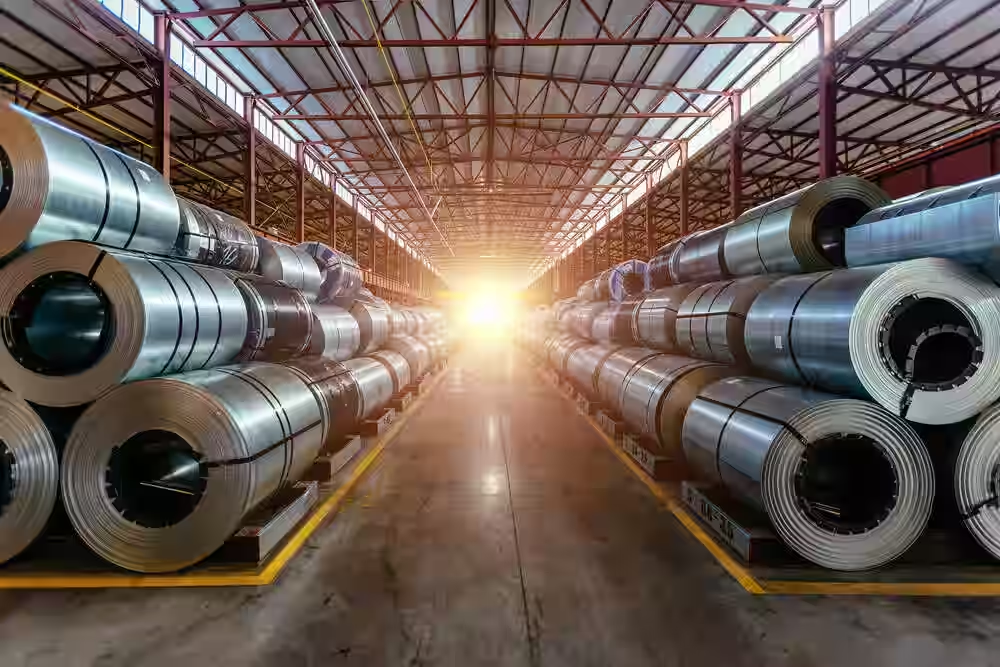
India’s largest steelmakers are facing growing pressure to demonstrate not only production capacity but also measurable environmental and social performance,with the latest sustainability disclosures highlighting how climate risks,resource efficiency and responsible sourcing are becoming central to industrial competitiveness.

The shift reflects changing investor expectations and the increasing role of transparent reporting in shaping the future of urban infrastructure and low-carbon manufacturing.The latest Business Responsibility and Sustainability Reporting (BRSR) filing submitted by JSW Steel for the 2025–26 financial year outlines the company’s environmental, governance and workforce related performance in line with India’s mandatory corporate sustainability disclosure framework.The filing also notes the company’s ResponsibleSteel certification for eligible operations, an internationally recognised framework that assesses responsible practices across steel production, including environmental stewardship, labour standards and governance.The Business Responsibility and Sustainability Report is increasingly significant because steel remains one of the most carbon intensive industries supporting urbanisation.From transport corridors and affordable housing to commercial buildings and renewable energy infrastructure, steel forms the backbone of India’s development agenda.As governments and investors prioritise climate resilience,sustainability disclosures have evolved from compliance documents into indicators of long term industrial preparedness.

Industry experts say the expansion of BRSR reporting is improving transparency by enabling investors,regulators and communities to compare companies using common environmental,social and governance metrics.These reports typically include information on greenhouse gas emissions, energy consumption,water management,occupational safety,supply chain practices and community engagement, allowing stakeholders to evaluate risks beyond financial performance.Urban planners argue that such reporting has wider implications for cities.As metropolitan regions pursue net zero ambitions and circular economy strategies, procurement decisions for public infrastructure may increasingly consider the environmental footprint of construction materials alongside cost and quality.Responsible sourcing of steel therefore has the potential to influence infrastructure planning, real estate development and public investment over the coming decade.The Business Responsibility and Sustainability Report also reflects the broader transition underway across India’s manufacturing sector.Companies are investing in renewable energy,resource efficient production processes, recycling systems and cleaner technologies to reduce emissions while maintaining industrial output.However,sustainability specialists caution that disclosure alone does not guarantee environmental improvement.The credibility of reported data depends on independent verification,consistent implementation and measurable progress against stated climate targets.

For investors, detailed sustainability reporting has become an important tool for assessing long term resilience.Financial institutions increasingly incorporate environmental and governance indicators into lending and investment decisions, particularly for industries with high energy consumption and significant carbon emissions.This trend is expected to accelerate as global supply chains place greater emphasis on traceability and lower-carbon materials.As India’s steel industry expands to support economic growth and infrastructure development, the focus is gradually shifting from production volumes alone to the quality, efficiency and accountability of manufacturing.The continued evolution of sustainability reporting is therefore likely to play a larger role in determining how industrial growth aligns with climate commitments, resource conservation and the creation of resilient,people centred urban economies.

Also Read : Tata Steel Eyes Higher Value Steel Products
India Responsible Steel Standards Gain Industry Focus
RELATED ARTICLES

LEAVE A REPLY

Please enter your comment!
Please enter your name here

- Advertisment -spot_img

Most Popular

Recent Comments

Mumbai Amazon Expands Digital Infrastructure With Powai Land Lease

Mumbai Amazon Expands Digital Infrastructure With Powai Land Lease

Amazon Data Services India Pvt. Ltd. has secured a long-term lease for nearly four acres of land in Powai through a transaction valued at...
Nagpur Luxury Housing Market Draws Fresh Investor Interest

Nagpur Luxury Housing Market Draws Fresh Investor Interest

Infrastructure-led urban growth is strengthening Nagpur's position within India's premium residential market, with improving connectivity, industrial investment and planned urban expansion encouraging greater interest...
India Specialty Fertilisers Rules Impact Farmers

India Specialty Fertilisers Rules Impact Farmers

Concerns over the retail sale of specialty fertilisers have intensified after industry representatives urged policymakers to review marketing practices that they say are limiting...
Mumbai Lloyds Realty Expands Long Term Housing Portfolio

Mumbai Lloyds Realty Expands Long Term Housing Portfolio

Lloyds Realty has outlined a development pipeline worth nearly ₹10,000 crore across Mumbai, signalling continued private sector investment in one of India's most land-constrained...
India Specialty Chemical Expansion Enters Cautious Phase

India Specialty Chemical Expansion Enters Cautious Phase

India’s specialty chemical industry is entering a more cautious investment cycle as weaker global demand,pricing pressure and uncertain export markets encourage manufacturers to reassess...
