India Interiors See Cardamom Rainforest Textile Innovation
Thai premium textile house Jim Thompson has introduced a rainforest-inspired range of statement fabrics aimed at interior designers and high-end homeowners, underscoring evolving demand for narrative-driven materials in contemporary spaces. The “Cardamom rainforest” collection — now entering markets including India through partnerships with local distributors — channels the visual and ecological richness of one of Southeast Asia’s most biodiverse ecosystems into bold upholstery, drapery and performance textiles.
While rooted in luxury design tradition, the new range goes beyond aesthetics to tap into wider environmental and cultural currents. Industry planners note that contemporary interiors increasingly value responsibly framed products that reflect climate, biodiversity and place-based narratives — trends also visible in architecture, urban design and hospitality post-pandemic. This signals a shift in how material choices in built environments are linked to sustainability ideas, even as global supply chains and creative collaborations become more important.The Cardamom textile series translates untamed rainforest motifs into layered jacquards and textured weaves, with patterns evoking vines, organic ground textures and stylised wildlife. These fabrics — offered in a range of colourways and material compositions — are designed to work across residential and commercial interiors. Performance variants that meet fire-retardant and abrasion resistance standards broaden their applicability in contract settings, from boutique hotels to luxury residences.
Importantly, this release reflects a growing global focus on storytelling in design — where products embody narratives tied to cultures, landscapes and ecosystems. A senior interiors specialist observing the launch noted that such collections appeal to designers who seek materials that convey meaning as well as form, especially in markets where sustainable sourcing and ecological awareness are priorities. This aligns with broader shifts in global urban markets toward people-centred and environmentally attuned design choices.From a market perspective, the entry of rainforest-inspired fabrics into the Indian interior design scene exemplifies how global brands are diversifying their footprint in high-growth regions. Distributors are positioning these textiles as alternatives to generic imports, offering designers a narrative asset that reinforces place-based aesthetics while addressing performance requirements. This reflects wider dynamics in the interiors sector, where storytelling, sustainability and technical performance are increasingly interwoven.
Urban designers and architects say that integrating nature-inspired materials into built environments can contribute to wellbeing, aesthetic quality and cultural resonance — attributes that matter in dense, aspirational cities. As cities grapple with climate-related stresses, the symbolic integration of ecosystems into design reinforces the value of biodiversity, even in urban and peri-urban interiors.
Looking ahead, the challenge for brands and designers will be to balance creativity, ecological respect and technical performance. As material narratives become more prominent, stakeholders across urban development and real estate may see opportunities to embed cultural and ecological resonance more deeply into city spaces and interiors.
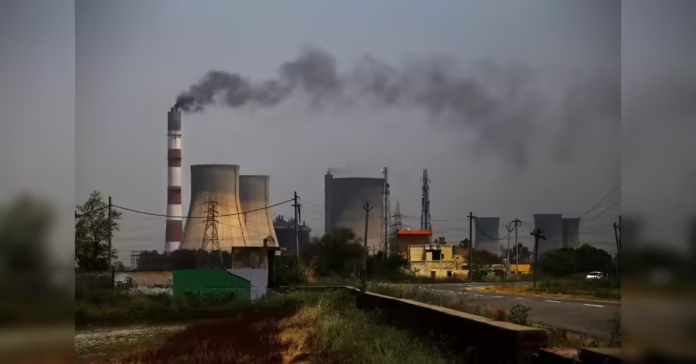
India’s National Green Tribunal (NGT) has issued formal notices to multiple state authorities and industry stakeholders over alleged pollution caused by coal transportation in Talcher, a major mining and industrial hub of Odisha. The development underscores mounting regulatory scrutiny of airborne emissions linked to the coal value chain, with broad implications for public health, local development and sustainable urban planning in the region.
The NGT’s East Zone Bench intervention comes amid growing concerns among residents, civic activists and environmental experts that unchecked coal dust from freight movement is deteriorating air quality, damaging local ecosystems and posing chronic health risks. Talcher, situated in Angul district and home to extensive coalfields and industrial establishments powering large thermal and captive energy plants, sits at the nexus of India’s energy infrastructure and urbanisation dynamics.Coal transported by rail and road from mines and processing units across the Talcher coalfields is a backbone input for regional power generation and industrial activity. However, the heavy movement of uncovered coal wagons and trucks along arterial highways and residential belts has long been linked to elevated particulate levels. Complaints lodged with the Odisha State Pollution Control Board cited repeated coal dust fallout on roads and neighbourhoods — a source of persistent respiratory ailments for many locals.
Public health specialists point out that fine particulate matter (PM2.5 and PM10) released during open coal transport can exacerbate asthma, bronchitis and cardiovascular conditions for children, elderly residents and construction workers alike. Urban planners note that this problem is compounded when coal haulage routes double as feeder roads for housing developments, logistics parks and commercial zones where daily commuter traffic and pedestrian use intersect.The NGT notices seek accountability and detailed action plans from implementing agencies, including measures to mitigate dust dispersion. Past judicial directives on similar pollution sources have emphasised covering coal wagons with tarpaulins, mechanising loading and unloading sites, and implementing regular pollution monitoring — but execution has been patchy.
For the regional built environment, the current episode rings alarm bells about the integration of industrial supply chains with city planning. Talcher’s urban footprint has grown alongside its industrial base, creating peri-urban clusters of residential settlements, worker housing and civic infrastructure. Without coordinated environmental management and transport logistics planning, these same growth patterns risk undermining the quality of life and long-term sustainability of urban communities.Stakeholders in housing and infrastructure sectors are watching closely, as dust-related pollution can translate into higher filtration and maintenance costs for buildings, affect construction schedules and complicate compliance with green-building standards. Developers increasingly factor ambient air quality into project design — from landscaped buffer zones to enhanced façade filtration — especially in regions with intense industrial activity.
NGT’s involvement could catalyse more rigorous enforcement, compelling the Odisha State Pollution Control Board and transport agencies to operationalise guidelines on coal dust control along major haulage routes. It may also prompt municipal authorities across Odisha’s emerging urban corridors to integrate air quality management more robustly into city masterplans, zoning codes and infrastructure prioritisation.Given India’s broader climate and clean-urbanisation commitments, balancing industrial supply chains with environmental safeguards is critical. How authorities and industry respond in Talcher may set precedents for managing similar coal-linked pollution pressures in other energy-industrial hubs across the country.
Coal India Allays Supply Fears As Power Demand Rises
State-owned Coal India Limited has surpassed its Government e-Marketplace (GeM) procurement target for the current financial year, achieving roughly ₹61,891 crore — about 114% of its ₹54,223 crore goal ahead of the FY26 close, highlighting strengthening operational discipline as India’s urban and infrastructure sectors accelerate. This performance accentuates how large public sector procurement intersects with broader construction supply chains and urban growth dynamics.
The GeM platform, a digital portal launched by the Government of India to enhance transparency, competitive pricing and supplier participation in public procurement, has emerged as a key mechanism for streamlining large-scale institutional spending. Coal India’s early achievement of its procurement milestone not only underscores disciplined project planning and vendor management across its subsidiaries but also signals robust demand for goods and services that undergird energy delivery and infrastructure execution — essential pillars for housing and commercial real estate expansion.Coal India’s procurement needs span heavy machinery, industrial consumables, safety gear, logistics and operational supplies. Many of these items are closely linked with infrastructure projects, from coal handling facilities and transport corridors to power plant expansions — all of which support the utilities and construction industries that shape city growth and built environments. Analysts note that organised procurement through GeM fosters competitive pricing for these inputs, which can indirectly moderate operational costs for developers and infrastructure contractors.
For the urban development ecosystem, reliable energy supply and transparent procurement practices contribute to greater confidence among developers and investors. Power security influences project financing timelines and cost structures for housing developments, commercial buildings and mixed-use townships. In emerging metropolitan clusters and secondary cities alike, assured energy access is a prerequisite for attracting labour, capital and long-term commitments from institutional players. Experts say that Coal India’s enhanced procurement performance complements wider capital flows in the National Infrastructure Pipeline, which envisions sustained investments in utilities, transport and urban services.The FY26 GeM performance milestone also reinforces Coal India’s role as a cornerstone PSU in India’s industrial fabric. Despite global pushes towards renewables, coal remains central to domestic power generation, accounting for a significant portion of electricity supply that supports households and businesses. Recent government data show the Ministry of Coal and its enterprises have consistently led GeM procurement rankings among central ministries and PSUs over multiple years — reflecting both operational scale and systemic transparency gains.
However, the urban sector’s reliance on coal-driven electricity underscores ongoing transitional challenges. As cities expand and demand for clean infrastructure grows, the built environment sector must balance short-term energy needs with longer-term climate commitments. Urban planners are increasingly factoring energy mix diversification into city planning frameworks, while national policy continues to drive renewable capacity additions alongside traditional generation.
Looking forward, Coal India’s procurement success — and its implications for industrial supply chains — will remain a touchstone for policymakers and developers alike. How these procurement patterns feed into transparent supply chains, domestic manufacturing linkages and infrastructure delivery efficiency could shape both investor sentiment and the pace of urban growth in India’s evolving built environment.
Meghalaya Mining Sweep Signals Enforcement and Safety Gaps
Law enforcement agencies in Meghalaya have confiscated more than 17 000 metric tonnes of illegally mined coal and 25.5 kg of explosive material from abandoned mine sites in East Jaintia Hills as part of a sustained crackdown following a deadly mine explosion earlier this month. The scale of the haul — equivalent to the output of several mid-sized industrial facilities — underscores deep challenges around unregulated resource extraction, cross-border supply chains and urban infrastructure safety in the region.
The operations, conducted overnight between 20–21 February, targeted multiple sites previously used for clandestine coal extraction and storage. Investigators recovered a total of 17 322 metric tonnes of coal, along with explosive materials commonly used in illegal mining. Although no arrests were made during this specific raid, law enforcement data shows that 94 FIRs have been filed and 22 individuals arrested in connection with unlawful mining and coal transportation since early February.This surge in enforcement follows a tragic explosion on 5 February at an unlicensed mine in the Thangsku area, which claimed dozens of lives and shone a spotlight on systemic safety failures and long-standing regulatory gaps. A judicial inquiry commission and a Special Investigation Team are now probing the causes of the blast and alleged enforcement lapses.
For India’s urbanisation and infrastructure ecosystem, the episode has broader resonance. Coal remains a backbone fuel for power generation that feeds city grids and energy-intensive building activity. Yet illegal mining — often linked to informal supply chains, weak land governance, and lack of environmental oversight — poses risks that extend into construction, housing supply and industrial power security. Urban planners and energy experts warn that unregulated extraction erodes regulatory trust and can distort building material markets while undermining environmental safeguards.Coal confiscated in past operations has reportedly entered informal markets, fuelling industries from brick kilns to construction sites without proper documentation or safety checks. This creates price distortions in urban building material supply chains and can incentivise unsafe labour practices. In regions where enforcement is lax, informal coal often substitutes for certified fuels and materials, undermining both environmental and safety standards.
The ongoing enforcement campaign also highlights governance challenges at the intersection of natural resource management and urban development. East Jaintia Hills police have intensified nightly raids, registered cases and seized vehicles suspected of transporting illegal coal — a signal that authorities are prioritising rule of law in a sector long plagued by illicit operations.Environmental planners stress that illegal mining not only endangers miners and local communities but also amplifies threats to water, soil and air quality — all of which intersect with housing health, building resilience and long-term land use planning. In rapidly urbanising districts that absorb rural migrants and industrial workers alike, these environmental impacts can shape patterns of settlement, infrastructure cost burdens and service delivery challenges.
For policymakers and city authorities, the Meghalaya case underscores the need for integrated frameworks that tie mining regulation to urban planning, public safety, environmental protection and sustainable construction protocols. Strengthened monitoring, digitised material tracking and community-level engagement could help avert future tragedies and align resource extraction with broader developmental goals.
Dhanbad Coal Mining Halt Disrupts Industrial Supply
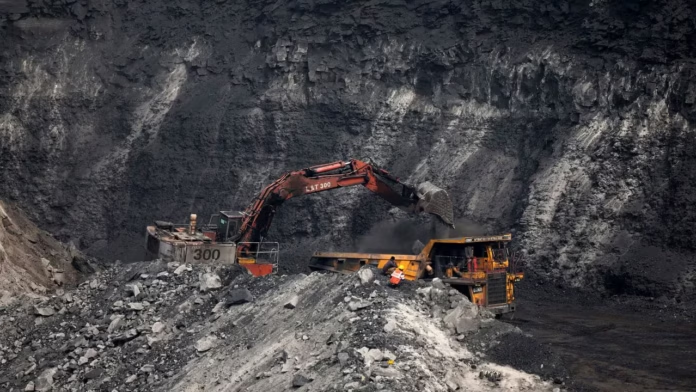
India’s footprint in global coal production is poised to deepen as Coal India’s South Eastern Coalfields Ltd (SECL) readies its Gevra coal block in Chhattisgarh to reclaim the title of the world’s largest single-site coal producer by next year. The expansion, driven by rising domestic energy demand and robust industrial activity, heightens the strategic importance of coal in powering cities and supporting infrastructure, even as the nation pursues cleaner energy transitions.
Located in Korba district, Gevra is already India’s largest opencast coal mine and has received environmental clearance to scale capacity to 70 million tonnes per annum. Current production is projected at about 56 million tonnes this fiscal year, and SECL officials are targeting output of around 63 million tonnes in 2027 — surpassing the output levels of long-established global leaders such as the Black Thunder mine in the United States.This anticipated milestone in coal production underscores coal’s continued role as a backbone of India’s electricity grid. Despite the accelerated deployment of renewable energy, coal still underpins a significant portion of baseload and peak power generation, which in turn fuels urbanisation, industrial estates, transportation hubs and residential demand for reliable electricity. For property developers and urban planners, assured power supply is a critical variable in project financing, construction scheduling and long-term asset valuation.
For cities scaling up rapidly, from smart-city corridors to mixed-use townships, dependable energy — even from traditional sources — remains a business imperative. Large-scale housing developments, commercial real estate and manufacturing zones rely on stable power to attract investment and sustain operations. Energy planners argue that without sufficient generation capacity, infrastructure backlogs can emerge, delaying building completions and inflating costs.While SECL’s push to make Gevra the world’s top coal mine reflects immediate energy imperatives, it also highlights broader tensions in India’s development pathway. The mine’s expansion was cleared under environmental protocols, yet coal extraction inherently involves land-use changes, supply chain logistics and carbon emissions. That dichotomy plays out in local economies and national policy: policymakers must manage near-term energy security alongside longer-term sustainability goals.
Moreover, SECL’s wider diversification plans — spanning gasification projects, solar capacity within mining operations, and rare-earth element extraction from overburden — point to an evolving energy and resource strategy that seeks to balance traditional fuels with future-oriented technologies. If realised, such initiatives could soften coal’s environmental footprint and align with resilient infrastructure goals.From a real estate and built-environment perspective, the ripple effects of Gevra’s growth are multifaceted. Enhanced energy availability can lower outage risks and operational costs for builders and tenants. Yet ensuring that coal-dependent urban expansion dovetails with climate-responsive city planning remains an ongoing challenge for municipalities and regulators.
As India scales up coal output at Gevra and integrates it with broader energy and urban development strategies, stakeholders across sectors — from power utilities to real estate developers — will be watching closely to balance economic growth with sustainability imperatives.
India Construction Solvent Market Expands With Infrastructure Growth
Demand for solvent-based construction products in India is forecast to grow steadily through 2035, mirroring robust infrastructure expansion and the burgeoning housing and commercial buildings market. Industry observers see the uptick as a barometer of broader activity in the built environment, where paints, adhesives and coatings — core components of solvent-based systems — are essential inputs for residential, industrial and urban renewal projects.
Global research firm IndexBox recently projected an upward trajectory for solvent-based product markets over the next decade, citing expanding construction volumes and rising maintenance work across sectors such as transportation, housing and energy infrastructure. While the report analysed global data, its themes resonate strongly with India’s current development priorities, where demand for quality finishes and durable building systems has risen alongside public and private infrastructure investments. (IndexBox data)Solvent-based products remain widely used in construction due to their performance in high-stress environments, particularly for protective coatings, sealants and specialised adhesives. In India, solvent-based demand has historically tracked infrastructure cycles — surging when major road, rail and urban projects accelerate and tempering in slower phases. With the government outlay on highways, metro systems, renewable energy parks and affordable housing schemes gaining momentum, industry insiders expect solvent product volumes to follow suit.
A senior analyst with a construction materials consultancy says, “These materials tell us where the market is building — and what it prioritises. When solvent-based coatings and sealants move ahead, you’re often seeing a rise in heavy-duty structural projects and advanced finishing requirements.” This sentiment reflects how product demand intertwines with project sophistication, from luxury residential towers to transport terminals and industrial complexes.For builders and developers, solvent-based products are not merely commodities but critical elements of quality assurance. Strong adhesion, weather resistance and rapid cure times are especially valued in climates with monsoon variability or high humidity — conditions characteristic of much of India’s densely populated regions. Projects that lean on solvent-based formulations often emphasise durability and lifecycle performance, aligning with long-term asset value strategies.
However, the environment around these products is evolving. Regulatory scrutiny and sustainability imperatives have increased attention on volatile organic compound (VOC) emissions associated with solvent-based systems. As India’s urban planners and sustainability advocates push for greener construction paradigms, there’s a parallel growth in water-based and low-VOC alternatives that balance performance with environmental performance. This transitional landscape creates both challenges and opportunities, encouraging manufacturers to innovate while meeting performance expectations in large-scale urban projects.For real estate and infrastructure stakeholders, the projected expansion of solvent-based product demand offers an early indicator of construction market health. Growing volumes suggest not just more projects but also complex building requirements — from high-rise developments to engineered transport corridors.
Looking ahead, the construction products sector will likely evolve alongside broader sustainability frameworks, balancing traditional solvent systems with greener technologies, all while underpinning India’s ambitious trajectory in housing and infrastructure development.
Coal Demand Set To Grow With Power And Urban Expansion
India’s coal consumption trajectory is showing signs of resurgence as electricity demand strengthens after a period of muted growth, prompting industry players and urban development stakeholders to reassess fuel supply dynamics that underlie power-driven construction and housing markets. Analysts say the uptick in power use this winter — after months of subdued activity earlier in the fiscal year — could herald renewed demand for thermal coal, even as renewable energy capacity expands.
Coal, which fuels a large share of India’s power generation, had experienced a rare slowdown in the latter half of the previous calendar year. But recent data point to a recovery in electricity consumption in December and January, driven by colder weather and a broad improvement in economic activity, according to industry participants tracking commodity flows and electricity usage.A senior supply chain executive involved in energy logistics noted that these shifts matter well beyond the coal sector itself. “Electricity underpins nearly every aspect of urban growth,” the executive said, highlighting how reliable power supports residential construction, commercial real estate operations, and industrial expansion alike. For city planners and real estate developers, stable energy inputs are crucial for timelines on housing projects, mixed-use developments and large commercial buildings.
Domestic coal output recently crossed historic production thresholds, yet demand had softened, creating inventory imbalances and testing operational plans at major mining and distribution firms. The expectation of renewed demand has industry forums and conferences preparing to tackle topics including logistics bottlenecks, price volatility and grid reliability—themes that intersect with broader infrastructure planning concerns in fast-growing urban regions.Energy economists point out that while renewables continue to make meaningful gains in capacity, coal remains a linchpin in meeting baseload and peak electricity needs. This co-reliance underscores a persistent tension in India’s push toward decarbonisation: expanding green energy generation while managing dependable supply for cities and industry. As electricity use grows, so does pressure on grid operators to balance intermittent renewable sources with thermal generation, which in turn affects how quickly urban populations can access continuous, affordable power.
For the property and construction sectors, the coal-power nexus isn’t abstract. Residential projects, industrial parks, data centres and critical infrastructure increasingly require assured power contracts before financiers and homebuyers commit. As grid demand stabilises and climbs, stakeholders argue that energy planning must integrate with urban planning — ensuring that power supply growth synchronises with housing demand, commercial building needs and local economic activity.
Looking ahead, city authorities, developers and energy suppliers will need to coordinate long-range strategies that weave together energy security with climate targets and sustainable urban growth. Strengthening renewable infrastructure and grid flexibility, while managing transitional coal demand, could define how quickly India’s cities scale up responsibly in the coming decade.
India Cement Sector Sees New Adani NAREDCO Alliance
Odisha has approved an investment pipeline of roughly ₹44,200 crore, including a large pumped storage hydropower project proposed by the Adani Group, marking one of the state’s most significant multi-sector clearances in recent years. The decisions, taken at the highest level of state review, combine renewable energy storage, semiconductor manufacturing and heavy industry — developments that could reshape not only industrial capacity but also housing demand and construction activity across emerging urban districts.
The centrepiece of the approvals is an Adani-led pumped storage hydropower facility planned in Nayagarh district. Pumped storage hydropower acts as a battery for the grid, storing surplus renewable electricity and releasing it during peak demand. As eastern India scales up solar and wind installations, such storage infrastructure is increasingly seen as essential to stabilise supply and support industrial growth corridors.For the housing and buildings ecosystem, the implications extend beyond energy security. Large energy and manufacturing investments often trigger secondary demand for worker housing, rental accommodation, logistics parks, warehousing and civic infrastructure. Urban planners note that districts hosting energy assets and semiconductor fabrication facilities tend to see parallel growth in residential layouts, affordable housing clusters and institutional buildings such as schools and healthcare centres.
Alongside the Adani hydropower project, the state cleared a semiconductor memory manufacturing unit in Khurda and a rare earth magnet production facility — both critical to India’s electronics and electric mobility ambitions. These capital-intensive units typically anchor long-term employment ecosystems, prompting township-style development and mixed-use urban expansion near industrial zones.Additional approvals include precision engineering facilities serving automotive, aerospace and defence supply chains, expanded cement manufacturing capacity, and a proposed cable landing station along the coast to strengthen digital infrastructure. Cement and building materials capacity, in particular, signal anticipated growth in construction volumes, suggesting that the Odisha investment plan is structurally linked to the state’s real estate and infrastructure trajectory.
Officials indicate the projects could collectively generate several thousand jobs across multiple districts. For smaller cities and peri-urban belts, this presents an opportunity to transition from extractive or primary-sector dependency towards diversified, technology-driven economies. However, urban development experts caution that coordinated planning will be crucial. Energy and industrial expansion must align with land-use zoning, water security management and climate-resilient building norms to avoid unstructured sprawl.As the Odisha investment plan moves from clearance to execution, the next phase will test institutional capacity — from environmental compliance to affordable housing integration. If implemented with balanced urban planning, the convergence of Adani hydropower and advanced manufacturing could catalyse a new wave of sustainable homes and buildings growth across the state.
Maharashtra Highlights Bela Gram As First Net Zero Panchayat
At Mumbai Climate Week 2026, climate planners and policymakers highlighted Bela Gram, a village in Bhandara district, Maharashtra, as the state’s first net zero Panchayat, showcasing its community-led approach to reducing greenhouse gas emissions and strengthening local sustainability. The presentation underscored how tailored grassroots leadership — rooted in Panchayat governance — can advance climate resilience well beyond policy discussions in urban centres.
Located in the Vidarbha region, Bela Gram has achieved net-zero status by balancing emissions through locally appropriate climate actions, including renewable energy deployment, extensive tree cover enhancement and waste management reforms. The village’s journey featured widespread plantation drives, solar rooftop adoption on public and private buildings, household-level waste segregation, and a community-wide ban on single-use plastics — interventions designed to reduce carbon emissions while improving quality of life.Organisers at Mumbai Climate Week pointed to Bela Gram as a replicable model of small-town climate leadership, carved out by Panchayat decision-making rather than large institutional mandates. Central to this recognition was the Panchayat’s efforts to pivot from traditional biomass-based activities to cleaner systems such as liquefied petroleum gas (LPG) for household cooking, and the installation of renewable energy systems that generate clean power at the source.
Urban planning and climate governance experts say that highlighting a rural Panchayat at a city-based climate forum reflects a growing understanding that sustainability efforts must bridge both urban and rural contexts. Climate Week organisers emphasised that equitable transitions require decentralised solutions embedded in local governance structures; examples like Bela Gram demonstrate how community engagement and inclusive planning can create durable climate gains even in areas with modest resources.The broader significance lies not just in emissions numbers, but in empowering elected local bodies — especially Panchayati Raj Institutions — to shape climate action that is socially responsive, economically beneficial and environmentally sound. Scholars note that such models may inform urban-rural synergies in Maharashtra’s climate strategy, especially as cities like Mumbai pursue net-zero pathways alongside rural constituencies confronting climate stress.
Critically, Bela Gram’s experience also illustrates how climate mitigation intersects with social development: by integrating waste management with livelihoods, expanding access to clean energy and incentivising environmental stewardship at the household level, the village has created a sustainability narrative that resonates with both rural residents and climate policymakers. This blending of ecological and socioeconomic priorities aligns with broader state ambitions to embed resilience into planning frameworks statewide.
As Maharashtra refines its climate action plans beyond Mumbai Climate Week, the spotlight on Bela Gram is likely to inspire similar village-level climate efforts across the state. Officials and experts are now exploring how community-driven decarbonisation can complement state and city action plans — from clean energy transitions to waste-responsive governance — helping bridge the urban-rural divide in climate resilience strategies.
Mumbai Metro Line 4 Pillar Crack Raises Safety Concern
A video circulating online showing visible cracks on a Metro Line 4 pillar near Vikhroli has reopened public and technical scrutiny of the under-construction corridor’s structural integrity, compounding safety anxieties after a deadly parapet collapse weeks earlier on the same project. The episode highlights the challenge of ensuring robust oversight in complex urban infrastructure, where construction quality, public trust and commuter safety are deeply intertwined.
The clip, reportedly filmed close to R City Mall, depicts fractures on a segment of the elevated Metro structure, prompting residents and engineers to flag potential construction anomalies to authorities. Social media posts also continue to surface from commuters in parts of the corridor, including stretches around Thane and Ghatkopar, raising questions about quality control and consistency in work practices.These concerns emerged in the wake of a parapet slab collapse on Metro Line 4 in Mulund West on February 14, an accident that killed one person and injured several others when concrete debris fell onto traffic below. In response, the Mumbai Metropolitan Region Development Authority (MMRDA) ordered comprehensive inspections across the full corridor and established a dedicated safety team to audit structural elements, enforcement protocols and construction compliance.
Urban infrastructure specialists caution that visible surface cracks — whether resulting from stress, joints, casting seams or genuine structural flaws — cannot be dismissed as superficial without technical assessment. Elevated urban transit corridors are subjected to dynamic loads and environmental stressors that demand meticulous engineering, independent verification and routine safety supervision. Incomplete adherence to approved designs or mismanagement of construction materials can have outsized consequences for urban mobility networks.The Line 4 corridor — part of a broader metro expansion connecting Wadala to Kasarvadavli — has already faced scrutiny over earlier incidents, including a reinforcement lapse reported during prior construction phases. That context has amplified civic anxiety, especially as residents and elected representatives call for third-party quality and safety audits and enhanced transparency around ongoing inspections and remediation plans.
Safety advocates note that in dense urban corridors, elevated structures interact continuously with public life; any lapse can risk not just long-term operational integrity but immediate human safety. Mumbai’s rapid metro rollout has been lauded for boosting connectivity across the metropolis, yet project delivery pressures — typical in megacities balancing growth with infrastructure demands — must not eclipse rigorous compliance benchmarks.The controversy also underscores a persistent tension in Indian infrastructure delivery: reconciling ambitious timelines with equally ambitious safety assurance frameworks. Public calls for deeper accountability — including sanctions, contractor oversight improvements and comprehensive audit protocols — signal a growing civic demand for infrastructure systems that are both efficient and demonstrably secure.
For agencies like MMRDA and statutory safety bodies, the priority now is to complete its corridor-wide review of Metro Line 4, clarify whether anomalies are benign construction joints or early indicators of distress, and communicate actionable findings to the public. The outcome will shape not only confidence in this particular project but also broader standards for India’s expanding metro networks — systems that must embody both engineering excellence and resilience to serve millions of daily commuters.