

Lodha Developers Strengthens Pune Presence

Lodha Developers has deepened its presence in western India’s housing market with the acquisition of an 80 per cent stake in Pune-based Solidrise Realty for ₹294.07 crore. The transaction, disclosed in a regulatory filing, signals continued consolidation in key urban centres as large listed developers expand land pipelines and execution capacity amid sustained residential demand.
With the deal, Solidrise Realty will operate as a subsidiary of Lodha Developers, adding to the company’s portfolio across the Mumbai Metropolitan Region, Pune and Bengaluru. The acquisition is expected to strengthen the group’s development footprint in Pune, a city that has seen steady end-user demand driven by IT, manufacturing and education sectors. Industry analysts note that strategic stake purchases allow established developers to scale faster in high-growth corridors without lengthy land aggregation cycles. In Pune, where regulatory approvals and land assembly can be complex, partnerships and acquisitions are increasingly becoming a preferred growth route.
Lodha Developers, which has delivered more than 100 million square feet of real estate, has in recent quarters pursued both residential expansion and large-scale digital infrastructure commitments. In January, the company formalised additional investment commitments in Maharashtra to develop an integrated data centre park, taking its overall proposed outlay in the segment to ₹1.3 lakh crore. The planned facility, with a projected multi-gigawatt capacity, is expected to anchor data-driven industries and generate employment over the long term.
The dual focus on housing and digital infrastructure reflects a broader shift among large developers towards diversified urban asset classes. Data centres, in particular, are being positioned as strategic infrastructure supporting cloud services, artificial intelligence and enterprise computing. Urban economists say such facilities, if powered by renewable energy andUrban economists say such facilities, if powered by renewable energy and designed with efficient cooling systems, can align with state climate objectives while creating high-value jobs.
Financially, Lodha Developers reported marginal year-on-year growth in consolidated net profit for the December 2025 quarter, with revenues showing a stronger uptick. Stable earnings and healthy cash flows have enabled large developers to pursue acquisitions even as borrowing costs remain elevated across the sector. The Solidrise Realty acquisition is modest in scale compared to the company’s broader capital commitments, yet it underlines a calibrated expansion strategy. Pune’s housing market has witnessed consistent absorption in mid-income and premium segments, supported by infrastructure upgrades such as metro expansion, ring road planning and improved highway connectivity. Developers with ready land parcels in well-connected micro-markets are likely to benefit from this momentum.
Market observers suggest that consolidation among organised players could also improve construction standards and project delivery timelines, particularly in a regulatory environment shaped by the Real Estate (Regulation and Development) Act. Larger balance sheets allow for better compliance, sustainability integration and adoption of green building practices. At the same time, real estate expansion must contend with rising urban pressures. Pune’s rapid growth has intensified demands on water supply, transport networks and waste management systems. Responsible project planning including energy-efficient design, wastewater recycling and transit-oriented layouts will determine whether new supply contributes to long-term resilience or strains civic infrastructure.
For Lodha Developers, the acquisition strengthens its western India portfolio at a time when institutional capital is favouring scale, governance and execution capability. As competition intensifies in core markets, strategic stake purchases such as this may define the next phase of urban real estate growth in Maharashtra.
Lodha Developers Strengthens Pune Presence
India Real Estate Embraces AI Transformation

India’s property developers are rapidly embedding digital intelligence across planning, construction and post-handover management, signalling a structural shift in how projects are conceived and delivered. The growing adoption of AI in real estate is reshaping investment strategies, buyer engagement and building performance standards at a time when cities face mounting pressure to become more efficient and climate-resilient.
Across metropolitan regions including Mumbai, Bengaluru and the National Capital Region, developers are deploying algorithm-driven design platforms to refine master plans before ground is broken. These systems test multiple layout variations, assess structural loads and model daylight, ventilation and energy flows. Industry experts say such tools are reducing design errors and cutting avoidable construction costs a key advantage in a market where input prices and financing costs remain volatile. Urban planners note that AI in real estate is also influencing land-use optimisation. By analysing mobility data, demographic trends and infrastructure capacity, firms can align projects more closely with transport corridors and civic amenities. This has implications for reducing commute times, improving walkability and lowering carbon intensity in expanding city districts. The commercial impact is equally significant. Sales teams are increasingly relying on predictive analytics to map buyer behaviour, price sensitivity and preferred configurations. Virtual simulations allow prospective homeowners to navigate properties remotely, compare specifications and evaluate long-term value. Analysts observe that such tools shorten decision cycles and enhance transparency in a sector historically criticised for information asymmetry.
Post-possession management is emerging as another frontier. Smart building platforms powered by AI monitor water consumption, energy usage and equipment performance in real time. Predictive maintenance systems flag faults before breakdowns occur, helping housing societies and commercial facilities reduce repair costs and service disruptions. Sustainability consultants argue that these systems can contribute meaningfully to emissions reduction targets if deployed at scale. Construction workflows are also evolving. Project managers are using data modelling to forecast material demand, labour deployment and schedule risks. This improves resource efficiency and reduces waste a persistent challenge in India’s building sector. With cities under pressure to deliver housing and infrastructure while limiting environmental impact, efficiency gains carry wider public value. However, experts caution that technology adoption must be accompanied by workforce upskilling and strong data governance frameworks. Smaller developers may face barriers related to cost and technical capacity. Policymakers and industry bodies are therefore examining standards that balance innovation with privacy, cybersecurity and equitable access.
As digital integration deepens, AI in real estate is moving from experimentation to operational necessity. For India’s rapidly urbanising regions, the challenge will be ensuring that this transformation supports inclusive growth, resilient infrastructure and lower-carbon development not merely faster transactions.
Also Read: India senior living real estate growth 2026
India Real Estate Embraces AI Transformation
Gujarat Dholera Data Centre Investment Boost

Gujarat has formalised a Rs 25,000 crore investment commitment for a 250MW greenfield data infrastructure project at Dholera Special Investment Region, signalling a decisive push to position the state as a national hub for artificial intelligence and hyperscale cloud capacity. The agreement, signed between the state government and L&T Vyom during the India AI Impact Summit 2026, outlines plans for a large-format, AI-ready campus within Dholera SIR. The proposed Gujarat Dholera data centre is expected to be operational by 2028, subject to technical studies and statutory clearances.
Officials confirmed that the company will undertake a comprehensive feasibility assessment covering land suitability, grid readiness, water access, cooling systems and sustainability benchmarks. The 250MW capacity places the project among the larger data infrastructure investments currently announced in India, reflecting surging demand for AI model training, cloud computing and advanced analytics. Dholera SIR, conceived as a planned smart industrial city, has been positioned as a future-ready urban node with integrated trunk infrastructure. Urban development analysts say the Gujarat Dholera data centre aligns with the state’s strategy of attracting high-value digital industries to newly developed economic zones rather than congested metropolitan cores.
Energy efficiency and carbon management are likely to be critical parameters. Hyperscale facilities require significant power and cooling resources, often raising concerns about grid stress and water consumption. Industry experts note that large campuses are increasingly integrating renewable energy procurement, waste heat management and advanced cooling technologies to lower environmental impact. The project’s “green” positioning will depend on how effectively these systems are deployed. The state government has allocated substantial budgetary support this year for AI and digital governance initiatives, signalling an integrated policy approach that links infrastructure, skills and regulatory facilitation. The science and technology department is expected to coordinate inter-agency clearances and utility provisioning.
From an economic standpoint, the investment could generate construction-phase employment over multiple years, followed by permanent technical and facility management roles. More significantly, analysts believe that anchor data centres often catalyse ancillary ecosystems including fibre connectivity providers, cybersecurity firms, hardware maintenance services and renewable energy developers. Real estate observers point out that large digital campuses tend to influence land valuation patterns and infrastructure priorities in surrounding zones. If executed as planned, the Gujarat Dholera data centre could reinforce the SIR’s positioning as a specialised technology corridor, complementing manufacturing and logistics clusters.
However, urban planners caution that digital infrastructure expansion must be balanced with sustainable resource planning. Long-term viability will depend on renewable power integration, resilient water management and inclusive employment pathways for local communities. As India’s AI and cloud markets expand rapidly, Gujarat’s bet on Dholera reflects a broader shift toward distributed digital capacity beyond traditional IT hubs. The coming feasibility phase will determine how swiftly this strategic investment translates into operational infrastructure.
Gujarat Dholera Data Centre Investment Boost
India senior living real estate growth 2026

Senior living real estate is emerging as one of India’s most structurally significant housing opportunities, with demographic momentum and changing family patterns positioning the segment for accelerated expansion through 2026 and beyond. Analysts say the convergence of ageing demographics, healthcare access and rising urban incomes could make senior living real estate a defining growth theme for the decade.
India’s population aged 60 and above is estimated at over 150 million and is projected to more than double by 2050, according to demographic studies. Longer life expectancy and the steady shift from joint to nuclear households are altering residential preferences. Increasingly, older adults are choosing independent, community-based environments that offer security, healthcare access and social engagement. A recent sectoral assessment by JLL India estimates that the value of India’s senior housing market could expand more than threefold by 2030, reaching roughly USD 8 billion. Yet penetration remains limited at around 1–2 per cent of potential demand significantly below mature markets such as the United States and Australia, where dedicated senior housing forms a recognised asset class. Supply remains modest. Industry data indicates that operational inventory currently stands at just over 22,000 units nationwide, concentrated in a handful of urban and retirement-focused destinations. Demand, however, is forecast to rise sharply, requiring thousands of additional units annually to bridge the shortfall. Meeting projected needs could require investments exceeding Rs 25,000 crore by the end of the decade.
For developers, senior living real estate offers diversification beyond cyclical luxury or mid-income segments. Revenue models typically combine outright sale, lease and service-based income streams, enhancing cash flow stability. Institutional investors are also beginning to evaluate the sector for its annuity-style returns and long-term occupancy potential. From an urban planning perspective, purpose-built senior communities can contribute to more inclusive city design. Integrated healthcare tie-ups, universal accessibility features and pedestrian-friendly layouts align with the broader goal of age-responsive infrastructure. Experts argue that embedding senior housing within mixed-use neighbourhoods rather than isolating it will be critical to preventing social segregation. However, regulatory clarity, service quality standards and skilled workforce availability remain challenges. Operators must balance affordability with high operational costs linked to medical and hospitality services. Consumer awareness is also evolving, as cultural attitudes towards retirement living gradually shift.
If executed responsibly, senior living real estate could address both a social need and a market gap. With demographic certainty underpinning demand, 2026 may mark a transition from pilot projects to scaled institutional participation. For India’s property sector, the opportunity lies not merely in building homes for older citizens, but in creating resilient, community-centric environments that support ageing with dignity.
Also Read: Mumbai Lokhandwala lifestyle housing demand rises
India senior living real estate growth 2026
Mumbai Lokhandwala lifestyle housing demand rises
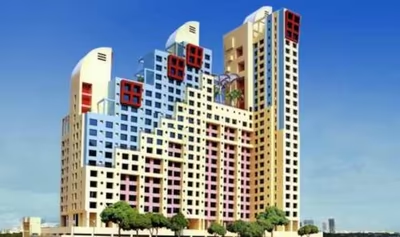
Lokhandwala in Andheri West continues to command sustained residential demand, reinforcing its position as one of the city’s most resilient lifestyle-driven micro-markets. Despite traffic congestion and high density, the neighbourhood’s mix of entertainment industry presence, retail vibrancy and social infrastructure keeps housing absorption steady across rental and ownership segments.
Situated within Andheri West, Lokhandwala has long benefited from proximity to major production hubs such as Yash Raj Films and Balaji Telefilms. This ecosystem has shaped its demographic profile, attracting actors, technicians, digital creators and media professionals. Real estate brokers note that demand in the locality is often lifestyle-led rather than purely investment-driven. At the centre of the neighbourhood is the Lokhandwala Market, a dense retail spine offering daily essentials, fashion outlets, electronics and specialty stores. The presence of this high-footfall commercial strip enhances walkability and reduces dependence on long commutes for everyday needs a factor urban planners increasingly identify as critical to liveable, compact city districts. The area’s food culture further strengthens its residential appeal. Legacy establishments such as High Point Restaurant and Yashins Food Inn coexist with cafés and global chains, supporting a late-night economy that aligns with the schedules of media and creative professionals. Analysts suggest that such mixed-use vibrancy sustains both rental yields and resale values. While built density remains high, Lokhandwala retains pockets of green relief. Chhatrapati Shivaji Maharaj Joggers Park and neighbourhood gardens provide limited but valued open space. Fitness studios and wellness centres add to the area’s health-oriented offerings, reflecting changing buyer expectations around community amenities.
Connectivity is another anchor. Andheri railway station and arterial links to the Western Express Highway and Link Road position Lokhandwala within a broader transport grid. Future metro expansions across the western suburbs are expected to further ease east–west travel, a long-standing bottleneck in the precinct. However, urban development experts caution that continued residential demand must be balanced with infrastructure upgrades. Stormwater management, parking solutions and pedestrian safety remain pressing concerns in older micro-markets. As redevelopment activity increases, regulatory oversight and sustainable building practices will be essential to prevent overburdening civic systems. Property consultants describe Lokhandwala as a self-contained urban enclave one where housing, retail, dining and nightlife intersect within a relatively compact footprint. In a metropolis marked by long commutes, such integrated neighbourhoods retain premium appeal.
As Mumbai’s housing market evolves, Lokhandwala’s enduring draw illustrates a broader trend: lifestyle density, when paired with connectivity and social infrastructure, can sustain demand even in saturated urban environments. The challenge ahead will be ensuring that this vibrancy aligns with long-term urban resilience and equitable access to public space.
Also Read: Pokhran Road 2 housing momentum
Mumbai Lokhandwala lifestyle housing demand rises
Pokhran Road 2 housing momentum

A new mid-premium residential cluster is set to add 283 apartments to Pokhran Road 2, reinforcing Thane’s emergence as a key end-user driven housing market within the Mumbai Metropolitan Region. The project, branded Oyster, forms part of a larger 4.8-acre township-style development and reflects sustained demand for infrastructure-linked housing corridors beyond Mumbai’s core.
The development is being undertaken by Shapoorji Pallonji Real Estate within its Northern Lights layout on Pokhran Road 2. Apartment configurations range from two- to three-bedroom units, with carpet areas between roughly 560 and 1,000 square feet. Pricing begins in the mid-premium bracket, positioning the inventory towards salaried professionals and upwardly mobile households seeking larger living spaces within commuting distance of Mumbai’s business districts. Pokhran Road 2 has steadily transformed over the past decade from a low-density stretch into one of Thane’s more structured residential micro-markets. Its proximity to the Eastern Express Highway and Ghodbunder Road provides arterial connectivity, while the under-construction Mumbai Metro Line 4 is expected to reduce travel times to central Mumbai and key employment nodes once operational. Urban economists observe that infrastructure-backed corridors such as Pokhran Road 2 are absorbing demand displaced by escalating prices in Mumbai’s western and central suburbs. Improved east–west road linkages within Thane city, along with access to schools, healthcare facilities and retail centres, have supported a shift towards self-contained neighbourhood living. The Oyster cluster emphasises cross-ventilated layouts, landscaped open areas and shared amenity spaces features that gained prominence in buyer preference following the pandemic. Developers across the region are recalibrating supply towards practical, mid-sized apartments that balance affordability with functionality. The 564 to 1,004 sq ft range reflects this recalibration, catering to nuclear families and first-time upgraders.
However, planners caution that sustained growth in Thane will depend on synchronised civic upgrades. Water supply reliability, waste management systems and traffic decongestion remain pressing concerns as residential density rises. Climate resilience, particularly in managing monsoon flooding and preserving green buffers, is increasingly central to long-term urban planning in the region. For Shapoorji Pallonji Real Estate, the launch strengthens its presence in a micro-market that continues to attract steady end-user demand rather than speculative investment alone. Analysts suggest that Thane’s residential cycle remains comparatively stable due to its diversified buyer base, spanning manufacturing, services and financial sector professionals.
As Metro connectivity progresses and social infrastructure matures, Pokhran Road 2 is likely to consolidate its position as a preferred mid-premium address. The critical question for policymakers will be ensuring that private residential expansion is matched by public infrastructure capacity a balance essential for sustainable growth across the Mumbai Metropolitan Region.
Also Read: Kolkata property registrations fall year on year
Pokhran Road 2 housing momentum
Kolkata property registrations fall year on year

The Kolkata property registrations tally fell to 3,052 units in January 2026, marking a 41 per cent decline from a year earlier and a sharp sequential drop from December’s elevated base. Market analysts attribute the slowdown largely to seasonal factors and year-end frontloading of transactions rather than a structural demand correction.
Data compiled by Knight Frank India from the Directorate of Registrations and Stamps Revenue, Government of West Bengal, indicates that the Kolkata Metropolitan Area began the year on a subdued note after a typically strong December closing cycle. January often reflects administrative lag and deferred documentation following year-end purchase decisions. While the headline decline appears steep, sector observers caution against reading it as a sign of weakening fundamentals. A significant proportion of transactions are believed to have been advanced into December, compressing January volumes. Economists tracking eastern India’s housing cycle note that similar fluctuations have occurred in previous years. Beyond volumes, the composition of demand offers clearer insight into market direction. Apartments sized between 501 and 1,000 square feet accounted for nearly 59 per cent of January registrations, a marked increase from the prior year. In contrast, units under 500 square feet saw their share shrink considerably. This shift suggests households are prioritising liveable space over minimum entry-level pricing a trend linked to hybrid work patterns and evolving family needs. Geographically, the South Zone of the city emerged as the most active cluster, contributing roughly 43 per cent of total registrations. Peripheral micro-markets such as Behala, Kasba and Sonarpur continue to draw mid-income buyers seeking relatively affordable housing with improving connectivity. The North Zone followed with about one-third of registrations, supported by redevelopment projects and established neighbourhood demand.
Urban planners argue that sustained recovery in Kolkata property registrations will depend on infrastructure delivery and employment growth across emerging corridors. Transport upgrades, civic service reliability and flood-resilient planning remain key concerns in a city vulnerable to climate stress. Developers, meanwhile, are recalibrating supply pipelines towards mid-sized units in peripheral locations, aligning inventory with demonstrated buyer preference. Institutional interest in structured residential projects is also rising, signalling confidence in the long-term fundamentals of the eastern metropolitan market. Looking ahead, analysts expect registration activity to normalise over the coming quarters as pending deals are executed and new launches enter the market. While January’s figures reflect a cooling phase, underlying housing demand drivers urbanisation, household formation and relatively moderate pricing compared to other metros remain intact.
For policymakers and industry alike, the focus will be on translating transactional recovery into resilient, well-serviced neighbourhoods that balance affordability with climate-ready infrastructure.
Also Read: YEIDA plans twin industrial townships
Kolkata property registrations fall year on year
YEIDA plans twin industrial townships

The Yamuna Expressway Industrial Development Authority has proposed carving out two 500-acre industrial townships branded as Japan City and Singapore City along the Yamuna Expressway corridor, signalling Uttar Pradesh’s continued push to attract foreign manufacturing and technology investment through planned urban clusters.
In a formal communication sent to the state government this week, Yamuna Expressway Industrial Development Authority (YEIDA) confirmed that land parcels in Sectors 5A and 7 of Greater Noida have been identified for the projects. Both sites fall within zones earmarked predominantly for industrial use under the notified master plan, with at least 70 per cent of land reserved for manufacturing and allied activities. Officials indicated that preliminary land acquisition planning has been undertaken, aligning the proposal with the state’s broader strategy to create investment-ready townships ahead of high-level diplomatic engagements with Japan and Singapore. The move reflects a model increasingly adopted by Indian states: offering geographically branded enclaves to signal policy alignment and sector-specific incentives to overseas investors. Urban development experts say the twin-township concept goes beyond marketing. Integrated industrial cities typically combine production facilities with logistics infrastructure, worker housing, commercial space and social amenities. If executed effectively, such planning can reduce commuting pressures and support more compact, employment-led urban growth.
The Yamuna Expressway corridor has already emerged as a high-growth belt anchored by logistics parks, electronics manufacturing clusters and the upcoming Noida International Airport in Jewar. By positioning Japan City and Singapore City within multi-purpose industrial sectors, YEIDA appears to be reinforcing the corridor’s identity as a manufacturing and export-oriented zone within the National Capital Region. However, planners caution that large-scale industrial townships must integrate environmental safeguards, water management systems and climate-resilient infrastructure from inception. The expressway region lies within a semi-arid belt that faces groundwater stress, making sustainable resource planning central to long-term viability. Economists tracking investment flows note that Japanese and Singaporean firms have historically shown interest in electronics, precision engineering, warehousing and urban infrastructure projects in India. Dedicated zones could help streamline approvals and cluster suppliers, improving ease of doing business. At the same time, equitable development outcomes will depend on how effectively employment generation translates into opportunities for local communities. Worker housing, skill development centres and accessible public transport links will be critical to prevent the emergence of isolated industrial enclaves.
If cleared by the state government, the proposed 1,000-acre combined footprint would mark one of the more ambitious industrial township initiatives along the Yamuna Expressway in recent years. The next phase will likely involve detailed project structuring, investor consultations and environmental clearances steps that will determine whether the proposal evolves into a fully realised cross-border industrial partnership
Also Read: Visakhapatnam housing market eyes steady growth
YEIDA plans twin industrial townships
Visakhapatnam housing market eyes steady growth

The Visakhapatnam housing market is projected to expand by 6–10 per cent in 2026, driven by airport infrastructure, technology investments and a widening employment base. Analysts tracking the eastern coastal city say the next phase of growth will hinge on how effectively new corridors integrate housing, transport and industrial development.
Long regarded as a strategic port and industrial centre, Visakhapatnam is repositioning itself as a diversified urban economy. A key catalyst is the upcoming Alluri Sitarama Raju International Airport at Bhogapuram, expected to be operational in the near term. Real estate consultants estimate that land values within a 10-kilometre radius of the airport site have already firmed up, with residential layouts and mixed-use proposals gathering pace. Technology sector expansion is also influencing demand patterns. Global firms such as Google and Cognizant have either announced or scaled up their presence in the region, creating fresh white-collar employment clusters. This is reshaping housing absorption across both affordable and mid-premium segments, particularly among younger professionals. Geographically, growth is no longer confined to established neighbourhoods. North Visakhapatnam including Madhurawada, Kommadi and adjoining stretches is witnessing accelerated residential launches. Improved arterial connectivity and proximity to upcoming employment hubs are encouraging developers to introduce larger, higher-specification projects. Bhogapuram, located roughly 40 kilometres from the city core, is emerging as a speculative investment belt, with plotted developments and gated communities targeting early movers.
Market observers note that the Visakhapatnam housing market is also becoming more institutionalised. Grade A projects with formal compliance standards, better amenities and professional facility management are gaining traction. This shift is attracting domestic funds and non-resident investors who previously focused on metropolitan markets. Demand remains broad-based. Entry-level housing continues to appeal to first-time buyers, particularly those employed in logistics, manufacturing and public sector undertakings. Meanwhile, mid-income and premium homes are drawing interest from technology and financial services professionals. Developers report that lifestyle features such as co-working lounges, energy-efficient systems and community open spaces are increasingly factored into purchase decisions. Urban planners, however, caution that sustaining 6–10 per cent annual growth will require coordinated infrastructure delivery. Transport linkages between the airport corridor and the existing city, water security planning and coastal resilience measures will be critical in ensuring that expansion does not outpace civic capacity.
If managed prudently, the Visakhapatnam housing market could evolve into a model for tier-two urban transformation one where infrastructure, employment and liveability advance in tandem. The coming two years will test whether planning frameworks can match investor optimism with sustainable urban outcomes.
Also Read: YM Infra Ashwin Sheth launch Marine Lines tower
Visakhapatnam housing market eyes steady growth