
Leadership Shift At Nippon Paint India Signals Growth Focus

LANXESS Showcases Coatings Solutions At Paint India

At Paint India 2026, one of the country’s leading platforms for the decorative and industrial coatings industry, speciality chemicals firm LANXESS AG presented an expanded suite of paint and coatings solutions designed to address evolving performance, durability and sustainability needs in construction and industrial applications. The showcase underscores how material technology players are adapting product portfolios to reflect both India’s infrastructure expansion and intensifying expectations around environmental performance.
LANXESS’s participation highlighted its focus on high-performance additives and resin systems that can improve adhesion, weather resistance and long-term finish quality across a range of coatings. These technologies are increasingly relevant as builders and specifiers seek materials that extend service life, reduce maintenance cycles and enhance aesthetic outcomes in diverse urban environments — from housing projects to commercial complexes and industrial facilities.Industry analysts note that the coatings value chain has been undergoing transformation, driven by expanding construction activity and a growing emphasis on sustainable building materials. Exhibitors at Paint India 2026 showcased products aligned with regulatory trends that prioritise low-VOC (volatile organic compound) formulations, improved environmental health profiles and compliance with green building standards. LANXESS’s portfolio features innovations that can help manufacturers develop coatings that meet these requirements while delivering robust performance in both interior and exterior applications.
According to sector experts, India’s coatings market is shaped by rapid urbanisation and infrastructure growth, including transport corridors, residential expansion and refurbishment initiatives. Demand for specialised coatings — such as anticorrosive, heat-resistant and easy-clean surfaces — has risen as project specifications incorporate durability and lifecycle considerations alongside aesthetics. This trend is evident in the product demonstrations and technical dialogues at the exposition.In practical terms, advanced additives and emulsion technologies showcased by LANXESS enable paint makers to tailor formulations for diverse climatic conditions, including high humidity zones in coastal and northeastern regions where moisture resilience is a key performance parameter. Such adaptability supports construction quality and building longevity, particularly in fast-developing urban zones where environmental exposure varies widely.
Sustainability remains a core theme across the coatings industry. With increasing adoption of green building certifications and environmental disclosure frameworks in India’s real estate and infrastructure sectors, chemical suppliers like LANXESS are positioning themselves as partners in reducing the ecological footprint of coatings production and application. Product innovations that lower energy inputs, facilitate recycling and align with VOC regulations play a crucial role in meeting these goals.Market observers also highlight that participation in industry exhibitions like Paint India strengthens collaboration across the value chain — from raw material suppliers to paint manufacturers, applicators and end-users. These forums accelerate the exchange of technical knowledge and encourage adoption of best practices in formulation and application technologies.
As India’s urban landscape continues to evolve, demand for coatings that balance performance, sustainability and cost-efficiency is set to grow. Solutions showcased by companies such as LANXESS reflect a broader shift toward technology-led material innovation that supports both functional requirements and environmental ambitions within the nation’s booming construction ecosystem.
Also Read: Kansai Paint Signals India Paint Market Growth
LANXESS Showcases Coatings Solutions At Paint India
Kansai Paint Signals India Paint Market Growth

Japan-based coatings major Kansai Paint Co Ltd is set to outline a comprehensive India strategy for its subsidiary Kansai Nerolac Paints Limited, signalling renewed focus on the country’s expanding construction and industrial ecosystem. The strategic blueprint, expected to be detailed during a scheduled investor interaction, places India at the centre of the group’s long-term growth ambitions amid shifting demand dynamics in the paint and coatings sector.
The planned roadmap comes at a pivotal time for the India paint market growth trajectory. With urbanisation accelerating, infrastructure investment expanding and housing upgrades becoming more aspirational, coatings demand has remained structurally resilient despite periodic cost pressures. Industry observers note that India’s decorative and industrial coatings market continues to expand in tandem with real estate and manufacturing activity, making it one of the most competitive segments in the building materials space.Recent quarterly results from Kansai Nerolac Paints Limited reflected revenue stability but also margin challenges arising from higher input costs and regulatory adjustments. While profitability fluctuations have drawn attention, the parent company has reiterated that India remains a priority geography within its global portfolio. Analysts suggest that the forthcoming growth plan may focus on strengthening premium product offerings, optimising distribution reach and enhancing operational efficiencies to sustain India paint market growth over the medium term.
The strategy is also expected to address evolving consumer and regulatory expectations. Urban development experts highlight that paints and coatings are no longer purely aesthetic finishes; they contribute to building durability, energy efficiency and indoor air quality. Demand for low-VOC and environmentally responsible formulations is rising, particularly in metropolitan regions where green building certifications and climate-resilient construction standards are gaining traction.From an infrastructure standpoint, coatings demand tracks closely with construction cycles. Growth in highways, metro systems, logistics parks and affordable housing typically fuels industrial and protective coatings consumption. Strengthening domestic manufacturing capabilities while maintaining supply chain resilience could therefore form a core pillar of Kansai Nerolac’s expansion blueprint.
Competition in the Indian coatings sector has intensified with new entrants and capacity additions reshaping pricing and distribution dynamics. Against this backdrop, a clearly articulated strategy from Kansai Paint Co Ltd may provide clarity on capital allocation, brand positioning and technological investments aimed at sustaining India paint market growth in a crowded marketplace.For urban planners and developers, the trajectory of the paint sector offers insight into the health of the broader built environment economy. As cities grow denser and infrastructure expands deeper into emerging regions, coatings innovation will increasingly intersect with sustainability metrics, lifecycle cost optimisation and occupant well-being.
The forthcoming blueprint will therefore be watched not only by market participants but also by stakeholders tracking how material innovation supports India’s transition toward resilient, efficient and environmentally aligned urban growth
Also Read: Nuvoco Launches Advanced Wall Putty For Built Environments
Kansai Paint Signals India Paint Market Growth
Nuvoco Launches Advanced Wall Putty For Built Environments
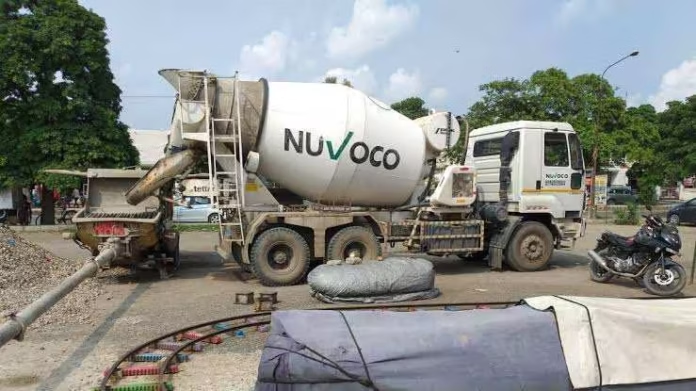
India’s building materials sector is witnessing a shift towards durability and sustainability in wall finishing products, with Nuvoco Vistas Corporation Limited rolling out its latest offering — a premium wall putty engineered for enhanced protection. The product, part of its Zero M suite, combines multiple protective functions in one application, reflecting evolving demand from urban developers, commercial builders and homeowners for surfaces that withstand environmental stressors.
The newly introduced wall putty integrates anti-microbial performance, water resistance and control of efflorescence (white salt deposits) — three core challenges in long-term wall performance — into a single formulation. By incorporating Silver Ion Technology and specialised hydrophobic polymers, the putty is designed to help inhibit microbial growth on surfaces, reduce moisture penetration and minimise salt crystallisation that often degrades finishes in both interior and exterior settings.In the context of India’s expanding construction market, products like this respond to more than aesthetic needs. Urban planners and building scientists point out that surface durability directly affects maintenance costs and building life-cycle assessments, especially in regions with high humidity or monsoon exposure. Better moisture control and biological resistance can also contribute to healthier indoor environments — a priority in dense urban housing and commercial spaces. This aligns with broader trends in Indian cities where sustainability standards and occupant well-being are gradually shaping material choices.
The Zero M Triple Shield Putty is positioned to bond effectively with cement plaster, concrete and mortar substrates — the dominant base materials in urban construction — while delivering a smoother and brighter finish. It is also manufactured with low-VOC (volatile organic compound) materials, an important consideration in reducing indoor air pollution and improving environmental profiles of building products. Such material-characteristics are increasingly factored into green building evaluations and certification systems.From a market perspective, the launch underscores how building materials firms are broadening portfolios beyond bulk commodities like cement to value-added, performance-oriented products. Analysts note that while cement and concrete remain fundamental to infrastructure growth, ancillary products such as advanced wall putties, tile adhesives and waterproofing solutions are gaining traction as urban builders seek integrated solutions that can improve project durability and reduce lifecycle costs. Earlier innovations in this space have similarly focused on performance improvements and ease of application.
The product will initially roll out through authorised dealers and retail channels across multiple Indian states, including northern, western and eastern regions, enhancing regional accessibility for builders and contractors. The distribution strategy aims to match product availability with areas experiencing high construction intensity, such as expanding urban zones and peri-urban corridors, where demand for durable finishing solutions is strong.
As India’s cities grow and construction standards evolve, durable and environmentally conscious material innovations like triple-function wall putty will likely play a supporting role in reducing maintenance burdens and enhancing the built environment. The next phase for material innovators will be demonstrating measurable performance advantages in long-term usage and integrating circular economy principles into product design.
Also Read: Assam Expands Industrial Base With New Cement Facility
Nuvoco Launches Advanced Wall Putty For Built Environments
Assam Expands Industrial Base With New Cement Facility

In a strategic push to strengthen industrial infrastructure in northeastern India, the Assam government on 20 February 2026 formally inaugurated a new cement manufacturing facility in the Barak Valley’s Cachar district, marking a significant milestone in regional economic development. The facility, with an annual capacity of 2 million tonnes, launches operations amid growing construction demand across the state and neighbouring regions, integrating industrial expansion with broader urbanisation goals.
The plant — one of the largest private sector investments in southern Assam — is the first in the Barak Valley equipped with a dedicated railway siding, a feature that planners say will streamline logistics and reduce transport costs for construction supply chains. This connectivity enhancement is particularly relevant for infrastructure projects in remote and emerging urban nodes where traditional transport bottlenecks have constrained growth.Government officials have framed the launch as part of Assam’s broader industrialisation roadmap, which aims to leverage regional strengths to create jobs, enhance manufacturing capacity and widen the economic base beyond traditional agricultural and tea sector opportunities. The new plant is expected to generate significant employment, both direct and indirect, for local communities, aligning with state priorities to curb outward migration of skilled labour and to deepen inclusive economic participation.
Industry analysts note that cement capacity additions in regions like the Barak Valley play a pivotal role in underpinning urban infrastructure and housing growth. Cement is a foundational material for roads, bridges, housing developments and industrial parks — all of which are critical to sustainable urbanisation strategies. By situating production closer to emerging markets in the north east, the facility could mitigate reliance on distant supply hubs, potentially lowering environmental impacts associated with long-haul freight and improving project execution timelines.However, expanding industrial capacity also brings environmental and policy considerations to the fore. Cement manufacturing is energy-intensive and contributes to carbon emissions, prompting calls among urban sustainability experts to prioritise cleaner production technologies and integrated climate resilience measures even as capacity grows. Balancing economic growth with environmental stewardship is increasingly seen as essential to making India’s rapid urban expansion both resilient and equitable.
The project is embedded within a broader wave of infrastructure initiatives in Assam, including an upcoming expressway linking Silchar and Guwahati and other logistic projects aimed at improving connectivity across the region — developments expected to further stimulate construction activity and cement demand.As the Barak Valley positions itself as a new industrial corridor, the launch of this cement plant marks a tangible step in transforming regional economic dynamics. The coming months will test how effectively this capacity can be integrated within wider development frameworks that prioritise climate-aware growth and improved urban outcomes.
Also Read: India Cement Capacity To Expand Through FY28
Assam Expands Industrial Base With New Cement Facility
India Cement Capacity To Expand Through FY28
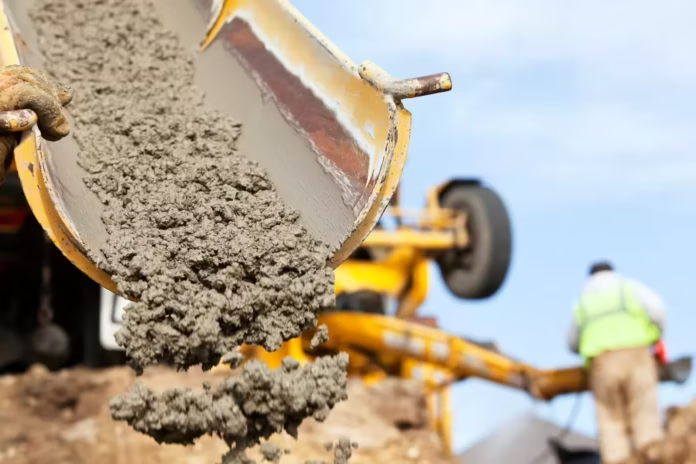
India’s cement sector is entering a pronounced expansion phase, with industry capacity projected to grow at a 7.4% compound annual growth rate (CAGR) through fiscal 2028, underscoring the continued momentum in construction demand and infrastructure development across the country. That projection comes from a recent industry outlook by a leading global brokerage, reflecting accelerated capacity additions amid persistent demand from urbanisation, housing and public works.
Over the coming three years, announced expansions are expected to add roughly 158 million tonnes of new production capability, driven by both greenfield plants and brownfield expansions at existing facilities. This shift marks a strategic phase where capacity build-out aligns with India’s broader urban and infrastructure investment push, including highways, metros, logistics hubs and mass housing schemes.Capacity growth reflects confidence among builders and policymakers that underlying demand drivers will remain resilient. Urban planners and market analysts note that strong cement capacity expansion often tracks with broader economic activity: it signals not only robust construction pipelines but also the readiness of industrial ecosystems to absorb population growth in urban centres while supporting rural-urban connectivity. This projected scale of expansion also highlights a structural pivot in how India’s built environment is being shaped ahead of major long-term sustainability and resilience goals.
At the same time, the expansion trajectory brings into focus the challenge of matching supply with effective demand. Cement capacity utilisation — a key metric that influences investment efficiency — is expected to remain in the high-60% range even as new plants come online. Sustained demand from both public and private sectors will be essential to absorb incremental capacity without exerting undue pressure on pricing or resource use.Cement plays a central role in urban infrastructure and real estate. Its growth underpins the construction of essential facilities like transport networks, housing and industrial parks. A growing capacity base can strengthen supply chains, reduce regional bottlenecks and enhance logistics efficiency by placing production closer to demand centres. That, in turn, can lower carbon footprints associated with freight and spur adoption of more sustainable construction materials and techniques.
However, growth at this scale also invites scrutiny on environmental fronts. Cement manufacturing is energy and emissions-intensive; expanding capacity must be balanced with innovations in low-carbon production, alternative binders and recycling of construction waste. Urban sustainability experts emphasise that long-term climate goals will depend on deploying greener technologies alongside the traditional expansion of capacity.
As capacity additions progress, policymakers and planners will need to carefully monitor regional demand patterns, resource availability and ecosystem impacts. Aligning cement capacity growth with sustainable urbanisation — including efficient land use, energy transition and equitable access to infrastructure — will be critical for India’s cities and towns to expand responsibly and resiliently through the rest of the decade.
Also Read: Andhra Pradesh Moves On Idle Cement Project Land
India Cement Capacity To Expand Through FY28
Andhra Pradesh Moves On Idle Cement Project Land

In Vijayawada, Andhra Pradesh’s industries leadership has signalled a firm shift in governance by pledging stringent action on long-stalled cement projects, responding to mounting concerns over dormant land tracts originally earmarked for industrial use but remaining undeveloped for decades. The announcement comes amid growing public frustration in rural districts where land set aside for industrial expansion has failed to translate into operations, jobs or equitable economic outcomes.
During a recent state legislative session, the state’s Industries Minister acknowledged that large swathes of fertile land in Palnadu district and adjacent mandals were acquired by private cement firms — sometimes as far back as 20–25 years ago — yet many failed to set up the promised manufacturing units. Instead, farmers surrendered land in anticipation of employment and local infrastructure development, only to see fields lie idle and community livelihoods disrupted.The government’s scrutiny extends to parcels awarded through the Andhra Pradesh Industrial Infrastructure Corporation (APIIC), which facilitated land allotments and, in some cases, mining rights for cement and related industries across multiple villages. Ministerial pronouncements indicate that the state will no longer tolerate non-compliance and is exploring measures to reclaim underutilised land, expedite project initiation, or reallocate assets toward active investment pipelines.
This intervention matters not only for industrial accountability but for the wider urban-rural development nexus. Cement production is a crucial input in construction and infrastructure value chains, and stagnation in plant establishment creates a ripple effect — delaying utilities expansion, employment generation and construction demand that could strengthen local economies. The perceived decoupling between land acquisition and actual industrial activity has fuelled distrust among communities who were promised socio-economic benefits.Urban and economic planners note that persistent delays in project implementation can weaken investor confidence if governance frameworks are seen as lax on milestones and penal measures. At the same time, clearing idle land for new or reconfigured industrial ventures could recalibrate regional investment flows, particularly if linked to sustainable industrial policies and well-defined timelines. These shifts are especially relevant as Andhra Pradesh accelerates its broader infrastructure and investment promotion agenda, which has included recent approvals of multiple projects across sectors.
However, legal and regulatory complexities around land tenure, contractual obligations, and environmental clearances remain significant hurdles. Experts suggest that transparent frameworks for land reversion and reallocation, coupled with community engagement, are essential to prevent further social dislocation and to ensure that industrial growth contributes meaningfully to local development.For Andhra Pradesh’s construction and industrial sectors, the next few months will be a critical test of whether renewed policy enforcement can convert long-promised industrial projects into tangible economic and employment outcomes, while upholding responsible land and ecosystem stewardship.
Also Read: India Cement Production Growth Accelerates In January
Andhra Pradesh Moves On Idle Cement Project Land
India Cement Production Growth Accelerates In January

India’s infrastructure economy showed steady momentum in January 2026, with cement emerging as the strongest performer within the country’s core industrial basket. Official data indicates that overall core sector output expanded by 4% year-on-year, but it was cement production growth — rising by over 10% — that signalled continued construction intensity across urban and regional markets.
The surge in cement output reflects sustained activity in housing, transport corridors, logistics parks and public infrastructure projects. Industry observers note that cement production growth is often a reliable early indicator of on-ground construction progress, especially in emerging urban clusters and peri-urban zones where residential and civic works are advancing simultaneously.This phase of cement production growth coincides with increased execution of government-backed capital expenditure and private sector participation in commercial real estate. Urban planners suggest that demand is being driven not only by metro rail and highway construction but also by warehousing, data centres and mid-income housing projects in Tier-II and Tier-III cities. These developments are expanding the geography of construction beyond metropolitan cores.
The implications extend beyond headline growth numbers. Cement is central to the built environment, and its performance shapes employment across supply chains — from quarrying and freight to on-site labour and project management. Strong cement production growth therefore signals continuity in construction-linked livelihoods and local economic circulation, particularly in rapidly urbanising districts.At the same time, the rise in output brings renewed attention to sustainability. Cement manufacturing remains energy-intensive and carbon-heavy. Urban development experts argue that while infrastructure expansion is essential, scaling low-carbon production methods and blended cement technologies will be critical to align construction growth with climate commitments. The challenge lies in balancing infrastructure demand with environmental responsibility, especially as cities position themselves for long-term resilience.
Compared with other core industries that showed mixed or subdued performance, cement’s double-digit expansion underscores where capital formation is currently concentrated. It also reflects project execution momentum rather than mere announcement cycles — a distinction that matters for assessing real economic traction.Looking ahead, analysts expect cement production growth to remain closely tied to public infrastructure pipelines and housing demand trends in the upcoming quarters. If sustained, it could reinforce confidence in the construction cycle while encouraging investment in greener manufacturing processes.
For India’s cities, the data suggests that the building phase of the current infrastructure push is firmly underway. The next test will be ensuring that this expansion translates into durable, inclusive and climate-aligned urban development rather than short-term construction spikes.
Also Read: CTO Realty Growth reports strong NOI growth
India Cement Production Growth Accelerates In January
CTO Realty Growth reports strong NOI growth

CTO Realty Growth has reported its strongest operational performance in recent years, citing record leasing volumes, rising occupancy and improved income metrics, as the US-based real estate investment trust sharpened its expansion pipeline for 2026.
According to its latest regulatory filing, portfolio occupancy climbed to 95.9 per cent by the end of 2025, reflecting sustained tenant demand across its retail-focused assets. The company attributed the gains to proactive asset management, disciplined capital deployment and selective acquisitions completed during the year. Net operating income (NOI), a key indicator of property-level profitability, increased meaningfully year on year, supported by higher rental rates and improved cost controls. Management also reported a return to stronger net income compared to the previous year, alongside solid growth in funds from operations (FFO) and adjusted funds from operations (AFFO) metrics closely tracked by REIT investors to assess recurring earnings performance. Industry analysts note that occupancy levels nearing 96 per cent signal healthy absorption in well-located, necessity-driven retail formats, even as parts of the broader commercial real estate market remain uneven. The ability to translate leasing momentum into higher NOI suggests effective tenant mix optimisation and stable rent collections.
For urban markets, the implications extend beyond investor returns. High-performing retail and mixed-use assets tend to anchor neighbourhood activity, generate employment and sustain local services. Real estate economists argue that consistent NOI expansion provides landlords with capacity to reinvest in building upgrades, energy efficiency improvements and public-facing amenities increasingly important in climate-conscious urban environments. Looking ahead, the REIT’s 2026 guidance projects further gains in FFO, AFFO and NOI, underpinned by an active acquisition and development pipeline. Management indicated that capital allocation will remain focused on income-producing properties with durable cash flows, while maintaining balance sheet discipline. Market observers suggest that continued growth will depend on stable consumer spending patterns, access to financing and prudent risk management in a higher-for-longer interest rate environment. Nevertheless, the company’s recent performance positions it among mid-cap REITs demonstrating operational resilience.
As cities recalibrate post-pandemic commercial patterns, the ability of landlords to sustain high occupancy and income growth will shape retail corridor vitality and broader urban economic health. For CTO Realty Growth, the test in 2026 will be whether disciplined expansion can reinforce both investor confidence and the long-term adaptability of its property portfolio.
Also Read: Kolkata riverfront development gets Rs 5000 crore push
CTO Realty Growth reports strong NOI growth
Kolkata riverfront development gets Rs 5000 crore push

Eden Realty Group has outlined a Rs 5,000 crore investment roadmap aimed at reshaping Kolkata’s eastern river edge, beginning with the launch of a large mixed-use residential project along the Hooghly. The announcement signals one of the city’s most ambitious private-sector bets on Kolkata riverfront development, at a time when waterfront regeneration is gaining policy and investor attention across Indian metros.
The first project under the plan, branded as a premium riverside township, will anchor a broader portfolio spanning luxury housing, hospitality, retail and Grade-A commercial spaces. According to senior company executives, the capital allocation will be deployed in phases across strategic river-facing parcels, positioning the initiative as a long-term urban play rather than a standalone residential venture. Urban planners note that Kolkata’s riverfront has historically remained under-leveraged compared to waterfront transformations seen in other global cities. With improved connectivity and renewed civic focus on public realm upgrades, large-format private investments could catalyse complementary infrastructure, including transport access, tourism facilities and public spaces. However, experts caution that river-sensitive development must align with flood resilience norms, ecological buffers and inclusive access principles. The anchor residential project sits opposite the Acharya Jagadish Chandra Bose Indian Botanic Garden and within a short drive of the Victoria Memorial, placing it within a historically and environmentally significant zone. Project planners say the master plan incorporates elevated landscaping, extensive open areas and orientation strategies designed to enhance natural ventilation and reduce heat gain design moves that are increasingly critical in a warming urban climate.
Beyond high-end towers, the company has indicated plans for hospitality assets along the river, including a five-star property, alongside commercial and retail components. Market analysts suggest that integrating hospitality with residential uses could diversify revenue streams while strengthening Kolkata’s positioning as a heritage and spiritual tourism hub.In parallel, the developer is expanding into other parts of the metropolitan region, including a mid-rise housing scheme along the Kona Expressway and low-density housing in south Kolkata. This diversification reflects sustained demand across income segments, even as premium waterfront homes remain a niche but aspirational category. Real estate consultants tracking eastern India observe that large-scale Kolkata riverfront development carries both opportunity and responsibility. Done well, it can unlock underutilised land, generate employment and enhance urban liveability. Poorly regulated growth, however, risks environmental degradation and exclusionary urbanism.
For the city, the larger question is how private capital integrates with public planning. If coordinated with transport upgrades, resilient drainage systems and accessible river promenades, such investments could mark a structural shift in how Kolkata engages with its river not as a back-of-house edge, but as a civic and economic spine.
Also Read: India Sothebys luxury housing advisory deepens
Kolkata riverfront development gets Rs 5000 crore push