

Delhi Vikaspuri Growth Reshapes West Delhi

Delhi: In west Delhi, Vikaspuri’s steady transformation from agrarian land on the city’s edge into a mature residential hub is emerging as a case study in how planned affordability and incremental infrastructure can shape long-term urban stability. The neighbourhood’s evolution over five decades underscores how middle-income housing clusters in the capital have matured into self-sustaining micro-economies even as governance and healthcare gaps persist.
Originally carved out near Budhela village in the late 1970s, the area saw phased development through public housing and cooperative group housing societies in the early 1980s. Early residents recall an environment defined by skeletal infrastructure: limited water supply, unreliable electricity and sparse retail access. Over time, basic services stabilised, local markets emerged and civic amenities expanded, mirroring Delhi’s outward urban push. Today, Delhi Vikaspuri growth is visible in its dense network of neighbourhood shops, private clinics, tuition centres and upgraded residential blocks.
Real estate observers note that such colonies, built on planned grids with internal parks and community spaces, have retained value because of their layout discipline and social cohesion. Compared to unplanned outer extensions, Vikaspuri benefited from early zoning clarity and cooperative ownership structures.
Urban planners say the colony illustrates the long-term payoff of structured land development. Internal green pockets originally part of the planning template now function as heat buffers and community gathering spaces. While tree cover along arterial roads remains uneven, residential parks have improved microclimatic comfort, an increasingly critical factor as Delhi faces rising summer temperatures.
Connectivity has strengthened the area’s economic viability. Metro access in adjoining corridors, road links to the National Capital Region and the growth of informal last-mile mobility have reduced commute friction for working households. Property consultants point out that such transit adjacency has helped stabilise rental demand and resale values, especially among middle-income families seeking predictable infrastructure without premium south Delhi pricing. However, Delhi Vikaspuri growth has not been without strain. Residents cite traffic congestion, shrinking carriageways due to encroachments and fragmented administrative oversight across overlapping constituencies. Healthcare infrastructure remains limited to smaller facilities, requiring travel to larger hospitals in neighbouring zones. Urban governance experts argue that mature colonies now require second-generation upgrades improved stormwater systems, pedestrian safety measures and coordinated civic management rather than first-phase provisioning.
Despite these constraints, Vikaspuri’s trajectory reflects a broader urban lesson. Affordable, planned neighbourhoods, when supported by gradual infrastructure reinforcement, can evolve into resilient social ecosystems. The colony’s cooperative culture, mixed regional demographics and embedded green spaces demonstrate how identity in large metros often forms at the mohalla level rather than the city scale. As Delhi recalibrates its development priorities towards climate resilience and equitable growth, established middle-income districts like Vikaspuri may offer a blueprint: incremental improvement, participatory community networks and infrastructure that keeps pace with density. The next phase will depend less on expansion and more on upgrading what already exists.
Delhi Vikaspuri Growth Reshapes West Delhi
NCR Namo Bharat Corridor Shifts Housing Axis

New Delhi: A proposed high-speed regional rail link connecting Gurugram, Faridabad and Noida is poised to recalibrate property demand patterns across the National Capital Region, with planners and developers anticipating a redistribution of residential and commercial growth along the transit spine. Estimated to involve an investment of roughly ₹15,000 crore, the NCR Namo Bharat corridor is entering an advanced planning stage, signalling the next phase of integrated mobility in the region.
Designed as a largely elevated rapid rail system, the corridor aims to cut travel time between the three economic centres to under an hour. Urban mobility experts note that predictable cross-city commuting can significantly alter housing choices, particularly in polycentric regions such as NCR where employment hubs are geographically dispersed. The NCR Namo Bharat corridor is expected to strengthen transit-oriented development across emerging micro-markets. Faridabad, traditionally viewed as a lower-cost alternative to Gurugram and central Noida, could witness the sharpest shift. Improved rail connectivity to corporate districts and IT clusters may enhance its appeal among end-users seeking larger homes and planned communities without sacrificing workplace access.
Real estate analysts observe that NCR’s housing cycle has recently been driven more by primary occupants than speculative investors. Stable end-user demand, combined with strong office absorption by technology firms and global capability centres, has underpinned price resilience. A seamless regional rail network could deepen this trend by encouraging households to weigh commute reliability alongside affordability and liveability. In Gurugram, integration with existing highways, metro corridors and arterial roads may create multi-modal nodes that ease congestion in established business districts. This, in turn, could moderate rental and capital value pressures by widening the residential catchment area for professionals working in the city.
Noida and Greater Noida, already supported by expressways and metro lines, stand to gain from stronger westward connectivity. Industry experts say improved cross-linkages can diversify demand across income segments, encouraging mixed-use projects that combine residential, retail and institutional functions around transit stations. From a sustainability perspective, the NCR Namo Bharat corridor aligns with broader efforts to reduce car dependency and transport emissions in one of India’s most polluted urban clusters. Transit-oriented growth, if supported by zoning reforms and pedestrian-friendly design, can limit unchecked sprawl while preserving peri-urban land.
However, planners caution that infrastructure alone does not guarantee balanced development. Timely execution, station area planning and integration with local bus and non-motorised transport systems will determine whether the corridor supports inclusive growth or simply inflates speculative land values. As the project advances towards implementation, market participants are already factoring its potential into land valuations and project pipelines. The longer-term impact will depend on delivery timelines and regulatory clarity, but the corridor has clearly entered the strategic calculus of NCR’s next real estate cycle.
NCR Namo Bharat Corridor Shifts Housing Axis
Bhumika Realty Strengthens Leadership with Dr Ram Kona

Bhumika Realty has reinforced its leadership team with the appointment of Dr Ram Kona as President and Head – CRM, marking a strategic push to enhance customer engagement and long-term client value across the company’s portfolio. Based in Mumbai, Dr Kona will spearhead customer relationship strategy, lifecycle management, and experience excellence, aligning business priorities with the evolving expectations of India’s real estate buyers.
The appointment underscores Bhumika Realty’s focus on people-first practices in an increasingly competitive housing market, where transparency, personalised service, and sustained client trust are becoming decisive factors. Industry experts note that companies integrating robust CRM frameworks can strengthen retention, accelerate repeat business, and build more resilient customer communities. Dr Ram Kona brings multi-sector expertise spanning real estate, financial services, and academia. Before joining Bhumika Realty, he served as President and Chief Business Officer at Mista Infra, where he managed analytics, housing finance initiatives, and CRM strategy. His career includes senior leadership roles at M3M India, Runwal Realty, Omkar Realtors & Developers, and Lodha Group, where he helped shape customer engagement policies and operational efficiency across large portfolios.
In addition, Dr Kona has extensive banking experience, having held leadership positions at YES Bank, Axis Bank, IDBI Bank, and Global Trust Bank. His academic tenure at GITAM University complements his practical experience, integrating research-driven insights into customer-centric business practices. A senior real estate analyst highlighted that “cross-industry experience in CRM allows leaders to implement innovative frameworks that balance analytics, service quality, and client retention, which is critical for sustainable growth.” Bhumika Realty emphasises that the CRM function is central to delivering differentiated buyer experiences across its residential and commercial projects. Dr Kona is expected to integrate analytics into decision-making, optimise customer lifecycle management, and implement structured frameworks to maintain high service standards. Analysts suggest that such initiatives can elevate brand credibility, encourage informed buyer decisions, and strengthen investor confidence in India’s urban real estate markets.
Mumbai’s evolving residential landscape is witnessing increased demand for transparent, service-oriented real estate experiences, particularly among high-value clients and institutional investors. By strategically investing in CRM leadership, Bhumika Realty is positioning itself as a customer-centric developer capable of blending operational efficiency with long-term relationship-building. Looking ahead, Dr Kona’s leadership is anticipated to strengthen Bhumika Realty’s market competitiveness while embedding sustainable practices in client engagement strategies, supporting the broader vision of inclusive, resilient, and high-quality urban development.
Bhumika Realty Strengthens Leadership with Dr Ram Kona
Dilip Kumar Bungalow Redevelopment Gets OC from Ashar Group

Ashar Group has secured the Occupancy Certificate (OC) for its flagship luxury redevelopment in Mumbai, transforming a historic Pali Hill bungalow into a high-end residential project. The project, featuring 4 and 5‑BHK apartments, duplexes, and a dedicated museum space, achieved certification nearly 20 months ahead of the RERA‑mandated 2028 timeline, signalling operational efficiency and confidence in Mumbai’s luxury redevelopment sector.
The development, spanning over 3,200 sq. ft. per unit, reflects growing market appetite for heritage-linked residences that integrate cultural value with modern amenities. Urban real estate experts suggest that early OC approvals in such projects provide both investor reassurance and a template for responsible redevelopment practices, combining preservation with sustainable urban densification. Residential transactions indicate strong market momentum, with current pricing averaging ₹1.65 lakh per sq. ft. and penthouse units reaching ₹1.81 lakh per sq. ft. Industry analysts highlight that the project has already amassed close to ₹500 crore in sales, demonstrating the resilience of Mumbai’s high-end real estate segment despite broader economic fluctuations. The integration of a museum within the project underscores an emerging trend in luxury redevelopment, where experiential and cultural dimensions enhance both market positioning and social value.
Pali Hill, one of Mumbai’s most prestigious neighbourhoods, has long been home to prominent figures from the entertainment sector. Observers note that heritage bungalows in the area, when redeveloped responsibly, command a price premium of 10–20% over standard luxury developments. Incorporating the historic and cultural narrative of the property not only preserves architectural memory but also strengthens the appeal of high-value urban housing to domestic and international buyers. Urban planners indicate that such heritage-focused redevelopments contribute to city sustainability by reusing existing plots rather than expanding urban sprawl, while also supporting a people-first approach that integrates community spaces and cultural touchpoints. The project’s early completion and compliance with statutory approvals demonstrate the potential for scalable models of luxury redevelopment in other high-demand zones across Mumbai, blending regulatory adherence, heritage preservation, and market viability.
Experts caution, however, that ongoing monitoring of construction quality, civic infrastructure integration, and environmental standards remains crucial to maintaining the long-term value of redeveloped luxury assets. The success of the project may set a benchmark for future redevelopment ventures seeking to balance exclusivity, cultural preservation, and sustainable urban growth in Mumbai.
Dilip Kumar Bungalow Redevelopment Gets OC from Ashar Group
PM Modi & French President Macron Ink Twenty Partnership Deals Strengthening India France Relations

Indian Prime Minister Narendra Modi and French President Emmanuel Macron signed 20 agreements in Mumbai, spanning defence, trade, technology, and healthcare sectors. The accords, formalised on February 16 at Lok Bhavan during Macron’s three-day visit, are expected to catalyse joint investments and elevate strategic ties between the two countries. Observers say the deals signal renewed momentum in Indo-French collaboration across both industrial and civic infrastructure domains.
The Mumbai leg of the visit included high-level bilateral talks, where officials emphasised enhancing trade, defence production, and advanced technology partnerships. Senior government sources noted that several of the agreements are designed to encourage private sector collaboration and innovation-driven projects. Analysts highlight that combining India’s large-scale manufacturing capabilities with French technological expertise could create a model for responsible, sustainable industrial growth. Among the key initiatives is the inauguration of a H125 helicopter production facility in Karnataka, developed jointly by France’s Airbus and India’s Tata Advanced Systems. The project, which can produce helicopters capable of operating at extreme altitudes such as Mount Everest, underscores the strategic and technological depth of the Indo-French defence partnership. Defence ministry officials indicated that similar joint ventures, including missile production and officer exchange programmes, are expected to strengthen national security and defence readiness.
Economic experts suggest the agreements are timely, coinciding with India’s new trade arrangements with the European Union. By formalising tax protocols and investment safeguards, the accords are likely to increase cross-border capital flows and attract French firms to urban development and infrastructure projects in India. Industry specialists also view the agreements as potentially enhancing sustainable technology transfer, smart city initiatives, and renewable energy adoption in urban regions. Cultural and educational collaboration also featured prominently, with commitments to establish an Indian cultural centre in France and support for India’s maritime heritage projects, including initiatives at Lothal. Urban planners indicate that such exchanges can foster knowledge-sharing on resilient urban design, heritage conservation, and people-first city planning.
Officials emphasised that the Indo-French partnership is guided by trust, openness, and shared ambition. Macron and Modi underlined the importance of multilateral cooperation in tackling global challenges, from climate change to regional security. Analysts say the agreements could serve as a blueprint for leveraging international partnerships to support inclusive urban and industrial growth in India while maintaining climate-resilient standards. With the 20 agreements now operational, the focus will shift to implementation and monitoring. Experts suggest that continuous collaboration between public authorities and private enterprises will be essential to maximise benefits for trade, infrastructure, defence, and urban sustainability.
PM Modi & French President Macron Ink Twenty Partnership Deals Strengthening India France Relations
Godrej Properties Names Abhimanyu Rathore As New HR Head

Godrej Properties has strengthened its human capital strategy in Mumbai with the appointment of Abhimanyu Rathore as Head – HR for the Mumbai Zone. The move signals a focused effort by the real estate developer to align workforce planning with business priorities in one of its most strategically significant markets. Rathore’s mandate will encompass leadership development, performance enhancement, and cultivating a resilient organisational culture to support growth across Mumbai’s competitive property landscape.
Rathore joins Godrej Properties from Tata Consumer Products, where he held senior HR leadership roles for over five years, most recently serving as Director – HR for the Ready-to-Drink business. In that capacity, he collaborated closely with cross-functional teams spanning sales, marketing, finance, and digital operations to design talent frameworks that matched evolving business objectives. Industry experts note that his experience in embedding structured performance and leadership frameworks positions him to address talent challenges in the complex real estate sector. Prior to Tata Consumer Products, Rathore held strategic HR positions at Vodafone Intelligent Solutions (VOIS), Bharti Airtel, and Siemens, supporting large matrixed teams and steering workforce transformation programmes. His early career at Tata Consultancy Services and his academic credentials, including an MBA in Human Resource Management from XLRI Jamshedpur, reflect a strong foundation in both corporate and structured HR systems.
At Godrej Properties, Rathore will oversee the Mumbai region’s people agenda, focusing on aligning human resource initiatives with business strategy, building leadership pipelines, and enhancing performance management systems. The appointment also underscores the company’s commitment to diversity, equity, and inclusive workplace culture, particularly critical in Mumbai’s urban real estate market, where attracting and retaining top talent is essential for delivering sustainable, high-quality projects. A senior HR consultant in the real estate sector commented that leadership appointments of this nature are vital for companies looking to future-proof talent strategies and drive organisational resilience, especially in cities with rapidly evolving urban development landscapes. By integrating experience from consumer products, telecommunications, and industrial firms, Rathore is expected to bring best practices in workforce transformation and cultural change to Godrej Properties’ operations.
As Mumbai continues to see robust demand for residential and commercial projects, having a dedicated HR leadership presence focused on the city enables Godrej Properties to enhance employee engagement, drive operational efficiency, and sustain competitive advantage. The appointment highlights a broader trend in Indian real estate: prioritising human capital as a strategic lever for business growth.
Godrej Properties Names Abhimanyu Rathore As New HR Head
TV producer Rajan Shahi Acquires Mumbai Madh Island Penthouse Near Jubin Nautiyal

Mumbai’s luxury residential segment witnessed a notable transaction as television producer Rajan Shahi acquired a 5BHK penthouse on Madh Island for ₹13.71 crore. The residence, located on the 35th floor of the Raheja Exotica Cyprus building developed by Raheja Universal, places Shahi alongside prominent neighbours such as playback singer Jubin Nautiyal on the 34th floor and actor Sanjay Mishra on the 15th floor.
Officially registered on December 26, 2025, the deal highlights sustained interest in premium high-rise properties within Mumbai’s coastal zones. The Shahi penthouse spans 3,248 sq ft of RERA-compliant carpet area, complemented by 400 sq ft of deck space and four dedicated parking slots. With a per sq ft acquisition price exceeding ₹37,000, the transaction underscores the continued premium valuation of sea-facing residences in the city’s northern suburbs. The state also benefited from stamp duty of ₹82 lakh and a registration fee of ₹30,000, reflecting ongoing revenue contributions from high-end property deals. Property analysts note that Madh Island’s appeal stems from its combination of scenic coastal views and relative spatial privacy within the metropolitan environment. Senior real estate consultants suggest that the acquisition by a high-profile media producer signals growing interest among high-net-worth individuals in expansive, lifestyle-driven residences beyond Mumbai’s traditional South and Western suburbs. “This trend reflects confidence in peripheral luxury developments as both residential investments and status symbols,” said a Mumbai-based property consultant.
The deal also illustrates broader dynamics in the city’s luxury housing sector, where high-rise developments in emerging coastal corridors are increasingly regarded as long-term investment assets. Strategists point out that proximity to celebrities and entertainment figures can enhance a property’s perceived prestige, potentially influencing pricing in similar projects. From an urban planning perspective, projects like Raheja Exotica Cyprus contribute to densification along the northern Mumbai coastline, while raising challenges related to sustainable infrastructure and service delivery. Local planners emphasise the importance of integrated solutions addressing traffic management, water supply, and environmental resilience as high-rise communities expand in traditionally low-density coastal areas.
For developers such as Raheja Universal, the transaction exemplifies ongoing monetisation strategies targeting premium buyers through projects that combine panoramic views, high-end amenities, and accessibility to city centres. Market experts anticipate that high-profile individuals investing in peripheral luxury developments will continue to shape demand in Mumbai’s emerging residential corridors. As Rajan Shahi joins Madh Island’s skyline, the acquisition reflects both the financial vitality and evolving character of Mumbai’s luxury real estate sector. Observers note that balancing lifestyle appeal with sustainable urban growth will remain a key consideration as high-net-worth buyers increasingly influence peripheral urban development patterns.
TV producer Rajan Shahi Acquires Mumbai Madh Island Penthouse Near Jubin Nautiyal
Delhi Royal Estate Land Set For Sale
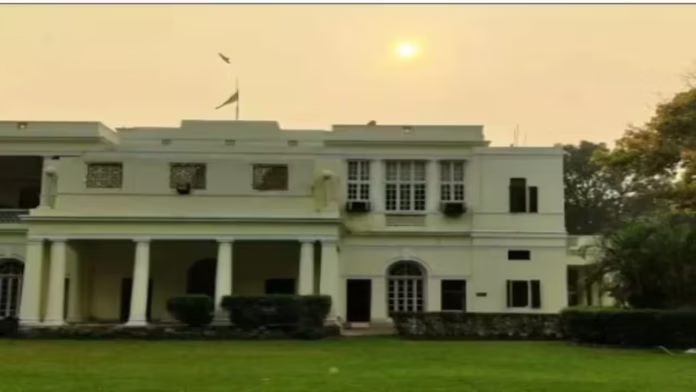
A prominent 3.2-acre landholding in central Delhi linked to the erstwhile Tehri royal family is set to be placed on the market, a move that could reshape one of the capital’s most tightly held real estate pockets. The proposed Delhi heritage property sale comes at a time when large contiguous land parcels in Lutyens’ Delhi are increasingly rare, underscoring shifting patterns of asset monetisation among legacy landowners.
Property consultants familiar with the transaction indicate that the site, located in a low-density bungalow zone, carries redevelopment potential subject to planning controls and heritage regulations. Given its scale and location, the parcel is expected to attract interest from institutional investors, ultra-high-net-worth individuals and diplomatic or quasi-institutional buyers. Large-format plots in central Delhi are governed by strict land use norms, height restrictions and green cover mandates. Urban planners note that any future development will need to comply with conservation guidelines, tree preservation rules and infrastructure capacity assessments. In this context, the Delhi heritage property sale is not merely a private transaction but a test case for how historic estates transition within a modern regulatory framework.
Market analysts suggest that such assets are often viewed as long-term capital preservation vehicles rather than quick-turn developments. With limited supply in established neighbourhoods, transactions of this scale can influence benchmark pricing across adjoining zones. However, buyers must factor in compliance costs, conservation obligations and sustainability expectations that increasingly shape approvals in the capital. The sale also reflects a broader trend of generational asset restructuring among erstwhile royal and legacy families. As maintenance costs rise and land values escalate, monetising portions of large estates has become a pragmatic financial strategy. In Delhi’s context, where land scarcity drives premium valuations, these decisions can unlock substantial capital while altering ownership patterns in historically exclusive enclaves.
Urban economists caution that while high-value land deals boost transaction volumes, they must align with responsible city-building principles. Adaptive reuse, energy-efficient construction and integration with public infrastructure will be critical if redevelopment proceeds. In climate-vulnerable cities, preserving tree cover and managing groundwater recharge remain central considerations in low-density districts. For the broader market, the Delhi heritage property sale signals continued confidence in prime central locations even as peripheral micro-markets navigate demand adjustments. It highlights how legacy land assets are being repositioned within a contemporary real estate cycle shaped by transparency norms, digital land records and sustainability benchmarks. As due diligence advances, attention will turn to how the eventual buyer balances commercial ambition with conservation and civic responsibility. In a city where history and modern growth intersect, the fate of such estates carries implications beyond a single transaction.
Delhi Royal Estate Land Set For Sale
Gurugram Noida Remain Key For Godrej Properties
