
Rubics Group Becomes Official Sponsor For Lionel Messi GOAT India Tour 2025

Mhada Agrees To Undertake Cluster Redevelopment Of Ageing Housing In South Mumbai

Mumbai’s long-pending housing redevelopment challenge in its historic southern neighbourhoods may finally see movement, as the state housing authority has agreed to directly undertake cluster redevelopment of ageing residential buildings if housing societies unite under a collective proposal. The move could provide overdue relief to tens of thousands of families living in structurally unsafe homes across South Mumbai.
Officials familiar with the matter said the Maharashtra Housing and Area Development Authority (Mhada) has communicated its willingness to redevelop clusters of old buildings that have failed to attract private developers for years. The key condition is that housing societies must come together, pass a joint resolution, and formally request Mhada to step in. The approach seeks to overcome long-standing barriers created by fragmented land ownership and commercially unviable plot sizes. Nearly 27,000 families currently occupy around 388 deteriorating buildings spread across areas such as Colaba, Girgaon, Byculla, Sewri, Prabhadevi, Mahim and the island city core. Most of these structures were originally rebuilt by Mhada several decades ago and now require a second cycle of redevelopment. Each building typically sits on small land parcels, often between 400 and 600 square metres, making independent redevelopment financially unattractive for private builders.
Urban housing experts note that repeated attempts by individual societies to appoint developers have failed due to limited development potential and disagreements among residents. “Cluster redevelopment is often the only viable solution in dense, land-scarce areas like South Mumbai, but coordination between multiple societies has always been the biggest hurdle,” said an urban redevelopment consultant. Resident representatives have welcomed Mhada’s decision, saying it could benefit a significant share of the affected buildings. Since the land ownership rests with the housing authority, its direct involvement removes legal uncertainty and aligns redevelopment with public housing objectives rather than purely commercial considerations. Resident groups have also renewed calls for the city to implement a mini-cluster redevelopment framework that lowers the minimum land size requirement, enabling smaller clusters to qualify for redevelopment benefits.
However, concerns remain about Mhada’s execution capacity. Housing activists pointed out that despite legal amendments empowering the authority to take over stalled redevelopment projects, progress on that front has been limited. Several cessed buildings identified for acquisition over the past few years continue to remain in limbo, leaving tenants displaced or living in unsafe conditions. “There is a clear policy intent to rescue residents trapped in stalled projects, but implementation has been painfully slow,” said a civic accountability advocate, adding that timely intervention is critical to prevent further loss of housing stock and community networks.
From a broader urban perspective, experts argue that state-led cluster redevelopment offers an opportunity to rebuild ageing neighbourhoods using safer construction, improved infrastructure, and more energy-efficient designs. If executed transparently and inclusively, such projects could contribute to safer, more resilient, and socially balanced housing in one of India’s densest urban districts.
Mhada Agrees To Undertake Cluster Redevelopment Of Ageing Housing In South Mumbai
Navi Mumbai Property Expo 2025 Showcases Homes From Affordable To Luxury Segments

Navi Mumbai’s growing stature as a residential and investment destination was on display this week as the Navi Mumbai Property Expo 2025 opened in Vashi, bringing together developers, buyers, and technology providers under one roof. Spread over four days at the CIDCO Exhibition Centre, the event highlights housing options across the Mumbai Metropolitan Region, ranging from entry-level homes to ultra-luxury properties, reflecting the region’s widening real estate spectrum.
The Navi Mumbai Property Expo is positioned as more than a sales platform. With its futuristic theme centred on the city’s upcoming airport and infrastructure-led growth, the event underscores how planned urban development is reshaping buyer sentiment. Officials associated with the expo noted that the pricing diversity—from approximately ₹15 lakh to ₹20 crore—mirrors the demand for both affordable housing and premium residences within Navi Mumbai and its surrounding nodes. Several developers have adopted immersive pavilion designs to attract visitors, signalling a shift in how real estate is marketed. Industry observers say such experiential formats are increasingly used to differentiate projects in a competitive market, particularly as buyers become more discerning about design, amenities, and long-term liveability rather than just location and price.
A senior representative from a participating residential developer said their projects focus on a broad demographic, offering compact homes for first-time buyers alongside larger apartments in established nodes. Incentives such as bundled home appliances and flexible payment plans, the official added, are aimed at easing the decision-making process for end-users navigating rising living costs. Luxury housing has also emerged as a strong theme at the Navi Mumbai Property Expo. One developer unveiled multiple new projects, including large-format apartments designed for high-net-worth buyers seeking privacy, space, and lifestyle amenities. Real estate analysts point out that such launches reflect confidence in Navi Mumbai’s long-term appeal, driven by improved connectivity, social infrastructure, and employment growth linked to the airport and commercial hubs.
Beyond residential showcases, construction technology firms are using the platform to highlight faster and more efficient building methods. A representative from a construction solutions provider explained that modern formwork systems and modular techniques can significantly reduce project timelines, helping developers deliver homes faster while potentially lowering environmental impact through reduced material waste. Urban planners observing the expo noted that Navi Mumbai’s planned layout offers an opportunity to integrate sustainability more effectively than in older city centres. However, they cautioned that future growth must balance density with green spaces, public transport access, and inclusive housing to ensure equitable urban development.
As the Navi Mumbai Property Expo continues to draw footfall, it reflects a broader narrative of a city transitioning from a satellite township into a self-sustaining urban centre—one where housing choice, infrastructure readiness, and sustainability will increasingly define its real estate trajectory.
Navi Mumbai Property Expo 2025 Showcases Homes From Affordable To Luxury Segments
Santacruz West Records Rs 164 Crore Bungalow Transaction In High Value Luxury Deal

Mumbai’s luxury real estate market has recorded one of its most significant standalone land transactions in recent years, underscoring sustained investor confidence in premium neighbourhoods despite broader market volatility. A large bungalow property in Santacruz West has changed hands for ₹164 crore, reinforcing the area’s status as a high-value redevelopment hotspot within the city’s western suburbs.
Property registration documents reviewed by market analysts show that the acquisition involves a sizeable estate located along Linking Road, a key commercial and residential corridor. The land parcel measures approximately 1,266 square metres and includes an independent ground-plus-one structure with ancillary facilities. The buyer paid close to ₹10 crore in stamp duty, reflecting the transaction’s scale and its positioning within Mumbai’s upper tier property market. The purchasing entity is linked to a luxury-focused real estate platform active in high-end residential development across Mumbai. Industry observers note that such acquisitions are increasingly driven by long-term redevelopment potential rather than the existing built structure. “Large, contiguous plots in established neighbourhoods are extremely scarce. When they come to market, they attract developers looking to create boutique, low-density luxury housing,” said a real estate analyst tracking premium land deals in the city.
Santacruz West has emerged as a preferred micro-market for such investments due to its combination of social infrastructure, coastal proximity, and connectivity to business districts like Bandra Kurla Complex. Over the past few years, several independent bungalows in the area have been acquired and redeveloped into small luxury apartment projects catering to ultra-high-net-worth buyers seeking privacy and location over scale. Urban planners point out that while luxury redevelopment boosts municipal revenues and upgrades ageing building stock, it also raises important questions about land use efficiency and inclusivity. Mumbai continues to face a housing affordability crisis, and the conversion of large plots into premium residences highlights the need for balanced planning policies that encourage sustainable density, green design, and equitable access to urban resources.
Experts suggest that future redevelopment on the site is likely to incorporate energy-efficient construction, improved water management systems, and compliance with evolving environmental norms. “There is growing pressure from buyers and regulators alike for luxury housing to demonstrate environmental responsibility, not just exclusivity,” noted a sustainability consultant working with residential developers in Mumbai. The transaction was formally registered in mid-November 2025, and while the buyer has not publicly outlined redevelopment plans, market participants expect a premium residential project aligned with ongoing luxury developments in the locality.
As Mumbai continues to attract domestic capital into prime real estate, deals of this nature reflect both the city’s enduring appeal and the urgent need to align high-value development with long-term urban sustainability goals.
Santacruz West Records Rs 164 Crore Bungalow Transaction In High Value Luxury Deal
Mumbai To Host Asias Largest Global Capability Center With $1 Billion Brookfield Investment

Mumbai is set to strengthen its position in Asia’s global services economy after a major international investor confirmed plans for what is being described as the region’s largest global capability centre. The project, planned for Powai in the eastern suburbs, signals growing confidence in Mumbai’s ability to deliver large-scale, sustainable commercial infrastructure while generating long-term skilled employment.
The proposed development will span around six acres and deliver nearly two million square feet of office space through a long-term build-to-suit arrangement for a multinational financial institution. Industry experts say the scale and tenure of the agreement reflect a shift towards India-based global capability centres being treated as core operational hubs rather than back-office extensions. Once completed, the campus is expected to support more than 30,000 jobs over the next few years. Officials associated with the project indicated that total investment is expected to exceed $1 billion, with completion targeted by the end of the decade. The development is being delivered in collaboration with a regional planning authority and a domestic venture partner, highlighting the increasing role of public–private partnerships in unlocking complex urban land parcels within Mumbai’s dense geography.
Urban analysts note that Powai’s evolution into a mixed-use employment district has been shaped by improved transport links, access to skilled talent from across the metropolitan region, and proximity to established residential and social infrastructure. These factors have helped position the city as a preferred destination for global firms consolidating technology, analytics, risk management and finance functions in a single location. Sustainability has been positioned as a central feature of the project. According to people familiar with the plans, the campus will operate on 100 per cent green power and adhere to advanced energy and water efficiency benchmarks. Such measures align with Mumbai’s wider push towards lower-carbon commercial buildings as the city grapples with climate risks, rising energy demand and pressure on public services.
State-level policy support has also played a role. Officials pointed to a recently introduced framework aimed at attracting high-value global capability operations by simplifying approvals and encouraging long-term commitments. The objective, they said, is to move beyond short-term job creation towards stable, knowledge-driven employment that supports inclusive urban growth. The announcement builds on earlier investments by the same global investor in the Mumbai Metropolitan Region, including office developments in Pune and acquisitions within the city’s primary business district. Collectively, these projects underline a broader bet on Mumbai’s ability to balance global capital, sustainable design and equitable economic opportunity.
For the city, the project represents more than a single corporate campus. It reinforces Mumbai’s emergence as a global capability centre hub while raising important questions about transit access, housing affordability and workforce inclusion—issues that will shape how the benefits of such investments are shared across the urban region.
Mumbai To Host Asias Largest Global Capability Center With $1 Billion Brookfield Investment
India Domestic Kitchen Appliances Demand In India Projected To Surge By 2032

India’s domestic kitchen appliances market is poised for robust expansion, with projections indicating growth from US$ 243.5 billion in 2025 to US$ 389.7 billion by 2032 at a CAGR of 6.9%. The surge is being propelled by rapid urbanisation, rising household incomes, and increasing consumer preference for smart, connected, and energy-efficient appliances. From AI-enabled ovens to Wi-Fi-integrated refrigerators, Indian kitchens are evolving into technologically advanced, sustainable spaces that meet modern lifestyle demands.
Smart and IoT-enabled appliances are emerging as the strongest growth drivers. Indian consumers are increasingly favouring devices that integrate seamlessly with mobile apps, voice assistants, and AI-driven personalisation. Smart refrigerators, automated dishwashers, and multifunctional cooktops are gaining popularity for their convenience, remote monitoring capabilities, and energy optimisation. “Connected kitchens are becoming a necessity rather than a luxury, particularly in urban India,” an industry expert observed, highlighting how technology is redefining household routines.Urbanisation and lifestyle shifts are further accelerating market growth. Expanding middle-class populations in cities such as Mumbai, Bengaluru, and Delhi are investing in modern appliances that save time, reduce manual effort, and support healthier cooking practices. Exposure to global culinary trends through digital media has heightened demand for multifunctional appliances, air fryers, and energy-efficient ovens. In higher-income households, replacement cycles favour smart and sustainable appliances that align with environmental goals while delivering long-term savings.
Retail and e-commerce channels are also reshaping the market landscape. While physical stores remain important for major appliances, online platforms have become pivotal in reaching tier-2 and tier-3 cities. E-commerce enables wider product selection, competitive pricing, bundled offers, and doorstep delivery, enhancing accessibility for smaller appliances such as blenders, coffee machines, and induction cooktops. Manufacturers are increasingly adopting omnichannel strategies to cater to tech-savvy and convenience-oriented consumers.Regionally, North America and Europe have influenced Indian consumer expectations, with premium, sustainable, and energy-efficient appliances becoming benchmarks. Within India, metropolitan centres are driving smart kitchen adoption, while emerging urban clusters present opportunities for compact, multifunctional, and space-saving appliances. Health-conscious trends are also pushing adoption of low-oil cooking devices, coffee machines, and food processors.
Major appliances, including refrigerators, ovens, and dishwashers, continue to dominate market value, while small appliances are generating high volume growth. Industry players are investing in AI integration, eco-friendly technologies, and modular designs to differentiate products and address evolving consumer needs. The market is highly competitive, with both established brands and emerging manufacturers innovating rapidly to capture urban and semi-urban demand.With technological innovation, expanding retail reach, and growing consumer awareness of sustainability, India’s domestic kitchen appliances sector is set to redefine urban kitchens. Over the next decade, Indian households are expected to embrace connected, efficient, and multifunctional appliances that not only simplify daily routines but also contribute to environmentally conscious and modern living spaces.
Also Read: India Haier Appliances Plans Rs 3,500 Crore Manufacturing Expansion Project
India Domestic Kitchen Appliances Demand In India Projected To Surge By 2032
India Haier Appliances Plans Rs 3,500 Crore Manufacturing Expansion Project
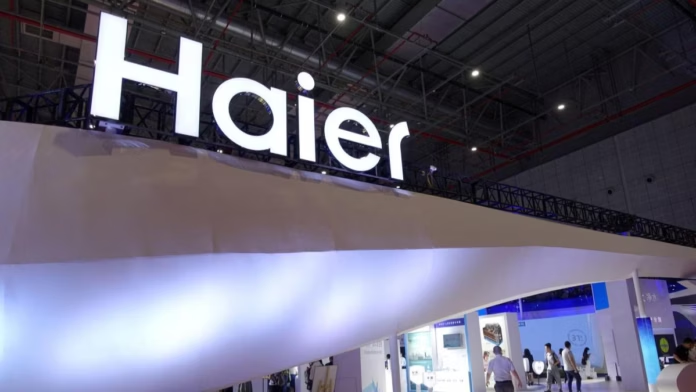
India’s Haier Appliances is set to invest Rs 3,500 crore to establish a new manufacturing facility, marking a significant expansion of its domestic operations. The move, expected to generate around 12,000 direct and indirect jobs, aims to strengthen local production, reduce import dependence, and support the company’s growing export ambitions. The new unit, to be located in western or southern India, underscores Haier’s commitment to boosting manufacturing capacity and meeting rising consumer demand across the country.
Currently, Haier operates two production units in Greater Noida and Pune. While the location of the third facility is still being finalised, company officials emphasise that the phased investment will enhance local manufacturing capabilities and create employment opportunities across multiple regions. “This expansion is part of our long-term strategy to deepen India’s manufacturing base and contribute to industrial growth sustainably,” a senior company executive said.The announcement comes alongside the launch of Haier’s Gravity AI Series Air Conditioners at the Greater Noida plant during the recent ‘AI for Air’ event. With nearly 90% of Haier appliances already produced locally, the new facility is expected to further reduce import dependence while supporting the company’s push for high-efficiency, technologically advanced products. Industry experts note that such large-scale manufacturing expansion could integrate energy-efficient production practices, aligning with India’s broader sustainable development goals.
The planned unit will also bolster Haier’s export strategy. Currently, Haier India exports products including bottom-mounted refrigerators to Australia, as well as shipments to Nepal, Sri Lanka, Bangladesh, and selected African markets. “While our domestic market remains the priority, the additional capacity will allow us to significantly increase exports over the next two years,” the executive added.Founded in 2003 and starting local production in 2007, Haier Appliances India has established a strong presence in refrigerators, televisions, and air-conditioners. The company reported revenues of around Rs 11,000 crore this year, holding 14% market share in both refrigerators and washing machines, and 8% in air conditioners. Its target for the next fiscal year is Rs 14,500 crore, with expansion across all product lines anticipated.
Analysts say that Haier’s investment reflects a wider trend in Indian manufacturing, where global companies are increasingly localising operations to enhance supply chain resilience and create inclusive economic opportunities. Integrating green building practices, renewable energy, and resource-efficient production in such projects could further support India’s sustainable urban and industrial development objectives.
Also Read: Kolkata Real Estate Legacy Unites Three Generations To Create Iconic Architectural Landmark
India Haier Appliances Plans Rs 3,500 Crore Manufacturing Expansion Project
Kolkata Real Estate Legacy Unites Three Generations To Create Iconic Architectural Landmark

Kolkata is preparing to welcome one of its most ambitious residential developments, with a new luxury tower on Chowringhee Road signalling a shift in how the city imagines architectural identity and high-value urban living. Conceived as a low-density, design-centric project, the development aims to position Eastern India on the map of global-standard residential icons, at a time when cities are increasingly competing to define themselves through smarter, more sustainable built forms.
Industry observers note that the project’s significance lies not only in its scale, but in the multi-generational leadership steering its vision. The developer, a long-established family-run firm, draws upon nearly a century of experience in shaping Kolkata’s urban fabric. An official familiar with the organisation said that the group’s intergenerational collaboration has been central to its ability to maintain continuity while embracing contemporary design priorities. Women in the family have also played prominent roles across planning, cultural design, and experience-building reflecting a broader shift in Indian real estate leadership structures. The upcoming tower, rising above 40 floors and offering only a limited number of expansive full-floor homes, is intended to be a statement piece rather than a volume-driven project. Designed by one of India’s most widely recognised architects, the building adopts a sculptural form that seeks to balance aesthetics with functional efficiency. Real estate analysts say such low-density luxury towers are becoming increasingly relevant in Indian metros, where growing demand for privacy and better space utilisation is reshaping the upper end of the housing market. While exclusivity is a defining aspect of the development, its urban impact extends beyond luxury. Experts suggest that iconic, well-designed structures can influence broader planning conversations encouraging cities to adopt standards that integrate architectural quality, resilience to climate pressures, and better resource use. With Kolkata’s historic core grappling with questions of density, heritage integration, and climate vulnerability, the arrival of a modern landmark adds new layers to ongoing debates on how the city should grow.
A senior urban planner stated that developments of this nature reflect evolving aspirations in Eastern India, where there is increasing interest in crafting contemporary identities while remaining mindful of long-term sustainability. Although high-end towers address a niche demographic, they often introduce construction innovations, façade technologies, and energy-efficient systems that can influence mainstream adoption over time.For prospective buyers, the project offers scarcity value only a few dozen residences will ever exist, each designed as an individually detailed, full-floor home. Market watchers anticipate strong demand from ultra-high-net-worth Indians seeking legacy assets within culturally rich urban settings.
As Kolkata faces the dual challenge of modernisation and climate resilience, the emergence of landmark residential structures may help redefine the city’s aspirations. The project, while exclusive, signals a broader ambition: to build with intention, elevate design ambition, and craft a skyline that reflects both heritage and a forward-looking urban future.
Also Read: Manesar Set For Major Disneyland Development With Industries Boosting Haryana Urban Growth
Kolkata Real Estate Legacy Unites Three Generations To Create Iconic Architectural Landmark
Delhi Expands Semicon India Programme Strengthening Full-Scale Semiconductor Design And Fabrication

Delhi is rapidly advancing its semiconductor ambitions through the Semicon India Programme, aiming to build a complete chip ecosystem encompassing design, fabrication, assembly, testing, and packaging. Union Minister of State for Electronics and IT, Jitin Prasada, highlighted that ten units approved under the programme have attracted ₹1.6 lakh crore in investments, targeting strategic sectors such as consumer electronics, automotive, telecom, aerospace, and industrial electronics, while boosting domestic capability and positioning India as a global semiconductor hub.
The government’s Production Linked Incentive (PLI) schemes have been instrumental in accelerating electronics manufacturing. Large-scale electronics manufacturing PLI, focused on mobile phones and essential components, has drawn ₹14,065 crore in investments as of October 2025, while IT hardware PLI, supporting laptops, tablets, servers, and ultra-small form factor devices, has garnered ₹846 crore. These initiatives have helped expand manufacturing output sixfold over the past decade, from ₹1.9 lakh crore in 2014-15 to ₹11.32 lakh crore in 2024-25, and propelled electronics exports to ₹3.26 lakh crore, now India’s third-largest export category.To strengthen domestic chip design, the Design Linked Incentive (DLI) Scheme has supported 23 companies developing 24 chip and SoC designs for satellite communications, drones, IoT devices, AI applications, LED drivers, smart meters, and telecom equipment. Additionally, 94 startups have received free access to Electronic Design Automation (EDA) tools, enabling nearly 47 lakh hours of design activity, a senior industry official noted.
Talent development is central to the programme’s success. The Chips to Startup (C2S) initiative has provided advanced design tools to 397 universities and startups, resulting in 56 chip designs at the Semiconductor Laboratory (SCL), Mohali, and training over 67,000 students and researchers. Complementing this, AICTE has introduced B.Tech in Electronics Engineering (VLSI Design), a Diploma in IC Manufacturing, and a Minor in VLSI Design and Technology, aligning academic pathways with industry needs. The SMART Lab at NIELIT Calicut has trained more than 62,000 engineers, targeting nationwide capacity for 1 lakh trainees.Industry-academia collaboration is further exemplified by the Indian Semiconductor Mission’s partnership with Lam Research, which aims to train 60,000 professionals in nanofabrication and advanced packaging over the next decade. The FutureSkills PRIME programme, a MeitY-NASSCOM initiative, complements these efforts by upskilling India’s digital workforce in emerging technologies, including semiconductors, through flexible, industry-aligned online learning.
By combining infrastructure development, strategic incentives, design support, and workforce training, the Semicon India Programme is positioning India as a self-reliant, globally competitive semiconductor hub. Experts suggest that this integrated approach will not only meet domestic demand but also create opportunities for India to capture a significant share of the international semiconductor market.
Also Read: Maharashtra Sees 8316 Crore Electronics Parts Projects Boosting Home Appliance Production
Delhi Expands Semicon India Programme Strengthening Full-Scale Semiconductor Design And Fabrication
Maharashtra Sees 8316 Crore Electronics Parts Projects Boosting Home Appliance Production
