
New Delhi Witnesses JSW Paints Taking Over Akzo Nobel India To Boost Paint Innovation

JSW Paints has completed its takeover of Akzo Nobel India after securing a 61.2% controlling stake, marking one of the largest consolidations in the country’s paint and coatings market. The move brings global brands such as Dulux into JSW’s portfolio and strengthens its position in decorative and industrial paints. The acquisition is expected to accelerate product innovation, expand distribution, and drive the shift toward more sustainable, high-performance paint solutions across India.
The acquisition, centred in New Delhi, reinforces JSW Paints’ ambitions of scaling into a top-tier player in a market experiencing rapid expansion. India’s paints sector has been buoyed by rising urbanisation, growing housing demand, and increasing emphasis on durable, low-emission coatings for both homes and large infrastructure projects. Industry experts believe JSW’s move will strengthen competition while raising expectations for higher-quality, environmentally safer paint products.A senior industry official noted that the integration of Akzo Nobel India’s capabilities with JSW Paints’ fast-growing operations could give the combined entity an unmatched technological and brand advantage. Akzo Nobel India is known for decades of research strength and an extensive distribution network. Its flagship brand Dulux carries strong goodwill among Indian households, developers, and industrial clients. Bringing it under the JSW umbrella positions the company to consolidate premium offerings while expanding its reach into emerging urban markets.
Executives within JSW Paints indicated that the immediate focus will be on product synergy, technology transfer, and scaling innovation pipelines. According to a company representative, integrating global-quality formulations with JSW’s manufacturing base will help accelerate the rollout of eco-friendly, heat-reflective, and low-VOC paints — categories growing in importance as Indian cities look to improve indoor air quality and reduce building-level heat loads. These solutions align with broader national ambitions of energy-efficient, climate-resilient construction.Urban planners point out that improved paint technology plays a deeper role in city-building than most realise. Long-lasting coatings reduce maintenance cycles for public buildings, social housing, bridges, and urban infrastructure. Heat-resistant paint solutions also support mitigation efforts in cities facing rising temperatures and frequent heatwaves. A consolidated and innovation-led paint manufacturer, they argue, could help push adoption of these solutions across states.
AkzoNobel’s global leadership expressed confidence in JSW Paints’ ability to carry forward the legacy of its India operations, calling the company a strong partner for a fast-growing region. Observers suggest this transition reflects a broader global strategy shift for AkzoNobel, while ensuring continuity for employees, distributors, and customers in India.The transaction was supported by Morgan Stanley as financial advisor, Khaitan & Co. as legal counsel, and Deloitte for financial and tax due diligence. As India’s real estate and infrastructure sectors continue to expand, the strengthened JSW–Akzo Nobel India platform is expected to play a significant role in shaping safer, more vibrant, and environmentally responsible urban spaces in the years ahead.
Also Read: Mumbai Roshan Family Leases Commercial Space To FabIndia At Rs 14.5 Lakh Rent
New Delhi Witnesses JSW Paints Taking Over Akzo Nobel India To Boost Paint Innovation
Mumbai Roshan Family Leases Commercial Space To FabIndia At Rs 14.5 Lakh Rent

Mumbai’s commercial real estate market has recorded another prominent transaction, with a well-known film industry family leasing a premium retail property in Andheri West to Fabindia Limited. The agreement, valued at Rs 14.5 lakh per month in the first year, highlights the continued interest of private investors particularly high-net-worth individuals in stable, income-generating urban assets.
The space, located in a mixed-use complex on Veera Desai Road, offers roughly 6,400 sq ft of carpet area. Industry analysts note that the lease rate, which works out to about Rs 227 per sq ft, reflects the growing demand for accessible high-street formats in dense, transit-connected neighbourhoods. Andheri West, with its combination of residential catchments, metro access and media-driven footfall, has emerged as one of Mumbai’s more resilient retail corridors. Documents reviewed by Urban Acres show that the agreement was formalised in early December 2025, with the property handed over a few months earlier. The deal includes a security deposit of Rs 87 lakh and the right to use five parking bays an amenity that several retailers consider essential given Mumbai’s constrained public parking supply. The lease runs for five years, with the tenant committed for 15 months and the owners bound through the entire tenure.
Rental escalation has been scheduled in tranches over the five-year period. After the initial monthly rent of Rs 14.5 lakh, the amount rises to Rs 15 lakh in the second year, followed by a jump to Rs 16 lakh in the third. The final two years see a steep increase to Rs 18.4 lakh per month, a pattern that reflects broader inflationary trends and the premium placed on established retail assets in the city’s western suburbs. A senior executive at a proptech analytics firm said the deal aligns with a rising pattern of high-profile individuals diversifying into commercial real estate. According to the executive, retail and office assets continue to draw investor appetite because they offer regular income while holding long-term capital appreciation potential. “This category of investors sees commercial property as a stable hedge in a volatile market,” the person added. Retail experts say Fabindia’s decision to expand in urban high streets indicates confidence in foot-traffic-driven formats, even as several brands balance their presence between malls, standalone stores and digital platforms. For cities like Mumbai where liveability demands sustainable, accessible and walkable commercial districts such leases contribute to strengthening mixed-use urban ecosystems.
While the owners did not respond to requests for comment and Fabindia’s response is awaited, analysts observe that the transaction underlines a shift towards professionally managed commercial portfolios among private investors. If supported by improvements in public transport, pedestrian safety and equitable urban design, corridors like Andheri West could further evolve into inclusive, low-carbon retail hubs that serve both residents and businesses.
Also Read: Chandigarh Housing Board Seeks Private Developer For Sector 53 Land Auction
Mumbai Roshan Family Leases Commercial Space To FabIndia At Rs 14.5 Lakh Rent
Chandigarh Housing Board Seeks Private Developer For Sector 53 Land Auction

The Chandigarh Housing Board (CHB) has initiated steps to divide a 21-acre parcel in Sector 53 into two portions, one of which may be auctioned to a private developer, following directives from UT administrator Gulab Chand Kataria. The move has stirred debate among residents’ associations, who argue that it contravenes the city’s master plan and CHB’s mandate to provide affordable housing.
According to a letter dated December 9 from CHB CEO Pardeep Kumar to the UT chief architect, approximately 11 acres of Sector 53 have been earmarked for a general housing scheme targeting UT employees. The remaining land’s zoning details have been requested to facilitate potential auctioning to private interests, effectively splitting the site into a public and private development zone. Baljinder Singh Bittu, chairperson of the Federation of Sector Welfare Associations Chandigarh (FOSWAC), criticised the initiative, stating, “CHB was established to deliver quality public housing. Treating land as a commercial asset undermines its fundamental purpose.” He noted that the 2031 Master Plan strictly designates this area for residential use, highlighting the tension between revenue generation and long-term urban planning. The proposal follows instructions from Kataria in October 2025 to explore dividing eight acres into separate pockets, with potential adjustments to floor area ratio (FAR), building height, and density to ensure financial viability while maintaining affordability for the economically weaker section (EWS). Inspections conducted by the UT administrator earlier in December reviewed multiple CHB and urban sites, including Sector 53 and adjacent projects, signalling administrative intent to accelerate housing development while exploring private partnerships.
Sector 53’s housing project has faced persistent delays. Initially proposed in 2018, high pricing led to weak demand, with only 178 applications received for 492 flats, causing the scheme to be shelved. A revived effort in 2023 was paused, only to be restarted under Kataria’s tenure in late 2024. Current estimates place three-bedroom flats at Rs 2.30 crore, two-bedroom units at Rs 1.97 crore, and EWS units at Rs 74 lakh up 35-40% from earlier rates, reflecting rising land and construction costs. A demand survey conducted in March 2025 revealed 7,468 applications for just 372 flats, indicating strong appetite for affordable housing despite price hikes. Industry experts note that balancing financial viability, regulatory compliance, and urban equity will be critical to the project’s success, particularly if part of the land is auctioned for private development.
As Sector 53 moves closer to implementation, the CHB faces the delicate challenge of reconciling administrative directives, resident expectations, and the city’s broader housing strategy. Ensuring equitable access, affordability, and adherence to master-plan provisions will be key for long-term urban sustainability in Chandigarh.
Also Read: Pune Welspun One Invests Rs 550 Crore To Build 1.2 Million Sq Ft Logistics
Chandigarh Housing Board Seeks Private Developer For Sector 53 Land Auction
Pune Welspun One Invests Rs 550 Crore To Build 1.2 Million Sq Ft Logistics
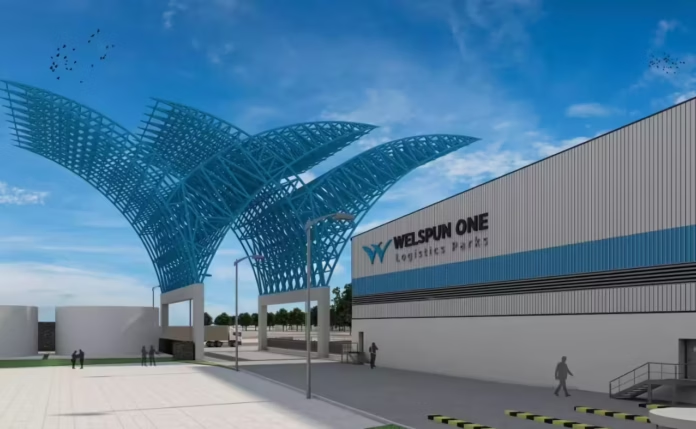
Welspun One, a leading warehousing and industrial real estate platform, has announced a Rs 550 crore investment to develop a 1.2 million sq ft Grade A logistics park in Pune. The project will be established on a 46-acre MIDC-notified land parcel in Talegaon MIDC Phase IV, marking the company’s maiden foray into Pune’s logistics ecosystem.
Strategically located within the Talegaon-Chakan belt, the park is designed as a first-mile logistics asset, enhancing connectivity between manufacturing units and fulfilment networks. Its proximity to key transport infrastructure including the upcoming Pune Ring Road, the Mumbai-Pune Expressway, and the Talegaon industrial hub positions it as a critical node for automotive, FMCG, engineering, e-commerce, and 3PL operations. “The Talegaon Chakan corridor continues to show robust fundamentals, from skilled labour availability to upcoming transport infrastructure,” said a senior Welspun One executive. “Our investment reflects the platform’s commitment to building future-ready industrial assets that combine operational efficiency with sustainable design practices.” The planned development will consist of four multi-building blocks ranging from 1 lakh to 3.5 lakh sq ft, catering to a mix of occupiers. The logistics park is expected to provide scalable plug-and-play facilities, enabling companies to commence operations quickly while maintaining international-grade standards in construction and operational efficiency.
Industry experts note that Pune has witnessed strong warehouse leasing activity in 2025, with around 7.4 million sq ft absorbed so far, a 10% increase over the previous year. Notably, the Talegaon Chakan submarket accounts for nearly 70% of this demand, reflecting its rising prominence as a manufacturing and logistics hub. Welspun One’s project is likely to attract both domestic and international tenants seeking proximity to industrial zones, efficient road connectivity, and modern operational amenities. This development complements Welspun One’s broader expansion strategy, which includes prior acquisitions in Hoskote and Devanahalli in Bengaluru, as well as partnerships in Nhava Sheva and Thane. With a current portfolio of approximately Rs 10,000 crore in assets under management and a development pipeline of 19 million sq ft, the company continues to deepen its presence in India’s key logistics corridors.
For Pune and the wider industrial ecosystem, the project is expected to generate employment opportunities, strengthen supply chain efficiency, and contribute to the city’s evolving industrial infrastructure. Analysts highlight that well-planned logistics parks in such corridors not only improve operational reliability but also support sustainable urban-industrial integration by reducing congestion, streamlining last-mile connectivity, and optimising land use.
Also Read: Bengaluru Sumadhura Group Signs Rs 600 Crore MoU For 100 Acre Industrial Park
Pune Welspun One Invests Rs 550 Crore To Build 1.2 Million Sq Ft Logistics
Bengaluru Sumadhura Group Signs Rs 600 Crore MoU For 100 Acre Industrial Park

Bengaluru-based Sumadhura Group has inked a Memorandum of Understanding (MoU) with the Telangana government to invest Rs 600 crore in developing a 100-acre Grade A industrial and warehousing park. Announced during the Telangana Rising Global Summit 2025 at Bharat Future City, the project aligns with the state’s long-term goal of emerging as a $3-trillion economy by 2047, leveraging manufacturing, logistics, infrastructure, and advanced industries as key growth drivers.
Set to be executed over a two-year horizon, the industrial park aims to offer plug-and-play facilities tailored to aerospace, automotive, pharmaceutical and e-commerce enterprises. By providing ready-to-operate modular production blocks and integrated logistics infrastructure, the initiative is designed to accelerate business operations and attract high-value investments. Industry experts note that such future-ready setups are increasingly important in positioning Indian states as competitive manufacturing destinations globally. The development is projected to generate approximately 8,000 direct jobs once operations ramp up, contributing to Telangana’s employment ecosystem and broader economic objectives. “Our Industrial Park is being conceived to meet global standards in operational efficiency, design and technology,” said a senior Sumadhura executive. “Backed by Telangana’s pro-growth policy environment, this investment is expected to draw quality industries while delivering meaningful socio-economic impact.” Officials highlight the park’s strategic connectivity, leveraging Telangana’s central logistics network and cargo infrastructure to reduce operational delays and enhance supply-chain efficiency. “This industrial hub is designed as a future-ready ecosystem with sustainability embedded across design and operations, catering to aerospace, automotive, pharmaceutical and e-commerce sectors,” said the group’s vice president of Industrial and Warehousing.
Beyond industrial expansion, Sumadhura Group plans a Rs 2,000 crore residential investment in FY26, including plotted housing in Bengaluru’s Devanahalli and mid-market developments across Whitefield, Outer Ring Road, and near Manyata Tech Park. Residential units are expected to range from Rs 75 lakh to Rs 2 crore, reflecting growing demand for urban housing proximate to employment hubs. Looking ahead, the developer intends to expand into Chennai and Goa, with Goa positioned for second-home and leisure residential projects starting from Rs 1 crore. Analysts suggest this combination of industrial and residential expansion exemplifies integrated urban development strategies, fostering connectivity, employment generation, and sustainable growth.
With this Telangana venture, Sumadhura Group reinforces its presence in the industrial sector while contributing to equitable economic growth. For policymakers and city planners, projects of this scale underline the importance of aligning infrastructure, workforce readiness, and regulatory frameworks to support industrial corridors and inclusive urbanisation.
Also Read: Bengaluru Sattva Vasanta Cove Launch Offers Studios And 1BHK Homes Airport Corridor
Bengaluru Sumadhura Group Signs Rs 600 Crore MoU For 100 Acre Industrial Park
Bengaluru Sattva Vasanta Cove Launch Offers Studios And 1BHK Homes Airport Corridor

Bengaluru-based developer Sattva Group has launched Vasanta Cove, a new residential project along the Devanahalli-Bellary Road corridor, targeting compact, well-amenitised homes at a time when demand is strengthening near the upcoming airport. Designed primarily as studio and one-bedroom units, the development caters to frequent flyers, aviation and logistics professionals, young couples, and investors seeking low-maintenance, income-generating properties.
Industry analysts note that North Bengaluru’s airport belt has emerged as a high-demand micro-market for smaller residential formats. “The steady inflow of aviation staff, logistics employees, and industrial park professionals is supporting rental demand and reducing vacancy risks for compact units,” said a real-estate analyst familiar with the corridor. At prices ranging from Rs 59 lakh to Rs 1.05 crore, Vasanta Cove positions itself as an accessible entry point for homebuyers and investors, offering lower ticket sizes than many mainstream apartment projects in the city. The project emphasises a functional, amenity-rich approach, with approximately 70% open space and a full suite of facilities to enhance lifestyle and rental appeal. Analysts note that branded developers offering such small-format, income-oriented housing tend to experience higher early-stage sales conversion and shorter marketing cycles. The project’s location benefits from proximity to the KIADB Aerospace Park and related industrial nodes, reinforcing its appeal for professional tenants.
Potential buyers, however, should consider specific corridor risks. The area is still maturing, with episodic traffic congestion along Bellary and Airport Roads, potential flight-path noise, and infrastructure delays. Vasanta Cove’s tentative possession timeline of December 2030 requires prospective owners to factor in holding costs and regulatory uncertainties. “For investors focused on medium-term rental yields, this corridor offers predictable tenant pools; for short-term speculators seeking rapid resale, liquidity may be thinner than in central Bengaluru,” said a senior urban planner. Despite these challenges, the project represents a pragmatic investment in Bengaluru’s evolving airport submarket. By combining a reputable developer, compact layouts, modern amenities, and connectivity, Vasanta Cove provides a balanced risk-return proposition for medium-term investors and end-users prioritising convenience and low maintenance. Buyers are encouraged to review RERA registration, cost sheets, parking allocations, and construction guarantees as part of due diligence.
Overall, Vasanta Cove underscores the growing relevance of strategically located, compact residential units in India’s emerging urban infrastructure corridors, signalling a shift in demand patterns toward accessible, functional housing with predictable returns.
Also Read: Bengaluru Yeshwantpur Station Rs 380 Crore Revamp Nears Completion Enhancing Commuter Connectivity
Bengaluru Sattva Vasanta Cove Launch Offers Studios And 1BHK Homes Airport Corridor
Bengaluru Yeshwantpur Station Rs 380 Crore Revamp Nears Completion Enhancing Commuter Connectivity

The Rs 380-crore redevelopment of Yeshwantpur Railway Station is nearing completion on its eastern side, signalling a major upgrade in commuter infrastructure at one of Bengaluru’s busiest transit hubs. The eastern sector, including a new entrance building, an elevated access road, and a multi-level parking facility, is almost ready, while western-side works including metro integration remain ongoing, railway officials confirmed.
The redevelopment, part of the national Amrit Bharat Stations Scheme (ABSS), is designed to enhance passenger experience, streamline footfall management, and integrate rail services with urban transport systems. Officials stated that the revamped eastern entrance and associated facilities will significantly improve access for office-goers, daily commuters, and long-distance passengers, while the multi-level parking is expected to alleviate congestion around the station. On the western side, critical components such as the air-conditioned concourse, ticketing counters, and direct linkage to the metro remain under construction. “The integration with the metro is a priority to ensure seamless connectivity across transit modes,” an official said. Once complete, the station will include expanded platforms, upgraded waiting areas, commercial zones, food courts, modern signage, and a pedestrian bridge linking rail and metro networks. Currently handling more than 60,000 passengers daily, the station is projected to accommodate over 100,000 commuters post-completion. Industry experts note that the upgrades will not only improve travel convenience but also boost local economic activity, potentially influencing property demand in surrounding areas. “Enhanced connectivity often correlates with increased real estate interest and commercial development,” a senior urban planner explained.
The Yeshwantpur redevelopment highlights Bengaluru’s broader urban mobility and sustainable infrastructure objectives. By combining improved structural design, passenger-focused amenities, and intermodal integration, the project aligns with principles of accessible and efficient city transport. Officials emphasised the use of durable materials and sustainable construction practices to reduce environmental impact and enhance long-term station resilience. For daily commuters and occasional travellers alike, the upgrades promise a more organised, comfortable, and efficient travel experience. While eastern-side works are approaching finalisation, stakeholders remain attentive to timely completion of western-side facilities, particularly the metro connection, which is key to realising the project’s full potential.
Once fully operational, the station will stand as a model for integrated transit hubs, balancing high passenger throughput with modern amenities and seamless interconnectivity, reflecting India’s growing focus on sustainable urban mobility and transit-oriented development.
Also Read: Gurugram Aditya Birla Project Sells Out 492 Units Generating Rs 1800 Crore
Bengaluru Yeshwantpur Station Rs 380 Crore Revamp Nears Completion Enhancing Commuter Connectivity
Gurugram Aditya Birla Project Sells Out 492 Units Generating Rs 1800 Crore

Gurugram witnessed a remarkable surge in residential demand as Aditya Birla Real Estate’s Birla Pravaah project sold all 492 units within 24 hours of launch, securing over Rs 1,800 crore in booked sales. The rapid sellout underscores strong buyer appetite for premium housing in the National Capital Region, reflecting both urban growth and shifting residential preferences.
Spanning approximately 5.075 acres, Birla Pravaah combines high-rise residential towers with substantial open green spaces, integrated amenities, and lifestyle-centric features. Industry experts note that well-planned developments with modern design, sustainable landscaping, and quality construction continue to attract discerning buyers, especially in markets like Gurugram where connectivity and infrastructure are expanding rapidly. An official from Aditya Birla Real Estate stated, “The response to Birla Pravaah highlights sustained confidence in structured, premium residential projects. Buyers are increasingly prioritising not just location, but a holistic living environment that balances comfort, community, and long-term value.” The sellout is particularly noteworthy given broader challenges in the real estate sector, including regulatory delays and fluctuating market sentiment. Analysts attribute the performance to multiple factors: strategic location near major business hubs, integrated amenities, brand reputation, and rising household incomes in NCR. “The project demonstrates that quality-led residential offerings can command strong demand even during broader market headwinds,” an industry observer said.
The launch also points to the growing preference for integrated green and sustainable spaces. With urban populations increasingly seeking cleaner, healthier, and inclusive living environments, developments that combine open spaces, energy-efficient design, and community-focused amenities are becoming a differentiating factor. Birla Pravaah’s design and planning reflect this shift, appealing to both investors and end-users. For the wider residential market, the sellout may set a precedent, signalling that premium housing in NCR remains resilient. Developers in the region are likely to adopt similar models, combining thoughtful design, sustainable infrastructure, and lifestyle-led offerings to attract high-value buyers.
As Gurugram continues to expand as a commercial and technology hub, projects like Birla Pravaah contribute not only to housing supply but also to community-building in high-density urban zones. For prospective buyers and investors, the milestone reinforces the importance of location, design, and quality in shaping long-term real estate value.
Also Read: Mumbai Birla Estates Aims Top Three Developer With Rs 45 Thousand Crore Pipeline
Gurugram Aditya Birla Project Sells Out 492 Units Generating Rs 1800 Crore
Mumbai Birla Estates Aims Top Three Developer With Rs 45 Thousand Crore Pipeline

Birla Estates, the real-estate arm of Aditya Birla Real Estate, has announced a Rs 45,000 crore project pipeline spanning the Mumbai Metropolitan Region (MMR), Bengaluru, Pune, and the National Capital Region (NCR), signalling its intent to become one of the top three developers in its core markets. The ambitious strategy combines residential launches and commercial portfolio expansion, reflecting growing confidence in urban real-estate demand across India.
The developer plans residential launches worth approximately Rs 13,932 crore by FY26, targeting high-demand zones for premium and luxury housing. Alongside residential projects, Birla Estates is strategically expanding its commercial portfolio through partnerships designed to generate stable annuity-income streams. Its current MMR commercial assets, spanning 6 lakh sq ft, reportedly generate around Rs 150 crore annually in rentals, providing a strong financial foundation for further investment. Industry experts note that the scale and diversity of the pipeline suggest a deliberate mix of asset-light and asset-heavy strategies. By exploring redevelopment opportunities in MMR, Birla Estates aims to unlock value from existing housing societies while conserving capital and accelerating project timelines. The company’s land bank, valued at Rs 70,000 crore in development potential, has already seen Rs 25,000 crore of projects launched, with nearly 80% sold, demonstrating strong market absorption.
A senior industry analyst observed, “Birla Estates is aligning its portfolio with urbanisation trends and premium housing demand. Expanding in cities like Mumbai, Bengaluru, Pune, and NCR positions it to capture both end-user and investor interest while leveraging existing assets for growth.” The group’s performance history reinforces confidence in its future trajectory. With consistent compound annual growth in bookings since FY20, Birla Estates expects annual sales to exceed Rs 15,000 crore, signalling robust demand for integrated residential communities and sustainable commercial developments. For homebuyers and investors, the pipeline reflects more than volume; it represents a strategic push towards quality, long-term urban infrastructure and community-based living solutions. The focus on commercial assets complements residential projects, providing holistic urban precincts with employment, lifestyle, and connectivity advantages.
By combining premium residential development, redevelopment-led urban renewal, and commercial expansion, Birla Estates underscores the evolving role of private developers in shaping India’s sustainable, inclusive, and modern urban landscapes. As the company progresses with FY26 launches, market watchers anticipate heightened competition among leading developers and improved housing choice for India’s urban population.
Also Read: Bengaluru Puravankara Subsidiary Secures Rs 509 Crore Tata Varnam Phase One Contract