
Tirupati Emphasises Lean Construction Methods To Speed Up Critical Urban Works

New Delhi Launches India’s First Kitchen Air Tap Marking Breakthrough In Household Innovation

New Delhi has introduced India’s first Kitchen Air Tap, a hands-free airflow system designed to dry vegetables and hands directly at the sink, addressing long-standing concerns around hygiene, waste, and kitchen clutter. Launched by a leading home-solutions brand, the device offers adjustable drying modes, integrates seamlessly into modern kitchen layouts, and supports sustainable urban living by reducing paper towel use while improving preparation efficiency for busy households.
The device, introduced under a premium consumer brand, combines controlled airflow with hands-free operation to deliver a cleaner approach to everyday kitchen tasks. According to an official associated with the project, the system was engineered in response to growing consumer concerns around hygiene and waste, particularly in urban households that juggle limited space with high usage demands. Traditional drying methods, the official explained, often contribute to cross-contamination, increased paper waste, and cluttered sink areas.Industry experts note that the rise of compact, multifunctional kitchen appliances is closely tied to changing lifestyles in India’s cities, where households increasingly prioritise health, efficiency, and sustainability. The air tap aligns with this shift by replacing disposable towels with a built-in airflow mechanism designed to remove moisture quickly and evenly. The approach also reduces the recurring cost of paper products, making the device economically appealing to families looking to optimise long-term household expenses.
A key feature of the new system is its adjustable airflow settings, which allow users to dry a variety of ingredients—from delicate leafy vegetables to sturdier root produce—without compromising texture or freshness. Culinary specialists say this improves food preparation, as moisture-controlled ingredients tend to cook more evenly and absorb flavours more effectively. The device also includes a mode to dry hands, merging two essential functions into a single fixture and reducing clutter around the sink.From a design perspective, the air tap integrates seamlessly above the sink, avoiding the counterspace challenges associated with standalone appliances. Urban planners and interior designers point out that such built-in solutions reflect a broader movement toward minimalistic and ergonomic kitchen layouts, especially in fast-growing apartment-driven cities. The device also contributes to better indoor air quality by reducing dust and pollen around the workspace—an added benefit in cities with high pollution levels.While the product targets premium urban households initially, analysts believe its dual-function, low-waste model aligns with India’s broader sustainability goals. As cities work toward reducing waste and promoting resource-efficient living, innovations that eliminate unnecessary consumables could support more climate-resilient, low-impact homes.
For India’s rapidly evolving domestic appliance market, the kitchen air tap represents a shift toward practical, accessible technology designed around real household behaviour rather than novelty. If adopted widely, such appliances could redefine the role of kitchen fixtures—making them smarter, cleaner, and more aligned with the needs of future sustainable cities.
Also Read:https:Mumbai Witnesses Rs 10.8 Crore Office Investment By Kartik Aaryan’s Parents In Vile Parle
New Delhi Launches India’s First Kitchen Air Tap Marking Breakthrough In Household Innovation
Mumbai Witnesses Rs 10.8 Crore Office Investment By Kartik Aaryans Parents In Vile Parle

Mumbai’s premium office market has recorded another high-value purchase, with the family of a leading Bollywood actor acquiring a commercial unit in Vile Parle for Rs 10.83 crore. The transaction adds to a growing trend of celebrities channelling capital into Mumbai’s real estate sector, signalling confidence in the city’s long-term growth as a diversified economic and cultural hub.
According to publicly available registration data reviewed by a property intelligence platform, the buyers close relatives of the actor finalised the deal on 27 November. Industry officials noted that the unit spans a carpet area of a little over 1,200 sq. ft. and includes dedicated car parking, a feature increasingly sought after in dense commercial corridors where mobility and accessibility challenges persist. The office is located within a well-known commercial complex in Vile Parle West, an area strategically positioned between major employment districts such as Andheri and Bandra. Urban planners say the locality’s strong transit connectivity proximity to railway stations, arterial roads, and the coastal link continues to attract both corporate and individual investors looking for long-term stability in a volatile market. “Well-connected micro-markets remain resilient because they support more sustainable commuting patterns and reduce pressure on already congested zones,” an urban mobility expert said.
The surrounding neighbourhood hosts a mix of hospitality assets, retail spaces, and educational institutions, contributing to its appeal as a compact, multifunctional urban node. Analysts highlight that concentrated amenities within walking distance help reduce car-dependency and align with broader city goals of fostering low-carbon, human-centric business districts. This purchase follows another celebrity-led real estate investment completed recently, in which an acclaimed actor and his family acquired two residential units in Andheri West and Kandivali West for a combined value of Rs 10.85 crore. Experts observe that such acquisitions, while financially significant, also reflect shifting lifestyle and professional needs, including the preference for flexible living-work arrangements and intergenerational property planning.
Market watchers believe that high-profile transactions tend to draw attention to emerging urban development patterns across Mumbai. “Celebrity investments often signal confidence in micro-markets that are evolving through improved infrastructure, mixed-use zoning, and better public amenities,” a senior real estate analyst said. These factors, they added, align with the city’s broader transition toward more inclusive and balanced spatial growth. As Mumbai continues to push for redevelopment of ageing buildings, transit-oriented corridors, and environmentally efficient commercial clusters, premium property purchases underscore the city’s ability to attract capital despite broader economic uncertainties. For citizens, sustained investment in these corridors can translate into better neighbourhood infrastructure, upgraded public spaces, and safer, more accessible urban environments provided planning remains equitable and future-ready.
Also Read: Pune Gains Major Boost As ESR Invests Rs 650 Crore In 60 Acres
Mumbai Witnesses Rs 10.8 Crore Office Investment By Kartik Aaryans Parents In Vile Parle
Pune Gains Major Boost As ESR Invests Rs 650 Crore In 60 Acres

In a move set to reshape Western India’s industrial corridor, a major Asia Pacific real asset platform has secured 60 acres in Talegaon for a new logistics and industrial park. The investment, valued at Rs 650 crore, marks a significant step in strengthening Pune’s position as a high-growth manufacturing and warehousing hub. The project aims to deliver over 1.35 million sq. ft. of modern space, reinforcing the region’s long-term economic trajectory.
The planned development, to be built in phases, will include a cluster of Grade A facilities designed to support sectors ranging from automotive and engineering to e-commerce and consumer goods. Industry observers note that the Talegaon belt has consistently attracted occupiers due to its favourable infrastructure, proximity to talent, and seamless regional connectivity. “The micro-market’s strategic location continues to draw investments from companies seeking resilient and well-connected supply-chain solutions,” a senior industry analyst said. Talegaon’s location along NH-48 and the Mumbai Pune Expressway remains one of its strongest advantages. The emerging Talegaon Chakan Road network has further improved access to industrial clusters, ports, and major consumption centres. This multimodal connectivity, experts say, is central to ensuring predictable logistics timelines an increasingly vital requirement for advanced manufacturing and export-oriented industries.
Officials involved in the project emphasised that Maharashtra has become one of the most dynamic industrial states in India, with rising interest from domestic and global firms. A senior executive from the investor organisation noted that their continued focus on the region reflects confidence in its manufacturing ecosystem and the long-term demand for high-quality industrial real estate. The executive added that the new park aims to deliver “future-ready, resilient, and community-conscious infrastructure”, aligning with broader sustainability targets. The Talegaon site also lies within an area earmarked by the state’s industrial development authority for expanded electronics and engineering activity. Planned infrastructure upgrades, including utility-strengthening and circular-economy initiatives, are expected to elevate the area’s competitiveness further. Urban planners point out that such clusters, when developed with sustainability considerations, hold potential to reduce carbon footprints by decreasing freight travel distances and supporting green logistics models.
The project’s design will integrate renewable energy systems, efficient water management, and green building standards in line with global ESG frameworks. The park will feature digital management tools and space for community amenities, recognising the growing emphasis on worker well-being and industrial inclusivity. All new buildings are set to target top-tier green certifications, contributing to India’s broader shift toward environmentally responsible urban growth. As industrial demand continues shifting toward cleaner, more efficient supply-chain nodes, Talegaon’s rise reflects a broader trend across Indian cities where infrastructure, sustainability, and economic opportunity increasingly intersect. The upcoming park is expected to generate employment across logistics, operations, and auxiliary services, supporting both regional mobility and more equitable job access.
Also Read: Navi Mumbai Airport Launch Positions Khopoli As Emerging Real Estate Investment Hub
Pune Gains Major Boost As ESR Invests Rs 650 Crore In 60 Acres
Navi Mumbai Airport Launch Positions Khopoli As Emerging Real Estate Investment Hub

Navi Mumbai’s long-awaited international airport is set to begin commercial operations on 25 December, marking a pivotal moment for regional mobility and economic expansion across the Mumbai Metropolitan Region (MMR). While immediate uplift is expected in areas closest to the aerotropolis, analysts say the economic ripple effects will reach emerging nodes such as Khopoli, which is gaining prominence due to its expressway connectivity and expanding industrial ecosystem.
The first phase of the Navi Mumbai International Airport (NMIA), inaugurated earlier in the year by the central government, is designed to handle up to 60 million passengers annually. A senior official from the planning authority noted that the facility is expected to become a major aviation hub in Asia, easing congestion at Mumbai’s existing airport and reshaping long-term development patterns across the region. Industry experts highlight that NMIA’s opening will influence a broad spectrum of real estate markets residential, commercial, warehousing, and hospitality. Enhanced air access, reduced travel times and multimodal connectivity are likely to strengthen not only Panvel and Ulwe but also peripheral locations that offer affordability and large land parcels. Khopoli, in particular, is emerging as a beneficiary of this shift. According to a recent advisory report, 2024 saw record-breaking land transactions across MMR, including significant acquisitions in micro-markets such as Khalapur, Palghar and Khopoli. Per-acre pricing in these areas increased from around Rs 11 crore in 2022 to Rs 17 crore in 2024, underscoring rising institutional interest.
Khopoli’s appeal is being reinforced by major developers who are placing long-term bets on the corridor. Large-scale projects by several leading firms including integrated townships, plotted developments and mixed-use communities are being positioned as future-ready residential hubs for a diverse demographic base. A senior real estate leader pointed out that improved connectivity from NMIA will act as a catalyst for economic activity, tourism and housing demand, especially for buyers seeking accessible yet less dense urban environments. The locality’s industrial foundation remains its strongest anchor. Located along the Mumbai Pune Expressway and surrounded by steel, chemical and manufacturing clusters, Khopoli has evolved into a strategic warehousing and production hub. Planning experts say this combination industry, expressway connectivity and airport-linked mobility positions Khopoli as a balanced growth zone where employment and housing demand can evolve sustainably. Khopoli is also drawing residents who prioritise affordability, nature access and hybrid-work flexibility. With the Sahyadris forming its backdrop, the area has long attracted tourists for its waterfalls, trekking routes and leisure destinations such as Imagicaa and Khandala. This blend of liveability and landscape appeal is prompting buyers to explore second homes and lifestyle-driven housing formats.
Developers are responding with gated communities and plotted layouts designed around walkability, open spaces and energy-efficient infrastructure features increasingly sought by urban families seeking resilient, inclusive living environments. A senior industry representative said the rising demand for lifestyle-centric housing reflects a shift toward practical, future-oriented urban choices across MMR. As NMIA begins operations, the region’s real estate landscape is set for gradual but sustained transformation. The challenge for planning agencies will be to guide this growth responsibly ensuring green mobility, equitable housing options and resilient infrastructure remain central to the region’s long-term development.
Also Read: Gurugram Realtor ElitePro Infra Wins Major Sales Award For Elan The Emperor Project
Navi Mumbai Airport Launch Positions Khopoli As Emerging Real Estate Investment Hub
Gurugram Realtor ElitePro Infra Wins Major Sales Award For Elan The Emperor Project

Gurugram’s residential market has recorded another moment of momentum, with a leading real estate consultancy receiving recognition for achieving the highest sales in a prominent premium housing project. The acknowledgement comes at a time when homebuyer sentiment in the National Capital Region continues to shift towards planned communities, transparent advisory, and long-term value creation.
According to industry officials, the consultancy’s performance stood out for its ability to translate demand into structured sales, particularly within a project positioned at the upper end of the market. Its team, they said, adopted a strategy centred on clear communication, systematic engagement, and an understanding of evolving buyer expectations in a rapidly changing urban environment. Sector analysts note that Gurugram’s residential landscape has matured considerably over the past decade, with prospective homeowners increasingly prioritising integrated neighbourhoods, reliable social infrastructure, and responsible development practices. In this context, consultancies that act as informed advisors rather than mere sales intermediaries have gained relevance. “Buyers are no longer impressed by only glossy brochures,” a senior market consultant said. “They want data-backed clarity, efficient processes, and guidance that aligns with long-term urban sustainability.”
The consultancy reportedly invested significant on-ground effort into mapping customer needs, assessing site-level details with clarity, and ensuring that interactions remained consistent and transparent. This approach, experts suggest, reflects a wider shift in the property advisory landscape, where trust-building and accurate information are emerging as key differentiators. From the first enquiry to the final transaction, the firm is said to have focused on reducing friction an aspect increasingly valued in large Indian real estate markets. Industry observers also point out that the award highlights the rising demand for well-planned, mixed-use communities an approach that aligns with national conversations around sustainable and inclusive urban growth. Developments offering walkability, green spaces, and social amenities tend to align more closely with India’s broader climate and equity commitments. Homes in such environments, analysts believe, are likely to see sustained demand as cities like Gurugram prepare for demographic and environmental pressures.
An official associated with the development emphasised that the achievement reflects both market strength and the consultancy’s internal culture of continuous learning. “The team’s discipline in managing buyer expectations and maintaining transparent processes has been central to this milestone,” the official said. As Gurugram’s urban footprint expands, the role of real estate consultancies is expected to deepen, especially in helping citizens navigate complex project offerings and increasingly sophisticated masterplans. For homebuyers, improved advisory standards may offer a pathway towards more equitable, informed, and sustainable choices an essential ingredient as Indian cities strive for climate-resilient and people-first growth.
Also Read: Hyderabad Office Market Surges With WeWork Leasing And Sub-Leasing To JPMorgan
Gurugram Realtor ElitePro Infra Wins Major Sales Award For Elan The Emperor Project
Hyderabad Office Market Surges With WeWork Leasing And Sub-Leasing To JPMorgan
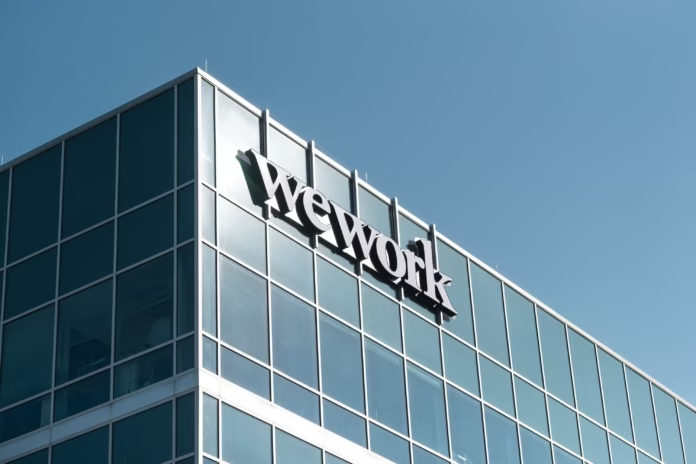
Hyderabad’s fast-growing commercial corridor has recorded one of its largest office space arrangements this year, with a leading workspace operator securing 1.75 lakh sq ft at the Skyview 20 complex in Hitech City and subsequently sub-licensing the entire space to a global financial services major. The dual agreements signal continuing momentum in the city’s Grade-A office market at a time when firms are seeking flexible, amenity-rich environments designed for hybrid operations.
According to documents reviewed by a data-centric real estate consultancy, the workspace provider entered a five-year lease at Skyview 20 earlier in November, taking two full floors within the tech park. The arrangement involved a starting monthly rental commitment of over Rs 1.7 crore, backed by a significant security deposit. The space, offered at rates below typical prime-market benchmarks, was secured in anticipation of growing occupier interest in managed office formats. Within days, the operator executed a service-based sub-licence agreement with a multinational banking and financial services entity, transferring nearly the entire area. Industry specialists say the company’s decision to opt for a fully managed environment highlights a broader shift among large corporations seeking to optimise workplace densities while maintaining high environmental and operational standards.
Data from the consultancy show that the sub-licensed space commands more than double the rent of the original lease, driven by enhanced fit-outs, collaborative zones, energy-efficient systems, and plug-and-play infrastructure. A senior office-market analyst noted that such price spreads reflect a growing readiness among corporate tenants to pay premiums for sustainability-aligned workspaces that reduce long-term operational overheads. Located in the heart of the Hitech City Madhapur belt, Skyview 20 forms part of a wider integrated campus known for attracting technology, engineering, and financial institutions. The district’s metro connectivity, walkable street patterns, and access to mixed-use developments have contributed to its rising importance as a model for high-density, job-rich urban nodes. Officials associated with the development said that well-planned transit-oriented clusters such as this help cities transition towards more inclusive and low-carbon economic growth. The multinational tenant has taken over 1,500 desks, along with dedicated parking and access to shared mobility infrastructure within the campus. Analysts say such large-format transactions demonstrate the resilience of Hyderabad’s office market, which continues to outpace several Indian metros in net absorption and new-age workplace adoption.
Earlier this year, the same financial group committed to a substantial pre-lease in Mumbai’s Bandra Kurla Complex, signalling its continued expansion across India’s principal business districts. Market commentators expect this to further accelerate demand for sustainable, flexible offices that allow enterprises to scale without long construction or compliance lead times. As cities compete for investment, experts argue that fostering energy-efficient office districts, safer commuting options, and gender-inclusive workplace design will be essential to sustaining long-term growth. Hyderabad’s latest leasing activity, they say, illustrates how integrated commercial hubs can support both economic productivity and more liveable urban futures.
Also Read: Pune Startup Tru Realty Gains Forbes Select 200 Honour For Global Vision
Hyderabad Office Market Surges With WeWork Leasing And Sub-Leasing To JPMorgan
Pune Startup Tru Realty Gains Forbes Select 200 Honour For Global Vision

TRU Realty, a young real estate developer with a growing footprint in Western India, has been listed in the Forbes Select 200 an annual compilation that identifies Indian companies demonstrating strong global readiness. The recognition positions the developer among a group of enterprises expected to influence the country’s next stage of economic expansion, especially in sectors where transparency and technology adoption remain critical.
Industry observers say the listing comes at a decisive moment for India’s property market, which is gradually shifting from legacy practices to digital-first systems aimed at improving accountability and reducing inefficiencies. In this context, TRU Realty’s focus on systemising the development and sales process has become a notable differentiator in an industry long constrained by opacity. The company’s leadership has anchored its strategy around a proprietary digital suite, TREOS, designed to automate core functions along the real estate value chain. The platform integrates tools for lead management, inventory planning, cashflow tracking, and compliance. Key components such as a faceless bidding module, real-time fund transfer mechanisms and a referral-led growth ecosystem are intended to reduce human error and minimise scope for discretionary decision-making.
A senior industry analyst noted that such systems, when implemented effectively, “help align the real estate market with broader urban goals improving trust, reducing administrative friction, and paving the way for more sustainable and citizen-friendly development outcomes.” By reducing paperwork and enabling secure digital transactions, platforms like TREOS also contribute to resource-efficient practices that support India’s long-term net-zero commitments. Responding to the recognition, the firm’s leadership said it reflected the company’s commitment to building a technology-forward ecosystem. The top executive said the honour “strengthens the organisation’s resolve to enhance process discipline and reinforce accountability across all project stages.” Another senior official added that the industry’s future growth depends on developers who prioritise clarity, communication and long-term value.
TRU Realty’s earlier work includes developments across 47 acres in Pune, including residential projects that have targeted mid-income homebuyers seeking better connectivity and climate-responsive design principles. In recent years, the company has begun expanding into Mumbai with upcoming projects in Santacruz (West) and Andheri (West). Industry experts estimate that these developments could collectively generate revenues of around ₹400 crore by 2028, reflecting the company’s gradual but steady entry into India’s most expensive real estate market. As Indian cities look to balance growth with sustainability and equitable access, developers that integrate digital systems with environmentally aligned planning can play an important role. TRU Realty’s recognition, analysts say, underscores the broader transformation underway in urban development where transparent processes, improved citizen experience and long-term resilience increasingly define success.
Also Read: Punjab Recognises Epique Real Ventures As Trusted Force In Property Consulting
Pune Startup Tru Realty Gains Forbes Select 200 Honour For Global Vision
Punjab Recognises Epique Real Ventures As Trusted Force In Property Consulting

Punjab’s property market has acknowledged a growing advisory firm for its expanding role in shaping investment decisions across the state, underscoring the need for credible intermediaries as Northern India’s real estate sector becomes increasingly complex and compliance-driven. Industry observers say the recognition signals a shift towards more transparent, professionalised services in a market long defined by informal networks.
Epique Real Ventures, a consultancy operating out of Mohali and Ludhiana, was recently named among the region’s most trusted real estate advisory brands by a state-led forum. The award was presented by a senior government representative and received by the firm’s leadership team, marking another milestone in its gradual expansion from a local brokerage to a formal advisory outfit with wider Northern Indian ambitions. Over the past two decades, the firm has facilitated more than 280 property transactions across commercial and residential segments. Its model, officials say, has relied heavily on compliance with the Real Estate (Regulation and Development) Act (RERA), a law that has reshaped Indian property markets by demanding transparency, timely delivery, and fair representation. In Punjab where legacy practices still influence buyer behaviour the emergence of advisory firms emphasising regulatory consistency is regarded as a structural step towards a healthier housing ecosystem.
A senior official familiar with the sector noted that buyers are increasingly seeking intermediaries capable of explaining long-term risks such as project delays, unclear land titles, and environmental vulnerabilities. “Advisory firms that prioritise due diligence are becoming indispensable, particularly as cities in the region confront questions of sustainability, climate resilience, and equitable access,” the official said. Industry analysts observe that Punjab’s urban growth stretching from Mohali’s commercial clusters to Ludhiana’s expanding residential corridors requires guidance that goes beyond transactional brokerage. Developers navigating tighter environmental norms and changing consumer expectations also rely on informed intermediaries to align projects with evolving urban priorities, including inclusive neighbourhood planning and resource-efficient construction. Responding to the recognition, a senior executive at the firm described the award as a validation of its long-term approach to building client trust. Another member of the leadership team emphasised that acknowledgement from the state’s financial leadership reinforces the organisation’s commitment to strengthening its presence across Northern India while providing advisory services grounded in integrity and local insight.
As Northern Indian cities confront rising land pressures, the need for transparent intermediaries capable of linking buyers, developers, and regulatory institutions is likely to intensify. Experts argue that real estate advisors who integrate environmental awareness, fairness, and regulatory compliance into everyday practice could help steer markets towards more sustainable and inclusive urban growth. With its latest recognition, Epique Real Ventures positions itself for a broader regional role one that could shape both investor behaviour and the development of more equitable property markets across the growing urban belt of North India.
Also Read: Mumbai Records Amitabh Bachchans Sale Of Two Goregaon Apartments Worth Rs 12 Crore
Punjab Recognises Epique Real Ventures As Trusted Force In Property Consulting
Mumbai Records Amitabh Bachchans Sale Of Two Goregaon Apartments Worth Rs 12 Crore

A major sale in Goregaon East’s luxury housing segment has drawn attention to the sustained appetite for premium high-rise living in the city, with property records confirming that two adjoining apartments in a prominent residential tower have changed hands for Rs 12 crore. The deal reflects a sizeable appreciation over the past decade, reinforcing investor confidence in western suburb micro-markets that continue to evolve around improved transit and mixed-use infrastructure.
The transaction involves two units located on a higher floor of an upscale development in the Oberoi Garden City precinct, a neighbourhood that has become emblematic of Mumbai’s shift towards integrated urban design. According to people familiar with the documentation, the apartments were originally acquired in 2012 and have now generated an approximate 47% return, demonstrating the resilience of premium residential assets even through periods of market flux. Property analysts say that high-rise developments in Goregaon East have consistently commanded strong interest due to their combination of planned amenities, stable governance by housing societies and proximity to emerging business districts. “This micro-market has benefitted from continued investment in public transport, especially the Metro, and a rising preference for neighbourhoods that blend residential comfort with ease of access to workplaces,” said a senior real estate consultant tracking suburban trends.
The wider rental and resale performance of the area is also linked to its emphasis on liveability. Over the past decade, Goregaon East has introduced more open spaces, upgraded pedestrian routes and community infrastructure, elements that increasingly shape homebuyer choices in dense urban environments. Urban planners argue that such neighbourhoods demonstrate how high-density housing can work more equitably when developments prioritise well-ventilated layouts, energy efficiency and better waste management systems. Industry observers note a growing shift in buyer expectations towards developments that offer long-term environmental and social benefits. “Modern homeowners are becoming more conscious about operational costs, resource efficiency and the overall environmental footprint of the buildings they choose,” said an official involved in sustainable housing projects. This shift is gradually pushing developers to integrate smarter water systems, improved insulation and renewable energy elements across upcoming residential towers.
While high-value celebrity-linked transactions often capture public attention, experts emphasise that they primarily mirror broader market conditions. The latest sale points to a steady upward trend in the luxury segment, supported by limited supply in Grade-A towers and rising aspirations among middle- and upper-income households seeking secure, future-ready communities. For Mumbai’s policymakers, such deals also serve as reminders of the need for equitable planning. As premium towers appreciate, the challenge remains to ensure that the city’s housing ecosystem spanning affordable to luxury evolves in a way that remains inclusive, resilient and aligned with long-term sustainability goals.
Also Read: Mumbai Records Saif Ali Khans Rs 30.75 Crore Investment In Andheri Offices
Mumbai Records Amitabh Bachchans Sale Of Two Goregaon Apartments Worth Rs 12 Crore