
Mumbai Records Saif Ali Khans Rs 30.75 Crore Investment In Andheri Offices

Mumbai Celebrates Turner Internationals Six Decades Of Transforming Skylines And Infrastructure Worldwide

Turner International marked its 60-year global journey with a landmark gathering in Mumbai this week, reaffirming its long-term commitment to India’s rapidly evolving construction landscape. The anniversary event, hosted at the Jio World Centre, showcased how the company aims to leverage six decades of experience to support India’s growing demand for resilient, low-carbon and future-ready infrastructure.
Over the past years, Turner has played a central role in shaping some of India’s major public and civic assets. Its project management expertise has supported the delivery of nationally significant developments ranging from airports and memorials to high-rise commercial hubs. Company officials noted that India remains one of its most active markets, driven by rising urbanisation, demand for complex engineering, and an industry-wide shift towards digital and sustainable construction. Executives at the event said Turner is now expanding its mandate across premium residential towers, large commercial precincts and advanced facilities such as data centres one of the fastest-growing real estate segments. According to senior representatives, this pipeline reflects both developer appetite and a broader need to build infrastructure that can keep pace with climate, demographic and technological pressures.
Industry experts attending the celebration highlighted Turner’s work on airport expansions, healthcare infrastructure and cultural institutions as examples of how global capabilities can be adapted to India’s local requirements. They argued that the next wave of construction will require deeper integration of digital tools, including Building Information Modelling (BIM) and smart building systems, to ensure projects are delivered with greater efficiency and lower environmental impact. Company leaders said the anniversary was also a moment to reflect on the need for cities to transition toward greener and more inclusive built environments. A senior official noted that sustainable materials, lifecycle-based planning and low-energy operations are increasingly becoming core expectations rather than add-ons for urban projects. “The future of construction is moving towards solutions that support both economic development and social equity,” the official said, adding that long-term partnerships with Indian developers and public agencies will be crucial. Attendees from major real estate, airport, healthcare and commercial development firms underscored the role of collaboration in enabling this shift. Several industry voices stressed that India’s infrastructure ambitions will only be met by enhancing project governance, strengthening workforce skills and accelerating the adoption of clean construction practices. As cities confront challenges ranging from heat stress and congestion to housing shortages, Turner’s renewed focus on innovation and sustainability resonates with broader policy goals. For citizens, this may translate into better designed hospitals, more energy-efficient public spaces and commercial centres equipped for digital economies.
While the evening celebrated a global legacy, the message was unambiguous: India will remain central to Turner International’s next chapter, and the company aims to contribute meaningfully to building cities that are more resilient, equitable and climate-ready.
Also Read: Mumbai LED Video Walls Market Set To Reach 72.8 Billion By 2031
Mumbai Celebrates Turner Internationals Six Decades Of Transforming Skylines And Infrastructure Worldwide
Mumbai LED Video Walls Market Set To Reach 72.8 Billion By 2031

Mumbai’s LED Video Walls market is poised for rapid expansion, projected to grow from USD 28.9 billion in 2024 to USD 72.8 billion by 2031, reflecting a CAGR of 13.5%. The surge is driven by AI-enabled automation, micro-LED innovations, and energy-efficient designs, reshaping visual communications across corporate, retail, and public spaces. Industry leaders are leveraging advanced content management and predictive maintenance to meet growing urban and commercial demands.
AI and machine learning are increasingly integral to modern LED video walls, enabling auto-calibration for consistent brightness, colour accuracy, and panel alignment. Machine learning algorithms optimise resolution and contrast based on content and environmental conditions, while predictive maintenance reduces downtime by detecting early component failures. “Integrating intelligent content delivery and energy optimisation is helping companies meet both regulatory standards and customer expectations,” an industry expert noted.Technological innovation is also reshaping product design. Micro-LED developments provide superior luminance and contrast for premium installations, while ultra-fine pixel pitches allow close-proximity viewing in control rooms, conference venues, and studios. Modular, seamless panels simplify installation and scalability, and high-brightness outdoor displays maintain visibility in extreme conditions. Additionally, sustainable architecture and low-power diodes are making LED systems more energy-efficient, supporting global goals for low-carbon urban development.
Commercial sectors are driving adoption, particularly retail, corporate, hospitality, and transportation. LED walls enhance immersive brand experiences, enable real-time public information displays, and support interactive installations with AR and XR integrations. Despite high initial costs and technical complexities, opportunities are expanding in smart city projects, digitalised transport hubs, and entertainment arenas. “The potential for LED walls in experiential environments is immense, particularly as urban spaces embrace interactive and sustainable infrastructure,” said a senior urban planner.Geographically, North America and Europe remain established markets, while Asia-Pacific—including India, China, and Japan—is witnessing rapid growth, propelled by infrastructure development and smart city initiatives. Market leaders such as Philips, LG, Samsung, NEC, and Panasonic are leveraging technological expertise and sustainability commitments to expand globally.
As the LED video wall sector evolves, emphasis on energy-efficient, modular, and AI-enabled systems positions it as a core element of the future urban landscape. By integrating cutting-edge display technologies with sustainability and digital transformation, cities and enterprises can deliver immersive visual experiences while advancing environmental and social objectives.
Also Read:
Mumbai LED Video Walls Market Set To Reach 72.8 Billion By 2031
Delhi Explores Mongolian Coking Coal Imports Despite High Transport Challenges And Rising Demand
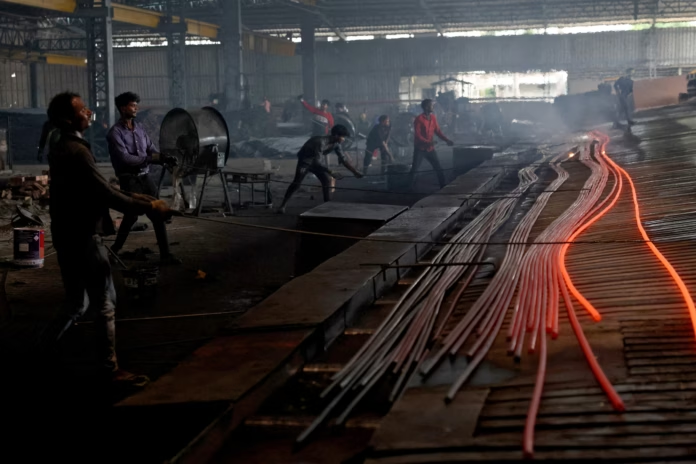
Delhi is assessing the feasibility of importing coking coal from Mongolia as it seeks to diversify sources for steel production. Despite significant transport and logistical challenges posed by Mongolia’s landlocked location, officials highlight the potential of high-grade coal at competitive prices. With India relying on imports for nearly 85% of its coking coal needs and demand expected to rise, the move reflects New Delhi’s efforts to secure stable, cost-effective supply chains for the expanding steel sector.
India’s steel industry is exploring Mongolian coking coal as a strategic alternative to traditional suppliers, amid rising domestic demand and growing reliance on imports. Currently, over half of India’s coking coal comes from Australia, with Russia and the United States supplying roughly 15% each. Industry analysts note that diversifying sources is essential to mitigate risks associated with supply disruptions, pricing volatility, and geopolitical uncertainties.Mongolia offers high-quality coking coal at potentially lower prices, but its landlocked geography presents substantial logistical hurdles. Two primary trade corridors exist: a longer route through Russia and a route via China. Officials caution that the China corridor may be unreliable in the long term, given Beijing’s strategic interests in Mongolian coal and the possibility of restricted access. Consequently, the Russia corridor is under careful assessment for feasibility and cost-effectiveness.
State-run Steel Authority of India (SAIL) has actively engaged with Mongolian suppliers to examine technical and logistical viability. Earlier this year, trial shipments were planned, including a test order of one metric ton, though deliveries have yet to materialise. A SAIL spokesperson confirmed, “We are in continuous engagement with Mongolian coking coal suppliers to ascertain technical and logistical feasibility for sourcing from Mongolia.”The push to source Mongolian coal aligns with broader goals of strengthening India’s steel supply chain while supporting sustainable urban growth. By securing affordable, reliable raw materials, cities can plan infrastructure projects more efficiently and maintain industrial continuity, indirectly contributing to energy-efficient and climate-resilient urban development. Experts note that diversifying coal sources also reduces dependency on single countries, enhancing resilience against geopolitical tensions and market fluctuations.The exploration of Mongolian coal comes as India cautiously rebuilds economic ties with neighbouring countries, including China, following a prolonged border standoff in 2020. Officials emphasise that sourcing decisions will balance commercial, logistical, and geopolitical considerations, with transport feasibility and pricing remaining key determinants.
If implemented successfully, Mongolian coal could complement existing imports from Australia, Russia, and the United States, stabilising supply and supporting India’s ambitious infrastructure and industrial growth targets. The initiative illustrates how strategic resource planning intersects with urban development imperatives, reinforcing the importance of diversified, cost-effective, and sustainable supply chains for India’s expanding steel sector.
Also Read:https://homesbuildings.com/chhattisgarh-jk-lakshmi-cement-expands-plant-investing-18-billion-inr-capacity/
Delhi Explores Mongolian Coking Coal Imports Despite High Transport Challenges And Rising Demand
Chhattisgarh JK Lakshmi Cement Expands Plant Investing 18 Billion INR Capacity

Chhattisgarh is set to witness a major boost in cement production as JK Lakshmi Cement commits INR 18.16 billion to expand its plant capacities. The investment will raise clinker output by 2.31 million tonnes annually and grinding capacity by 1.2 million tonnes, strengthening supply to eastern and central India. Announced at the Chhattisgarh Investor Connect event, the expansion highlights the state’s growing industrial significance and rising demand for infrastructure and housing.
The state has become a strategic hub for cement production, driven by sustained infrastructure projects, housing development, and increasing industrial activity. Industry analysts suggest that enhancing production capacity in Chhattisgarh will not only support regional supply chains but also position JK Lakshmi Cement closer to its long-term target of approximately 30 million tonnes annual capacity.“This expansion is a key milestone in JK Lakshmi Cement’s next growth phase,” said Shrivats Singhania, deputy managing director. “It strengthens our ability to meet regional market demand while fostering a future-ready organisation underpinned by cleaner energy, digital systems, and disciplined execution.”
JK Lakshmi Cement’s presence in the state has grown steadily since commissioning the integrated Durg plant in 2015. Recent upgrades include improved rail connectivity for smoother logistics, adoption of energy-efficient technologies, and increased utilisation of waste heat recovery and alternative fuels. These measures underscore the company’s commitment to sustainable industrial practices while maintaining operational efficiency.Arun Shukla, president and director, pointed to Chhattisgarh’s “strong and broad-based economic momentum,” describing it as one of India’s most promising cement markets. He emphasised that the expansion reflects confidence in the state’s industrial environment and reinforces the company’s focus on innovation, long-term value creation, and regional development.Beyond production gains, the project is expected to enhance supply reliability across eastern and central India, supporting infrastructure expansion and urban housing development. Local employment is likely to benefit from new operational demands, contributing to economic growth and broader regional development objectives.
The expansion also reflects a broader industry trend of integrating environmental sustainability into growth strategies. By investing in cleaner energy and resource-efficient processes, JK Lakshmi Cement aligns its operations with India’s net-zero ambitions, while demonstrating how industrial expansion can coexist with sustainable urbanisation goals.As Chhattisgarh’s industrial ecosystem evolves, projects such as this are set to play a key role in shaping a more resilient, inclusive, and economically vibrant region, offering lessons for other emerging markets seeking to balance growth with environmental responsibility.
Also Read: https://homesbuildings.com/mumbai-showcases-nippon-paint-india-beyond-paint-innovations-driving-green-building-leadership/
Chhattisgarh JK Lakshmi Cement Expands Plant Investing 18 Billion INR Capacity
Mumbai Showcases Nippon Paint India Beyond Paint Innovations Driving Green Building Leadership

Mumbai witnessed a major step in sustainable urban development as Nippon Paint India unveiled its “Beyond Paint” innovations at IGBC Mumbai 2025. The new portfolio introduces advanced surface engineering solutions designed to improve building efficiency, reduce energy consumption, and enhance occupant comfort. Highlighting the company’s leadership in green building practices, the launch demonstrated how innovative coatings and protective films are shaping climate-positive, future-ready constructions across India’s rapidly evolving urban landscape.
The launch, attended by industry stakeholders, highlighted technologies that combine design excellence with measurable sustainability outcomes. Among the offerings, the Cool Tec Solution uses heat-reflective coatings to lower surface and indoor temperatures, reducing energy demand for cooling. Jiki Art brings designer-inspired finishes that provide aesthetic appeal without compromising durability, while N-Shield Protective Films offer architectural surface protection that simplifies maintenance and refurbishment.“These solutions illustrate how surface engineering can drive operational efficiency and sustainability,” said a senior executive from Nippon Paint India. “IGBC Mumbai provides an ideal platform to showcase how coatings can contribute to greener, smarter, and cooler buildings in India.”
Industry experts noted that the integration of such technologies aligns with green certification frameworks like IGBC, LEED, and GRIHA, which are increasingly being adopted in India’s urban projects. By reducing energy consumption, extending building lifecycles, and improving occupant comfort, these innovations demonstrate the growing role of advanced materials in achieving net zero and climate-resilient urban environments.Analysts emphasise that decorative coatings are no longer merely aesthetic components but pivotal in sustainable architecture. With cities like Mumbai facing rising temperatures, high-density construction, and energy challenges, the adoption of heat-reflective and protective coatings could significantly mitigate environmental impact. Developers and architects are increasingly considering such solutions as part of holistic green building strategies.Nippon Paint India, part of Asia’s leading NIPSEA Group, brings a legacy of innovation and sustainability to the market. Recognised under GreenCo and GreenPro frameworks, the company continues to expand its portfolio across decorative coatings, waterproofing, construction chemicals, and protective technologies, reinforcing its role in shaping future-ready urban spaces.
As India’s construction sector moves towards sustainable growth, these innovations reflect the broader imperative of designing cities that are energy-efficient, resilient, and environmentally responsible, offering both social and economic benefits. By focusing on solutions that go “Beyond Paint,” Nippon Paint India underscores how material innovation can become a cornerstone of India’s green building movement.
Also Read:https://homesbuildings.com/mumbai-realty-giant-lodha-unveils-rs-14000-crore-projects-spanning-mmr-pune-bengaluru/
Mumbai Showcases Nippon Paint India Beyond Paint Innovations Driving Green Building Leadership
Mumbai Realty Giant Lodha Unveils Rs 14,000 Crore Projects Spanning MMR Pune Bengaluru
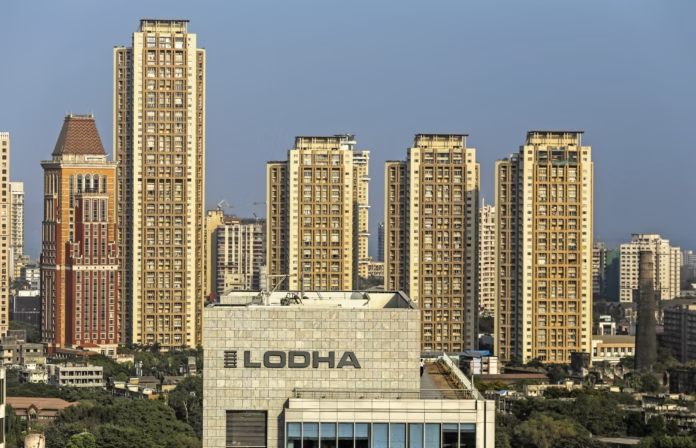
Lodha Developers has outlined one of its most ambitious launch calendars yet, preparing to introduce 15 new residential projects across the Mumbai Metropolitan Region, Pune, and Bengaluru in the latter half of FY26. The pipeline, valued at around Rs 14,000 crore, signals the firm’s confidence in sustained housing demand and reflects the broader shift towards professionally managed, environmentally conscious urban development.
According to company officials, the rollout will add nearly 10 million sq. ft. of saleable space and help the developer stay on course to meet its full-year pre-sales guidance of Rs 21,000 crore. The announcement follows a strong first half of the fiscal year, during which the firm introduced projects worth more than Rs 13,000 crore and reported steady growth in pre-sales. Industry analysts noted that the company’s performance in the year’s first six months an 8% rise in pre-sales to over Rs 9,000 crore demonstrates both market resilience and the continued dominance of branded players in India’s urban housing hubs. A consultant tracking the sector said demand in MMR and Pune, particularly in the mid-income and premium segments, “remains supported by better credit access, improved project execution, and the push for more climate-responsible buildings”.
Despite the aggressive launch pipeline, the developer is not relying solely on fresh inventory. Executives indicated that internal strategies now focus equally on accelerating construction cycles, bolstering digital-first sales processes, and reducing unsold stock in completed or near-completed projects. These measures, analysts said, are becoming increasingly important as metropolitan buyers prioritise timely delivery, transparent governance, and energy-efficient urban lifestyles. The firm’s cumulative footprint now includes more than 110 million sq. ft. delivered and another 130 million sq. ft. under development. With this scale comes growing responsibility. Urban policy experts argue that large developers play a crucial role in reducing the construction sector’s carbon footprint, especially in regions such as MMR and Bengaluru where infrastructure stress and heat vulnerability are intensifying. “Developers with significant pipelines need to embed greener building materials, water-sensitive design, and inclusive amenities,” said a Mumbai-based urban planner.
In a notable strategic shift, the company is also preparing to enter the Delhi-NCR market with a pilot housing project in Gurugram. This marks its first significant move outside its traditional western and southern base. With NCR’s residential market recovering and governance reforms attracting institutional capital, competition among branded developers is expected to sharpen. For citizens, the expansion underscores the evolving nature of India’s urban housing market where demand is increasingly steered by trust, sustainability features, public transport access, and long-term cost-efficiency rather than by short-term speculation. As India’s metros attempt to expand without exacerbating inequality or climate risk, the choices made by major developers will continue to shape how inclusive, resilient, and low-carbon these cities become.
Also Read: Baloda Bazar Chhattisgarh Transformed By Ambuja Cements CSR Rural Health Nutrition Drive
Mumbai Realty Giant Lodha Unveils Rs 14,000 Crore Projects Spanning MMR Pune Bengaluru
Baloda Bazar Chhattisgarh Transformed By Ambuja Cements CSR Rural Health Nutrition Drive

Baloda Bazar, Chhattisgarh, is witnessing a significant transformation as Ambuja Cements intensifies its CSR initiatives focused on rural health and nutrition. Covering 13 villages, the programme engages communities through nutrition awareness sessions, home visits, and digital tools for monitoring maternal and child well-being. From promoting kitchen gardens to screening adolescent girls for anaemia, the initiative combines practical health interventions with community empowerment, reinforcing sustainable nutrition practices and preventive healthcare in the region.
During the Poshan Pakhwada (Nutrition Fortnight), Ambuja Cements conducted interactive nutrition demonstration sessions across all targeted villages. These sessions reached over 250 participants, including adolescent girls and lactating mothers, and highlighted balanced diets, safe cooking methods, and maternal nutrition. Local Anganwadi workers received hands-on training on the Poshan Tracker app, enabling more precise digital monitoring and facilitating data-driven planning for community health programmes.Beyond knowledge sharing, the initiative emphasises practical interventions to enhance dietary diversity. Ambuja Cements distributed kitchen garden seeds to 123 households, encouraging families to grow vegetables and herbs. This approach not only supplements nutrition but also fosters self-reliance and sustainable food practices in rural households. An official involved in the programme noted that “empowering communities to take ownership of their nutrition ensures long-term behavioural change and healthier outcomes for mothers and children alike.”
Healthcare screening forms another cornerstone of the CSR effort. A health camp in Rawan village assessed 34 adolescent girls for anaemia and sickle cell conditions, providing counselling and nutritional supplements where required. Simultaneously, awareness campaigns marked key health observances such as World No Tobacco Day, reaching over 600 villagers through mobile vans and interactive community sessions. These campaigns promoted preventive health practices and reinforced the importance of lifestyle choices alongside nutrition.The initiative also demonstrates effective integration with local health systems. By training frontline health workers and utilising digital tools, Ambuja Cements’ CSR programmes enhance monitoring, planning, and implementation of government nutrition schemes. Industry experts highlight that such public-private collaboration can strengthen rural healthcare infrastructure and create scalable models for other regions.
Through sustained interventions, Baloda Bazar communities are gradually adopting healthier behaviours and embracing preventive healthcare measures. Ambuja Cements’ approach combines education, hands-on support, and technology to build resilience, emphasising sustainable well-being and inclusive growth. The programme exemplifies how corporate responsibility, when strategically aligned with community needs, can contribute meaningfully to improving health outcomes and promoting equitable development in semi-urban and rural India.
Also Read: https://homesbuildings.com/chennai-itpl-launches-greenfield-bitumen-plant-boosting-sustainable-road-material-supply/
Baloda Bazar Chhattisgarh Transformed By Ambuja Cements CSR Rural Health Nutrition Drive
Hyderabad Market Strengthens Through Five-Acre Acquisition For Rs 4150 Crore Housing Plan

Hyderabad’s real estate landscape is set for another major expansion as a leading national developer has secured a five-acre parcel in Neopolis, Kokapet through a government-led e-auction, with plans to build a premium residential project valued at an estimated Rs 4,150 crore. The acquisition signals intensifying interest in the city’s western growth corridor, where demand for well-planned, climate-responsive housing continues to strengthen.
According to officials familiar with the auction conducted by the Hyderabad Metropolitan Development Authority (HMDA), the developer emerged as the highest bidder on the MSTC e-tendering platform. Formal allotment is expected after the mandated approval process is completed. The proposed development is likely to include around 2.5 million sq. ft of saleable residential space, aimed at mid-to-upper income households seeking connectivity, social infrastructure, and sustainable design features. Neopolis, a fast-urbanising precinct near the Financial District and HITEC City, has evolved into one of Hyderabad’s most sought-after residential markets. Its rapid transformation has been shaped not only by technology companies and commercial hubs but also by robust investments in mobility, public amenities, and community facilities. Urban planners note that Neopolis’ master-planned approach wide roads, regulated densities, and open-space provisions has made it a test case for integrated, future-ready development in Indian cities.
Industry analysts say the latest land deal reinforces the developer’s growing confidence in Hyderabad, following a previous 7.8-acre acquisition in Kukatpally earlier this year and several successful residential launches in western clusters. “Hyderabad continues to show healthy absorption levels driven by steady employment creation and transparent planning frameworks,” said a senior real estate consultant. “Developers are willing to undertake larger projects where infrastructure can support long-term growth.” The city has emerged as one of the company’s fastest-expanding markets, with annual sales crossing Rs 2,600 crore in 2025. Executives attribute this performance to a combination of rising homeownership sentiment, preference for organised gated communities, and demand for energy-efficient homes. A company representative said the priority now is to scale up responsibly by focusing on user-centric design, mobility access, and resilient built-form strategies.
As Hyderabad’s residential footprint expands, urban experts caution that growth must be balanced with ecological considerations. Kokapet’s evolving built environment provides an opportunity to embed climate-responsive layouts, green building standards, and inclusive public spaces. Such approaches, they argue, are essential for cities aspiring to achieve equitable and low-carbon growth as housing demand accelerates. If executed thoughtfully, the new project could help strengthen the supply of organised housing while supporting broader municipal goals around liveability, mixed-use density, and sustainable urban form. For homebuyers, the development promises improved access to social amenities; for the city, it represents another step toward creating well-connected, environmentally conscious neighbourhoods.
Also Read: Mumbai Introduces Paradigms Superstar-Signature Edition Transforming Bandra Into Ultra-Luxury Hub
Hyderabad Market Strengthens Through Five-Acre Acquisition For Rs 4150 Crore Housing Plan
Mumbai Introduces Paradigms Superstar-Signature Edition Transforming Bandra Into Ultra-Luxury Hub

A new ultra-premium residential project in Bandra is seeking to reshape how high-income homebuyers engage with coastal living in India’s financial capital. Developed by a leading Mumbai real estate firm, the 23-storey tower offers only twenty full-floor residences, positioning itself as a quieter, more mindful alternative to the city’s conventional luxury developments. Its arrival also signals a growing industry shift toward climate-responsive architecture and wellness-driven design in dense metropolitan environments.
Industry analysts say the project’s launch comes at a time when affluent buyers are increasingly prioritising privacy, energy efficiency and long-term resilience over sheer opulence. A senior architectural consultant noted that “premium consumers are beginning to link luxury with environmental performance and personal wellbeing, especially in high-stress urban centres like Mumbai.” Each home spans an entire floor and is supported by a private lift lobby for added discretion features that have become sought-after in a post-pandemic market. The building’s form has been designed around sun-path analysis, cross-ventilation and three open-sided layouts intended to maximise daylight while reducing dependence on artificial cooling. According to project officials, the façade’s high-performance glazing aims to improve acoustic control and mitigate coastal heat gain, a growing concern as Mumbai experiences longer and more intense warm seasons.
The interiors adopt a restrained palette of stone, timber and textured finishes, reflecting an industry-wide move away from ostentatious décor. Wellness is positioned as a central theme, with facilities such as an infrared sauna, hyperbaric oxygen chamber and cryogenic therapy suite amenities more commonly found in global spa destinations than in residential towers. Alongside these, landscaped decks, a green yoga terrace and low-noise meditation areas have been integrated to offer quieter breathing spaces in a neighbourhood known for heavy traffic and activity. The development also includes community-oriented leisure spaces such as lounges, a gaming zone, a small café and an open-air cinema, signalling a broader trend of residential buildings doubling as social infrastructure for busy professionals seeking balance. An executive involved with the project said the idea was to “create a vertical retreat that acknowledges the city’s pace but also softens it.”
With prices starting at INR 18 crore for the four-bedroom sky suites and villas, the property caters to Mumbai’s high-net-worth residents, corporate leaders and public personalities. Yet the project’s emphasis on climate-responsive design, thermal efficiency and a reduced ecological footprint subtly aligns with the broader direction Indian cities must adopt as climate risks mount. For Mumbai, where rising temperatures and coastal vulnerabilities are reshaping urban priorities, such developments illustrate how luxury housing can evolve toward more conscious, resilient living. While these homes remain accessible only to a select demographic, planners argue that design innovations piloted in the premium segment often influence wider housing standards over time a shift crucial for creating cities that are both aspirational and sustainable.
Also Read: Chennai ITPL Launches Greenfield Bitumen Plant Boosting Sustainable Road Material Supply
Mumbai Introduces Paradigms Superstar-Signature Edition Transforming Bandra Into Ultra-Luxury Hub