
Navi Mumbai Launches 4508 Ready Homes First Come First Served Scheme Today
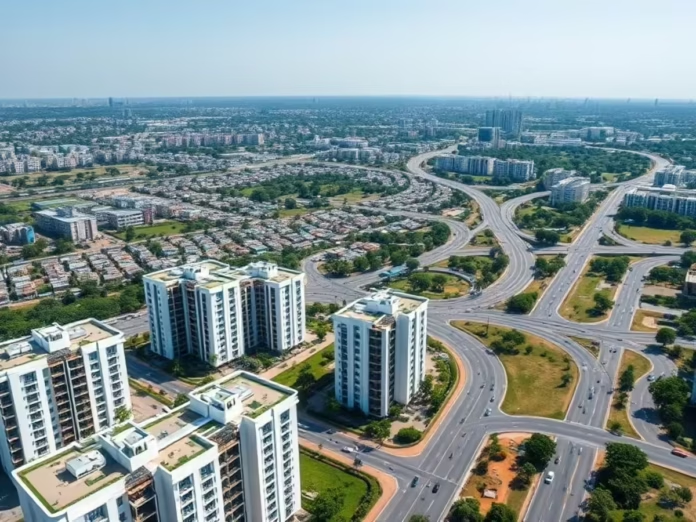
This FCFS initiative builds on CIDCO’s 2024 PMAY efforts, which delivered 67,000 homes largely through lotteries. By allowing applicants to choose their preferred units, the new model may better accommodate lifestyle preferences, commuting patterns, and proximity to civic infrastructure factors for sustainable urban living. Analysts highlight that such measures also support gender-neutral and socially inclusive development by facilitating broader access to home ownership. Industry observers suggest that Navi Mumbai’s approach could set a precedent for other fast-growing Indian cities, demonstrating how transparent allocation mechanisms combined with location-sensitive planning can enhance the social and environmental sustainability of urban housing. With a strong focus on inclusivity, connectivity, and readiness, the scheme aligns with efforts to create low-carbon, equitable urban habitats capable of supporting resilient communities.
Neopolis Auctions Set Record As Plot Fifteen Fetches Rs 151 Crore Price

Hyderabad’s premium land market has scaled new heights after another round of e-auctions in the Neopolis precinct delivered unprecedented prices, reinforcing the corridor’s status as one of India’s most valuable real estate destinations. Two fresh land parcels drew extraordinary bids, contributing significantly to the city’s development authority and signalling continued confidence in well-connected urban growth centres.
According to officials, the latest auction generated more than ₹1,350 crore from just two plots, with rates averaging over ₹142 crore per acre among the highest recorded for Hyderabad. One parcel, a large tract situated near the Outer Ring Road, achieved ₹151 crore per acre, setting a new benchmark and exceeding earlier expectations from market observers. Analysts noted that the aggressive bidding reflects sustained appetite for premium, well-located land suited for high-density residential and mixed-use projects.A senior urban development official said the strong response demonstrates how strategic public land release can unlock revenue while guiding growth towards planned zones. The state development authority has now collected nearly ₹2,700 crore across two phases of auctions, placing it on track to meet its fiscal target for the broader land monetisation programme. Officials added that phased release helps preserve land value, prevent speculative accumulation, and support more orderly urban expansion.
Market watchers believe that the participation of both major developers and high-net-worth individual consortiums highlights confidence in the long-term prospects of the Kokapet–Neopolis cluster. The entry of a leading national developer in this round is likely to bring large-scale, high-quality construction, which could influence future pricing and elevate the area’s built environment. Industry experts explain that such investments when planned with efficient mobility and climate-responsive design can contribute to more resilient and equitable urban growth.
Neopolis has emerged as a preferred location for investors due to its proximity to HITEC City and the Financial District, two of Hyderabad’s most important employment hubs. Excellent road connectivity and limited availability of large, contiguous land parcels have further intensified demand. As the corridor continues to attract capital, planners emphasise the importance of ensuring that upcoming development incorporates inclusive housing, sustainable materials, and low-carbon infrastructure to prevent the area from becoming inaccessible to diverse income groups.
While the soaring prices may raise concerns about affordability in the wider market, sector experts argue that premium land sales can generate substantial public revenue useful for social housing, green mobility, and civic infrastructure. The ability of cities to recycle land value gains into equitable amenities will be essential for building more resilient and liveable neighbourhoods.With average land rates at Neopolis now well above ₹140 crore per acre, Hyderabad’s western corridor has firmly established itself as a high-demand development zone. The challenge ahead will be guiding this momentum towards a more inclusive urban fabric that balances economic growth with sustainability and access.
Neopolis Auctions Set Record As Plot Fifteen Fetches Rs 151 Crore Price
India Realty Sees Jefferies Back Lodha Godrej Amid Rising Labour Cost Pressure
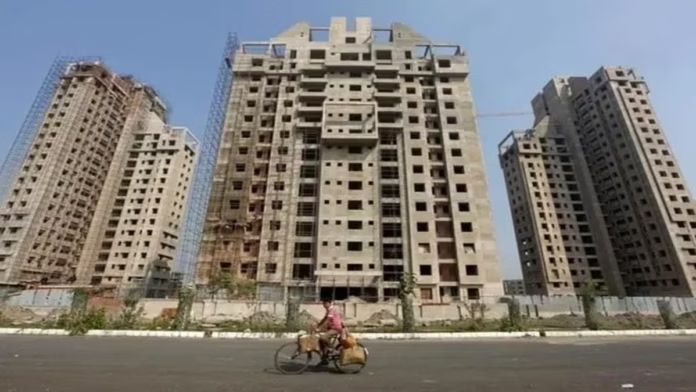
India’s real estate sector is preparing for a fresh round of cost pressures even as the market grapples with weakening sentiment and volatile trading patterns. Global brokerage assessments suggest that two leading developers are better positioned to maintain momentum, but industry-wide concerns around rising labour expenses and muted post-festive sales continue to cast a shadow over the months ahead.
Analysts tracking the sector note that large listed developers are expected to deliver stronger pre-sales in the second half of FY26, supported by a pipeline of new launches and demand in established urban centres. According to a sector specialist, firms with sizeable land banks and diversified product lines are likely to weather near-term volatility more effectively. This outlook comes at a time when the broader realty index has retreated sharply from last year’s high, reflecting caution across the equity market.
Industry experts attribute a large part of this caution to the implementation of new labour regulations, which could increase workforce-related expenses by 10% to 15%. Labour generally accounts for 15% to 30% of a project’s construction costs, depending on geography and scale. In cities such as Mumbai, where highly urbanised landscapes have already pushed up baseline costs, labour typically forms around one-fifth of total spending, excluding land. A senior consultant explained that while the impact in Mumbai may be comparatively moderate, developers across India will nonetheless face upward revision in their budgets.
Developers have indicated they are unlikely to absorb these higher costs on their balance sheets. Instead, most are expected to gradually pass on the increases to homebuyers. Market observers note that this may influence affordability, especially in dense metropolitan regions where supply remains tight and land values are resistant to downward correction. This dynamic adds another layer of complexity to city planners’ ambitions for more inclusive and accessible housing.The potential shift in pricing comes at a time when buyers are already navigating elevated interest rates and a broader economic slowdown. Some analysts warn that even a marginal rise in end-user prices could dampen demand in mid-income segments, which form the backbone of housing consumption in urban India. Others argue that strong employment trends in technology and services hubs may offset part of this pressure, particularly in markets such as Bengaluru and Pune.
Beyond immediate cost escalations, experts stress the need for long-term strategies that encourage efficient construction, better labour welfare, and greener building methods. Adopting sustainable materials, mechanisation, and safer working conditions could help stabilise project costs over time while supporting more equitable development. As Indian cities continue to expand, the intersection of affordability, labour rights, and sustainable construction will remain central to shaping a more inclusive real estate ecosystem.
India Realty Sees Jefferies Back Lodha Godrej Amid Rising Labour Cost Pressure
Godrej Properties To Acquire Multiple Land Parcels With Thirty Thousand Crore Potential

New Delhi’s residential market is set for another year of heightened activity as a leading national developer prepares for an extensive round of land acquisitions, estimating a cumulative potential revenue of nearly ₹30,000 crore in the current financial year. The company’s strategy reflects a broader resurgence in housing demand across Indian cities and a renewed appetite for greenfield expansion after several years of cautious deployment.
According to a senior company executive, the business development pipeline has strengthened significantly through the first half of the fiscal, supported by a mix of outright purchases and partnerships with landowners. The approach, the executive noted, allows the developer to secure a diversified portfolio across metros and emerging urban centres while preserving financial discipline in a competitive land market.The company has already exceeded its internal land investment guidance for the year, having crossed the previously announced benchmark of ₹20,000 crore in gross development value. Industry experts attribute this acceleration to a combination of robust sales, increased liquidity in the organised real estate sector, and a shift in consumer preference toward planned communities, plotted developments, and low-carbon townships that prioritise open spaces and infrastructure.
The executive acknowledged that land prices have firmed up across most regions but stressed that the firm maintains a conservative internal target-setting process to avoid undue pressure on teams and to ensure that acquisitions support long-term sustainability goals. The company anticipates maintaining its trajectory and closing the fiscal with at least ₹30,000 crore in fresh development potential.Recent acquisitions include a 75-acre site in Nagpur, where the developer intends to launch a plotted housing community with an estimated top-line of about ₹750 crore. In addition, a 30-acre parcel in South Bengaluru has been secured for a mixed-use township expected to generate roughly ₹3,500 crore in revenue. Both projects are designed to integrate amenities, walkable environments, and resource-efficient design features that are increasingly important for homebuyers and city planners alike as India moves toward more climate-resilient urban growth.Beyond acquisitions, the company plans to focus on accelerating construction and handovers in the latter half of the fiscal year.
Sales bookings in the first six months rose by 13 per cent year-on-year, signalling stable demand even in a high-interest environment. With a full-year target of ₹32,500 crore in bookings, the developer is confident of closing the year on a strong note.Urban policy analysts suggest that the company’s aggressive expansion reinforces a structural shift toward integrated, scalable, and environmentally conscious urban housing formats. As Tier II and III cities gain traction with plotted developments and township models, the outlook for more equitable and climate-aligned urban growth appears increasingly positive.
Godrej Properties To Acquire Multiple Land Parcels With Thirty Thousand Crore Potential
Mumbai Mhada To Auction Eighty Four Commercial Shops Across Prime City Locations Soon

Mumbai’s real estate market is set for a fresh burst of commercial activity as the Maharashtra Housing and Area Development Authority (MHADA) opens online auctions for 84 commercial shops across multiple neighbourhoods. The initiative aims to widen access to small and medium enterprises seeking formal retail or office spaces in a city where affordability and availability remain persistent barriers. With prices starting at ₹28 lakh and extending to ₹10 crore, the auction caters to a broad spectrum of business needs.
The listed units are distributed across areas with strong residential catchments and heavy pedestrian movement, such as Malvani in Malad, Goregaon East and West, Kurla, Mulund, Majasawadi and Powai. Property consultants describe these micro-markets as resilient, noting their ability to attract local entrepreneurs, service-based businesses and neighbourhood retail operators. Officials involved in the process say the aim is to bring underutilised public assets into productive economic use while supporting decentralised business growth across the city’s suburbs.
Registration for the auction opened on 27 November, with applicants required to complete online submissions, upload documents and make deposit payments by 21 December. The process, conducted entirely through MHADA’s e-auction portal, concludes with bidding on 23 December and the announcement of results a day later. According to an official, the digital framework is designed to improve transparency, reduce discretion and ensure equal access for bidders regardless of geography.For many businesses, the availability of formal retail units within established communities offers long-term stability and the opportunity to transition away from informal or temporary premises. Analysts note that commercial property ownership, even at a small scale, can provide financial security and predictable overheads for entrepreneurs. It also strengthens local economies by enabling residents to establish ventures within walking distance of their homes reducing travel, energy use and the ecological costs associated with dispersed commercial activity.
The distribution of units highlights another policy intention: encouraging balanced economic development across suburban pockets. Clusters such as Malvani, with 29 available units, and Goregaon East, with 17, reflect MHADA’s focus on areas experiencing steady population growth and rising demand for essential services. Urban planners observe that such initiatives help create more self-sufficient neighbourhoods, reducing dependency on central business districts and supporting inclusive urban development.
For registered bidders, the key requirement is strict adherence to timelines. Applications missing documents or deposit payments will be automatically rejected. MHADA officials emphasise that the process rewards preparedness, given the competitive nature of commercial real estate in Mumbai. As the city continues to expand and diversify its economic base, the release of these commercial units through a transparent, digital-first mechanism offers both opportunity and direction. It aligns with broader goals of supporting local enterprise, optimising public land use and fostering walkable, business-friendly communities that contribute to a more sustainable and equitable urban environment.
Mumbai Mhada To Auction Eighty Four Commercial Shops Across Prime City Locations Soon
Mumbai PTC Model Unlocks Stalled Slum Redevelopment And Creates Risk Free Pathways

Mumbai is witnessing a quiet but consequential shift in its approach to slum redevelopment as the Permanent Transit Camp (PTC) model gains traction across several neighbourhoods. Designed as a risk-free mechanism to fast-track stalled projects, the model relocates eligible households to fully sanctioned permanent structures built on separate plots, freeing the original land for consolidated development. Urban planners say the approach is reshaping both market behaviour and settlement patterns in areas long trapped in redevelopment deadlock.
For years, redevelopment struggled in locations where sale prices could not exceed certain thresholds, making rehabilitation financially unviable. Construction costs climbed, premiums to authorities ballooned and negotiations with residents grew increasingly fragmented. “Developers simply walked away because the numbers never worked,” a senior housing official said. Entire clusters remained unchanged for decades, constraining mobility, infrastructure delivery and overall neighbourhood safety.The PTC model shifts this equation by separating rehabilitation from the primary development site. A dedicated PTC building planned, sanctioned and constructed to permanent standards is created within the vicinity. Once complete, eligible families are permanently rehoused in this block, gaining access to formal infrastructure, secure tenancy and improved living conditions. With the original settlement vacated, the land becomes a unified, dispute-free parcel available for redevelopment with far greater efficiency.
One of the model’s most transformative features is its financing structure. Third-party funders often land controllers or future investors cover all expenses, from construction to compliance. Developers, meanwhile, operate without financial exposure, earning fixed fees based on rehabilitation FSI. Industry experts say this creates a low-risk, timeline-driven framework that removes the uncertainty commonly associated with traditional slum rehabilitation. It also shields projects from market fluctuations, lending cycles and pre-sale pressures.The urban gains are substantial. A single PTC tower can clear multiple clusters within a one-to-two kilometre radius, reducing density in highly congested pockets. Wider access roads, improved emergency response routes and better municipal servicing follow organically. Residents moving into PTC blocks report cleaner surroundings, more stable utilities and safer social environments. Over time, these shifts support more equitable neighbourhoods while reducing the footprint of informal housing.
For the real estate sector, the PTC model resolves one of the most persistent concerns: the reluctance of buyers to invest near partially cleared slum parcels. By consolidating rehabilitation upfront, the model ensures redevelopment sites emerge clean, organised and legally stable, strengthening valuations and reducing rate erosion.As Mumbai continues to intensify its vertical housing agenda, the PTC framework is emerging as a scalable, balanced pathway. It aligns financial feasibility with humane urban planning, offering dignified housing for residents, predictable returns for developers and more efficient land use for the city. For a metropolis seeking both growth and inclusion, the PTC model is fast becoming a pivotal tool in shaping a more stable and equitable urban future.
Mumbai PTC Model Unlocks Stalled Slum Redevelopment And Creates Risk Free Pathways
Mumbai Students Displaced As Sewri Redevelopment Fails To Provide Functional School Facilities

Mumbai’s ambitious slum redevelopment initiative in Sewri has left hundreds of schoolchildren without adequate educational facilities, raising questions about civic accountability and urban planning. Following the demolition of a BMC primary school in 2013, students were shifted to a one-room kitchen (1RK) unit with minimal infrastructure, a solution that proved insufficient and ultimately unsustainable.
The redevelopment site, located along R A Kidwai Marg opposite TB Hospital, began construction in 2009 under a project led by private contractors in partnership with the Slum Rehabilitation Authority (SRA) and BMC. While the redevelopment has advanced residential and commercial objectives, the promised new school has yet to materialise. Records indicate that the temporary 1RK facility, not officially recognised under the BMC education department, housed a declining student population from 250 in 2013 to just nine by 2019 before shutting down entirely during the pandemic.
“This is a classic example of urban development prioritising profit over social infrastructure,” a civic education official commented. The failure to provide a fully functional school on-site has affected not only student enrolment but also community trust in civic authorities. Former municipal committee members noted that the builder was allowed to proceed with selling residential units despite the unfulfilled educational commitments, highlighting systemic gaps in enforcement and oversight.The situation has prompted intervention from political representatives. Borivli MLA has formally requested criminal accountability for the developers, SRA officials, and BMC personnel involved in the project. The case underscores broader challenges in Mumbai’s urban redevelopment framework, where civic amenities promised under the Rehabilitation and Resettlement schemes often lag behind residential construction.
Urban planners and education experts emphasise the importance of integrating sustainable, inclusive, and gender-neutral educational spaces into redevelopment projects. The Sewri case exemplifies the social risks of neglecting such integration, with children disproportionately bearing the brunt of infrastructural delays. Analysts argue that timely completion of civic facilities is critical not only for social equity but also for maintaining urban resilience and community cohesion.
As Mumbai continues to pursue large-scale redevelopment initiatives, the Sewri school debacle serves as a cautionary tale. Strengthening regulatory mechanisms, enforcing accountability, and embedding educational and social infrastructure into project timelines are essential to align urban growth with sustainable and equitable development goals. Without these measures, redevelopment projects risk eroding public trust and undermining the city’s social fabric.
Mumbai Students Displaced As Sewri Redevelopment Fails To Provide Functional School Facilities
Mumbai Tenants Allege Shah Housecon Fraud Misappropriation In Malad East SRA
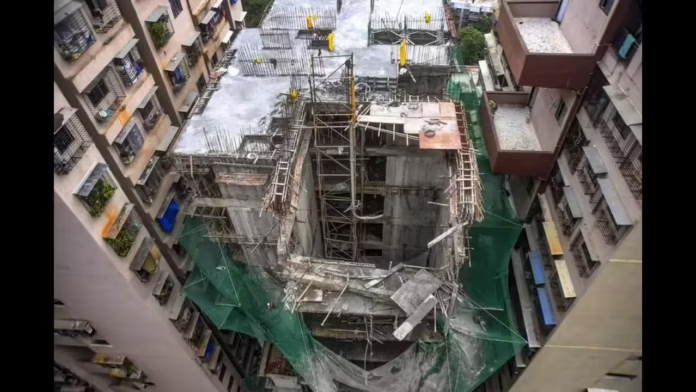
Mumbai’s Malad-East Slum Rehabilitation Authority (SRA) project led by Shah Housecon Pvt Ltd (SHPL) has come under scrutiny following multiple allegations of fraud, misappropriation, and non-compliance. Promoted by Mansukh and Akash Shah, SHPL reportedly collected significant sums from residents promising rehabilitation but allegedly failed to deliver, prompting legal action and public concern over stalled urban redevelopment.
According to affected residents, SHPL entered several memorandums of understanding and obtained loans from investors but subsequently issued termination notices while diverting funds for personal use. Complaints indicate families were charged approximately ₹24,000 each under the guise of rehabilitation, yet many report not receiving possession or rent compensation. Some tenants allege the company accepted rent from encroachers despite not adhering to the statutory provisions of the SRA scheme.Legal filings in the Bombay High Court cite non-payment of rent and non-delivery of housing units. In one instance concerning the Jai Hanuman and Dadi SRA project, a 13.2 order has been issued against SHPL to address grievances, highlighting unresolved claims from residents such as Shantaben and Hiraben, who remain without their promised homes.
Industry experts note that such disputes undermine the credibility of SRA redevelopment schemes, which are critical to sustainable urban renewal in densely populated cities. “Redevelopment projects require strict compliance with statutory guidelines to protect vulnerable residents and ensure transparency,” said a senior urban planner. The High Court’s intervention underscores the judiciary’s role in mediating disputes between developers and citizens, ensuring statutory obligations are fulfilled.The allegations against SHPL illuminate wider challenges in Mumbai’s redevelopment sector, particularly concerning accountability and fund utilisation. By accepting payments without progressing construction or allotment, developers risk eroding public trust and delaying critical housing solutions. Authorities, experts emphasise, must enforce stringent monitoring to prevent exploitation and maintain equity in urban housing schemes.
While SHPL may defend its practices through legal avenues, residents and civil society groups urge swift action to recover diverted funds and facilitate housing delivery. Industry stakeholders suggest that such cases also highlight the need for greater transparency, better governance frameworks, and timely audit mechanisms in public-private redevelopment partnerships.The outcome of the Bombay High Court proceedings is expected to set important precedents for accountability in SRA projects, reinforcing residents’ rights to safe and timely housing while ensuring urban redevelopment progresses in a lawful, equitable, and socially responsible manner.
Mumbai Tenants Allege Shah Housecon Fraud Misappropriation In Malad East SRA
Mumbai Housing Societies Can Proceed Redevelopment As Supreme Court Denies IBC Moratorium Claims

Mumbai’s long-stalled redevelopment landscape received a decisive push forward after the Supreme Court held that a development agreement cancelled before insolvency cannot be revived under the Insolvency and Bankruptcy Code (IBC). The ruling, delivered in a case relating to a cooperative housing society in Bandra, clarifies that the IBC’s moratorium does not extend to rights that no longer exist, offering long-awaited relief to residents living in unsafe and ageing buildings.
The dispute centred on a redevelopment agreement that had been terminated years before the developer entered insolvency. When the society appointed a new firm to take up construction, the former developer attempted to claim protection under the IBC’s Section 14 moratorium, arguing that its “development rights’’ constituted an asset. The Court disagreed, noting that no possession was granted, no demolition or construction was ever undertaken, and no enforceable right survived at the commencement of insolvency. According to a legal expert familiar with the case, the judgment draws a clear line between active assets and rights that have expired due to non-performance.
Industry observers say the ruling offers renewed certainty to cooperative housing societies across the Mumbai Metropolitan Region, particularly those navigating redevelopment after years of delays. A senior urban planner noted that redevelopment is not merely a commercial transaction but an essential safety and resilience measure, as many societies continue to inhabit structurally vulnerable buildings. Ensuring that such communities are not held hostage to insolvency disputes, the planner added, is vital for equitable and sustainable urban renewal.The Court underscored that the IBC is designed to resolve genuine financial distress, not to give non-performing developers a platform to assert extinguished claims. It drew on earlier jurisprudence to emphasise that moratorium protection applies only to assets that legally belong to the corporate debtor at the time of insolvency. Contracts terminated for prolonged non-performance, the bench indicated, do not fall within this scope.
Equally significant is the Court’s clarification on the limits of writ jurisdiction. It upheld the Bombay High Court’s direction to process redevelopment permissions, pointing out that the High Court had not interfered in insolvency proceedings but merely ensured statutory compliance. For many residents living in unsafe structures, this distinction matters: it prevents administrative paralysis when authorities hesitate to act out of fear of breaching the IBC.The ruling also highlights a broader, people-centric interpretation of urban law. A senior government official remarked that insolvency cannot be allowed to obstruct the rehabilitation of citizens, particularly where communities have waited years for safe, dignified housing.
The judgment places residents’ rights at the centre of redevelopment frameworks, reinforcing the need to balance commercial recovery with human well-being.For Mumbai, where hundreds of projects remain stalled due to disputes involving terminated agreements, the judgment is expected to streamline decision-making and reduce uncertainty. By drawing firm boundaries around what constitutes an asset under the IBC, the Supreme Court has restored momentum to societies seeking renewal while encouraging a more transparent, accountable redevelopment ecosystem.
Mumbai Housing Societies Can Proceed Redevelopment As Supreme Court Denies IBC Moratorium Claims
Mumbai Preity Zinta Sells Bandra Apartment For Rs14.08 Crore For Larger Reinvestment
