
Mumbai Developer Unveils ₹1200 Crore Commercial Project Spanning 2.09 Lakh Sq Ft In Mahim
Mumbai Infrastructure Projects Drive Property Prices Up By Nearly Twenty Three Percent

Mumbai’s ambitious infrastructure expansion is reshaping its urban landscape, triggering a pronounced rise in property prices across several submarkets. From large-scale transit corridors to sea links and airport-led development, a new pattern of connectivity is redefining how residents navigate the city and how investors evaluate long-term opportunities. The transformation is contributing to improved liveability, shorter commutes, and a more integrated regional economy, all of which are central to developing inclusive and sustainable metropolitan growth.
The city currently has one of India’s most extensive infrastructure pipelines, valued at more than ₹1 lakh crore and steered through state, central and regional planning authorities. Officials note that these projects collectively aim to create a metropolitan system aligned with India’s broader economic goals while reducing the environmental strain caused by fragmented travel routes and high vehicle dependence. Improved transit access, they argue, is also key to enabling equitable mobility for all income groups.Among the most transformative developments is the Mumbai Coastal Road, a 10.58 km corridor designed to ease pressure along the western seaboard. Analysts say the enhanced waterfront connectivity has sparked double-digit price appreciation in neighbourhoods such as Worli, Malabar Hill and Marine Drive. Average rates climbed from ₹28,000 per sq ft in H1 2024 to ₹32,000 in H1 2025, driven by faster commutes and renewed interest in premium redevelopment zones. Property researchers add that the project may gradually shift commercial interest back toward the city’s southern districts.
Across the harbour, the Mumbai Trans Harbour Link (MTHL) has fundamentally altered travel patterns between the island city and Navi Mumbai. The 21.8 km sea bridge has reduced cross-city journeys from nearly two hours to under 30 minutes, creating a surge in residential and commercial demand around Ulwe and Panvel. Prices jumped by 20 per cent year-on-year, supported by the upcoming international airport, emerging logistics hubs and a steady flow of mid-income buyers seeking homes with better connectivity.Metro expansion continues to be one of the strongest drivers of decentralised growth. With more than 100 km of new corridors at various stages of completion, micro-markets such as Andheri, Dahisar, BKC and Thane have recorded a 13 per cent increase in values. Urban planners note that metro-linked development encourages mixed-use clusters, reduces pressure on road transport and supports a more climate-responsive urban movement.Further north, the Goregaon–Mulund Link Road tunnel promises to cut east-west travel times significantly. Property values in Goregaon and Mulund grew by around 12.5 per cent as early anticipation of the project attracted mid-income families and small businesses.
The strongest price movement, however, has been recorded around the Navi Mumbai International Airport zone, where rates rose by 23 per cent. Industry experts observe that the airport influence area is rapidly emerging as a multi-sector ecosystem blending residential, warehousing and commercial demand.Together, these projects signal a long-term real estate shift that ties economic growth to resilient mobility planning. While affordability remains a challenge in several pockets, planners emphasise that accessible public transport and well-distributed connectivity are essential elements in building a more inclusive, sustainable and future-ready Mumbai.
Mumbai Infrastructure Projects Drive Property Prices Up By Nearly Twenty Three Percent
Mumbai Firm Announces 22.5 Percent Second Interim Dividend For FY26 Shareholders

Mumbai’s real estate sector recorded another steady financial performance this quarter as a leading construction and development company announced a 22.5% second interim dividend for FY26, signalling confidence in its cash flows despite a softer operational quarter. The board approved a payout of ₹0.45 per share, to be disbursed to eligible shareholders on 2 December, based on a record date of 18 November.
The company released its unaudited results for the second quarter of FY26, reporting a moderate decline in standalone revenue due to lower operational income. Total income fell to ₹90.1 crore from ₹102.4 crore in the same quarter last year. While revenue eased, the firm managed its expenses more efficiently, reducing total costs to ₹46.7 crore, which helped stabilise margins and maintain financial resilience.Industry analysts noted that the real estate sector has been navigating fluctuating demand, uneven construction cycles, and rising borrowing costs. “Well-capitalised firms with disciplined project execution are better positioned to sustain dividend payouts in such environments,” an industry expert said, highlighting the need for stronger governance and liquidity buffers in the built environment sector.Operational profitability remained broadly stable. EBITDA, excluding other income, stood at ₹11.1 crore, compared to ₹12.9 crore a year earlier. Notably, the EBITDA margin improved from 18.3% to 19.1%, supported by cost rationalisation measures. The company reported a profit before tax of ₹40.2 crore, marginally lower than the previous year’s ₹41.8 crore, but profit after tax remained healthy at ₹30.1 crore.
For the first half of FY26, earnings painted a more optimistic picture. PAT climbed to ₹91.1 crore, up from ₹74.6 crore in H1 FY25, reflecting stronger profitability and a significant improvement in half-yearly PAT margins from 32.2% to 38%. Total income for the first six months also edged higher to ₹239.9 crore.A senior company official said the group has maintained “steady sales momentum across ongoing developments,” adding that new launches in high-demand micro-markets are expected to strengthen overall sales in the coming quarters. The official also noted that the company has prioritised financial prudence, supporting both shareholder returns and future project commitments.The group recently introduced a luxury residential project in a prime Mumbai business district, signalling its intention to focus on more sustainable, transit-connected developments. Urban planners argue that such projects must integrate energy-efficient design, compact land use, and inclusive amenities to align with Mumbai’s long-term vision for equitable and low-carbon urban growth.
As the city continues to densify, dividend declarations combined with strategic project launches reinforce developer confidence in the market. For homebuyers and investors, stable financial performance adds a layer of security especially as the sector undergoes regulatory tightening and rising climate adaptation expectations. How well developers balance profitability with sustainable, citizen-friendly urban development will shape Mumbai’s next phase of growth.
Mumbai Firm Announces 22.5 Percent Second Interim Dividend For FY26 Shareholders
Mumbai Developer Unveils ₹370 Crore Project Adding 2.2 Lakh Sq Ft In Bhandup

Mumbai’s eastern suburbs are set to see a fresh addition to their mid-income housing stock, with Marathon Nextgen Realty announcing a ₹370-crore residential expansion in Bhandup. The development, which brings 2.2 lakh sq. ft. of new saleable area into the market, reinforces the neighbourhood’s growing role as an affordable yet well-connected residential cluster within the Mumbai Metropolitan Region (MMR).
The company’s latest rollout includes a new tower within the Neo Park layout, spread across 6.5 acres, contributing close to 1.2 lakh sq. ft. of carpet area. Two additional towers one under the Neovalley Narmada project and another within the Neo Park Ashoka cluster add nearly 1 lakh sq. ft. more, taking the combined Gross Development Value of the launch to ₹370 crore. According to company representatives, the portfolio is aimed at the “Neohomes” segment, positioned for young working households seeking compact but efficient homes.Urban planners note that Bhandup’s growing residential appeal is tied closely to the area’s infrastructure upgrades. The upcoming Shangrila Metro Station, along with the progress on the Goregaon–Mulund Link Road, is expected to significantly reduce cross-city commute times. Improved transit access, they add, is essential for creating inclusive housing opportunities in land-constrained Mumbai, where many residents rely heavily on public transport. Greater connectivity also supports the city’s broader shift towards lower-carbon mobility systems.
Industry experts point out that compact, transit-linked homes in suburbs like Bhandup remain crucial for keeping Mumbai’s housing market accessible to diverse income groups. Such projects, they argue, help balance the city’s supply gaps while enabling mixed-income communities a goal increasingly highlighted in sustainable city planning frameworks.The developer has previously delivered over 700 units under its Neohomes category in Bhandup, with another phase nearing completion. Representatives say the area has been central to the company’s growth strategy, especially as demand rises for smaller, energy-efficient homes designed for evolving urban lifestyles. The firm is currently active across MMR with more than 8 million sq. ft. of completed developments and over 6 million sq. ft. under execution.
Analysts believe the latest project will contribute to easing pressure on Mumbai’s mid-income housing segment, where supply continues to trail demand. However, they emphasise that long-term improvements in affordability will depend on sustained transport expansion, inclusive zoning, and planning models that integrate jobs, homes, and essential services.As eastern suburbs like Bhandup continue to densify, city planners suggest that future development must prioritise public space, climate resilience and gender-safe mobility networks principles increasingly central to Mumbai’s urban transition. For now, the project marks another step in strengthening housing access in one of the city’s fastest-transforming residential districts.
Mumbai Developer Unveils ₹370 Crore Project Adding 2.2 Lakh Sq Ft In Bhandup
Mumbai Real Estate Sees Fourfold Institutional Investment Surge To USD 1.19 Billion

Mumbai’s real estate market has recorded a sharp acceleration in institutional capital flows this year, with new data showing a fourfold increase in investments during the first nine months of 2025. The city attracted USD 1.19 billion in institutional inflows between January and September, reflecting renewed confidence from global and domestic investors in both residential and commercial assets. The rise stands out at a time when overall institutional investments across India have softened, signalling Mumbai’s strengthening economic fundamentals and infrastructure-led momentum.
According to a leading property consultancy’s latest capital markets assessment, foreign investors accounted for nearly two-thirds of the money entering Mumbai’s real estate sector. Stakeholders familiar with the report noted that American and Japanese investors led the inflows, signalling long-term interest in stable returns across housing, offices, and income-yielding developments. Domestic institutions contributed the remaining share, continuing their steady participation in the city’s large-scale project pipeline.Industry experts attribute the surge to Mumbai’s expanding infrastructure network, which has reshaped real estate demand patterns and reduced sectoral risk. A senior capital markets official explained that connectivity projects such as the Mumbai Trans Harbour Link and the Coastal Road have redefined the city’s accessibility and development potential. “These projects improve investor visibility on future growth corridors and reduce the uncertainties traditionally associated with complex urban developments,” the official said.
The consultancy highlighted that this is the fourth consecutive year in which Mumbai’s institutional investments have crossed the USD 1 billion threshold. Analysts view this consistency as evidence of structural stability in the city’s property market, supported by diversified asset classes ranging from premium housing and warehousing to mixed-use commercial spaces. Additionally, an emerging preference for sustainable and energy-efficient developments has drawn attention from global funds seeking climate-aligned investments.Despite Mumbai’s strong performance, nationwide institutional inflows fell 10 per cent during the same period, underscoring the uneven recovery across Indian real estate markets. While some cities continue to wrestle with sluggish project pipelines, Mumbai’s combination of economic scale, transport upgrades, and regulatory improvements has positioned it as a resilient destination for investment. A senior urban economist noted that global investors increasingly view Mumbai as a long-term, climate-sensitive growth market where large-scale projects can integrate sustainability goals with economic returns.
Experts emphasise that sustained investment must be matched by citizen-centric planning, including equitable access to housing, improved public transport, and climate-resilient infrastructure. As Mumbai continues to attract capital, future development will need to prioritise inclusive urban design and low-carbon construction practices to prepare the city for growing environmental and social pressures.The current investment surge, while promising, represents only one part of Mumbai’s long-term urban transformation. How effectively the city channels these funds into resilient, accessible, and environmentally responsible projects will determine the lasting impact on its residents and its evolving built environment.
Mumbai Real Estate Sees Fourfold Institutional Investment Surge To USD 1.19 Billion
Hosur Gets Rs 60 Million Boost For New 85 Acre Industrial Park

Hosur is set to see a new phase of industrial expansion as a global logistics and industrial developer announced plans to invest Rs 60 million in creating an 85-acre industrial park on the city’s growing manufacturing corridor. The proposed facility aims to attract warehousing, light-manufacturing, and allied supply-chain operations, strengthening Hosur’s position as a rising industrial hub in southern India and contributing to more planned, sustainable regional development.
The project comes at a time when Tamil Nadu is sharpening its focus on logistics-driven growth, supported by improved road connectivity and an expanding ecosystem of MSMEs and export-linked industries. According to a senior official aware of the investment plan, the developer intends to position the park as a modern, flexible industrial estate capable of serving companies across electronics, engineering goods, e-commerce, and consumer-durables segments. “The intent is to build a park that encourages efficient operations and responsible land use while supporting long-term job creation,” the official said.
Industry analysts note that Hosur has emerged as a preferred alternative to congested metropolitan belts such as Chennai and Bengaluru, particularly for firms seeking well-serviced industrial land at competitive costs. The city’s proximity to the Karnataka border and access to skilled labour have made it attractive for large manufacturers as well as greenfield logistics investments. Experts suggest that the new park could play a role in easing regional warehousing pressure and improving supply-chain reliability for businesses serving southern markets.While formal design details are yet to be released, people familiar with the project said the development would incorporate features typically associated with next-generation industrial infrastructure, such as energy-efficient buildings, optimised internal circulation, and provisions for renewable power integration. These elements align with Tamil Nadu’s broader ambition to support industries that adopt cleaner energy, reduced emissions, and improved resource efficiency.Urban planners argue that industrial developments of this scale must prioritise environmental safeguards, given Hosur’s rapid expansion and the demand pressures it has placed on transport networks, land, and essential services. “New industrial estates should not only boost economic activity but also strengthen ecological resilience,” a planning consultant observed, noting the need for waste-reduction systems, sustainable water management, and gender-inclusive employment facilities.
If executed carefully, the project could help Hosur transition towards more balanced industrial growth, with opportunities for local communities, improved logistics linkages, and enhanced regional competitiveness. As cities across India grapple with rising industrial demand, projects that embed sustainability into their core design could provide a pathway to more equitable and climate-conscious development.The proposed industrial park signals steady investor confidence in Hosur’s expanding industrial ecosystem. Its success, however, will depend on how effectively it integrates economic aspirations with environmental responsibility a balance increasingly central to the future of India’s fast-urbanising industrial districts.
Hosur Gets Rs 60 Million Boost For New 85 Acre Industrial Park
Dubai Sees NBCC Sign Mou To Co Develop Dh 3 Billion Projects

India’s public and private sector companies recorded a series of strategic developments this week, reflecting how overseas partnerships, renewable-energy investments, and resilient manufacturing practices are shaping the country’s broader urban and economic future.
From large-scale real estate collaborations in West Asia to digital transformation programmes in Australia and clean-energy orders at home, industry experts say these shifts signal a more internationally integrated and sustainability-led growth model.A major public sector construction company announced that it has signed a memorandum of understanding in the United Arab Emirates to co-develop real estate projects valued at approximately Dh 3 billion. The agreement, according to senior officials, aims to combine Indian engineering expertise with the UAE’s expanding urban development pipeline. The collaboration is expected to cover residential, commercial, and mixed-use assets, with an emphasis on efficient building technologies and long-term maintenance frameworks. Urban planners observed that such cross-border developments increasingly prioritise energy-efficient construction and inclusive design an approach aligned with global climate goals and the growing demand for equitable urban spaces.
In the technology sector, an Indian IT services provider has been selected to modernise the digital infrastructure of a major beverage group headquartered in Sydney. The programme includes shifting legacy systems to a cloud-based platform, strengthening cybersecurity, and embedding artificial intelligence into key operational processes. Executives familiar with the agreement said the transition will improve reliability across the company’s production and distribution network in Australia and New Zealand. Analysts pointed out that as global businesses look to decarbonise operations, digital transformation has become essential to reducing resource wastage and improving supply-chain transparency factors increasingly relevant to sustainable city systems.
Back in India, the renewable-energy sector reported a major order win as a leading wind-turbine manufacturer secured a 100 MW supply contract for a project being developed in Gujarat. The company will provide its latest-generation machines along with limited engineering and commissioning support. Representatives noted that the order reflects renewed momentum in India’s wind corridors, especially as states look to stabilise grid performance while expanding zero-carbon energy sources. Clean-energy specialists added that consistent capacity growth remains crucial for cities aiming to reduce emissions amidst rising electricity demand.Meanwhile, one of India’s prominent producers of surfactants and speciality chemicals reported steady quarterly performance despite global market volatility. Company officials stated that while overall volumes remained flat, strong demand for speciality products helped counter softness in mainstream performance chemicals. Industry observers attributed these trends to shifting consumer behaviour in the home and personal care segment, where sustainability, affordability, and changing urban lifestyles are driving long-term product innovation.
Together, these developments illustrate an economic landscape where international cooperation, green transition pathways, and technology-led efficiency are becoming central to shaping resilient, low-carbon, and inclusive cities. As India deepens its role in global value chains, experts say continued emphasis on sustainability and transparent governance will determine how equitably this growth reaches urban residents.
Dubai Sees NBCC Sign Mou To Co Develop Dh 3 Billion ProjectsDubai Sees NBCC Sign Mou To Co Develop Dh 3 Billion Projects
Mumbai Leads As LTTS And Autodesk Forge Alliance To Advance Digital Manufacturing

India’s technology and industrial sectors reported a mix of strategic wins and cautious stability this week, underscoring how digital transformation and clean-energy investments are becoming central to long-term urban and economic resilience across the region. While major technology firms announced overseas partnerships aimed at modernisation, core manufacturing segments signalled sustained but uneven recovery as global consumption patterns continue to shift.
A leading Indian technology services company confirmed a major contract to overhaul the digital infrastructure of a prominent beverage producer headquartered in Sydney. The engagement involves migrating decades-old systems to a unified cloud platform, strengthening cybersecurity, and automating service delivery through artificial intelligence. According to executives familiar with the programme, the transition is expected to improve operational reliability across multiple production sites in Australia and New Zealand. Industry analysts noted that such cross-border partnerships reinforce the growing role of Indian IT players in building climate-responsive, resource-efficient supply chains worldwide.
In the domestic renewables sector, a major wind-energy solutions provider announced a 100 MW turbine-supply order for a project coming up in Gujarat. The company will deliver its latest 3.3 MW machines and provide limited engineering, procurement, and commissioning support along with multiyear maintenance services. An official said the order represents “renewed investor confidence in India’s wind corridors,” particularly as states look to stabilise power supply while meeting clean-energy targets. Energy planners highlighted that steady capacity additions especially in wind-rich regions remain critical for cities aiming to cut emissions and build net-zero electricity grids.
Meanwhile, one of India’s leading surfactants and specialty-ingredients manufacturers reported a steady second quarter despite turbulence in global markets. Company representatives said volumes were broadly flat compared with the previous year, with strong double-digit gains in the high-margin speciality segment helping cushion declines in commodity-linked performance products. Analysts attributed the uneven demand to shifting consumption trends in the home and personal care sector, where both affordability pressures and changing lifestyle patterns are reshaping market behaviour. Domestic sales faced temporary strain, though executives expressed confidence that the transition towards more sustainable formulations driven by urban consumers will expand medium-term opportunities.Collectively, the developments across technology, renewable energy, and manufacturing illustrate how Indian enterprises are positioning themselves in a world increasingly shaped by climate priorities, digital adoption, and volatile supply chains. For cities, these sectoral shifts influence everything from energy reliability to employment patterns and the sustainability of everyday consumer goods. Experts say that as industries diversify and modernise, policy support must continue to encourage low-carbon production, transparent supply chains, and worker-friendly ecosystems.
While each sector faces its own pressures, the underlying trend is clear: India’s industrial growth is gradually being steered by digital modernisation and green transition goals. How effectively companies scale these shifts will shape the resilience and inclusiveness of the country’s future urban economy.
Mumbai Leads As LTTS And Autodesk Forge Alliance To Advance Digital Manufacturing
Pune Sees Office Supply Surge Adding 37 Million Sq Ft Inventory Nationwide
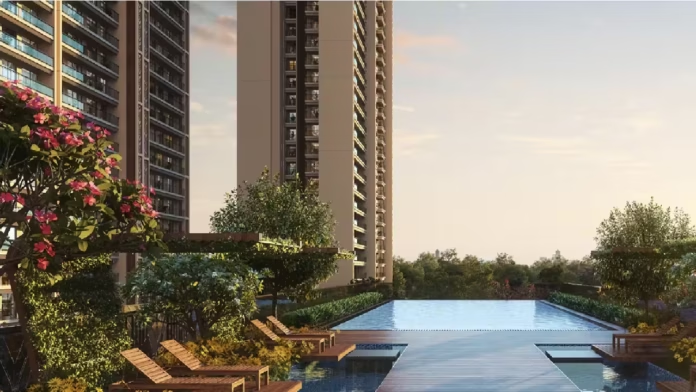
The supply of commercial office space in India’s major cities grew 26% year-on-year, with Pune emerging as the frontrunner, adding 3.7 million sq ft of new inventory. The surge reflects heightened demand for modern, flexible workplaces and underscores the resilience of urban commercial real estate in the post-pandemic landscape. Industry experts suggest that this growth signals both corporate expansion and a strategic shift toward tier-2 cities.
Analysts attribute Pune’s leading position to its strong IT, ITES, and start-up ecosystem, which continues to attract both domestic and international firms. “Pune’s new office additions highlight the city’s evolving position as a commercial hub, with high-quality workspace becoming a key factor in corporate site selection,” said a real estate analyst familiar with the market.Across other top cities, including Bengaluru, Hyderabad, and Gurugram, the growth has been steady but less pronounced, reflecting market maturity and land availability constraints. Bengaluru added approximately 3.2 million sq ft, while Hyderabad and Gurugram each reported around 2.8 million sq ft of new space. The increase in supply is closely aligned with corporate demand for sustainable and technologically advanced office buildings that incorporate energy efficiency, flexible layouts, and wellness-oriented design.
From a regulatory and urban planning perspective, the expansion underscores the need for cities to integrate infrastructure, mobility, and environmental considerations. Stakeholders note that ensuring sustainable development is critical as office density increases. Modern office spaces now increasingly include net-zero building practices, renewable energy integration, and gender-neutral design elements to support inclusivity.An official from a leading commercial real estate consultancy observed, “The post-pandemic office market is not just about square footage. Companies are prioritising resilience, smart building features, and flexible lease structures, which also encourages developers to focus on quality over quantity.”
Pune’s 3.7 million sq ft addition is concentrated in IT parks and business districts that offer superior connectivity and amenities. The city’s growth trajectory signals a broader trend of tier-2 urban centres emerging as viable alternatives to traditionally dominant metros, attracting both start-ups and established enterprises.As India’s office market continues to expand, the emphasis on sustainable, inclusive, and technology-enabled workspaces is likely to define the next phase of urban commercial real estate growth. Observers suggest that cities focusing on green building certifications, integrated transit solutions, and resilient infrastructure will be better positioned to capture long-term demand.
Pune Sees Office Supply Surge Adding 37 Million Sq Ft Inventory Nationwide
Noida Great Value Realty Launches Rs 1600 Crore Luxury Residential Project Sector107
