
Mumbai Developer Marathon Nextgen Realty Reports 36% Profit Jump Despite 22% Revenue Fall

Mumbai Mandates Online Rent Registration Ending Stamp Paper Deals For Legal Transparency

In a significant move towards governance transparency and tenant protection, the Maharashtra government has made online registration mandatory for all rental agreements in Mumbai and surrounding regions. The policy aims to replace the decades-old practice of paper-based rental contracts, bringing all transactions under a verified legal framework and reducing informal dealings that often lead to disputes.
According to officials, this reform intends to make renting safer for both tenants and landlords by introducing a traceable, digital record for every agreement. “The new rule ensures accountability and legal validity for all rental arrangements,” a state housing department official explained. “Stamp paper-only agreements will no longer be recognised under the law.”
Under the new framework, every rental contract must be registered digitally and contain specific details such as the rent amount, deposit value, and lease duration. The document will also carry a digital government seal, ensuring authenticity. The government has capped residential deposits at three months’ rent and commercial deposits at six months’ rent. Additionally, every agreement must have a minimum term of 11 months to qualify for registration.
Failure to comply with these norms could result in penalties of up to ₹5,000 or even a three-month jail term for property owners. The government believes these deterrents will accelerate the city’s transition to transparent, digitally recorded rental transactions.Experts say the reform is a major step in formalising Mumbai’s vast rental housing sector, which has long operated through informal cash-based agreements. A senior property consultant noted that this could “significantly reduce legal grey zones” while also helping authorities gather accurate data on rental trends and housing demand.
The digital registration platform will simplify the process for both tenants and landlords. Documents such as Aadhaar, PAN, and property details must be uploaded to the government’s official portal. Once verified, the system generates a registered e-agreement that holds the same legal status as a traditional document.For citizens, the change offers long-term benefits including legal clarity, protection from fraud, and a reliable means of resolving disputes. It also aligns with Mumbai’s broader push towards paperless governance and digital urban infrastructure. By digitising the city’s rental framework, Maharashtra is taking another step toward a transparent, equitable, and inclusive housing ecosystem.As one urban planner summarised, “This isn’t just a procedural reform it’s a structural shift in how Mumbai defines trust and accountability in its housing market.”
Mumbai Mandates Online Rent Registration Ending Stamp Paper Deals For Legal Transparency
Mumbai Parking Demand Reveals Real Estate Investor Confidence And Luxury Housing Market Trends

In India’s competitive real estate market, parking availability has evolved from a basic facility to a subtle yet powerful barometer of buyer sentiment, investor confidence, and project viability. Industry analysts suggest that the rate at which parking spaces sell or remain unsold can reveal far more about a development’s long-term prospects than traditional market metrics like price or location.
At new housing launches, swift uptake of parking slots often signals strong end-user demand and investor optimism. Conversely, projects where developers struggle to sell or must discount parking spaces tend to be dominated by short-term investors, with weaker prospects for sustained occupancy. “When a project is launched, investors quietly track what’s called ‘parking velocity’. It’s an underrated but telling measure of who’s buying residents or speculators,” explained a senior housing market analyst.
In emerging neighbourhoods, where urban infrastructure is still taking shape, fast-selling parking bays indicate investor conviction about future growth and migration. In contrast, mature micro-markets with sluggish parking sales could point to saturation or limited end-user activity.Real estate consultants note that in cities such as Mumbai, Delhi, and Bengaluru, the scarcity and cost of parking spaces have turned them into a quasi-asset class. In premium projects, one parking slot can cost anywhere between ₹10 lakh and ₹30 lakh depending on location and configuration. In ultra-luxury developments, additional parking slots are sometimes traded or leased separately, offering investors an unconventional but lucrative secondary revenue stream.
Developers typically follow what experts call the “bedroom-minus-one” rule: a 3BHK apartment includes two parking slots, a 4BHK comes with three, and so on. This ratio not only shapes project design but also influences the pricing strategy and overall marketability. “For luxury buyers, parking location and access time are deal breakers,” said a senior director at a global real estate consultancy. “A surface slot near the entryway is far more desirable than a multi-level automated system, no matter how advanced.”
Industry observers agree that parking policy remains underregulated. While open parking cannot be sold as per housing authority norms, covered parking may be priced separately. This grey area often causes disputes during possession handovers.As Indian cities face acute space shortages, developers and urban planners are exploring automated, shared, and green mobility-integrated parking systems. Experts believe that the next evolution in urban real estate will depend not just on how people live but where they park.
Mumbai Parking Demand Reveals Real Estate Investor Confidence And Luxury Housing Market Trends
Mumbai Sea-Facing Juhu Flat Linked To Harshad Mehta Set For Auction Soon
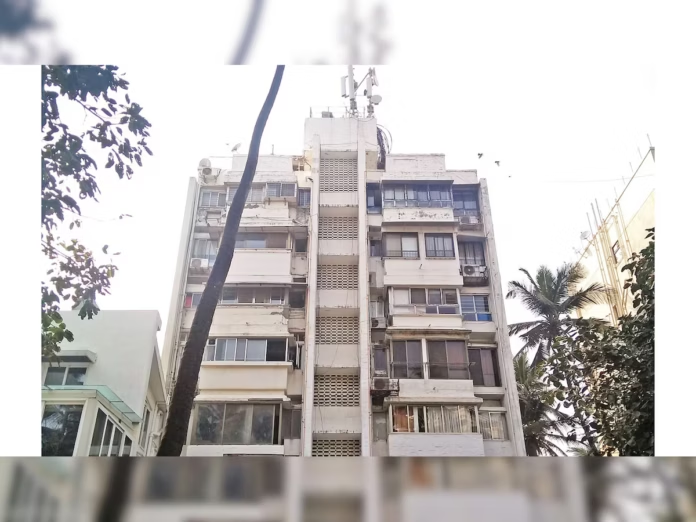
A sea-facing apartment in Juhu once associated with late stockbroker Harshad Mehta is set to be auctioned by a special court overseeing securities-related offences. The 1,150-square-foot flat, located in the Vandana Cooperative Housing Society at Janki Kutir, will be sold on an “as is, where is” basis, marking yet another attempt to liquidate assets tied to the infamous 1992 securities scam.
The property, previously owned by the late Sushila Shah a partner in Romil Exports and a judgment debtor in a case linked to Mehta’s firm, Orion Travels has a complex legal history. The special court approved its sale on 10 October, inviting potential buyers to submit offers through a public notice. Similar auctions held in 2021, 2023, and early 2025 had failed to attract bidders.
According to local brokers, unencumbered flats in the same Juhu building command prices ranging between ₹45,000 and ₹50,000 per square foot. The upcoming sale could therefore fetch over ₹5 crore if market demand remains strong. However, experts believe the property’s litigation history and association with the Mehta case might deter some buyers.
“This is a prime address, close to Prithvi Theatre and Juhu beach, yet buyers tend to be cautious when properties are burdened with legacy legal complications,” said a Mumbai-based real estate consultant.Harshad Mehta, once hailed as the “Big Bull” of Dalal Street, masterminded a ₹700-crore securities scam in the early 1990s by exploiting banking loopholes and manipulating stock prices. His actions triggered a market collapse that wiped out the savings of thousands of small investors, leading to a major overhaul of India’s financial regulations. Mehta was convicted in four criminal cases before dying of a heart attack in custody in 2001.
Over the years, authorities have auctioned several assets belonging to Mehta and his associates, including eight Worli Sea Face apartments in the Madhuli building, which were sold in 2009 for ₹32.6 crore. The latest auction continues the long process of recovering funds from properties linked to the scam.For Mumbai’s real estate market, the renewed interest in legacy properties like this one highlights both the city’s enduring demand for coastal homes and the importance of transparent asset disposal mechanisms. As experts note, each such sale reflects not only a piece of financial history but also the city’s evolving relationship with accountability and urban value recovery.
Mumbai Sea-Facing Juhu Flat Linked To Harshad Mehta Set For Auction Soon
Bengaluru MAIA Estates Secures Rs 120 Crore Funding For Seven Project

Bengaluru’s real estate sector has received a notable boost as MAIA Estates announced securing Rs 120 crore from Arnya to develop The Seven, a high-end housing project in South Bengaluru’s Basavanagudi area. Scheduled to commence in early 2026, the project will span approximately 6 lakh square feet, positioning itself as a premium residential offering targeting affluent buyers seeking spacious homes in established neighbourhoods.
Founded in 2016, MAIA Estates has steadily grown its portfolio, currently overseeing developments across 11 million square feet in Bengaluru. The company has focused on projects that combine modern design with sustainable practices, aiming to create inclusive and energy-efficient communities. Industry experts note that this funding milestone reinforces Bengaluru’s status as a resilient hub for luxury residential development.
The Seven is expected to feature a mix of large-format residences, including 4-BHK and 5-BHK apartments, designed to meet the growing demand for expansive homes in well-connected urban localities. Analysts highlight that the Basavanagudi location adds strategic value to the project, offering proximity to educational institutions, commercial centres, and established civic infrastructure, which makes it particularly appealing to long-term investors and high-net-worth individuals.
An official from MAIA Estates explained that the infusion of capital will be used to initiate construction while implementing advanced building techniques to ensure structural safety, energy efficiency, and minimal environmental impact. “We are committed to aligning our developments with sustainable urban planning principles, integrating green spaces, and utilising materials and systems that reduce carbon footprint,” the official said.
Market observers suggest that The Seven exemplifies the emerging trend of luxury redevelopment projects in central Bengaluru neighbourhoods, where legacy properties and underutilised plots are being transformed into modern residential complexes. This reflects broader shifts in urban housing demand, with a focus on quality, size, and amenities rather than mere unit quantity.The project is anticipated to reach completion by 2029, contributing to Bengaluru’s ongoing narrative of high-end residential expansion while balancing environmental sustainability and modern lifestyle expectations. MAIA Estates’ approach underscores the potential for responsible urban development that meets market demand without compromising on ecological or social considerations.
Bengaluru MAIA Estates Secures Rs 120 Crore Funding For Seven Project
Mumbai Malabar Hill Redevelopment Drives High End Luxury Large Homes Demand Rapidly

Malabar Hill, one of south Mumbai’s most prestigious residential neighbourhoods, is witnessing a notable surge in redevelopment activity as demand for large, high-end homes rises. Historically dominated by century-old bungalows and long-standing family estates, the area is now seeing major real estate developers initiate projects, signalling a new phase of construction in a location where new developments were once rare.
This transformation is reshaping both the skyline and market dynamics of the elite neighbourhood.The current supply of luxury housing in Malabar Hill remains limited, which has helped sustain strong demand despite some of the highest property prices in the country. Developers are focusing on 4-BHK and 5-BHK apartments, duplex units, and penthouses, catering to affluent homebuyers seeking larger living spaces.
Active projects are concentrated along prime roads including Narayan Dabholkar Road, Nepean Sea Road, and Ridge Road, offering modern amenities, improved infrastructure, and high-quality construction standards.
Long-term residents have expressed concerns regarding the increase in construction, citing potential disruptions to their surroundings, loss of greenery, and strain on local services. Heavy machinery, high-rise structures, and underground drilling are cited as possible threats to the natural balance of the hill. However, developers argue that many older structures require structural upgrades to meet modern safety standards.
They maintain that redevelopment can improve urban planning through enhanced drainage systems, energy-efficient infrastructure, and better traffic management, ultimately benefiting residents in the long term.
Industry experts note that redevelopment in historically significant areas like Malabar Hill requires a careful balance between preserving heritage and accommodating growing demand for premium housing. By engaging with housing societies and incorporating sustainable design practices, developers aim to create projects that are safer, more efficient, and aligned with contemporary living standards.
The trend also reflects broader shifts in Mumbai’s residential market, where high-net-worth buyers continue to prioritise space, luxury, and long-term lifestyle value.While construction activity is increasing, regulatory compliance, community consultation, and environmental considerations remain essential to ensure a sustainable urban transformation. Redevelopment in Malabar Hill is thus emerging as a model for integrating modern housing demands within historically and socially sensitive urban landscapes.
Mumbai Malabar Hill Redevelopment Drives High End Luxury Large Homes Demand Rapidly
Delhi NCR Developers Urge Site Specific Construction Amid Severe GRAP Stage Three

With air quality in Delhi-NCR persisting in the ‘severe’ category, the Commission for Air Quality Management (CAQM) has invoked GRAP Stage III measures, restricting construction and demolition to mitigate hazardous pollution. The move, while aimed at protecting public health, has prompted developers to call for a more calibrated approach to avoid delays in ongoing residential and commercial projects.
Industry representatives contend that RERA-registered developments, which already adhere to strict environmental standards, should be exempted or allowed under controlled conditions. “Site-specific regulation, where construction continues only at locations with air quality below GRAP Stage III thresholds, can safeguard public health while preventing unnecessary project delays,” said a senior developer familiar with the matter. They emphasised that indiscriminate bans could jeopardise delivery timelines and inflate project costs for homebuyers.
Developers propose enabling low-pollution construction activities to continue, provided compliance with construction and demolition (C&D) waste management guidelines. Techniques such as aluminium shuttering, monolithic construction methods, and hydraulic rebar cutters are cited as less polluting alternatives to conventional practices. Painting and other minor activities, contributing less than 11% to total particulate emissions, could also continue with adequate safeguards.
Concrete batch mix plants located on-site have been suggested to operate under strict controls to minimise vehicular movement and reduce emissions. Continuous real-time air quality monitoring at construction sites ensures that activities can be paused or modified if pollution spikes above safe thresholds. “These measures create a balance between environmental responsibility and economic continuity,” added an urban planning expert.
Nevertheless, some industry voices underline the urgency of GRAP Stage III enforcement. Dinesh Gupta, president of CREDAI Western UP, affirmed that stringent measures are necessary under severe air quality conditions. Developers and contractors are being urged to maintain water sprinkling, debris covering, minimal diesel generator usage, and adoption of eco-friendly energy solutions to further mitigate pollution.
The debate reflects the broader challenge of sustaining urban growth while protecting public health in India’s densely populated metro regions. Experts suggest that policy frameworks incorporating real-time data, pollution-mitigating construction techniques, and tiered restrictions may offer a sustainable solution, ensuring project continuity without compromising air quality goals.As Delhi-NCR confronts recurring pollution crises, a nuanced, evidence-driven approach may emerge as the model for balancing development needs with environmental imperatives, particularly in sensitive urban corridors undergoing rapid infrastructure and residential expansion.
Delhi NCR Developers Urge Site Specific Construction Amid Severe GRAP Stage Three
Telangana Orders Construction Of 28 MW Solar Power Plant At KTPP Site

Telangana has taken a significant step towards augmenting renewable energy capacity with plans to establish a 28 MW solar power plant at the Kakatiya Thermal Power Plant (KTPP) in Chelpur, Jayashankar Bhupalpally district. Principal Secretary (Energy) Navin Mittal directed officials to initiate the necessary processes for the project, signalling the state’s commitment to integrating sustainable energy solutions alongside conventional power generation.
Mr. Mittal, accompanied by Telangana State Power Generation Corporation (TS-Genco) Chairman and Managing Director S. Harish, conducted a detailed inspection of Units 1 and 2 of KTPP on Tuesday to review operational performance and assess infrastructure readiness. “Integrating solar power within existing thermal plant frameworks represents an important step towards hybrid energy models and reduced carbon footprints,” an official said.
Following the inspection, Mr. Mittal visited the Tadicherla-I Coal Block Opencast Mine (OCP) to evaluate coal transport logistics. Officials briefed him on the proposed land acquisition for laying a dedicated conveyor belt from Tadicherla to KTPP, which aims to streamline coal movement, minimise road transport, and reduce environmental impacts from vehicular emissions.
The principal secretary emphasised the need for expeditious land acquisition while ensuring transparent and fair rehabilitation measures for affected communities. “Efficient execution of both renewable integration and coal transport infrastructure is critical to sustainable power operations and urban energy resilience,” an energy department source noted.
Experts highlight that hybridising thermal plants with solar installations not only diversifies power sources but also contributes to India’s net-zero energy goals. “Projects like KTPP’s solar integration can serve as replicable models for other states seeking to blend renewable energy with conventional plants, enhancing grid stability and long-term sustainability,” said an energy analyst.
The solar project aligns with Telangana’s broader renewable energy strategy, which targets increased solar and hybrid capacities to meet growing urban and industrial electricity demand while reducing carbon emissions. By coupling traditional coal-based generation with solar power, the state aims to maintain reliable energy supply without compromising environmental commitments.
Officials also underscored that coordinated planning of land, logistics, and rehabilitation is essential to minimise delays and maximise the efficiency of new energy projects. The initiative demonstrates how policy, governance, and technical oversight can converge to deliver environmentally responsible energy infrastructure.As Telangana expands its renewable portfolio alongside established thermal operations, projects such as the 28 MW KTPP solar plant reflect a balanced approach to energy security, economic growth, and climate-conscious urban development.
Telangana Orders Construction Of 28 MW Solar Power Plant At KTPP Site
Mumbai Government Forms Committee To Record Flat Owners Names In Land Records

The Maharashtra government has established a high-level committee in Mumbai to devise a uniform framework for recording the names of individual apartment owners in official land records. The initiative is aimed at simplifying property transactions, easing access to home loans, and accelerating redevelopment projects in the state’s densely populated urban areas.
Currently, most apartment owners hold documents such as sale deeds and housing society share certificates, but their names are not recorded in the 7/12 extract or Property Register Cards, which form the legal record of land ownership. “This gap often complicates mortgage approvals, delays redevelopment, and can trigger legal disputes,” an official said.
Under the Maharashtra Land Revenue Code, 1966, property rights are recorded under Sections 149 to 151. However, the system presently captures only the land-holding entity typically a cooperative society or developer rather than individual apartment holders. Practices vary across districts, resulting in inconsistencies for multi-storeyed properties, the government noted in a resolution issued on 30 October.
The newly formed committee is chaired by the additional chief secretary (Revenue), with members including officials from urban development, cooperation, law, rural development, registration, and land records. Its mandate is to propose clear rules for incorporating individual apartment ownership into land records while defining how common areas, amenities, and underlying land are documented. The panel has been asked to submit recommendations within one month.
Industry experts welcome the move, highlighting its potential to improve transparency and unlock stalled redevelopment projects in Mumbai’s older housing stock. “Standardising apartment ownership in land records will streamline property financing and reduce legal ambiguities,” an urban property consultant said.The committee will also examine frameworks adopted by other Indian states for registering vertical property ownership, aligning its recommendations with the forthcoming vertical property rules. These rules are particularly critical for Mumbai, where most residential units are located in stacked apartments rather than horizontal plots.
Officials emphasise that once implemented, the reform will benefit citizens by making property transactions more straightforward and secure. Banks will be able to verify ownership more efficiently, while developers and society members can resolve disputes over common areas and maintenance responsibilities.The initiative aligns with broader urban governance goals, fostering equitable and transparent property systems while supporting sustainable city redevelopment. By formalising apartment ownership in official records, Maharashtra aims to modernise its land registry, reduce procedural bottlenecks, and provide a reliable legal framework for the state’s rapidly urbanising landscape.
Mumbai Government Forms Committee To Record Flat Owners Names In Land Records
India Housing Market Value To Surge 20 Percent In FY26 Despite Flat Volumes
