
Concorde Buys 3 Acres in Hennur for Premium Residental Development

NHPC plans massive 27,000 MW renewable energy expansion

NHPC has outlined a robust renewable pipeline totalling over 27 000 MW—including 8 193 MW operational, 9 843 MW under construction, and 9 030 MW in survey—to bolster India’s net‑zero and climate goals. India’s flagship hydropower PSU, NHPC Ltd, is dramatically expanding its renewable footprint, with over 27 000 MW of clean energy capacity in its pipeline.
Speaking at the ET India Net Zero Forum, its chair revealed the current portfolio includes 8 193 MW of commissioned “green” capacity, alongside 9 843 MW under construction and 9 030 MW in survey stages—cutting across hydro, pumped storage, solar, wind and green‑hydrogen initiatives. This expansion supports India’s stated ambition of achieving 500 GW of non‑fossil fuel capacity by 2030, with NHPC already commissioning 3 000 MW of renewables through 2027. As part of the government’s RE Implementing Agency programme, NHPC has tendered 16 000 MW and awarded 15 000 MW to development partners.
However, grid stability remains a key concern. The company emphasises the intermittency of wind and solar, and is calling for enhanced capacity in energy storage and alternative sources such as green hydrogen and biomass to balance India’s energy mix. NHPC also operates where geography meets ambition—hydropower dams are being stitched into eco-efforts. The company reports parallel afforestation drives alongside dam projects to broaden forest cover and biodiversity. Cross-border collaboration is emerging as another strategic lever. NHPC is exploring hydropower ventures with Bhutan and Nepal; it is already active in Nepal, tapping into the region’s latent hydro potential .
NHPC’s outlook for pumped-storage hydropower is vigorous. A pre-feasibility study is underway for pumped hydro systems, facilitating clean baseload power and energy balancing. The company’s pipeline includes solar, wind and battery initiatives too, alongside hydropower . Earlier, NHPC pledged to deliver 16 700 MW of renewable capacity by 2030 and produce 500 tonnes of green hydrogen annually, backed by ₹80 261 crore capital investment and ₹450 crore for hydrogen infrastructure . Despite this momentum, India’s grid continues to rely heavily on coal, which still contributes around 75% of generation. Renewable sources are rapidly growing, but still require robust storage and grid integration capacity—NHPC’s trajectory aims to fill that gap.
Execution challenges remain. Ensuring quality project delivery and tying together solar, hydro, storage and hydrogen infrastructure requires complex coordination. Furthermore, visibility across tenders and clear PPA agreements will determine financial viability . Critics note that while afforestation adds green cover, genuine ecological value depends on species mix, long‑term survival and community stewardship. Transitioning rural economies – especially in Himalayan hydropower zones – requires ensuring gender‑inclusive local benefit and ecosystem integrity. If managed well, NHPC’s growth strategy could serve as a model for low‑carbon, climate‑resilient urban and rural development. Clean-energy expansion, storage capacity and cross-border collaboration support India’s net‑zero vision, while hydropower-led green corridors promise both ecological and energy dividend.
Yet the devil lies in delivery: from PPA frameworks and grid upgrades to storage roll-out and hydrogen affordability. With ₹100 billion-scale investment already underway, NHPC’s journey stands at a crossroads between policy promise and structural preparedness. For India’s rapidly urbanising regions, robust renewable infrastructure is essential for equitable, gender‑neutral energy access. NHPC’s renewable ambition offers the kind of scalable, green backbone that cities and communities rely upon—but its success will be judged not by capacity plans, but by clean energy actually flowing when needed.
NHPC plans massive 27,000 MW renewable energy expansion
Kapadvanj Acts Against Unsafe Buildings Before Rains

Kapadvanj Municipality in Kheda district has intensified its drive against structurally unstable buildings by issuing demolition notices to more than 20 property owners. The civic action underscores growing urgency among local governments across the state to prevent disasters triggered by building collapses during the rainy season.
This pre-emptive crackdown comes on the heels of a tragic incident last year in Kapadvanj where a child lost their life following the collapse of a dilapidated building. That accident drew significant public outrage, exposing lapses in both municipal vigilance and landlord accountability. The municipality has since been under pressure to act decisively before another avoidable tragedy occurs.
Municipal officials said the identified structures pose an immediate threat to public safety. The chief municipal officer has cautioned that property owners will face criminal charges if their negligence results in injury or death. “If any incident occurs due to your negligence, criminal action will be taken under relevant laws,” reads the strongly worded official notice.
In cases where landlords reside outside the city or have remained unresponsive, the notices have been served to current tenants instead, shifting legal accountability to those occupying the premises. Several landlords reportedly failed to respond to earlier communications from the civic body, forcing authorities to act directly on-site.This proactive move in Kapadvanj is part of a broader, statewide effort to mitigate risks posed by ageing, unmaintained structures. Gujarat’s Urban Development Department has instructed all municipal bodies to identify vulnerable properties and carry out structural surveys with urgency. The directive has triggered action across both major urban centres and smaller municipalities.
In Ahmedabad, the municipal corporation has declared 513 residential structures as “dangerous,” especially in areas where large gatherings are expected during the upcoming Rath Yatra on June 27. Over 190 units have already had their water and sewer connections disconnected due to non-compliance. Another 1,300-plus units have received formal repair orders.Surat’s Limbayat area has seen a similar surge in civic action, where over 1,500 old buildings have been issued repair or demolition notices. The objective is clear — to prevent avoidable collapses during peak monsoon, when weakened structures face additional stress from heavy rain and flooding.
This rising focus on preventive demolition has emerged as a crucial urban risk management strategy. Experts in urban planning argue that structural safety, especially in older districts, must be integrated into sustainable city design. Ageing infrastructure not only endangers lives but also places disproportionate burdens on emergency services during weather extremes.Kapadvanj’s crackdown may set a precedent for other tier-two towns where enforcement of building codes has historically been lax. The move also opens up dialogue on the need for inclusive redevelopment policies — ones that balance heritage conservation with structural safety, and tenant rights with public welfare.
As climate variability increases the frequency and intensity of extreme weather, cities must re-evaluate the safety and resilience of their built environments. The Kapadvanj Municipality’s recent actions reflect an important shift towards accountability, public safety, and proactive civic governance.
Also Read : Reliance to invest Rs 8000 crore in beverage expansion drive
Kapadvanj Acts Against Unsafe Buildings Before Rains
City Design That Makes Us Feel Healthier
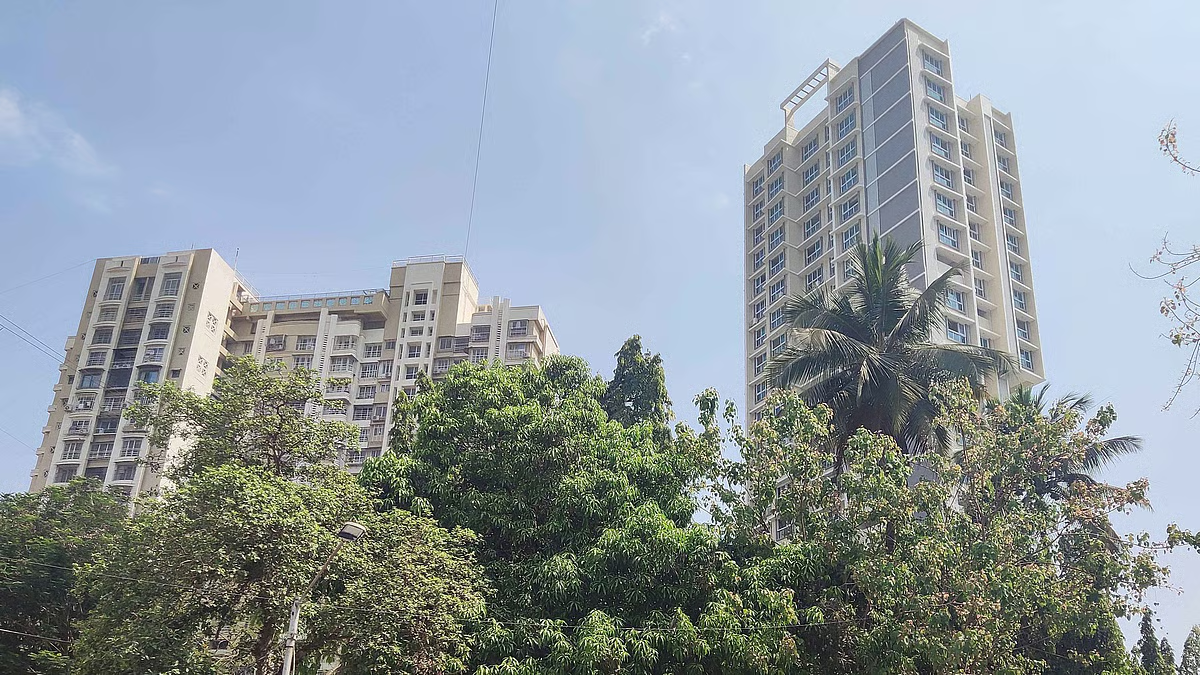
In the age of rapid urbanisation and increasing mental health concerns, a transformative question is being asked by urban designers and architects: What if our cities could actually make us feel healthier? Moving beyond the aesthetic and structural aspects of architecture, there is growing emphasis on the science of how spaces impact our psychological and physiological well-being.
This idea is rooted in a salutogenic approach to design — a concept that places the origins of health, not disease, at the core of architectural thinking. Coined by medical sociologist Aaron Antonovsky in 1979, salutogenesis focuses on what supports human health and well-being, in contrast to the traditional pathogenic model that focuses on risks and illness.At the forefront of this movement is architect and thinker Tye Farrow, who advocates for architecture that contributes positively to human performance, emotional resilience, and neurological stability. According to him, buildings and cities are not neutral backdrops. They constantly communicate with our nervous systems, influencing hormone production, stress responses, and even cognitive clarity.
Recent studies underscore just how much our surroundings shape us. On average, humans now spend close to 90% of their lives indoors — more time than some marine animals spend submerged in water. This statistic raises critical concerns about how our built environments are either harming or healing us.The salutogenic framework builds on three psychological dimensions: comprehensibility (does a space make sense and is it easy to navigate?), manageability (do we feel in control of our environment?), and meaningfulness (does the space provide a sense of purpose or connection?). These principles guide the design of environments that reduce cortisol levels (stress hormone), increase serotonin and endorphin levels (the ‘feel-good’ chemicals), and ultimately foster more resilient communities.
Designing for health isn’t merely about aesthetics. It’s about neurological engagement. When buildings incorporate natural light, plant life, open views, and clear spatial navigation, they don’t just look good — they help people feel safe, empowered, and connected. These features, when deliberately embedded into cities, can create what experts call “neurologically rich” environments that support brain health and emotional well-being.India’s rapidly densifying cities stand to benefit immensely from such a shift in design philosophy. Rather than viewing architecture as static structures, there is an urgent need to reframe them as living systems that influence public health. Schools, hospitals, public housing, offices and even transport hubs can become active contributors to the health of urban populations if they are designed to reduce stress and encourage social interaction.
Furthermore, salutogenic design aligns naturally with sustainable city goals — reducing dependency on resource-heavy interventions while creating spaces that are inherently more livable and inclusive. It calls for an end to the dominance of sterile, rigid forms and the embrace of softer, nature-integrated, human-scaled design practices.This mindset is slowly gaining traction globally, with architects, public planners and developers reconsidering the long-term impact of spatial choices on society. Leading design bodies are beginning to integrate salutogenic guidelines into urban codes and healthcare architecture, recognising buildings as non-invasive tools for preventive health.
In the context of Indian cities aiming to become smart, green, and equitable, prioritising the salutogenic value of design could be a key strategy. As urban development accelerates, embedding health outcomes into blueprints may determine whether cities serve as environments of thriving or merely surviving.
When city design becomes a catalyst for health, well-being ceases to be a byproduct — it becomes the purpose. And that could change everything.
Also Read : Reliance to invest Rs 8000 crore in beverage expansion drive
City Design That Makes Us Feel Healthier
Reliance to invest Rs 8000 crore in beverage expansion drive

Reliance Consumer Products Ltd (RCPL), the FMCG arm of Reliance Retail, is set to invest ₹6 000–₹8 000 crore over the next 12–15 months in beverage manufacturing, establishing 10–12 new production facilities across India. This bold move, including greenfield plants and co-packing units, signals a strategic challenge to dominant players Coca‑Cola, PepsiCo, and regional brands and will further Reliance’s ambition to command national market share by 2027.
RCPL currently operates 18 beverage plants—many through joint ventures—and has recently opened plants in Guwahati (with Jericho Foods & Beverages) and is developing a bottling unit in Bihar, amplifying distribution across eastern and northeastern regions . One of its recent launches, “Spinner,” a Rs 10 sports drink developed in collaboration with a noted former cricketer, is priced 20–40 per cent lower than equivalent global brands, capturing value-conscious consumers in Tier II and Tier III towns . Analysts describe this as RCPL’s most aggressive expansion yet, highlighting a long-term strategy targeting scale, price competitiveness, and expanded brand portfolio, which also includes Campa Cola, Sosyo, RasKik, and Independence. With India’s soft drink market valued around Rs 1.6 trillion and projected to grow 6–7 per cent annually, Reliance’s capacity ramp‑up aims to meet rising demand and challenge entrenched MNC dominance .
In FY 2024–25, RCPL posted revenues of Rs 11 500 crore, with legacy brands Campa and Independence each crossing the Rs 1 000 crore mark. Early monsoon rains, however, dampened peak‑summer sales—prompting the company to accelerate its national roll‑out. The target is 70 per cent beverage market coverage by March 2026 and full national reach by March 2027 . Reliance isn’t just building production—it’s leveraging its expansive retail ecosystem comprising Reliance Fresh, Smart, and JioMart, offering seamless distribution and quick commerce logistics . Meanwhile, Coca‑Cola and PepsiCo are responding with budget “B‑brand” lines and returnable Rs 10 glass bottles to protect premium margins
The strategy seems calibrated: deliver low‑cost, widely available beverages, while scaling operations in previously underserved regions. Northern and eastern bottling units—especially the ₹1 000‑crore Campa plant in Bihar—are integral to these plans. Meanwhile, its pricing strategy, with 200 ml bottles at Rs 10—half the price of established rivals—is being sustained through higher trade margins (6–8 per cent vs the industry norm of 3.5–5 per cent) However, challenges remain. MNCs benefit from established brand equity and established 4 million outlet distribution networks; soft drink penetration in India remains below one‑third of potential . Moreover, the rising trend toward health and low‑sugar beverages means RCPL may need to expand into better-for-you variants to stay competitive .
Financially, RIL’s shares traded at Rs 1 428.90 on 19 June, marginally down, though analysts remain bullish, viewing this pivot as a value-rich, backward-integrated FMCG play.
Reliance to invest Rs 8000 crore in beverage expansion drive
Kansas City Towers to Become Urban Homes

Kansas City is set to witness a major transformation in its North Loop district, where two long-vacant office buildings — the Poindexter and Centennial towers — are being redeveloped into sustainable, mixed-income urban housing. Spearheaded by Arnold Development Group, the $76.6 crore project aims to convert these heritage structures into up to 192 residential units in the first phase, aligning with the city’s goal of promoting equitable and eco-friendly urban growth.
These two buildings, which once housed operations of DST Systems Inc., have remained unused since early 2020. The Poindexter Building, a seven-storey structure dating back to 1902, and the Centennial Building, a mid-century concrete edifice from 1950, together offer more than 490,000 square feet of potential living space. Importantly, they also come with over 1,500 existing garage parking spots — a logistical advantage that makes them prime for adaptive reuse.
Arnold Development Group, known for its sustainability-driven urban projects, has been working on the proposal for nearly a year. The firm envisions a vibrant residential community where 20 per cent of the homes are reserved for renters earning up to 60 per cent of the city’s median family income, helping to alleviate the city’s mounting demand for affordable housing. The upper floors of the Poindexter Building are also planned to house shared spaces such as a clubroom and co-working areas.
The Kansas City Planned Industrial Expansion Authority (PIEA) recently advanced the general development plan, paving the way for future property tax abatements and sales tax exemptions on construction materials. These incentives are considered essential to the financial viability of the conversion. In parallel, Arnold Development is pursuing federal and state historic tax credits and applying to the city’s Housing Trust Fund.
While preserving the historical character of the buildings, the project also intends to integrate energy-efficient upgrades, including Passive House-level standards in future phases. Although some modern technologies like triple-glazed windows may be restricted due to historic conservation rules, newer construction phases are expected to incorporate green building practices, reduced carbon footprints, and rooftop green spaces.Following the completion of the current phase, Arnold Development is eyeing additional development on the surrounding DST-owned surface parking lots. Long-term plans suggest the potential addition of hundreds more residential units and up to 62,000 square feet of retail space, turning this underutilised zone into a lively, walkable community.
For now, the focus remains on the conversion of the Poindexter and Centennial buildings, with the project expected to begin by late 2025 and completed within three years. If realised as planned, the redevelopment would not only preserve Kansas City’s architectural legacy but also set a model for inclusive and sustainable urban revitalisation.
Also Read : Lodha Acquires 945 Transit Camp Units for Vikhroli Redevelopment
Kansas City Towers to Become Urban Homes
Lodha Acquires 945 Transit Camp Units for Vikhroli Redevelopment

Lodha Developers has acquired 945 Permanent Transit Camp (PTC) units—spanning approximately 3.39 lakh sq ft—in Mankhurd from Arihant Construction for ₹567 crore, with ₹34 crore paid as stamp duty. The deal, registered on 3 June, enables Lodha to meet its Slum Rehabilitation Authority (SRA) obligations connected to its flagship Vikhroli redevelopment project
Under Mumbai’s Development Control & Promotion Regulations (DCPR) 2034, particularly Regulation 33(11), developers can transfer unutilised Floor Space Index (FSI) from one project to another by providing mandated PTC units elsewhere. Here, Lodha will hand over the acquired Mankhurd units to the SRA in lieu of PTC requirements, allowing it to unlock additional FSI in Vikhroli without building those camps on-site. Industry analysts note this has emerged as India’s largest off‑site PTC transfer and underscores a growing trend of leveraging asset-backed strategies to optimise commercial outcomes within regulation frameworks. For Arihant, monetising 83,000 sq m of its free‐sale inventory in a single transaction delivers substantial cash flow in one stroke.
This structure benefits Mumbai’s redevelopment model, aligning efficiency with sustainability. Off‑site compliance reduces time and carbon impacts from constructing PTCs at primary sites. It also supports equitable housing by delivering legal, permanent homes for displaced communities. However, experts caution that strict adherence to timelines and quality standards is crucial. Past projects have faced delays in PTC handovers, stalling free‑sale developments and triggering compliance issues. For transparency, stakeholder groups advocate for public monitoring of handover schedules, certification, and occupancy safeguards before enabling FSI bonus rights.
With prime land scarcity in Vikhroli, Lodha’s move reflects strategic urban planning—integrating regulatory compliance with market expansion. If executed effectively, it sets a benchmark for large-scale redevelopment: delivering affordable housing off-site while unlocking additional residential capacity, accelerating project timelines, and mitigating ecological impact.
Lodha Acquires 945 Transit Camp Units for Vikhroli Redevelopment
Joon Realty Launches Rs 450 Crore Adi Grand in Jaipur

Joon Realty has launched Adi Grand, a 40-acre ultra‑luxury, climate‑positive retreat near Jaipur, backed by a ₹450 crore investment. Situated along the upcoming Delhi–Jaipur–Mumbai Expressway (NH 148), the development features emission-reversing design, over 60% open green space centred on a man‑made lake, branded villas, a luxury resort, and a 75,000 sq ft clubhouse, complete with golf courses, landscaped gardens, and spa facilities.
Construction is underway and pre‑bookings are set to open in July 2025, with handovers scheduled by early 2027. Innovative eco‑tools like passive solar architecture, 100% rainwater harvesting, solar street lights, EV charging stations, greywater recycling, and on-site waste management aim to ensure carbon‑positive operation. This launch aligns with growing investor interest in mixed‑use developments, which attracted US$191 million from institutional investors in Q1 2025—a 46% jump year‑on‑year—according to Colliers. Such projects are increasingly attractive for blending lifestyle and investment returns.
As Joon Realty transitions from land‑banking to asset creation under its ₹1,125 crore capex strategy, the firm emphasises that Adi Grand reflects evolving consumer demands. According to a company spokesperson, high‑net‑worth buyers are placing enhanced value on environmental performance, with India’s sustainable luxury market projected to reach US$39 billion by 2025. Perfectly positioned an hour from heritage icons like Hawa Mahal and Amer Fort, Adi Grand appeals to NRIs, urban executives, and eco‑conscious investors. Passive design elements, combined with extensive biodiverse planning, promise net‑neutral or positive ecological impact. Still, critics urge detailed disclosures on CO₂ offsets and water savings to validate sustainability claims.
Execution risks remain, particularly regarding timeline pressures and compliance with strict environmental regulations. Land‑use alignment with heritage zones and protected ecosystems will require mindful collaboration with authorities. From a market perspective, luxury retreats with expressway connectivity and green credentials offer strong ROI potential. Government incentives—such as green tax rebates and low‑interest climate finance—could enhance viability further.
Ultimately, Adi Grand is billed as a flagship in climate‑responsive urban‑rural living, blending regenerative landscape, luxury amenities, and strategic policy alignment. With its promise of a sustainable future, it challenges the real estate sector to redefine luxury as responsible stewardship of natural and built environments.
Joon Realty Launches Rs 450 Crore Adi Grand in Jaipur
Bengaluru Tenants Buy Homes to Escape Rent Exploitation

Amid soaring rents and alleged exploitation by landlords, a growing number of Bengaluru tenants are rethinking their housing choices—some even opting to purchase homes rather than continue renting, despite short-term stays in the city. A recent Reddit post highlighting extreme rental experiences has sparked citywide discussion. Tenants cited issues such as mandatory six-month deposits, inflated maintenance charges, and unreturned security money.
The viral post described how landlords often deduct large sums arbitrarily—one tenant reported a ₹2,500 deduction for a table lamp worth ₹500. “What was once seen as a flexible housing option is now increasingly perceived as a financial trap,” one resident noted, expressing how renters feel pressured into homeownership not for investment, but to avoid alleged harassment by landlords.
One case in Ramagondanahalli illustrates this shift. A tenant who vacated a fully furnished villa claimed that the landlord deducted nearly ₹1 lakh from their deposit. This included charges for items discarded by the landlord’s own renovation worker, who was later fired. Even though a handover inspection showed all items intact, deductions followed when the landlord re-inspected the property.
Despite the landlords’ defence, some property owners admit the system is ripe for abuse. “Yes, some landlords charge unnecessarily—it’s easy money,” one wrote, acknowledging the lack of tenant protection and transparency in many housing agreements. The conversation has opened up broader concerns about housing affordability and rental governance.
Many renters say existing laws provide little recourse when landlords delay or withhold deposits. This insecurity is driving some to view property ownership as a safer, long-term alternative—even if they don’t plan to stay in Bengaluru permanently. However, not all agree that homeownership is the right response. “Owning a home in Bengaluru isn’t a small decision,” said one Reddit user.
“Buying property because of a few bad experiences might not be financially sound. It should align with long-term goals, not short-term frustrations.” The debate underscores a larger structural issue: a lack of regulatory oversight in Bengaluru’s rental market. Without standardised agreements or stronger legal safeguards for tenants, housing flexibility is fast becoming a liability—especially in India’s fastest-growing tech hub.
Bengaluru Tenants Buy Homes to Escape Rent Exploitation
Tata Chip Staff Get Housing Boost from Dholera Project
