
India Coal Production Milestone Strengthens Energy Security

Asian Paints Growth Slows Amid Housing Demand Shift

India’s decorative paints sector is showing signs of a consumption slowdown, with Asian Paints reflecting weaker momentum in its latest quarterly performance. The development signals a shift in urban consumption patterns, particularly in housing-related spending, where discretionary upgrades such as repainting are increasingly being deferred.
The company reported modest revenue growth of around 4 per cent year-on-year in the October–December quarter, even as net profit declined by roughly 4.6 per cent. This divergence points to underlying cost pressures and muted demand conditions, despite stable sales volumes. Industry observers interpret this as a sign that while construction activity continues, end-consumer spending on finishing and decorative segments is lagging.The slowdown appears closely linked to shifting urban consumption behaviour. Housing-related spending, particularly repainting cycles, has become more discretionary, with households delaying upgrades amid competing lifestyle expenses. Market insights suggest that changing social patterns—such as a rise in destination events over home-based gatherings—are indirectly impacting repainting demand, traditionally a key driver for the sector. At a broader level, this trend highlights a disconnect between structural growth in construction and actual consumption within the built environment. While infrastructure and housing supply continue to expand, the pace at which consumers invest in interior upgrades is becoming more cautious. For cities, this indicates that economic recovery is uneven—strong in core construction activity but softer in consumption-led segments.
Competitive pressures are also intensifying the slowdown. The entry of new players and aggressive pricing strategies have reshaped the paints market, forcing established companies to balance volume growth with margin protection. Analysts note that increased competition is not only affecting pricing power but also accelerating shifts in consumer preferences, especially in price-sensitive segments.Despite these headwinds, there are pockets of resilience. Industrial coatings and business-to-business segments have shown relatively stronger growth, supported by infrastructure and manufacturing activity. This suggests that while retail demand remains subdued, institutional demand linked to construction and industrial expansion continues to provide stability.From an urban development lens, the performance of companies like Asian Paints offers a nuanced view of city growth. Paint demand is often one of the final indicators in the construction cycle, reflecting completion and occupancy rather than just project initiation. A slowdown here can indicate delays in consumption rather than in construction itself.
Looking ahead, a recovery in demand will likely depend on improvements in consumer sentiment, stable input costs, and sustained housing activity. As cities continue to expand, the alignment between construction growth and end-user consumption will be critical.For the built environment sector, the current phase serves as a reminder that urban growth is not just about building more—but also about how and when people choose to invest in the spaces they inhabit.
Also Read: Nuvoco Cement Expansion Backed By Fresh Capital
Asian Paints Growth Slows Amid Housing Demand Shift
Nuvoco Cement Expansion Backed By Fresh Capital
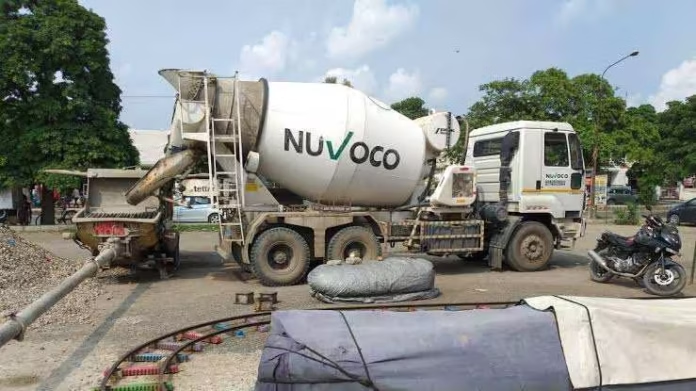
A fresh capital infusion into Nuvoco Vistas Corporation’s cement business is signalling renewed momentum in capacity creation, as India’s construction sector aligns with rising infrastructure and housing demand. The move comes amid a broader India cement demand recovery, where financing activity is increasingly tied to long-term expansion rather than short-term cycles.
The company’s wholly owned subsidiary, Vadraj Cement Limited, has raised ₹300 crore through a structured issuance of compulsorily convertible debentures to a group of institutional investors. The fundraising, executed via private placement, involves 30,000 instruments that will convert into equity over time, strengthening the subsidiary’s capital base. The proceeds are expected to support operational and financial restructuring within Vadraj, including repayment of internal financial support and associated costs. This is particularly significant given the asset’s recent transition into Nuvoco’s portfolio, following a debt resolution-led acquisition aimed at reviving stalled cement capacity.From an urban development perspective, such capital deployment reflects a deeper structural shift in the cement sector. As the India cement demand recovery gains traction, companies are focusing on balance sheet strengthening and capacity readiness to meet future demand from infrastructure corridors, housing projects, and industrial clusters.
Industry observers note that cement financing today is increasingly aligned with long-term urban growth patterns. Investments are not only directed at expanding output but also at improving operational efficiency, logistics integration, and energy use. For assets like Vadraj, which are being revived and integrated into larger networks, capital infusion plays a critical role in accelerating utilisation and reducing project delays.The timing is notable. India’s infrastructure push—driven by transport networks, urban redevelopment, and regional connectivity—has begun translating into steady material demand. Cement, as a core input, is closely linked to execution timelines of public and private projects. Strengthening production capacity ahead of peak demand cycles ensures that supply constraints do not hinder development.At the same time, the nature of funding—convertible instruments rather than conventional debt—suggests a cautious but strategic approach. By linking capital to future equity conversion, companies can manage leverage while aligning investor returns with long-term operational performance. This approach also provides flexibility in a market where demand recovery remains steady but not uniform.There is also a sustainability dimension to these investments. Reviving and modernising existing cement assets allows companies to integrate cleaner technologies, improve energy efficiency, and reduce emissions intensity. As cities increasingly prioritise climate-resilient infrastructure, the environmental performance of building materials will become as important as their availability.
Looking ahead, the trajectory of the India cement demand recovery will depend on how effectively such capital investments translate into operational capacity and timely project execution. For urban India, this will shape not just the speed of construction, but also the quality and sustainability of the built environment in the years to come.
Also Read: India Cement Output Growth Holds Amid Core Slowdown
Nuvoco Cement Expansion Backed By Fresh Capital
India Cement Output Growth Holds Amid Core Slowdown

India’s core infrastructure output slowed in February 2026, but a strong rise in cement production has highlighted underlying resilience in construction activity, even as broader industrial momentum weakened. The divergence underscores how India cement demand recovery is continuing to support urban development and infrastructure execution despite macroeconomic headwinds.
Official data shows that cement production grew by 9.3 per cent year-on-year in February, emerging as one of the fastest-expanding segments within the eight core industries. This comes even as overall core sector growth dropped to 2.3 per cent, marking a three-month low and reflecting stress in energy-linked sectors such as crude oil and natural gas. The strength in cement output points to sustained activity in construction, particularly across housing and public infrastructure. Urban planners and industry observers note that cement consumption often serves as a proxy for on-ground project execution, linking it directly to how quickly cities expand and infrastructure is delivered. The ongoing India cement demand recovery therefore signals that project pipelines remain active, even if broader industrial indicators appear subdued.This trend is closely tied to India’s infrastructure-led growth strategy. Public investment in transport networks, urban systems, and logistics corridors continues to drive demand for building materials. Cement, which carries a weight of over 5 per cent in the core industries index, plays a critical role in translating policy intent into physical development on the ground.
At the same time, the moderation in overall core sector growth reveals an uneven recovery. While cement and steel recorded healthy expansion—steel output rose 7.2 per cent in February—the slowdown in electricity generation and contraction in energy sectors pulled down the aggregate index. Analysts interpret this as a sign that construction demand is holding steady, but broader industrial conditions remain fragile.For cities, this divergence has practical implications. Strong cement output suggests that housing projects, road construction, and urban infrastructure are continuing, albeit at a measured pace. However, slower growth in supporting sectors like energy could affect project timelines, costs, and overall efficiency of execution.The India cement demand recovery is also becoming more geographically dispersed. Growth in Tier 2 and Tier 3 cities, supported by regional infrastructure investments and housing demand, is contributing to a wider distribution of construction activity beyond major metropolitan areas. This shift is expected to support more balanced urbanisation, reducing pressure on large cities while enabling new growth centres.From a sustainability perspective, rising cement demand brings both opportunity and responsibility. As production scales up, the sector faces increasing pressure to adopt low-carbon technologies and energy-efficient processes. Industry-wide efforts to integrate renewable energy and reduce emissions will be critical in ensuring that construction growth aligns with climate-resilient urban development goals.
Looking ahead, the durability of the India cement demand recovery will depend on consistent infrastructure execution and stable input conditions. While current data indicates steady construction momentum, translating this into long-term urban transformation will require coordinated planning, efficient delivery, and a continued focus on sustainable building practices.
Also Read: Shree Cement Reflects India Cement Demand Recovery
India Cement Output Growth Holds Amid Core Slowdown
Shree Cement Reflects India Cement Demand Recovery

A renewed India cement demand recovery is beginning to reshape the country’s construction and infrastructure landscape, with early signals reflected in operational momentum at major producers such as Shree Cement. The shift highlights improving construction activity across housing and public works, underlining how material demand often mirrors the pace of urban expansion.
Recent industry trends suggest that cement consumption is picking up after a muted phase, supported by easing input costs and better production efficiencies. For large manufacturers like Shree Cement, this has translated into improved volumes and capacity utilisation, indicating that project pipelines—especially in housing and infrastructure—are gradually regaining traction. The India cement demand recovery is therefore not just a sectoral shift but a broader signal of economic activity linked to construction.The recovery aligns closely with India’s infrastructure-led growth strategy. Increased public capital expenditure on transport, logistics, and urban infrastructure continues to anchor demand for core building materials. As cities expand and new corridors emerge, cement remains a foundational input, connecting policy decisions directly to on-ground development outcomes. Industry observers note that sustained government spending is likely to stabilise demand cycles over the medium term.Urban planners highlight that cement demand is often a leading indicator of city-building intensity. Housing accounts for a significant share of consumption, tying the sector to affordability, migration, and urbanisation patterns. With Tier 2 and Tier 3 cities seeing increased policy focus and investment, demand is becoming more geographically distributed. This shift could reduce pressure on megacities while enabling more balanced regional growth.
However, the recovery remains measured rather than uniform. Broader infrastructure output data indicates steady but moderated growth, reflecting cautious investment sentiment amid global uncertainties. For companies like Shree Cement, this means navigating a landscape where demand is improving but still sensitive to policy execution and macroeconomic conditions.On the supply side, the sector is undergoing structural changes. Cement producers are expanding capacity while simultaneously investing in cleaner energy and efficiency improvements. Shree Cement, for instance, has been advancing its use of renewable energy, signalling a wider transition towards low-carbon production. This evolution is critical as the construction sector faces increasing pressure to align with climate goals and reduce its environmental footprint.From an urban development perspective, the India cement demand recovery carries significant implications. Improved supply conditions and cost rationalisation can make housing and infrastructure projects more viable, potentially easing affordability constraints. At the same time, integrating sustainability into material production will be essential for building climate-resilient cities.
Looking ahead, the trajectory of demand will depend on how effectively infrastructure investments translate into execution on the ground. For cities, this will determine whether growth remains uneven or evolves into a more inclusive and sustainable urban expansion model.
Also Read: Goa Land Crisis Intensifies Pressure On Urban Planning
Shree Cement Reflects India Cement Demand Recovery
Goa Land Crisis Intensifies Pressure On Urban Planning

A growing shortage of accessible and legally viable land in Goa is reshaping conversations around urban development, with policymakers, planners, and local communities increasingly questioning the sustainability of current growth patterns. The Goa land crisis has emerged as a defining challenge for the state’s future, influencing housing affordability, infrastructure planning, and environmental conservation.
Unlike larger metropolitan regions, Goa’s land dynamics are constrained by geography, ecological sensitivity, and fragmented ownership patterns. With large portions of land falling under protected zones, coastal regulation areas, and forest cover, the supply of developable land has remained limited even as demand from tourism, real estate, and migration continues to rise. Urban planners note that the Goa land crisis is not merely a question of scarcity but of competing priorities. Tourism-driven development, second-home demand, and infrastructure expansion are placing pressure on finite land resources, often leading to conflicts between economic growth and environmental preservation. In several cases, projects have faced delays or opposition due to concerns around ecological impact and community displacement.
The situation has also exposed structural gaps in land governance. Experts point to outdated land records, unclear titles, and complex approval processes as key factors slowing down responsible development. These challenges can lead to speculative activity, where land prices escalate without corresponding improvements in infrastructure or services.
From a housing perspective, the Goa land crisis is contributing to rising costs, making it increasingly difficult for local residents to access affordable housing. As land values climb, developers tend to prioritise premium or tourism-oriented projects, further narrowing the availability of mid-income and affordable housing options.
Environmental considerations remain central to the debate. Goa’s fragile coastal ecosystems and biodiversity-rich interiors are highly sensitive to unplanned construction. Urban development in such contexts requires careful zoning, low-impact construction practices, and a focus on resilience against climate risks such as flooding and coastal erosion.
Industry observers suggest that a shift towards more compact, mixed-use development could help optimise land use while reducing pressure on greenfield areas. Transit-oriented planning and redevelopment of underutilised urban pockets are also being discussed as potential solutions to balance growth with sustainability.
The Goa land crisis is also prompting a broader rethink of economic strategy. As land becomes a limiting factor, there is increasing emphasis on diversifying growth beyond land-intensive sectors. Knowledge-based industries, digital services, and low-impact tourism models are being explored as alternatives that can generate employment without placing excessive strain on land resources. For policymakers, the challenge lies in aligning land use policies with long-term urban resilience goals. This includes improving data transparency, streamlining approvals, and ensuring that development frameworks prioritise both ecological protection and social equity.
As Goa navigates this complex transition, the way it addresses the land constraint will have lasting implications. The outcome will not only shape the state’s urban form but also determine whether growth can remain inclusive, environmentally responsible, and economically viable in the years ahead.
Goa Land Crisis Intensifies Pressure On Urban Planning
Pune Micro Zoning Plan To Reshape Property Values

Property valuation in Pune is set for a structural overhaul, with the state government preparing to introduce a micro-zoning framework aimed at refining how ready reckoner rates are calculated. The move, expected to begin in 2027, is likely to significantly alter the way property transactions are valued, with implications for homebuyers, developers, and urban planning.
At present, property values for stamp duty calculations are determined using broad geographic zones, often grouping diverse neighbourhoods under a single rate. Officials indicate that the proposed system will break these large zones into smaller, more granular segments, allowing valuations to better reflect actual on-ground conditions. The Pune micro zoning plan is being positioned as a corrective step to address long-standing inconsistencies in property pricing.
Urban economists point out that the existing framework has often led to distortions, where older or lower-income housing clusters are valued similarly to premium developments located nearby. This has had a direct impact on transaction costs, particularly for buyers in informal or ageing housing stock who end up paying higher duties than their property’s market value would justify.
The Pune micro zoning plan seeks to resolve this by introducing technology-led mapping of properties using Geographic Information Systems (GIS). By assigning values at a plot or building level, authorities aim to capture variations within even short distances—differences driven by infrastructure access, building typology, and neighbourhood characteristics.
According to officials familiar with the proposal, the new system will initially be rolled out in high-density and high-value regions such as Pune and the Mumbai Metropolitan Region, where price disparities are most pronounced. A phased expansion across Maharashtra is expected once the framework is tested and stabilised.
The reform is also expected to introduce differentiated valuation across property categories, including informal settlements, redevelopment projects, and formal residential or commercial assets. This could improve equity in the taxation system by ensuring that valuation benchmarks are aligned with the socio-economic realities of each segment. From a governance perspective, the use of digital mapping and publicly accessible data could improve transparency in the real estate sector. Industry experts note that making valuation data available through official portals may reduce disputes, curb under-reporting, and strengthen trust in the property registration process.
However, planners caution that the success of the Pune micro zoning plan will depend on the quality of data collection and the frequency of updates. In rapidly evolving urban environments, outdated valuation maps can quickly lose relevance, especially in cities like Pune where infrastructure projects and land-use changes continuously reshape local markets.
The reform also intersects with broader urban goals. More accurate property valuation can support better fiscal planning for local bodies, enabling targeted investments in infrastructure and services. It may also encourage more balanced development by reflecting the true cost of land across different parts of the city.
As the rollout timeline approaches, stakeholders across the real estate ecosystem will be watching closely. If implemented effectively, the Pune micro zoning plan could mark a shift towards a more data-driven, equitable, and transparent property valuation system—one that aligns more closely with the realities of a rapidly changing urban landscape.
Pune Micro Zoning Plan To Reshape Property Values
Pune GCC Leasing Drives Flexible Workspace Expansion

Pune’s commercial real estate market continues to see strong traction from Global Capability Centres (GCCs), with a major flexible workspace operator securing a multi-year managed office deal for over 1,100 seats in the city. The Pune GCC leasing trend reflects the growing role of the city as a strategic hub for global firms seeking scalable and agile workplace solutions.
The latest transaction involves a long-term agreement at a Grade A office property in Yerwada, a location that has steadily gained prominence due to its proximity to the airport and established business districts. The scale of the deal underscores the increasing preference among multinational firms to outsource workspace management while retaining operational flexibility. Market analysts observe that the Pune GCC leasing momentum is being driven by a structural shift in how global firms operate in India. GCCs, which were once primarily back-office units, are now evolving into centres for research, innovation, and core business functions. This transformation is influencing workspace design, with demand rising for integrated environments that accommodate collaboration, technology infrastructure, and specialised functions within a single facility.
Flexible workspace providers are positioning themselves to cater to this shift by offering customised office solutions that go beyond traditional leasing models. These include built-to-suit layouts, shared amenities, and the ability to scale occupancy in line with business growth. For occupiers, this reduces capital expenditure and allows faster market entry. From an urban development perspective, the Pune GCC leasing trend is reinforcing the city’s position within India’s knowledge economy. With a strong talent pool, established IT ecosystem, and improving connectivity, Pune is increasingly competing with larger metropolitan regions for global investment in office space.
However, urban planners caution that the rapid expansion of office demand, particularly in select micro-markets, must be supported by parallel infrastructure upgrades. Areas such as Yerwada, which are witnessing increased commercial activity, will require enhanced public transport connectivity, traffic management, and sustainable mobility solutions to prevent congestion and environmental stress. Sustainability is also becoming a critical consideration in workspace design. As GCCs align with global environmental standards, demand is rising for energy-efficient buildings, optimised resource use, and lower carbon footprints. Flexible workspace operators are expected to play a key role in enabling such transitions through shared infrastructure and efficient space utilisation.
The Pune GCC leasing trend is also influencing employment patterns, with large-scale office deals signalling continued hiring activity in sectors such as technology, finance, and engineering. This has downstream effects on housing demand, urban services, and local economic activity. As global firms deepen their presence in India, Pune’s ability to accommodate evolving workplace needs will be central to sustaining its growth trajectory. The expansion of managed office solutions indicates a shift towards more adaptive and resilient commercial real estate models, aligning with the broader transformation of urban workspaces in a post-pandemic economy.
Pune GCC Leasing Drives Flexible Workspace Expansion
Pune West Housing Pipeline Expands With New Launches

A fresh wave of residential supply is set to enter Pune’s western suburbs, with a leading city-based developer outlining plans to introduce nearly 1,400 housing units across multiple micro-markets. The Pune west housing pipeline reflects sustained demand in key growth corridors, driven by infrastructure upgrades, employment hubs, and evolving homebuyer preferences.
The proposed developments are spread across established and emerging residential belts such as Sinhgad Road, Bhugaon, and Hinjewadi Phase 1—locations that have seen consistent absorption due to their connectivity and proximity to economic centres. Together, these projects account for a sizeable development footprint exceeding 1.7 million square feet, signalling confidence in the region’s residential market. Industry observers note that the Pune west housing pipeline aligns with broader trends shaping the city’s expansion. Western Pune has emerged as a preferred destination for both end-users and investors, owing to its integration with IT corridors, improved road networks, and access to social infrastructure such as schools, healthcare, and retail.
Sinhgad Road, in particular, has transitioned from a peripheral stretch to a well-connected residential zone, supported by upgrades in mobility infrastructure and linkages to central Pune. Meanwhile, Bhugaon is attracting buyers seeking lower-density environments and access to natural surroundings, reflecting a post-pandemic shift towards lifestyle-oriented housing choices. Hinjewadi Phase 1 continues to anchor demand due to its proximity to one of India’s largest IT clusters. The steady influx of professionals has sustained housing absorption in the area, with compact and mid-segment homes witnessing strong traction. Analysts suggest that this demand is likely to remain resilient as employment activity in the technology sector continues to expand.
The Pune west housing pipeline also highlights the scale at which developers are positioning themselves to capture festive-season demand, a period traditionally associated with heightened homebuying activity in India. However, urban planners caution that the pace of new supply must be matched by corresponding upgrades in civic infrastructure, including water supply, waste management, and public transport. From a sustainability standpoint, the concentration of new housing in western corridors raises questions about long-term urban balance. Experts emphasise the need for integrated planning approaches that prioritise green spaces, energy-efficient construction, and reduced commute distances to ensure that growth does not come at the cost of environmental degradation.
Real estate analysts further point out that large-scale project pipelines can influence pricing dynamics and inventory levels, potentially stabilising housing affordability if supply keeps pace with demand. At the same time, disciplined execution and regulatory compliance will remain critical to maintaining buyer confidence. As Pune continues to evolve into a major urban and economic hub, the trajectory of the Pune west housing pipeline will play a key role in shaping the city’s residential landscape. The coming years will test how effectively developers and authorities can align growth with infrastructure capacity and sustainability goals, ensuring that expansion remains both inclusive and future-ready.
Pune West Housing Pipeline Expands With New Launches
Pune Residents Flag Commercial Activity In Housing Areas
