

India First Career Conclave for Architects to be Held in Mumbai on June 14 Backed by CREDAI MCHI

Mumbai, June 6, 2025 — The WOArchitect Career Conclave (WCC) 2025, billed as India’s first dedicated career conclave for architects, is set to take place on Saturday, June 14 at NESCO, Goregaon (Mumbai). The one-day event will focus on bridging the gap between architectural education and professional opportunities across the design and construction industry.
The event has received official support from CREDAI-MCHI, the apex body of real estate developers in the Mumbai Metropolitan Region. Organisers say the conclave is aimed at architecture students, recent graduates, practicing architects, and those exploring alternative or interdisciplinary careers in the built environment. Key components of the conclave include walk-in job interviews, higher education guidance, career counselling, and expert sessions across themes such as legal practice, entrepreneurship, urban research, and architectural management.
Speakers confirmed for the event include Ar. Amol Shimpi, Ar. Rupali Gupte, Ar. Hrishikesh Phadke, and Ar. Amita Gore, among others. The conclave will be inaugurated by Shri Narayan Rane, Member of Parliament and former Union Minister. The event is organised by WOArchitect, a platform co-founded by architects Milind Surve and Snehal Jagdale Surve, which currently serves over 15,000 members through its digital initiatives. According to the organisers, WCC 2025 aims to become an annual career-oriented platform for the architectural profession, which has so far lacked formalised career development infrastructure in India.
India First Career Conclave for Architects to be Held in Mumbai on June 14 Backed by CREDAI MCHI
SHAPING SUSTAINABLE BUILT ENVIRONMENTS

AR. PRAVEEN SOMA is the Principal Counsellor at the Indian Green Building Council (IGBC), where he has been pivotal since 2010 in advancing India’s green building movement. He has facilitated over 1,000 green building projects across India, contributing significantly to the nation’s sustainable infrastructure. As a key figure in developing IGBC’s Green Homes Rating System, he has influenced a substantial portion of India’s green building footprint. An IGBC Accredited Professional and trained assessor, he holds a Bachelor’s degree in Architecture from SPA, JNTU, Hyderabad. Ar. Soma is also a prominent speaker, regularly contributing to the Green Building Congress and other sustainability forums.
As Principal Counsellor at CII, how do you see the organization’s efforts influencing the adoption of green building practices across India, especially through the certification of over 9000 eco-friendly products?
- CII’s Impact on Green Buildings: Since its inception in 2001, CIIGreen Business Centre (CIIGBC) has been a pioneer in the green building movement. India’s first Platinum-rated green building was established in 2003, achieving NetZero Energy status by 2018. This
initiative has inspired over 14,000 projects spanning 13 billion sq. ft., demonstrating tangible benefits such as energy and water savings, waste reduction, and increased adoption of renewable energy. Today, IGBC holds over 92% market share among all green-rated projects in India, covering 35+ rating typologies. - CII GreenPro’s decade of Impact: Since its launch in 2015, CII GreenPro has certified over 10,000 ecolabeled products across 40+categories, spanning building materials, consumer goods, and industrial products. GreenPro’s life cycle assessment-based certification has helped reduce 7.5 million tonnes of CO2 in the last three years and has contributed to the creation of over 200,000 green jobs. Today, developers, corporations, and public works departments (PWDs) actively adopt green procurement strategies, lowering embodied carbon footprints and promoting a circular economy
With 30 IGBC Rating Systems shaped under your leadership, what key criteria have evolved over the years, and how do these ratings address the unique environmental challenges of different building typologies?
- The 35 IGBC rating systems have evolved into tailored sustainability frameworks, addressing the unique needs of residential, commercial, industrial, and infrastructure projects while setting high sustainability 99 benchmarks. These rating systems not only align with national codes such as ECBC, NBC, and UPC-1 but also exceed them by 20-30%.
- Net Zero Leadership: IGBC pioneered Net Zero standards with the launch of Net Zero Energy in 2018, Net Zero Water in 2019, Zero Waste to Landfill in 2022, and Net Zero Carbon in 2024. Currently, IGBC is collaborating on 150+ Net Zero projects, driving
sustainability across these domains. - Climate-Responsive Sustainability: IGBC’s criteria have evolved to incorporate India’s diverse climatic zones, ensuring region-specific strategies for energy efficiency, water conservation, and resource optimization.
- Expanding Sustainability Goals: IGBC ratings now encompass carbon neutrality, occupant wellbeing, and net-zero objectives, aligning with global sustainability standards and enhancing the built environment’s resilience.
- Future-Ready Innovations: By integrating advanced technologies, IGBC frameworks promote smart building solutions, renewable energy adoption, and circular economy principles, paving the way for next-generation sustainable developments.
Can you walk us through the importance of the GreenPro Ecolabel Certification, and how it contributes to ensuring that products used in green buildings meet stringent ecological standards?
GreenPro Ecolabel Certification: Driving Sustainability in Building & Manufacturing GreenPro Ecolabel Certification, a Type 1 Ecolabel based on ISO 14024, serves as a crucial tool for promoting sustainable products in the building and manufacturing industries. It offers third-party assurance that a product meets stringent ecological standards, strengthening the green building ecosystem. Many leading green building rating systems, including IGBC, recognize GreenProcertified products, enabling builders and architects to select materials that align with sustainability benchmarks. GreenPro follows a lifecycle assessment approach, evaluating a product’s raw materials, manufacturing processes, usage, and disposal to ensure minimal environmental impact.
Certified products are:
- Free from hazardous substances
- Designed for lower carbon footprints
- Manufactured using sustainable resources GreenPro-certified materials contribute to energy efficiency, indoor air quality, and environmental footprint reduction, making them a preferred choice for sustainable construction. Global Recognition & Circular Economy Impact GreenPro fosters international collaborations and export opportunities, supporting Net-Zero and Circular Economy Goals. By promoting lowcarbon and circular economy principles, the certification encourages the use of eco-friendly materials and responsible manufacturing practices, driving the transition to a more sustainable future.
How do you envision the future of green buildings in India? What trends, such as Net Zero Energy buildings or water waste management, do you see gaining traction in the coming decade?
- The Future of Green Buildings in India: Key Trends
- Net Zero Energy Buildings (NZEBs): NZEBs, which generate renewable energy to fully offset their energy consumption, are gaining momentum, driven by IGBC certifications and government sustainability initiatives.
- Water Conservation & Waste Management: With rising water scarcity, buildings will increasingly adopt rainwater harvesting, wastewater treatment, and reuse systems, supported by IGBC’s Net Zero Water certification.
- Smart & Sustainable Materials: The use of adaptive materials that enhance energy efficiency, insulation, and durability will continue to grow. The shift towards recyclable, locally sourced, and low-carbon materials will redefine sustainable construction practices.
- Policy & Market Transformation: Strengthened government regulations, financial incentives, and corporate ESG commitments will accelerate the green building movement across the country, fostering widespread adoption of sustainability initiatives.
In your opinion, how should architectural education evolve to better prepare the next generation of architects to integrate sustainability into their designs from the outset?
Architectural education must evolve to position sustainability as a core principle, rather than an afterthought. Future architects should be trained to integrate environmental responsibility into design from the outset. This requires a shift from conventional approaches to a holistic, sustainability driven framework that prepares architects for a greener future.
- Key Areas of Evolution:
- Sustainability as a Core Principle: Embedding climate-responsive design, circular economy principles, and resource efficiency into the curriculum. Sustainability should
Architectural education must evolve to position sustainability as a core principle, rather than an afterthought. Future architects should be trained to integrate environmental
responsibility into design from the outset. be a core part of architectural learning, with energy-efficient design, material selection, and waste management forming the foundation of a student’s design approach - Hands-on Learning & Real-World Application: Encouraging green building certifications, energy modeling, and site-specific sustainable solutions through practical projects.
- Focus on Passive Design: Architectural education should emphasize natural lighting, passive cooling, and ventilation, helping students design buildings that reduce energy consumption using natural resources.
- Technological Integration: Leveraging advanced tools such as parametric design, AI-driven optimization, and BIM for energyefficient architecture.
- Interdisciplinary Collaboration: Fostering cooperation with environmental scientists, urban planners, and policy experts for comprehensive, sustainable solutions.
- Policy & Ethics Awareness: Educating students on green building codes, carbon neutrality goals, and ethical responsibilities in sustainable development.
- Adapting to New Technologies: With advancements in AI, BIM, and sustainable materials, architectural education must evolve to equip students with modern tools for efficient and eco-conscious design. By embedding sustainability from the foundation of architectural education, future architects can design buildings that are not only aesthetically compelling but also environmentally responsible, resilient, and regenerative.
What challenges and opportunities exist in integrating green building practices into affordable housing projects, and how can we make sustainability accessible to all socioeconomic segments?
- Cost Constraints and Initial Investment: Green building practices often involve higher upfront costs for sustainable materials and technologies, which can be a challenge for affordable housing developers working within tight budgets.
- Long-Term Savings and Government Incentives: Despite the initial cost, green buildings offer longterm savings through energy efficiency, reduced utility bills, and
water conservation. Government incentives, tax rebates, and green building certifications can help offset these costs for developers. - Low-Cost Sustainable Materials and Prefabrication: Utilizing affordable, sustainable materials like locally sourced or recycled products, and adopting modular or prefabricated construction methods, can make green building practices more accessible without compromising on quality or cost.
- Community Engagement and Education: Educating low-income communities on the benefits of sustainable housing, such as lower utility bills and healthier living environments, can increase demand for green homes and help residents embrace sustainability.
- Policy and Financing Support: Governments should introduce policies that offer financial incentives, green building certifications, and accessible financing options, making it easier for developers to build affordable, sustainable homes for all socioeconomic segments.
How do effective project management and construction practices contribute to the sustainability of a building project, and what key strategies should be implemented to ensure long-term environmental stewardship?
- Effective project management ensures efficient resource management by optimal use of materials, energy, and water, reducing waste and minimizing environmental impact.
- By adopting sustainable construction practices such as using eco-friendly materials, low-emission equipment, and efficient site operations, carbon emissions can be reduced, enhancing long-term sustainability.
- Through waste and water conservation practices such as implementing recycling programs, rainwater harvesting, and efficient plumbing systems, construction waste is reduced, and responsible water use is promoted.
- Project management involves quality control and collaboration by ensuring proper execution, regular monitoring, and stakeholder training, which improve building performance, extend lifespan, and foster environmental responsibility.
What role does policy advocacy play in advancing green building initiatives, and how can closer collaboration between industry stakeholders drive the green building movement forward more effectively?
- Policy Advocacy for Green Buildings: Strong policies and regulations help drive sustainable construction by setting environmental standards, offering incentives, and ensuring compliance with green building practices.
- Industry Collaboration for Impact: Closer collaboration among architects, developers, policymakers, and technology providers fosters innovation, promotes knowledge sharing, and accelerates the adoption of sustainable solutions.
SCRIPTING A SMARTER TOMORROW

A Conversation with TARAL TRIVEDI, MD, Somfy India In an exclusive conversation with Homes & Buildings, Taral Trivedi, Managing Director of Somfy India, shares his perspectives on India’s evolving smart home landscape, the challenges of affordability, and the growing intersection of sustainability, technology, and comfort.
Is the Indian consumer ready for fully integrated smart homes, or does modular adoption remain dominant? How is Somfy catering to this evolving demand?
The Indian market, being quite pricesensitive, is still not fully ready for complete end-to-end smart home solutions. Presently, modular adoption dominates, with integration largely
limited to lighting, shading, and AV systems. At Somfy, our business extends beyond motorisation and automation. For over 50 years, our pioneering spirit has been rooted in
delivering comfort and convenience. We are proud that Somfy Smart Shading now operates on Zigbee® 3.0, ensuring seamless interoperability. This global IoT standard creates an
ecosystem where products work effortlessly together, easing integration for manufacturers, installers, and end users. Being a part of the Connectivity Standards Alliance, Somfy remains committed to developing open, secure, and scalable solutions for connected living.
Affordability often remains a barrier to adoption. How is Somfy
making smart home technologies more accessible to a broader market segment?
Recognising this challenge, we introduced affordable solutions such as Retractable Curtain Tracks and entry-level curtain motors. These products are designed for quick, effortless installation and are priced accessibly, without compromising on quality. For example, our retractable tracks can motorise curtains up to four metres wide and 20 kilograms in weight, while our entry-level motors can handle up to 10 metres and 35 kilograms. Backed by a three-year warranty, these innovations make smart shading solutions available to a wider audience.
Sustainability is becoming central to architecture and urban living. How is Somfy aligning its innovation roadmap with India’s sustainability goals?
Sustainability is deeply embedded in Somfy’s DNA. Climate change and A Conversation with TARAL TRIVEDI, MD, Somfy India In an exclusive conversation with Homes & Buildings, Taral Trivedi, Managing Director of Somfy India, shares his perspectives on India’s evolving smart home landscape, the challenges of affordability, and the growing intersection of sustainability, technology, and comfort. 97 the urgent need to cut CO2 emissions have fundamentally altered the way buildings are designed. Our solutions are centred around three pillars: dynamic insulation, natural light management, and natural ventilation. Motorised solar shading, for instance, optimises thermal exchanges, keeping
interiors cooler and reducing reliance on air conditioning. Natural light management improves occupant comfort while cutting down artificial lighting needs, and automated
windows promote ventilation without excessive energy use. Moreover, through our Act for
Green initiative, 80% of Somfy’s products today meet strict eco-design standards, reducing environmental impact across the product lifecycle.
Older buildings often pose challenges when integrating
smart technologies. What retrofitfriendly innovations does Somfy offer for legacy properties?
We have specifically designed solutions for such challenges. Our Retractable Curtain Tracks and battery-operated WireFree motors allow easy retrofitting without the need for extensive civil works or rewiring. These battery-powered options offer six to nine months of autonomy and can be fully recharged overnight. Installation is quick and hassle-free, and radio control technology enables seamless wireless operation, making smart upgrades accessible even in older homes.
Developers are increasingly looking for differentiation. How does Somfy collaborate with real estate projects, and when should automation ideally be integrated?
Our approach to project collaboration is end-to-end — from design build to product specification, installation, and commissioning. Early integration is crucial. When involved during the design phase, we can optimise motorisation quantities, advise on façade symmetry, and reduce capital and operational costs. A case in point is a recent partnership
with a global EDA solutions provider, where we designed a dynamic solar shading system with flexible local controls. Using our Sonesse 50 UQ motors, we operated two blinds with a
single motor, delivering high acoustic performance and energy efficiency without inflating costs. Seamless execution across design, installation, and post-commissioning phases has become a Somfy hallmark.
Finally, how do you see the role of smart automation evolving in India’s homes in the coming years?
Smart automation is no longer a luxury; it is fast becoming an expectation. Indian consumers are increasingly aware of the value it brings — from energy savings to improved comfort and sustainability. Somfy’s vision is to enable homes that not only offer luxury and convenience but also contribute meaningfully to greener, more resilient urban living. We believe the future of smart homes will be defined by simplicity, sustainability, and seamless experiences — and Somfy is proud to be shaping that future.
MAKING SMART HOMES SMARTER A VISION FOR INDIA’S FUTURE

An exclusive conversation with SUMAN KUMAR LOKANATH, Head of Marketing, Sales, and Strategy at Cinebels.
From a niche luxury segment to mainstream adoption—how would you assess the current maturity of the smart home ecosystem in India?
The smart home journey in India has been nothing short of remarkable. What began as a luxury concept has now evolved into a genuine necessity for modern living. Today, smart homes are about more than gadgets; they are ecosystems offering convenience, security, energy efficiency, and personalisation. We are seeing a fundamental shift in expectations, with consumers increasingly demanding integrated solutions—lighting, climate control, entertainment, and even health monitoring. With local manufacturing making devices more affordable, and internet penetration reaching deeper into urban and semi-urban areas, smart homes are no longer aspirational; they are becoming essential. In fact, homes priced over ₹1 crore are now almost expected to feature at least some level of automation. The industry has moved well beyond buzzwords to everyday reality.
Given India’s diverse housing— from high-rises in Mumbai to independent homes in Kerala—how are smart home solutions adapting to these varying needs?
India’s diversity is both a challenge and an opportunity. Each city, each region, and sometimes even each neighbourhood has unique architectural and lifestyle nuances. Customisation, therefore, is key. While a farmhouse in Delhi may prioritise expansive automation for security and entertainment, a compact Mumbai apartment may need intelligent space optimisation. Our strategy has been to work closely with System Integrators to tailor bespoke solutions. Additionally, collaborating with local manufacturers ensures that products are adapted to Indian conditions and consumer behaviour. We are building flexible, modular ecosystems that make smart living possible—whether in a 500 squarefoot flat or a 5,000-square-foot bungalow.
Could you share an innovation specifically designed for Indian
consumers that might not have relevance globally?
One of our proudest innovations is the “Hum Free Fan Control”, developed specifically to address the constant irritation of noisy ceiling fans—an issue scarcely noticed elsewhere but a daily annoyance in India. Similarly, independent geyser control allows users to manage water heating smartly, saving both energy and money. Split AC control systems fine-tuned for India’s climatic extremes, and integration with local DTH services like Jio TV, are examples of how we innovate for uniquely Indian requirements. In India, interoperability across brands and devices is critical, given the fragmented landscape—and our systems are designed precisely to ensure this seamless experience.
Is the Indian consumer ready for fully integrated smart homes, or does modular adoption still dominate?
Currently, fully integrated homes are embraced mainly by High Net-Worth Individuals (HNIs), but for the broader market, modular adoption remains the entry point. Most homeowners begin with lighting or security, and gradually expand into climate control, AV systems, and access management. Recognising this, our solutions are scalable—allowing consumers to start small and upgrade over time without facing compatibility issues. Our goal is to futureproof homes so that automation grows naturally alongside the user’s evolving lifestyle.
Affordability remains a challenge. What innovations have helped bring smart homes within reach of a larger audience?
Affordability is crucial, and we’ve addressed this through smart modularity. By integrating with local manufacturers for critical functions— like lighting control, HVAC systems, and security—we significantly reduce costs while maintaining premium quality. Platforms like Control4, RTI, Elan, URC, Crestron, and Savant allow us to create flexible, budget-sensitive
solutions without compromising on experience. We advocate a “mix and match” approach: start with essential features, and layer up as needs and budgets evolve.
With AI and multilingual voice assistants advancing, how close
are we to truly ‘Indian’ smart homes?
The future of smart homes lies in voicedriven, culturally adaptive automation. Natural language processing (NLP) is improving rapidly to accommodate not just Hindi or Tamil, but dozens of Indian dialects and accents. We’re integrating AI models that learn user preferences and behaviours—whether it’s adjusting lighting based on the time of day or playing a preferred music playlist. However, a truly seamless “Indian voice home”—one that intuitively understands linguistic nuance and cultural context—is still a work in progress. We are confident it’s on the near horizon.
Sustainability is now a mandate, not a choice. How are your smart home solutions aligned with India’s green goals?
Sustainability is deeply woven into our innovation roadmap. Smart metering, water leak detection, air quality monitoring, and energy load balancing are no longer “add-ons”—
they are integral features. Our projects have achieved measurable outcomes: energy savings of up to 20% and water wastage reductions of over 30% in certain residential complexes. Smart automation is not just about luxury—it’s about responsible, conscious living.
Older buildings are often seen as barriers to smart tech. How have you tackled retrofit challenges?
Retrofitting older homes is no longer an obstacle. With compact wireless devices like Confio and protocols like Z-Wave, Zigbee, and the emerging universal standard Matter, we can now automate homes with minimal civil work. Devices fit into existing switchboards, and wiring constraints are easily bypassed. This opens up a vast, untapped market—allowing even decades-old buildings to leap into the smart age.
Developers are increasingly embedding automation into projects. How early should smart planning begin, and how are you collaborating with them?
The earlier, the better. When automation is integrated during the design phase, we can
optimise wiring layouts, maximise system compatibility, and futureproof the development. We’ve partnered with leading developers, showcasing automated demo flats and even implementing community-wide solutions like VOIP and high-speed fibre connectivity. Today’s discerning buyers expect smart living—and we help developers deliver it effortlessly.
BUILT FOR BHARAT INSIDE HIKVISION’S SMART SECURITY STRATEGY FOR A DIVERSE INDIA

In an exclusive interaction with Meenakshi Singh from Homes & Buildings, MR. ASHISH P. DHAKAN, MD & CEO, Prama Hikvision India Pvt. Ltd., decodes the transformation of India’s smart home security ecosystem. From modular, AI-powered innovations tailored to middle-income housing to climate-resilient technologies engineered for India’s extremes, he shares how Hikvision is enabling a new era of connected living—secure, scalable, and smartly designed for the Indian context.
India’s smart home sector has often been caught between perception and practical adoption. Has the ecosystem finally transitioned from aspirational hype to lived reality?
Absolutely. India’s smart home ecosystem is no longer confined to conceptual enthusiasm. It is maturing rapidly, propelled by factors like urban migration, rising disposable incomes,
and an expanding tech-savvy middle class. In fact, the smart home market is projected to touch US$7.3 billion by 2025, with a CAGR of 7.72% from 2025 to 2029. Beyond the numbers, key enablers include smartphone penetration and digitisation, which have unlocked user-friendly interfaces for controlling home devices. Additionally, increasing awareness around security and privacy has made consumers more proactive. As price points become more accessible, we are witnessing real integration into daily lives—not just in metros, but increasingly in Tier 2 and Tier 3 cities as well.
India is a complex housing market, from high-density urban towers to independent homes in rural belts. How does Hikvision design across this diverse topography?
Diversity in Indian housing has been a driving force in our product innovation. At Hikvision, we’ve architected an entire suite of solutions that cater to this landscape. Our AcuSense technology filters noise and distinguishes real threats through intelligent motion detection. ColorVu cameras provide truecolour night vision, even in low-light rural setups. Panoramic cameras, black housing aesthetics, and varying megapixel options allow flexibility based on environment and infrastructure. Moreover, we’ve expanded beyond video security into access control, video door phones, biometric and facerecognition terminals, flap barriers, and even handheld detectors, ensuring that whether it’s a gated society in Gurgaon or a standalone bungalow in Satara, security is never compromised.
Are there innovations that were born specifically for Indian conditions—solutions that wouldn’t necessarily work in Western markets?
Indeed. A standout example is our Multi-Apartment Security Solution—a five-tier access management ecosystem engineered in collaboration with Indian developers and resident
associations. From perimeter-level surveillance to in-flat video verification, this solution maps the journey of every visitor. It integrates with elevators, common lobbies, and main gates using facial recognition and real-time alerts. The system even stores visitor logs on the cloud while giving residents mobile control via the Hik-Connect app. This tailored approach is hyperrelevant to India’s high-rise housing culture and community living ethos—
something not seen in many global markets.
How is Hikvision addressing the affordability gap—ensuring smart home access isn’t limited to premium buyers?
Affordability is not a constraint—it’s an innovation opportunity. We’ve made focused R&D investments to build scalable, modular systems. For instance, our entry-level smart cameras with 1080p HD, two-way audio, and night vision are now available at price points accessible to the mid-market. Our modular product architecture allows residents to start
small—with a smart doorbell or a camera—and scale up over time to full home automation.
We’re also deploying AI-based threat detection, cloud-based management, and energy-efficient technologies, making our solutions not only costeffective but also sustainable.
From the humid coasts of Chennai to the frigid terrain of Leh—how do you engineer consistency in performance across India’s climatic extremes?
Our products are built with India’s diverse climatic reality in mind. We use IP66 and IP67-rated housings for weather resistance, corrosionproof coatings for salt-heavy coastal regions, and temperature resilience ranging from -20°C to 60°C. Select models even feature built-in heating, defogging mechanisms, and ultra-low temperature functionality. This ensures that whether it’s the monsoons in Mumbai or a dust storm in Rajasthan, our cameras don’t flinch. This resilience is embedded in our product DNA through rigorous testing, which goes far beyond standard industrial benchmarks.
With security becoming a key differentiator for developers, how
can real estate stakeholders leverage your solutions during early-stage planning?
While OEMs like us provide the backbone, true value emerges when integration begins at the blueprint level. We’re increasingly collaborating with developers during project conception to design bespoke security ecosystems. These co-created solutions are not just about product placement—they’re about aligning with architecture, resident lifestyles, and evolving urban risks. We’re happy to white-label technologies, adapt UIs, and even provide backend service frameworks to support long-term maintenance and upgrades.
BUILDING A GREENER TOMORROW

In a candid and inspiring conversation, DR. MALA SINGH — Founder & Director of PEC Greening India and Chairperson of IGBC (CII) Mumbai Chapter — reflects on her journey, the evolution of sustainable architecture in India, and her unwavering mission to mainstream net-zero development across sectors.
Dr. Mala Singh, you’ve been a torchbearer for sustainable development in India. What initially inspired you to establish PEC Greening India back in 2012?
My journey into sustainability was fuelled by a simple but profound realisation — that built environments should nurture both people and the planet. Very early on, I understood that
buildings are not just structures; they are living ecosystems that impact health, climate, and community well-being. When I founded PEC Greening India in 2012, green building was still a relatively new conversation in India. Most developers either misunderstood sustainability or viewed it as an expensive afterthought. I saw a gap — a need for holistic, accessible expertise that could translate sustainability from a concept into everyday practice. At PEC, our goal was not just to consult but to become catalysts — educating stakeholders, bridging policy and practice, and ultimately shaping a future where green development is the norm rather than the exception. It’s not just a career for me — it’s a mission that defines every project, every conversation, every action.
Over the last decade, green building has gone from niche to necessity. How would you describe this evolution?
It’s been extraordinary to witness. Ten years ago, green buildings were seen as boutique projects, often limited to premium segments. Today, sustainability is mainstream, and developers, corporates, and even individual homeowners are embracing it proactively. This transformation has been driven by multiple forces: greater environmental awareness, global climate urgency, government mandates, and the growing importance of ESG (Environmental, Social, and Governance) metrics in corporate governance. Initiatives like
IGBC, GRIHA, and BRSR frameworks have provided structure, credibility, and incentives to push the movement forward. Crucially, India has adapted international sustainability standards to our local context — focusing on affordability, climate responsiveness, and community needs. As a result, green development is no longer a luxury or a compliance checklist; it’s a business imperative and a societal responsibility.
What were some of the early challenges you faced convincing developers to embrace green certification?
Mindset — that was the biggest hurdle. In the early days, many developers saw green building certification as an added cost, not a value creator. They were focused on upfront margins rather than the long-term returns through operational savings, asset valuation, and customer loyalty. At PEC Greening India, we worked hard to change this narrative. We demonstrated that with smart design and material selection, the incremental cost of building green could be minimal — and the ROI substantial. Energy efficiency, water conservation, better indoor environments — all these translate directly into lower operating costs and higher occupancy. Today, most progressive developers realise that “green makes business BUILDING A GREENER TOMORROW In a candid and inspiring conversation, DR. MALA SINGH — Founder & Director of PEC Greening India and Chairperson of IGBC (CII) Mumbai Chapter — reflects on her journey, the evolution of sustainable architecture in India, and her unwavering mission to mainstream net-zero development across sectors. 69
sense.” The sceptics of yesterday are now the advocates, and that, to me, is one of the most rewarding shifts we’ve enabled.
You were part of achieving India’s first IGBC Net Zero Platinumcertified building. Could you tell us about that milestone?
Yes, it remains one of my proudest projects. At Globicon Terminal in Navi Mumbai, the leadership was truly visionary — they didn’t just want a certification; they wanted to set a benchmark. Net-zero wasn’t just a design choice — it was embedded in every decision. Passive design strategies, an optimised building envelope, high-efficiency systems, on-site renewable energy generation — every intervention was thoughtfully crafted. We also implemented water conservation and waste management strategies to ensure a truly holistic approach. What made it possible was the client’s total commitment. They believed in sustainability not as a marketing tool but as a legacy. And that’s critical — net-zero isn’t achieved by technology alone; it’s a mindset, a culture of excellence.
ESG is becoming a dominant conversation across industries. How do you help organisations move beyond tokenism?
It’s essential to understand that ESG isn’t about ticking boxes — it’s about resilience, relevance, and long-term value. At PEC, we help organisations identify material ESG risks and opportunities specific to their sector. We support them in setting real, actionable goals — not just publishing glossy reports. We focus on energy audits, carbon accounting, green procurement, governance structures — weaving ESG into daily business operations, not treating it as a side project. True transformation happens when ESG becomes embedded in decisionmaking, leadership, and culture. Our ultimate goal is to future-proof companies, making sustainability an engine of growth, not just an obligation.
You’ve contributed extensively to policy frameworks and green
rating systems. What impact have these collaborations had?
Collaborating with IGBC and various government bodies has been deeply fulfilling. It allowed us to tailor green standards to India’s diverse socioeconomic landscape — making them practical, scalable, and regionally relevant. These efforts have opened up green adoption beyond elite projects. Today, we see mid-income housing, infrastructure projects, and even educational campuses striving for certification. It has also unlocked incentives, built skilled manpower through training programmes, and fostered public-private collaboration. Green development is no longer restricted to a few visionaries. It is becoming a collective movement — and policy innovation has played a huge role in that.
Through the IGBC Green Academy, you’re also shaping the next generation. How important is education in this journey?
Education is everything. If we want sustainability to become second nature, we must start early and make it aspirational, not burdensome. The Green Academy’s professional certification programmes have created a new cadre of green champions — architects, engineers, consultants, and even students who are equipped with real-world knowledge. We focus on practical, applied learning — case studies, simulations, live project analysis — because sustainability is not theory; it’s practice. And the more people understand its systems-level impact, the more empowered they become to drive real change.
Looking ahead, what emerging trends in sustainable architecture and green innovation excite you the most?
There’s a huge wave of innovation coming. Passive, climate-responsive architecture is making a strong comeback, where buildings work with nature rather than against it. AI-driven building management systems are optimising energy and water consumption in real-time. Retrofitting of existing buildings — making old structures green — is gaining serious momentum. The idea of health and wellness being integral to sustainability is also taking root — air quality, natural light, biophilic design. And of course, the dream of netzero cities — powered by renewables, circular economy principles, and resilient infrastructures — is no longer fantasy. It’s the future we are actively building.
Finally, what’s next on your vision board for India’s green future?
Net-zero must become the default — not the exception. My dream is to mainstream net-zero construction across India’s cities, towns, and villages. We also need to institutionalise sustainability into education, governance, and everyday choices. I am deeply committed to expanding the IGBC’s reach into Tier 2 and Tier 3 cities, empowering infrastructure projects, and building a skilled green workforce. At PEC and IGBC, our mission is simple but urgent: accelerate the transition from ambition to action. Because the future will belong to those who build it responsibly — and the time to act is now.
Delhi Plans Faster Real Estate Clearances

Government-industry taskforce has submitted a reform-oriented blueprint recommending sweeping policy changes aimed at fast-tracking approvals, slashing costs, and promoting sustainable urban growth. The comprehensive proposal, now under review by the Delhi government, is expected to transform how redevelopment and real estate projects are approved, offering a major boost to investor sentiment and development timelines.
At the heart of the reform package is a plan to drastically reduce amalgamation charges for integrated commercial developments. Currently pegged at a steep 10% of the official circle rate, these charges have long been a sticking point for developers. The taskforce has recommended bringing them down to just 1%, which would significantly lower the entry barrier for large-scale commercial redevelopment in Delhi.
The proposed changes extend to group housing societies, cooperative societies, and Delhi Development Authority (DDA) housing colonies, especially those with buildings over 50 years old or deemed structurally unsafe. Instead of the current rigid norms requiring four hectares of land for redevelopment, the taskforce recommends allowing redevelopment by default in these cases. It also seeks to ease the consent requirement, suggesting 75% of stakeholders’ approval should suffice to initiate redevelopment, expediting decisions that often drag on for years due to procedural hurdles.
The Municipal Corporation of Delhi (MCD), Delhi Metro Rail Corporation (DMRC), DDA, Confederation of Indian Industry (CII), and Delhi State Industrial and Infrastructure Development Corporation (DSIIDC) are among the institutions represented in the taskforce. Together, they have proposed a streamlined, single-window clearance mechanism for approvals, especially for land amalgamation and layout plans. Under this model, amalgamation charges would be collected at the time of approval, and DDA’s screening committee would handle layouts, reducing the need for multiple departmental clearances.
Another critical suggestion involves removing the mandatory requirement for MCD layout approval for single-plot developments—unless there is a change in land use. This is expected to benefit countless individual plot owners who often face unnecessary bureaucratic delays for simple construction or renovation work.
The report also proposes introducing incentives for sustainable construction. Projects adhering to green building norms and certified by government-recognised agencies would be eligible for additional ground coverage of up to 4% and Floor Area Ratio (FAR) bonuses of up to 5%. These incentives are aimed at encouraging eco-friendly practices in real estate development, especially for projects exceeding 2,000 sq m of built-up area.
On the financial front, the taskforce calls for recalibrating how reserve prices for land auctions are calculated. It suggests using a multiplication factor of 1 for industrial plots and 1.5 for commercial plots, aligning auction pricing more closely with market expectations. The same factors would apply to stamp duty valuations, reducing the current gap between circle rates and market rates—an issue often flagged by developers and homebuyers alike.
A senior Delhi government official noted that the reforms aim to unlock stalled potential in the city’s ageing housing stock and underutilised land parcels while reducing red tape and promoting environmentally responsible growth. If implemented, the measures could set the stage for a more transparent, efficient, and equitable real estate ecosystem in the capital.
The final decision on the reforms now rests with the Delhi government. But if adopted, they could set a benchmark for urban policy in India’s other metropolitan regions, aligning Delhi’s housing landscape more closely with the nation’s aspirations for inclusive and sustainable urban development.
Also Read : Mumbai Developer Acquires Stake in ₹2300 Cr Project
Delhi Plans Faster Real Estate Clearances
Ashwin Sheth Group Acquires Stake in ₹2300 Cr Project
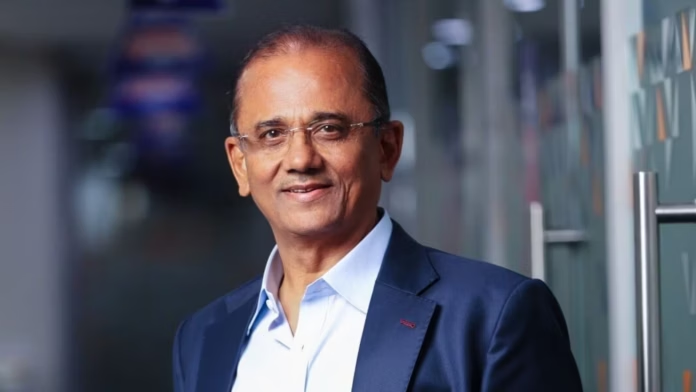
Mumbai’s luxury real estate market received a notable boost with the Ashwin Sheth Group announcing the acquisition of a 50% stake in a marquee residential development in Marine Lines, South Mumbai. The project, named One Marina, carries a gross development value (GDV) of ₹2,300 crore and is expected to redefine the standards of high-rise luxury living along the iconic coastline of the city.
The strategic investment was backed by a ₹540 crore infusion from PAG, a Singapore-based investment giant, marking a significant move in the redevelopment of legacy plots in South Mumbai’s dense urban fabric. The funding aims to expedite construction and ensure premium quality standards in one of Mumbai’s most space-constrained but aspirational neighbourhoods.
The Ashwin Sheth Group acquired the stake from previous joint developers, including the promoters of Sheth Creators, and has now joined hands with the landowner, YM Infra, to take the project forward. The acquisition also enabled the group to settle the existing dues with J.C. Flowers ARC, thereby resolving financial encumbrances inherited from earlier developers and paving the way for accelerated progress on the site.
Located close to Marine Drive and the historic Princess Street flyover, the One Marina project is expected to stand 74 storeys high, offering a rare combination of vertical scale and coastal luxury. The project is already under construction with work having reached the 9th podium level. Once completed, it will offer a range of upscale residential formats including spacious 3 BHKs, 4 BHKs, sea-facing duplexes, triplexes, and exclusive penthouses.Of the total one million square feet under development, the Ashwin Sheth Group will control approximately 400,000 square feet of saleable area. This positions the company as a dominant player in a project that is expected to command high demand from elite homebuyers seeking exclusivity in the southern tip of India’s financial capital.
According to Ashwin Sheth, chairman and managing director of the group, the partnership with PAG will not only bring global capital but also institutional discipline and governance to the development process. “With One Marina, we are building a landmark that reflects our commitment to luxury, design excellence and South Mumbai’s legacy. This is the first of many ventures as we deepen our presence in the ultra-luxury segment,” he said.Sunil Hotchandani, who heads fundraising for the group, added that this venture aligns with the developer’s broader strategy of unlocking potential in underutilised and financially constrained land parcels. “Our vision is to breathe life into legacy projects with both capital and credibility,” he said.
The move is emblematic of a growing trend in Mumbai’s real estate sector, where private equity and strategic funding are transforming stalled or legacy land parcels into high-value assets. With land scarcity tightening supply in South Mumbai, the One Marina project could emerge as a symbol of urban luxury meeting financial engineering and timely execution.
While the tower adds yet another high-rise silhouette to the Mumbai skyline, its development highlights a larger industry shift—where legacy urban spaces are being repurposed with sustainability, design sensibility and long-term livability at the core. With rising expectations of homebuyers in a post-pandemic world, developments like One Marina are being positioned not just as premium addresses but as future-ready homes designed for resilient and inclusive living
Also Read : Tata Steel to Launch Green Steel Project in July 2025
Mumbai Developer Acquires Stake in ₹2300 Cr Project
GUARDIANS OF THE NEW SMART HOME FRONTIER

In conversation with MR. ADITYA KHEMKA, Managing Director, CP PLUS (Aditya Infotech Ltd.) In a world where security is no longer a luxury but a necessity, CP PLUS stands as a sentinel of smart innovation. Mr. Aditya Khemka, the dynamic Managing Director, shares with Homes & Buildings Magazine how the company is redefining smart surveillance for India’s evolving landscape — blending technology, sustainability, and user empowerment.
Listening to India: Crafting Smart Solutions for a Diverse Nation
“Innovation at CP PLUS is never a onesize-fits-all exercise; it is a dialogue with India itself,” says Mr. Khemka. From bustling metropolises to remote villages, CP PLUS has engineered smart home security solutions that adapt to the unique realities of the country. The company’s Wi-Fi-enabled smart cameras, STQCcertified for cybersecurity, and their solar-powered surveillance units with robust 18,000 mAh batteries, demonstrate how technology can thrive even where electricity cannot. “Our cameras are not mere devices — they are autonomy incarnate, built for an India where the sun shines brighter than the power grid.”
Advanced innovations such as FullColour Video with spotlight-assisted night vision, Human Body Detection powered by AI, and Motion Tracking redefine the very idea of surveillance. CP PLUS cameras do not simply watch; they anticipate, pursue, and protect — even in off-grid locations, enabled by 4G connectivity and PIRbased motion detection. “We believe technology must be empathetic. It must illuminate, not intimidate.” Ease of use remains central to the design philosophy. With panoramic 360° views, View & Talk features, seamless Alexa and Google Home integration, and privacy mode, CP PLUS ensures that smart security is as intuitive as it is advanced.
Securing the Cloud: The EzyKam+ Revolution
Recognising the vulnerabilities of traditional video storage, CP PLUS introduced Secure Cloud Storage for its EzyKam+ range — an innovation Mr. Khemka describes as a “paradigm shift towards user-centric, indigenised surveillance.” “Gone are the days of lost footage due to stolen SD cards or damaged devices,” he notes. Recordings are now backed up in real time on Indian servers, protected by state-of-the-art encryption. Users can access their data effortlessly through the EzyKam+ app, with 95 flexible subscription options tailored for diverse needs. “Security should be frictionless — not a burden, but a seamless experience.
Homegrown Innovation for India’s Realities
Where broadband is a luxury and power lines unreliable, CP PLUS has risen to the challenge. Their 4G-enabled solar cameras, designed specifically for India’s digital deserts, offer offgrid surveillance that would find little resonance in hyper-connected Western cities. “In India, necessity breeds a different kind of invention,” explains Mr. Khemka. “Our rural innovations are not adaptations of Western models. They are interventions designed for our soil, our sun, and our people.”
Democratising Security: Making Smart Surveillance Affordable
CP PLUS’s commitment to affordability is not rhetorical — it is fundamental. “Security should not distinguish between skyscrapers and chawls,” Mr. Khemka asserts. Through indigenous manufacturing, optimised supply chains, and a relentless focus on user-centric engineering, CP PLUS has made premium security accessible to the middle and mass market alike. The EzyKam+ App acts as a unifying control hub — offering live feeds, cloud access, motion alerts, and twoway audio — under a single, intuitive platform. “Our goal is simple: remove friction, empower users, and make security second nature.”
Smart Security for Every Structure, Every Climate
Understanding India’s architectural and climatic diversity, CP PLUS has crafted solutions that marry tradition with technology. Wireless cameras with adhesive mounts allow retrofit
installation in heritage homes without invasive civil work. Solar-powered models provide autonomy where power supply is uncertain. Moreover, CP PLUS products are built to endure India’s harshest conditions. Engineered with IP66 and IP67 standards, these cameras withstand monsoons, dust storms, and temperature extremes from 0°C to 60°C. “In India, protection must endure — rain, sun, dust, and doubt.”
Looking Ahead: The Vision
for a Smarter, Safer India
Mr. Khemka is clear-eyed about the road ahead. “The smart home revolution is not just about automation; it’s about empowerment. It’s about giving homeowners, no matter where they live, the confidence to embrace security without compromise.” With a relentless focus on innovation, sustainability, and inclusivity, CP PLUS is poised not just to lead, but to shape the future of intelligent living in India.