
Tata Steel to Launch Green Steel Project in July 2025

Vikas Jain Appointed NAREDCO Maharashtra NextGen President

Vikas Jain, a turnaround specialist and chief executive officer of Mumbai-based Labdhi Lifestyle, has been unanimously appointed as President of NAREDCO Maharashtra NextGen, the youth wing of the state real estate body. He succeeds Ridham Gada, now serving as Vice‑Chairman. Jain’s appointment comes at a pivotal moment as India’s real estate sector targets a trillion‑dollar valuation by 2030, and NAREDCO seeks to energise its NextGen platform with modern financial and tech tools.
Labdhi Lifestyle, under Jain’s stewardship, has delivered over 22 projects in the Mumbai Metropolitan Region, maintaining a reputation for quality, timely execution, and debt-free operations. These credentials position Jain uniquely to steer young professionals through an era of evolving consumer expectations and regulatory complexity. In his inauguration address, Jain set a clear agenda. “Finance will be our theme for 2025–26,” he declared, signalling a shift towards capital structuring, innovative financial instruments, and building credibility to attract investment. He emphasised that real estate must evolve into a professionally managed, consumer-centric, governance‑oriented, and innovative industry.
Expressing support, the President of NAREDCO Maharashtra noted that Jain’s insight into project financing and sector dynamics is well-suited for catalysing growth in the youth segment. Gada, in his new role, praised Jia… those same qualities. Jain’s roadmap encompasses four strategic pillars: enhanced RERA compliance, adoption of PropTech, structured financing, and institutionalised leadership development. By embedding transparency and digital tools throughout the value chain, the aim is to build trust among homebuyers and investors—an essential factor in sustaining sectoral momentum. Jain intends to launch workshops and webinars on financial literacy, regulatory dynamics, PropTech adoption, and ESG integration.
Governance and accountability are central to Jain’s platform. He proposes a “peer‑review panel” for member projects to audit governance and customer feedback. Coupled with greater RERA clarity and adoption of tech-driven systems—such as digital dashboards and AI‑based monitoring—these steps are expected to improve trust and reduce disputes. Urban experts highlight that real estate in Mumbai, especially in its satellite cities, is undergoing transformation. Rapid urbanisation, climate stress, and evolving demographics demand excellence in planning and execution. A NextGen leader focused on finance, technology, and eco‑comfort can significantly influence future urban morphology.
An industry consultant observed: “Jain’s mandate links finance with sustainable planning, which is key for equitable urban growth in Maharashtra.” The consultant underscored that today’s developers must be “not just builders, but city‑shapers.” NAREDCO Maharashtra NextGen functions as a crucible for emerging professionals—including architects, planners, and financiers—keen on leadership roles. Under Jain’s presidency, the association plans to initiate mentorship programmes pairing veterans with next-gen leaders, aiming to reimagine housing products with climate-resilient design, equitable pricing, and digital aesthetics.
Labdhi Lifestyle’s portfolio already exhibits several NextGen benchmarks: pre-certified green building projects, integrated community amenities, early adoption of digital sales tools, and compliance-oriented governance. Jain pointed out that scaling such initiatives across the MMR would enhance livability and reduce carbon footprints. Critically, finance-led growth must align with affordability. Jain proposes exploring low-cost construction models using local materials and modular design—enhancing sustainability while preserving unit economics. Embedded urbanist and gender-focused design choices—such as barrier-free access and shared amenity spaces—are also part of the NextGen vision.
RERA compliance has long been a weak link, leading to delivery delays and consumer disputes. Jain’s tenure aims to correct this with standardised project disclosures and grievance redress mechanisms. Access to alternative capital channels, such as ESG bonds and REIT frameworks, is also on the agenda to reduce funding gaps and reliance on traditional debt. As Maharashtra drafts its housing policy and zero-carbon roadmaps, NAREDCO NextGen’s priorities could intersect with public institutional goals. Jain’s network with financiers and policymakers may help align industry initiatives around urban green bonds and sustainable finance incentives.
However, challenges remain. Implementing standardised financial systems across a fragmented developer base, navigating varied state regulations, and ensuring tech adoption across small and mid-sized players will demand sustained effort. Jain’s ability to unite NextGen members into cohesive professional cohorts will be crucial. The urban planning community notes this leadership shift as a potential inflection point. An architect specialising in urban design commented: “If NextGen prioritises finance, tech integration, and ESG mandates, it could define new affordable luxury categories in MMR—heightening quality without inflating costs.”
Meanwhile, more than a symbolic appointment, this represents a strategic pivot. With homebuyers now digitally informed and environmentally conscious, the real estate sector must deliver on transparency and performance. Jain’s blending of financial acumen, regulator understanding, and tech orientation suggests a path toward modern professionalism among India’s next real estate maestros. The real test of leadership lies in tangible outcomes. Will capital reforms proceed alongside large-scale RERA compliance tools? Can PropTech rollouts gain traction across midsized developers? Will green criteria translate into procurement standards?
Vikas Jain has signalled his intent. But the structural transformation of Maharashtra’s real estate landscape will depend on his ability to mobilise youth talent, enforce governance cultures, and demonstrate sustainability in project execution. If successful, the NextGen model may well be replicated across India’s developing megacities, as the sector navigates a future defined by equity, environment, and enterprise.
Vikas Jain Appointed NAREDCO Maharashtra NextGen President
Ranbir Alia Bungalow in Mumbai Nears Completion

A high-profile luxury redevelopment project in Mumbai’s Pali Hill owned by leading Bollywood duo Ranbir Kapoor and Alia Bhatt—is nearing completion, attracting attention for both its star association and estimated market valuation of over ₹300 crore. Real estate experts suggest the six-storey property could become one of the most prestigious residences in the upscale Bandra neighbourhood.
The bungalow, under renovation for the past few years, stands as a symbol of generational legacy and ultra-luxury living. Situated in the heart of Pali Hill—a locality known for housing a mix of cinema celebrities, industrialists, and high-net-worth individuals—the residence is now entering its final stages of construction. Recently shared visuals on social media reveal a nearly finished façade, complete with added vertical landscaping, floor-wise fencing, and a polished structural exterior. Yet, the absence of a front gate drew online humour and speculation, highlighting the public’s keen eye for celebrity architecture. This property is more than just a celebrity residence. It is a piece of Mumbai’s film heritage. According to property consultants and heritage experts, the plot originally belonged to legendary actor Raj Kapoor and was later passed down to subsequent generations of the Kapoor family. The bungalow is named after Ranbir Kapoor’s late grandmother and matriarch of the Kapoor household, and it carries not just real estate value, but strong emotional and cultural significance.
While the exact dimensions of the property remain private, experts in Mumbai’s luxury property market estimate the land value and structural upgradation alone could push its market valuation into the ₹350–400 crore bracket. A senior official from a prominent global real estate consultancy said that “for a property of this heritage in Pali Hill, with a redevelopment footprint of this magnitude, the valuation is not just driven by location, but also by architectural premium, legacy, and privacy.” Bandra’s Pali Hill micro-market remains one of the most sought-after areas in the city for high-end real estate, with rates easily crossing ₹1.2 lakh per square foot in new constructions. The area’s popularity is further enhanced by its longstanding association with film personalities, top industrialists, and elite professionals. Bollywood veterans, popular actors, and business leaders continue to reside or invest in this belt, maintaining its aspirational appeal.
The Kapoor-Bhatt bungalow adds a fresh layer of aspiration for younger homebuyers and luxury developers eyeing Mumbai’s land-starved, heritage-driven residential sectors. More than just a home, the property signifies a growing trend where ultra-luxury real estate and family legacy intersect in India’s financial capital. In addition to the Pali Hill residence, the Kapoor family also inherited the iconic RK Studios and another bungalow in Chembur, both of which were later sold or repurposed in parts. The upcoming completion of the Kapoor-Bhatt residence also marks a rare example of a legacy family reinvesting in its own urban roots, rather than choosing isolated, suburban gated compounds. This pattern of staying invested in a prime central city location underscores a maturing shift in India’s luxury real estate choices, where provenance and urban heritage are becoming as valuable as square footage or modern amenities.
Local observers note that celebrity homes in Mumbai often become architectural landmarks in their own right. Their scale, design sensibilities, and security layouts often influence development patterns in surrounding plots. The Kapoor-Bhatt bungalow, with its multi-storey structure and terrace-level greenery, is already prompting comparisons with nearby luxury homes owned by other public figures in the entertainment industry. While the construction progress suggests the couple may move in within the next month, final interior works, furnishing, and green landscaping could extend the timeline slightly. Nevertheless, the property is clearly in its final leg, and urban planners note that such high-visibility developments could add further upward momentum to an already overheated micro-market.
Despite the online buzz around the incomplete gate and the playful public banter that ensued, officials involved with the property’s design clarified that the gate installation is part of the final security and automation phase. A senior architectural consultant connected to the project remarked that “these last stages are where we incorporate eco-friendly materials, automate entrances, and install air-purification systems to align with the city’s new green building standards.” As Mumbai continues to grapple with issues around congestion, sustainability, and equitable housing access, landmark residences such as this often spark larger debates. Can celebrity-led luxury homes coexist meaningfully with the city’s push for more inclusive housing? While the answer remains complex, such developments undeniably shape Mumbai’s skyline and public imagination.
For now, as the Pali Hill landmark inches toward completion, it symbolises not just a dream home for two of India’s most prominent entertainers, but also the enduring aspiration to build roots in a city where land, legacy, and lifestyle converge.
Ranbir Alia Bungalow in Mumbai Nears Completion
Panvel Hiranandani Launches Rs 1100 Cr Arena Project

Mumbai Metropolitan Region (MMR), Hiranandani Communities has launched ‘The Arena’—a premium residential enclave pegged at over ₹1,100 crore. The project, located within the sprawling 588-acre integrated township of Hiranandani Fortune City, brings over 1,700 upscale apartments to a fast-growing micro-market shaped by major infrastructure investments and shifting urban aspirations.
Spread across more than 10 acres, The Arena is set to redefine luxury living with eight elegant towers. The first phase of the launch comprises three towers housing 600 units, offering configurations of 2, 3, and 4 BHK apartments with carpet areas ranging from 730 to 1,900 sq. ft. Designed for upwardly mobile urban dwellers, the residences start at ₹1.31 crore and are crafted to deliver a future-ready, wellness-focused lifestyle.Panvel’s evolution from a peripheral town to a key economic and real estate hub has been accelerated by transformative connectivity projects such as the Mumbai Trans Harbour Link (MTHL), the upcoming Navi Mumbai International Airport, and strategic highway and freight corridor networks. This robust infrastructure pipeline has catalysed a new wave of demand, turning Panvel into a magnet for investors and end-users alike.
What sets The Arena apart is its seamless blend of residential elegance with a curated lifestyle. Residents will have access to an integrated sports colosseum, educational institutions including the Hiranandani International School, commercial centres, healthcare, and cultural amenities. The project’s design encourages active living and community engagement, appealing to both younger homebuyers and global Indians seeking premium investments with long-term growth potential.As Panvel rides the wave of Mumbai’s “3.0” urban transition, developments like Hiranandani Fortune City are addressing an unmet demand for sustainable, high-quality, and holistic living solutions. The township’s masterplan reflects a commitment to sustainability, incorporating future-ready infrastructure, open green spaces, and eco-conscious construction standards that align with India’s climate-resilient urban agenda.
According to senior company officials, the migration of skilled professionals and rising disposable incomes have made Panvel an ideal canvas for such a large-scale, integrated residential development. With branded players entering the market, the micro-region is poised to see significant capital appreciation in the near to mid-term, supported by robust rental yields and lifestyle-driven demand.The Arena thus emerges as a flagship offering in the luxury segment that resonates with aspirational homebuyers seeking more than just a residential address. It offers a living experience where quality construction meets strategic location and future-forward infrastructure.
As real estate continues to play a defining role in shaping post-pandemic urban life, Panvel’s ascent signals a decisive shift in Mumbai’s growth narrative—from saturated urban centres to well-connected, self-sufficient, and sustainable satellite townships.
Also Read : Mumbai Birla Estates Secures Rs 420 Crore IFC Backing
Panvel Hiranandani Launches Rs 1100 Cr Arena Project
Mumbai Birla Estates Secures Rs 420 Crore IFC Backing
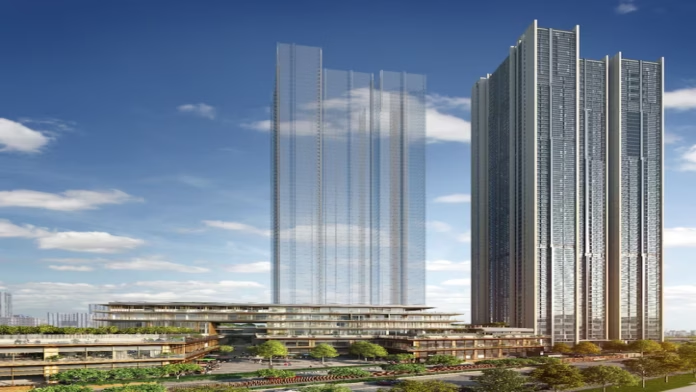
Birla Estates, the real estate arm of the Aditya Birla Group, has secured a landmark investment of ₹420 crore from the International Finance Corporation (IFC) to fuel its upcoming residential projects in the Mumbai Metropolitan Region and Pune. The funding underscores a pivotal moment for sustainable urban development in India’s high-growth housing corridors, signalling the growing role of green capital in shaping future cities.
The investment, approximately USD 50 million, will be channelled through two Special Purpose Vehicles (SPVs) promoted and managed by Birla Estates. The capital infusion has been earmarked for two key projects—₹272 crore for a large-scale development in Thane, Mumbai, spanning 6.43 million sq ft of saleable area, and ₹148 crore for a 3.13 million sq ft residential project in Manjri, Pune.Under the structure, Birla Estates will retain a 56% economic interest in the SPVs, while IFC, the private-sector arm of the World Bank Group, will hold the remaining 44%. The partnership reflects a deeper alignment between global institutional capital and India’s aspirational housing demand, especially in emerging Tier I and II cities.
Executives at Birla Estates highlighted that the funding will reinforce their commitment to delivering high-quality, resource-efficient housing that meets the aspirations of India’s rising urban middle class. The focus of both projects is to integrate environmentally sustainable design, advanced energy management systems, and inclusive community infrastructure to support first-time homebuyers and long-term residents alike.This collaboration marks IFC’s strategic emphasis on strengthening climate-resilient urban infrastructure and bridging the housing deficit in fast-growing economies. The institution’s regional leadership reiterated that the partnership will enhance access to sustainable homes in India while stimulating job creation, local supply chains, and long-term economic resilience.
Real estate analysts view the development as a turning point for environmentally aligned housing finance in India. With urbanisation accelerating and the demand for affordable yet high-quality homes rising, institutional capital is now increasingly directed towards projects that demonstrate both commercial viability and environmental stewardship.Birla Estates, which has recently expanded its footprint across key Indian metros including Delhi-NCR and Bengaluru, also marked its entry into the Pune market this year with strong quarterly sales. The latest funding will allow the company to scale operations in line with India’s decarbonisation goals, especially as policy emphasis on green building norms and sustainable infrastructure continues to grow.
As Indian cities grapple with the challenges of unplanned urban sprawl and climate-related stress, partnerships like the one between IFC and Birla Estates represent an emerging blueprint for building cities that are not only liveable but also equitable and environmentally sound.
Also Read : Worli Duplex Sold for Record ₹225 Crore
Mumbai Birla Estates Secures Rs 420 Crore IFC Backing
Worli Duplex Sold for Record ₹225 Crore

Mumbai’s upscale real estate market has once again captured attention with a record-setting transaction at the coveted Worli Sea Face, where a premium duplex apartment has been sold for a staggering ₹225.76 crore. The high-rise residence, part of the under-construction luxury project Naman Xana, marks one of the most significant residential deals in the city’s recent history.
The deal was finalised through a private real estate entity and involves a duplex spanning the 30th and 31st floors of the tower, scheduled for completion in 2027. With a total built-up area of 11,485 square feet—including a 1,227 sq ft sea-facing balcony—the apartment boasts a carpet area of 9,214 sq ft and comes with six dedicated car parking slots. The effective price works out to ₹2.45 lakh per sq ft on carpet area and ₹1.97 lakh per sq ft on built-up area, establishing a new benchmark for luxury homes in South Mumbai.
Stamp duty amounting to ₹13.55 crore was paid, and the transaction was registered on 26 May. The buyer, operating through Shaula Real Estates Pvt Ltd, joins a rising wave of ultra-high-net-worth individuals securing exclusive residences in prime coastal locations.This transaction, while exceptional in value, is part of a broader trend reshaping Mumbai’s luxury property segment. Just days after this deal, another major sale occurred in the same project, where a business leader acquired two duplex units for a cumulative ₹639 crore—at an unprecedented ₹2.83 lakh per sq ft, based on RERA carpet area.
Real estate analysts view these acquisitions as a signal of enduring confidence among the financial elite in Mumbai’s long-term property appreciation. Demand for expansive, high-specification homes has surged post-pandemic, with affluent buyers prioritising space, privacy, natural views, and wellness-oriented living. Sea-facing balconies, exclusive access points, and modern amenities have become defining factors in these transactions.Worli, with its strategic coastal location and proximity to the city’s commercial and cultural hubs, has emerged as a key micro-market for such luxury developments. Projects like Naman Xana offer not only architectural sophistication but also align with emerging expectations of urban luxury—balancing aesthetics, privacy, and lifestyle convenience.
Industry insiders suggest that this appetite for high-value housing could steer future developments toward more environmentally conscious and sustainable models. With public focus intensifying on equitable access and green urban design, there is a growing call for premium projects to integrate eco-sensitive features while maintaining exclusivity.
As Mumbai continues to evolve into a city of vertical growth and polarising real estate stories, deals like this shine a light on the widening gulf between aspiration and accessibility. Yet they also reflect a dynamic and maturing market where real estate is both a financial asset and a lifestyle statement.
Also Read : Navi Mumbai Enforces Audits for Ageing Buildings
Worli Duplex Sold for Record ₹225 Crore
Navi Mumbai Enforces Audits for Ageing Buildings

Navi Mumbai Municipal Corporation (NMMC) has made it mandatory for all buildings older than 30 years to undergo a structural audit. The move comes after a civic survey for 2024–25 flagged 527 buildings as unsafe for habitation, raising concerns over the safety of thousands of residents and workers occupying these ageing premises.
Officials stated that under Section 265(A) of the Maharashtra Municipal Corporation Act, a structural audit is compulsory for all buildings that have been in use for more than three decades. These assessments must be conducted by civil or structural engineers registered with the NMMC. Property owners are also required to submit a completion certificate issued by the appointed engineer, verifying that the recommended repairs have been executed and the structure is now deemed safe.
According to the civic body, the age of a building is calculated from the date it was first occupied or brought into use, not merely from its construction date. The policy aims to ensure that older buildings, which may be vulnerable to structural wear and tear, do not pose a hazard to public safety.NMMC has invoked provisions under Sections 264(1) to 264(4) of the Act to classify the identified 527 buildings as hazardous. These include both residential and institutional structures, many of which are located in high-density urban zones. In a bid to encourage swift compliance, the civic body has uploaded a list of registered engineers on its official website, making it easier for property owners and housing societies to engage qualified professionals.
Failure to comply with the audit directive could attract penalties under Section 398(A), with a fine of ₹25,000 or an amount equivalent to the property’s annual tax—whichever is greater. NMMC officials have further warned that individuals or organisations continuing to occupy buildings deemed unsafe will be held fully responsible in the event of any mishap.With a firm September 2025 deadline in place, property owners are expected to submit audit reports to the respective Assistant Commissioner, Departmental Officer, or the Assistant Director of Urban Planning. The NMMC’s approach not only reinforces public safety measures but also sets a precedent for proactive risk management in rapidly growing urban areas.
Navi Mumbai, known for its planned infrastructure, is now facing the challenge of ageing housing stock. Several buildings constructed during the early expansion of the city in the 1980s and 1990s are now approaching or exceeding the 30-year mark. Without regular inspection and maintenance, these structures could become liabilities in the face of extreme weather, seismic risks, or simple design fatigue.Urban planners and safety experts have welcomed the NMMC’s decision as a necessary intervention to prevent avoidable tragedies. By mandating professional assessments and holding stakeholders accountable, the civic administration is underlining the urgent need for sustainable building management.
As cities across India wrestle with questions of urban resilience, Navi Mumbai’s structural audit mandate offers a replicable model. It places civic responsibility on both the administration and property owners to protect lives, assets, and the broader urban ecosystem. In a city poised for further vertical growth, safety must form the foundation of development.
Also Read : Tata Steel Begins Green Transition in UK
Navi Mumbai Enforces Audits for Ageing Buildings
Tata Steel Begins Green Transition in UK
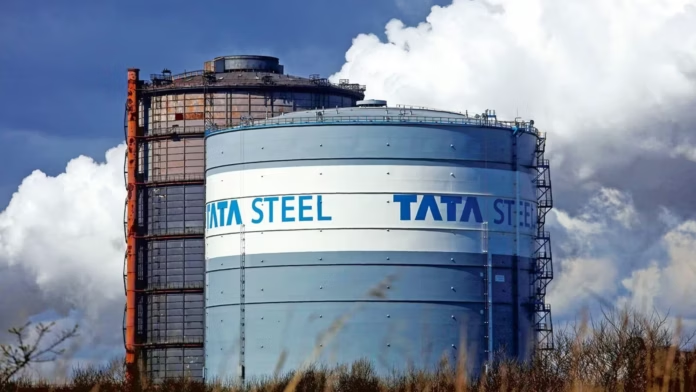
Tata Steel has formally set the timeline for a transformative shift in British steelmaking, as it prepares to construct a state-of-the-art Electric Arc Furnace (EAF) at its Port Talbot facility in South Wales. The multi-billion-pound investment marks a historic moment in the UK’s industrial landscape, signalling a departure from traditional coal-fired blast furnaces and a bold move toward decarbonised steel production.
According to the company’s latest annual report for FY2024-25, construction of the £1.25 billion EAF is scheduled to begin by July 2025, with operations expected to commence by the end of 2027. The initiative is being driven by Tata Steel’s vision to modernise steelmaking while drastically cutting carbon emissions in line with the UK’s net-zero ambitions.The project has received a significant boost from the UK Government, which has pledged £500 million in support. Tata Steel will contribute the remaining £750 million. Once commissioned, the new furnace will have the capacity to produce up to 3 million tonnes of low-emission steel annually, primarily using recycled scrap metal. This transition is projected to reduce industrial carbon emissions in the UK by 8% and cut emissions at the Port Talbot site by an estimated 90%.
The new electric arc furnace will replace the ageing coal-based blast furnaces currently operating at Port Talbot. Basic engineering has been completed, and equipment procurement is expected to commence shortly. The facility is designed to support energy-efficient operations and improve domestic scrap recycling, positioning Tata Steel as a leader in sustainable industrial practices.However, the green shift comes with a challenging social cost. Tata Steel has acknowledged that approximately 2,800 jobs are expected to be lost during the transition. To mitigate the impact, a £100 million Transition Board has been set up, comprising £80 million from the UK Government and £20 million from Tata Steel. The board will focus on reskilling programmes, employment support, and community development to ensure that the region’s workforce remains resilient.
Despite the downsizing, Tata Steel UK will continue to employ around 5,000 workers post-transition, ensuring continuity in operations and maintaining a significant economic footprint in South Wales. The long-term objective is to secure a future-proof steel industry capable of meeting both environmental standards and market demand.The EAF project is part of Tata Steel’s larger commitment to green steelmaking, which includes enhancing self-sufficiency in steel production through greater use of local scrap and fostering a circular economy. The plant’s design also aligns with the UK’s industrial strategy, which aims to reduce dependence on imported raw materials and promote greener production technologies.
Tata Steel’s strategic pivot to sustainable manufacturing underscores a growing global trend where heavy industries are under pressure to curb emissions without compromising output. For the UK, this project represents not only environmental stewardship but also industrial renewal in a post-carbon era.
The company has made it clear that the investment is not just about upgrading infrastructure but securing the future of steelmaking in the UK for decades to come.
Also Read : Ambuja Cement Expands Rapidly Under Adani
Tata Steel Begins Green Transition in UK
Ambuja Cement Expands Rapidly Under Adani

Ambuja Cement, now a key arm of the Adani Group’s industrial portfolio, is rapidly expanding its footprint across India, having crossed the 100 million tonnes per annum (MTPA) cement capacity mark in FY25. This milestone, achieved in record time through aggressive acquisitions and targeted brownfield expansion, positions the company as a pivotal player in India’s infrastructure and housing growth.
Ambuja Cement now accounts for nearly 30 per cent of the cement used in Indian homes and large-scale infrastructure projects, according to its latest annual report. Since being acquired by the Adani Group in 2022 from Swiss major Holcim, the company has witnessed a transformational shift in its scale, operations, and strategic focus.The company’s leadership credits its swift scale-up to a combination of precision in execution and a forward-looking approach. Its managing leadership described the growth as “a story of resilience driven by a focused vision and operational agility.” Ambuja is currently the second-largest cement manufacturer in India and now ranks among the top ten globally by capacity.
Much of this growth stems from both inorganic and organic efforts. Ambuja acquired regional cement players like Penna Cement, Sanghi Industries, and Orient Cement, while simultaneously pushing brownfield expansion at its existing plants. By FY26, Ambuja aims to raise its capacity to 118 MTPA, with a long-term goal of reaching 140 MTPA by FY28. Projects in key locations such as Bhatapara, Dahej, Kalamboli, Sindri, and Marwar are in various stages of development.The company’s financial performance has kept pace with its expansion. In FY25, Ambuja reported sales volumes of 65.2 million tonnes, generating revenue of ₹35,045 crore and a net profit of ₹5,158 crore. The company continues to operate with a debt-free balance sheet, which it says reflects strong capital discipline and sustainable investment planning.
A critical aspect of Ambuja Cement’s strategy is its push towards green energy and cost efficiency. The company aims to power 60 per cent of its future cement production and over 80 per cent of its clinker capacity through renewable energy sources. It is also investing heavily in logistics optimisation—an area that traditionally eats into margins in the cement sector.Through enhanced freight practices like increased use of seaborne routes, optimised depot locations, and use of specialised rakes under schemes such as GPWIS and BCFC, Ambuja has already reduced logistics costs by six per cent. The target is a further 15 per cent reduction by FY30, which could significantly improve long-term competitiveness.
As India marches towards its vision of becoming a $5 trillion economy, cement will remain a core building block for urban growth, transport infrastructure, and affordable housing. Industry estimates suggest that installed cement capacity in India could rise to 850 MTPA by 2030 and to 1,350 MTPA by 2050.In this high-growth landscape, Ambuja Cement’s rapid expansion is not just a tale of market competition, but a reflection of the broader demand for infrastructure-backed, climate-resilient development. Its green energy transition and operational efficiency strategy place it at the intersection of sustainability and industrial growth an increasingly critical benchmark for future-ready businesses.
While UltraTech Cement, part of the Aditya Birla Group, continues to lead the market with over 183 MTPA capacity, the rivalry is intensifying. Both firms are aggressively acquiring regional players and ramping up production. However, Ambuja’s momentum under Adani’s stewardship signals that the cement sector is undergoing a transformative shift, potentially redefining capacity leadership and sustainability standards in the coming years.
Also Read : Mumbai Borivali Set for Apple Store Debut Soon
Ambuja Cement Expands Rapidly Under Adani
Mumbai Borivali Set for Apple Store Debut Soon

Mumbai’s western suburb of Borivali is poised for a major retail transformation, as global tech giant Apple India secures a prominent 12,616 sq ft space in Oberoi Realty’s Sky City Mall for its next flagship store in Maharashtra. This marks Apple’s second outlet in the city and fourth in India, underlining a strategic shift to expand beyond traditional premium locations such as Bandra and Andheri.
The lease agreement, formally registered for 130 months—just under 11 years—commits Apple India to a monthly rent of ₹17.35 lakh. It includes a lock-in period of nearly the full term and a standard escalation clause of 15% every three years. Additionally, the tech major has made a security deposit of over ₹1 crore. This long-term commitment not only indicates confidence in Borivali’s evolving market but also reflects the shifting dynamics of Mumbai’s urban commercial landscape.
Sky City Mall, where the new store will come up, is part of a larger 25-acre integrated township being developed by Oberoi Realty through its arm Incline Realty Private Limited. The mall itself offers a gross leasable area of over 12 lakh sq ft and a carpet area of over 7 lakh sq ft, with an expected catchment of more than 3,000 families residing within the complex and adjacent residential neighbourhoods.Crucially, this move reflects a growing trend of major international brands tapping into emerging premium retail zones in Mumbai’s northern suburbs. With enhanced metro connectivity via the Western Express Highway and dual access to metro exits, Borivali’s infrastructure upgrades are increasingly drawing high-profile retail investments.
The Apple-Oberoi lease also includes a unique revenue-sharing model. Beyond the fixed monthly rent, Apple will share 2% of its store revenue with the developer for the first 42 months, increasing to 2.5% thereafter. This arrangement indicates a shift in how high-value retailers and developers are partnering—aligning interests based on performance rather than static rentals.Real estate industry insiders suggest that Sky City Mall is being positioned as one of India’s most aspirational commercial retail hubs. While per sq ft rentals at the mall range from ₹400 to ₹1,000 based on brand categories and location within the mall, Apple’s lower rate stems from the revenue-linked structure. Yet its presence is likely to set a new benchmark, pushing up the area’s overall retail profile.
INOX has already confirmed a 10-screen multiplex as an anchor tenant, signalling Sky City Mall’s positioning as a full-spectrum leisure and lifestyle destination. With retail, entertainment, and residential components integrated into a single development, the project offers a compelling case for sustainable urban living, reducing commute times and encouraging walkable neighbourhoods—a core tenet of equitable and eco-conscious city planning.
Apple’s move to Borivali could serve as a bellwether for retail decentralisation in India’s metro cities, where affluent footfall is no longer confined to conventional high streets. It may also stimulate further investments in infrastructure, services, and public amenities across Mumbai’s northern corridors, making Borivali a case study for future-ready urbanisation.
Also Read : AMNS India Aids Chenab Bridge Construction with Steel