Coal India, coal auction India, energy security India, West Asia crisis, industrial supply India, urban infrastructure, power sector India, fossil fuels India, sustainable energy transition, infrastructure development, coal demand India, energy markets India
India’s largest coal producer is stepping up domestic supply in response to global energy disruptions, with Coal India planning to auction over 25 million tonnes of coal in April. The move comes amid tightening fuel availability linked to geopolitical tensions in West Asia, with implications for industrial output, energy security, and the cost of urban infrastructure development.
The state-run miner will offer 25.62 million tonnes through its digital auction platform during the month, aiming to cushion industries against supply volatility and rising import costs. The auctions are being conducted through a unified system designed to simplify procurement and improve transparency for buyers across sectors. The Coal India coal auction is a direct response to disruptions in global energy markets, particularly reduced availability of liquefied natural gas and crude supplies from the Middle East. These constraints have driven up international fuel prices, prompting industries to shift back towards coal as a relatively stable and accessible energy source. Data from recent months indicates a scaling up of auction volumes. Coal India had already increased e-auction offerings in March compared to February, signalling a calibrated effort to meet rising demand across power generation, metals, and small-scale industries.
For urban economies, the implications are significant. Coal continues to underpin electricity generation, construction material production, and manufacturing—sectors that are central to city expansion and infrastructure delivery. Industry experts note that ensuring adequate domestic supply can help prevent project delays, stabilise input costs, and maintain continuity in urban development pipelines.The auction mechanism itself is evolving as part of broader market reforms. By consolidating multiple sales windows into a single digital platform, the system allows more efficient price discovery and wider participation. Notably, buyers from neighbouring countries have also been allowed to directly participate, reflecting a push towards regional market integration and more efficient utilisation of surplus production. However, the increased reliance on coal also highlights a complex trade-off between immediate energy security and long-term sustainability. The ongoing global energy shock has already led several Asian economies to ramp up coal usage to offset shortages of cleaner fuels, raising concerns about emissions and environmental impact. Urban planners and energy analysts argue that while the Coal India coal auction provides short-term relief, it underscores the need for accelerated investment in renewable energy and diversified fuel sources. Dependence on fossil fuels during crises can create structural lock-ins, complicating efforts to transition towards low-carbon urban systems.
At the same time, industries—especially smaller enterprises—are increasingly sensitive to fuel price volatility, with some already building coal inventories in anticipation of further cost pressures. This behaviour reflects the broader uncertainty shaping India’s industrial and urban growth outlook.As the auctions roll out through April, the effectiveness of the Coal India coal auction will be measured by its ability to stabilise supply without triggering price distortions. In the longer term, balancing energy resilience with sustainability goals will remain central to India’s evolving urban and infrastructure strategy.
Dhanbad Coal Mining Halt Disrupts Industrial Supply
Coal production at a key mining block in Dhanbad has been suspended following a labour-led disruption, highlighting persistent tensions between industrial operations and local employment demands. The halt at Bharat Coking Coal Limited’s (BCCL) ABOCP Block-II site has stalled both extraction and dispatch since early April, raising concerns about supply continuity for downstream industries and the stability of coal-dependent urban economies.
The disruption began on April 2, when a group of local workers blocked operations at the site, bringing mining and transportation activities to a standstill. The company has described the stoppage as unauthorised and has initiated legal action, including filing a police complaint and engaging local authorities to restore normalcy. At the centre of the dispute is a long-standing employment arrangement involving local labourers engaged in ancillary work such as shale picking at railway sidings. Over time, changes in mining processes—including mechanisation and mandatory coal crushing—have reduced the need for such roles. However, workers have continued to demand full-time wages and associated benefits, despite limited engagement under an earlier administrative agreement. The Dhanbad coal mining halt underscores broader structural shifts within India’s mining sector, where operational efficiency and automation are increasingly replacing labour-intensive practices. While these transitions are essential for productivity and cost control, they often leave informal or contract workers vulnerable, particularly in regions where mining forms the backbone of local livelihoods.
Industry analysts note that even temporary disruptions at coking coal sites can have ripple effects across sectors such as steel manufacturing, power generation, and infrastructure development. BCCL, a subsidiary of Coal India, plays a critical role in supplying coking coal to the steel industry, making continuity of operations vital for industrial supply chains. From an urban development perspective, such disruptions highlight the interconnected nature of extractive industries and city-building. Coal remains a key input for infrastructure projects, construction materials, and energy systems that power urban growth. Interruptions in supply can delay projects, increase costs, and strain already complex logistics networks.The situation also reflects the need for more inclusive transition frameworks as industries modernise. Urban planners and policy experts argue that reskilling programmes, formal employment pathways, and community engagement mechanisms are essential to balance efficiency gains with social equity. Without such measures, labour unrest risks becoming a recurring challenge in resource-dependent regions.
Authorities are currently assessing the situation, with no clear timeline for the resumption of operations. The company has escalated the matter to senior officials and security agencies, indicating the seriousness of the disruption.As India continues to expand its infrastructure base and urban footprint, the Dhanbad coal mining halt serves as a reminder that industrial growth must be aligned with local economic realities. Addressing labour concerns alongside operational reforms will be critical to ensuring resilient and conflict-free supply chains in the long term
A new construction technology emerging from IIT Guwahati could reshape how buildings are designed in earthquake-prone regions, as researchers unveil a framework for 3D-printed concrete walls with enhanced seismic resilience. The development is significant for India’s rapidly urbanising regions, where demand for faster, cost-efficient, and disaster-resilient housing is rising alongside climate and geological risks.
The research focuses on improving the structural performance of 3D-printed walls, a method increasingly explored for its ability to reduce construction time, labour dependence, and material waste. However, adoption in seismic zones has remained limited due to uncertainty over how such structures behave under repeated earthquake stress. To address this, the IIT Guwahati team conducted full-scale experimental testing on multiple wall configurations under simulated seismic conditions. These included conventional printable concrete, advanced ductile concrete capable of absorbing damage without collapse, and a hybrid system integrating steel reinforcement directly into the 3D printing process. Findings indicate that combining ductile material properties with embedded reinforcement significantly improves structural stability during cyclic loading—an essential factor in earthquake performance. Researchers also developed a method to incorporate steel reinforcement without disrupting the automated printing process, aligning the technology with existing safety standards.
For urban development, the implications extend beyond engineering innovation. As cities expand into high-risk zones and climate uncertainties intensify, the need for resilient and scalable construction systems is becoming central to planning frameworks. Industry experts suggest that earthquake resistant 3D printed walls could help bridge a critical gap between speed of construction and long-term structural safety.The technology also aligns with sustainability priorities. By eliminating formwork and optimising material usage, 3D printing can significantly reduce construction waste and embodied carbon—two major concerns in conventional building practices. For resource-constrained regions, particularly in the Northeast, such efficiencies could support more affordable and accessible housing solutions.Urban planners note that the integration of digital construction methods with resilience-focused design could redefine how infrastructure is delivered in emerging cities. Faster build times can accelerate housing supply, while improved safety standards reduce vulnerability in disaster-prone areas—both key to inclusive urban growth.
The research team has also tested the framework at a building scale by simulating a single-storey structure, demonstrating its ability to predict real-world performance. The next phase will focus on multi-storey applications and resistance to other extreme conditions such as impact and blast forces. As India pushes towards smarter and more climate-adaptive cities, innovations like earthquake resistant 3D printed walls could play a pivotal role in reshaping construction practices. The challenge ahead lies in scaling the technology, integrating it into regulatory systems, and ensuring it remains cost-effective for widespread adoption.
A fresh wave of industrial investment is set to reshape India’s northeastern construction landscape, as Shree Cement approves a ₹1,800 crore integrated manufacturing facility in Meghalaya. The project marks a significant capacity addition in a region historically constrained by limited local production, with implications for infrastructure delivery, logistics efficiency, and regional economic development.
Planned at Daistong village in East Jaintia Hills district, the upcoming unit will include both clinker and cement production, with capacities of nearly one million tonnes per annum each. The facility is expected to be operational by early 2028, positioning it as a key supply hub for the Northeast’s expanding infrastructure and housing demand.The Meghalaya cement investment by Shree Cement reflects a broader shift in how construction material companies are approaching India’s regional growth corridors. While traditional capacity expansion has been concentrated in central and western markets, companies are now targeting underserved geographies where infrastructure pipelines are accelerating but supply chains remain fragmented.Urban planners point out that the Northeast’s infrastructure push—spanning highways, border connectivity, and urban development—has significantly increased demand for building materials. However, long transport distances from existing plants have historically inflated costs and delayed project execution. By establishing production closer to demand centres, the new facility could help reduce logistics bottlenecks and stabilise supply.
Industry experts note that an integrated plant structure—combining clinker and grinding operations—offers operational efficiency and cost control, particularly in regions with challenging terrain and transport constraints. The Meghalaya cement investment by Shree Cement is therefore expected to enhance competitiveness not only for the company but also for regional construction ecosystems reliant on timely material availability.From a financing perspective, the project will be supported through a mix of internal accruals and debt, indicating confidence in long-term demand visibility. Analysts suggest that such capital allocation reflects a strategic bet on sustained infrastructure spending and housing growth across emerging urban clusters in the Northeast.The move also aligns with a wider trend of decentralised industrial growth, where manufacturing footprints are expanding beyond traditional industrial belts. For states like Meghalaya, such investments can generate employment, strengthen ancillary industries, and improve industrial diversification—critical factors in building resilient regional economies.At the same time, the environmental and social footprint of new cement capacity remains under scrutiny. Cement production is energy-intensive and contributes significantly to carbon emissions, raising questions around sustainable manufacturing practices. Experts highlight the importance of integrating cleaner technologies, efficient energy use, and responsible land utilisation as such projects scale.
Looking ahead, the success of the Meghalaya cement investment by Shree Cement will depend on execution timelines, regulatory clearances, and the pace of infrastructure demand in the region. If aligned effectively, the project could serve as a catalyst for more balanced industrial growth—bridging gaps between India’s core and peripheral markets while supporting more efficient, locally anchored urban development.
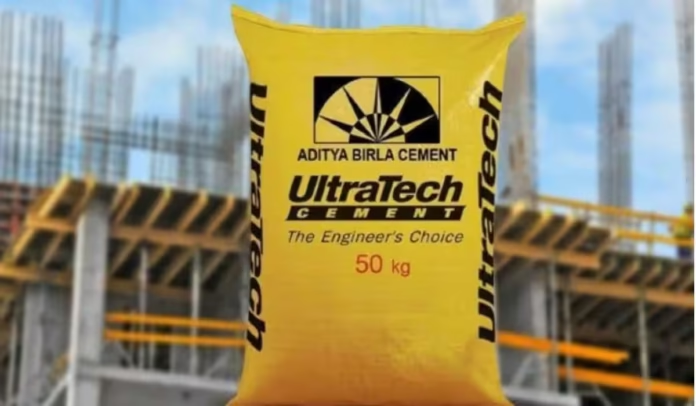
India’s largest cement producer is sharpening its push into the building materials ecosystem, with UltraTech Cement appointing a new chief executive to lead its upcoming wires and cables vertical. The move signals a deeper strategic shift as construction majors look to integrate electrical infrastructure products alongside core materials, reshaping supply chains for India’s fast-growing urban and real estate markets.
The newly appointed executive will lead UltraTech’s entry into the wires and cables segment—an area closely tied to urban infrastructure, housing, and industrial development. Industry insiders indicate the role will focus on building operational capabilities, establishing market presence, and scaling the business in a sector dominated by established electrical goods manufacturers. The expansion comes at a time when India’s urbanisation trajectory is accelerating demand for integrated construction solutions. From residential towers to transit systems and data infrastructure, wires and cables form a critical backbone for energy distribution and connectivity. Analysts note that UltraTech’s move could help streamline procurement across large-scale projects, particularly in rapidly developing urban clusters.This leadership appointment also reflects a broader trend among construction material companies diversifying into adjacent segments. With margins in core cement operations facing cyclical pressures, firms are increasingly entering higher-value product categories linked to the built environment. The wires and cables business is expected to complement UltraTech’s existing portfolio of construction solutions, which already spans multiple building products.
Market observers suggest the timing is strategic. India’s wires and cables sector has witnessed steady growth over the past few years, driven by infrastructure expansion, electrification, and rising demand from real estate. However, the segment remains competitive, with price volatility in raw materials such as copper and the presence of both organised and unorganised players shaping market dynamics. The appointment of a seasoned industry leader—someone with experience across consumer electricals and industrial businesses—signals the company’s intent to compete aggressively. Senior executives familiar with the development say the leadership team is expected to prioritise distribution networks, manufacturing scale, and brand positioning in the initial phases.For urban development, the implications extend beyond corporate strategy. Integrated supply chains can reduce project delays, improve quality consistency, and potentially lower costs in large infrastructure and housing developments. As cities expand and retrofit for climate resilience, reliable electrical systems will play a critical role in energy efficiency and safety.
Looking ahead, the success of UltraTech’s wires and cables venture will depend on execution speed and its ability to differentiate in a crowded market. If scaled effectively, the move could redefine how building materials companies participate in India’s urban growth story—shifting from commodity suppliers to end-to-end infrastructure enablers.
UK Devine Chemicals Expands With New Facility Move
UK-based specialty chemicals manufacturer Devine Chemicals has relocated to a significantly larger facility in County Durham, marking a strategic expansion aimed at scaling production, innovation, and global distribution capabilities. The move reflects growing demand for advanced chemical additives used across construction, coatings, and industrial applications.
The new site in Consett spans approximately 30,000 square feet—roughly double the size of its previous premises—and is designed to support increased manufacturing output and operational efficiency. The relocation forms part of Devine Chemicals’ long-term growth roadmap, following several years of sustained business expansion and rising international demand. At the core of this transition is a shift towards integrated production and research capabilities. The facility is expected to house dedicated innovation spaces alongside expanded warehousing and processing infrastructure. Industry observers note that such consolidation of R&D and manufacturing functions is becoming increasingly critical in the specialty chemicals sector, where product performance and customisation are key differentiators.Devine Chemicals operates across a diverse set of industries, including paints, coatings, construction chemicals, adhesives, and agrochemicals. Its portfolio includes water-based additives such as dispersants, rheology modifiers, and pigments—materials that are essential to improving durability, efficiency, and sustainability in construction and building applications.
The expansion comes at a time when global construction systems are undergoing transformation, with increasing reliance on high-performance materials to meet stricter environmental and durability standards. Additives used in coatings and construction chemicals are playing a growing role in enabling longer-lasting infrastructure, reduced maintenance cycles, and improved energy efficiency in buildings.From an urban development perspective, the relocation signals how upstream manufacturing sectors are adapting to support evolving construction demands. As cities prioritise climate resilience and sustainable building practices, the demand for advanced material inputs—such as low-emission coatings and performance-enhancing additives—is expected to rise.The new facility is also likely to have regional economic implications. Expanded operations could support job creation and strengthen local supply chains in North East England, a region increasingly positioning itself as a hub for advanced manufacturing and industrial innovation.However, the scale-up also underscores broader industry challenges. Chemical manufacturing remains resource-intensive, and expansion plans across the sector are increasingly being evaluated against sustainability benchmarks. Experts suggest that companies investing in modern facilities will need to integrate energy-efficient processes and environmentally responsible production methods to remain competitive in a decarbonising economy.
Devine Chemicals’ relocation aligns with a wider trend of mid-sized industrial firms investing in capacity expansion to meet global demand while improving operational resilience. As construction, coatings, and infrastructure sectors evolve, such investments are expected to play a pivotal role in shaping supply chains that are both efficient and environmentally aligned.
India’s paint industry is entering a phase of pricing adjustments amid weak consumption trends, with companies such as Asian Paints, Berger Paints, Kansai Nerolac and Indigo Paints initiating price increases to manage rising input costs. The development signals a widening gap between cost pressures and demand recovery, raising concerns for the sector’s near-term growth outlook.
According to recent industry assessments by Motilal Oswal Financial Services, paint manufacturers have begun implementing price hikes ranging from 3% to as high as 8%, with additional revisions expected in phases through April. These measures are largely aimed at offsetting the impact of elevated raw material costs linked to crude oil derivatives. The paints sector remains structurally sensitive to global oil movements, as nearly 40% of its input basket—including solvents, resins and binders—is derived from crude-based materials. This dependency has intensified cost volatility, particularly amid geopolitical uncertainty, forcing companies to prioritise margin protection even as demand conditions remain fragile.This evolving dynamic is shaping the broader India paint demand outlook, which appears subdued in the near term. Industry experts note that while pricing actions may stabilise margins, they risk dampening consumption further—especially in price-sensitive rural and semi-urban markets where discretionary spending remains uneven.
The slowdown comes at a time when the paints industry has been closely tied to India’s urban growth cycle. Demand is typically driven by residential construction, infrastructure expansion, and renovation activity. However, muted housing demand in certain segments and slower rural recovery have softened volume growth, despite ongoing urbanisation trends.Data from industry studies indicates that while the long-term trajectory of the sector remains intact—supported by housing programmes, infrastructure investments, and rising consumer aspirations—the current phase reflects a cyclical adjustment. Decorative paints, which account for the majority of demand, are particularly exposed to fluctuations in household spending and real estate activity.The pressure is further compounded by increasing competition and capacity expansion across the sector, which has limited the ability of companies to fully pass on cost increases without affecting volumes. Analysts suggest that any meaningful improvement in the India paint demand outlook will depend on a broader recovery in consumption, particularly in rural markets and affordable housing segments.
From an urban development perspective, the paints industry remains a critical downstream indicator of construction health. Reduced momentum in paint demand often signals slower activity in housing completions and building upgrades, both of which are essential for improving urban liveability and infrastructure quality.Looking ahead, the sector’s recovery will likely hinge on a combination of stabilising input costs, improved consumer sentiment, and sustained infrastructure spending. For now, the balance between pricing discipline and demand revival will remain a key challenge for paint companies navigating an uncertain operating environment.
A sustained wave of infrastructure expansion across emerging and developed economies is set to drive long-term growth in the global concrete block making machines market, with demand expected to steadily rise through 2035. The shift reflects deeper structural changes in how cities are being built—faster, denser, and increasingly dependent on standardised construction materials.
Industry estimates indicate that the concrete block making machines market could expand from around $319 million in 2025 to approximately $482 million by 2035, reflecting consistent growth over the decade. This trajectory is closely tied to accelerating urbanisation, public infrastructure spending, and the global push for affordable housing solutions.Concrete blocks, widely used in residential and infrastructure projects, are favoured for their durability, cost efficiency, and ease of mass production. Machines that can produce uniform, high-quality blocks at scale are therefore becoming critical to modern construction ecosystems. As cities expand and construction timelines compress, developers are increasingly relying on automated and semi-automated production systems to improve efficiency and reduce labour dependency.Urban development experts note that this trend is particularly visible in Asia-Pacific and parts of Africa, where population growth and migration to cities are placing pressure on housing and civic infrastructure. Governments in these regions are investing heavily in roads, public transport systems, and affordable housing, all of which require reliable and scalable building materials.
The growth of the concrete block making machines market also reflects a broader industrial transition towards mechanisation in construction supply chains. Traditional brick-making processes, often labour-intensive and inconsistent in output, are gradually being replaced by automated systems capable of meeting modern quality and volume requirements.However, this expansion brings environmental considerations into sharper focus. Concrete production is a significant contributor to carbon emissions, and the scaling up of block manufacturing raises concerns around resource consumption and sustainability. Industry stakeholders are increasingly exploring energy-efficient machinery, recycled aggregates, and alternative materials such as fly ash to mitigate environmental impact.Parallel trends in the wider construction equipment sector reinforce this outlook. The global concrete equipment market itself is projected to grow steadily through 2035, supported by infrastructure investments and industrial activity. This suggests that machinery used in material production, including block-making systems, will remain integral to the built environment’s evolution.
For cities, the implications are twofold. On one hand, improved access to efficient construction technologies can accelerate housing delivery and infrastructure development. On the other, ensuring that this growth aligns with sustainability goals will require stronger regulatory frameworks and technological innovation.As governments and developers navigate the next phase of urban expansion, the balance between speed, affordability, and environmental responsibility will define how the construction sector—and its enabling technologies—evolves over the coming decade.
A ₹1,800 crore industrial investment by Shree Cement in Meghalaya is set to reshape the region’s construction ecosystem, with a new integrated cement facility planned in East Jaintia Hills. The project signals a deeper push into India’s Northeast, a geography increasingly seen as critical for infrastructure-led growth and regional connectivity.
The proposed plant, to be developed at Daistong village, will add close to one million tonnes per annum (MTPA) each of clinker and cement capacity. It is scheduled for commissioning by early 2028, according to regulatory disclosures. Shree Cement has indicated that the investment will be financed through a mix of internal accruals and borrowings, reflecting a long-term capacity strategy aligned with rising construction demand. This Meghalaya cement plant investment marks a strategic shift towards under-served markets where infrastructure expansion is accelerating. The Northeast has historically faced supply constraints due to logistics bottlenecks and limited industrial capacity. By establishing a local production base, the project is expected to reduce transportation costs and stabilise cement availability for public works and real estate activity.Urban planners note that such investments could play a catalytic role in enabling road networks, housing, and public infrastructure projects across hill states. With connectivity projects under implementation, including highways and cross-border trade corridors, regional demand for construction materials is projected to rise steadily over the next decade.
At the same time, the Meghalaya cement plant investment raises critical questions around sustainable industrialisation. Cement production is carbon-intensive, and new capacity additions increasingly face scrutiny over emissions, resource use, and ecological impact—particularly in environmentally sensitive regions like the Northeast. Experts suggest that integrating energy-efficient technologies and alternative fuels will be key to aligning expansion with India’s broader climate commitments.Local economic implications are also significant. The project is expected to generate direct and indirect employment, while stimulating ancillary sectors such as logistics, mining, and small-scale services. However, land use, environmental clearances, and community engagement will remain central to ensuring that development benefits are equitably distributed.Industry observers see this move as part of a wider trend of cement manufacturers diversifying geographically to balance demand cycles and reduce regional concentration risks. For Meghalaya, the entry of a major national player could intensify competition and improve supply resilience, while also raising the bar for environmental compliance and operational standards.
As the project moves towards execution, its long-term impact will depend not just on capacity addition, but on how effectively industrial growth aligns with ecological safeguards and inclusive development priorities in the region
India Star Cement ESG Rating Signals Sustainability Push
India’s cement sector is seeing a gradual shift towards sustainability-linked benchmarking, with Star Cement receiving an ESG score that signals growing scrutiny of environmental and governance practices in heavy industries.Star Cement has been assigned a score of 65 by NSE Sustainability Ratings & Analytics for the financial year ending 2025, based on publicly disclosed information.
The independent assessment—conducted without direct engagement from the company—evaluates performance across environmental, social, and governance parameters, reflecting an emerging framework for accountability in the construction materials sector. The development highlights the increasing relevance of ESG metrics in sectors traditionally driven by cost and capacity considerations. As infrastructure expansion accelerates across India, the Star Cement ESG rating offers insight into how companies are aligning operational practices with broader sustainability expectations tied to urban development and climate resilience.ESG ratings, typically built on disclosures related to emissions, resource use, workforce practices, and governance standards, are becoming a key reference point for institutional stakeholders. Analysts tracking the Star Cement ESG rating note that independently generated scores—especially those based solely on public data—can serve as a credibility benchmark, reducing reliance on company-led disclosures.For the cement industry, which is among the most carbon-intensive segments globally, such evaluations carry particular weight. Environmental performance, including energy efficiency and emissions management, is increasingly influencing not only investor perception but also regulatory frameworks and procurement decisions in infrastructure projects.
The rating also reflects a broader transition in how India’s construction ecosystem is being assessed. Urban planners and policy experts suggest that as cities expand, material suppliers will face growing pressure to demonstrate compliance with sustainability standards. ESG-linked assessments could play a role in shaping procurement norms for public infrastructure and large-scale real estate developments.Importantly, the voluntary nature of the evaluation signals a shift towards third-party, data-driven analysis in the absence of formal engagement. NSE Sustainability Ratings & Analytics, a SEBI-registered provider, relies on publicly available disclosures to generate such scores, underscoring the importance of transparency in corporate reporting. While a score of 65 indicates a moderate level of alignment with ESG parameters, industry observers note that the real significance lies in the direction of travel. Companies are increasingly expected to move beyond compliance towards measurable improvements in environmental impact and governance practices.
As India continues to build at scale, ESG-linked frameworks like the Star Cement ESG rating could become integral to how infrastructure supply chains are evaluated. The interplay between sustainability metrics and construction demand is likely to define the next phase of growth—where efficiency, resilience, and accountability carry as much weight as output.