Home Blog Page 320

Dwarka Expressway Driving Gurgaon Real Estate Transformation

0
Dwarka Expressway Driving Gurgaon Real Estate Transformation

Dwarka Expressway Driving Gurgaon Real Estate Transformation

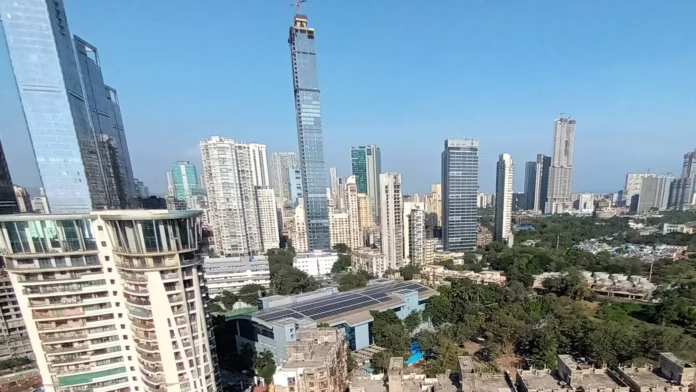
Gurgaon’s real estate market has witnessed a significant evolution over the past decade, establishing itself as a premier investment hub in North India. Renowned for its luxury housing, corporate presence, and cutting-edge infrastructure, the city has consistently attracted high-net-worth individuals, expatriates, and professionals seeking world-class living standards. Over the years, key corridors such as MG Road, Golf Course Road, and the Sohna Elevated Corridor have been instrumental in shaping the city’s skyline. Among these, the emergence of Dwarka Expressway as a real estate hotspot is now redefining the city’s growth trajectory. Once considered a speculative investment zone, this corridor has rapidly transformed into a thriving residential and commercial micro-market, offering a compelling mix of affordability, connectivity, and infrastructure-driven appreciation.

The rapid development of Dwarka Expressway is underpinned by the increasing land values and extensive infrastructure upgrades in the region. Connectivity has played a pivotal role in attracting real estate developers and investors alike. The expressway offers seamless access to key employment hubs, including Cyber City and Udyog Vihar, while also serving as a crucial link between Gurgaon and Delhi. With the upcoming Delhi-Mumbai Expressway, International Convention Centre, and Global City project, property demand along this stretch has surged. Data from leading property consultants indicates a steady increase in both residential and commercial property prices, with appreciation rates outpacing those in other established micro-markets of Gurgaon. The robust demand for premium residences, coupled with government-led infrastructural developments, has further cemented Dwarka Expressway’s position as the next big investment destination.

From an urban development perspective, the rise of Dwarka Expressway signifies a shift towards planned expansion, reducing the burden on traditional city centres. This corridor offers better road networks, planned residential layouts, and upcoming metro connectivity, enhancing ease of living for future residents. Compared to other established locations such as Golf Course Road, where property prices have already peaked, the expressway presents a relatively cost-effective alternative without compromising on amenities. However, despite the rapid progress, challenges persist in ensuring equitable urban development. Civic planners have raised concerns about last-mile connectivity, water management, and sustainable infrastructure planning, highlighting the need for integrated solutions that align with Gurgaon’s long-term urbanisation goals.

Sustainability remains a key consideration as Gurgaon continues to expand towards Dwarka Expressway. The unchecked urban sprawl in past decades led to infrastructure strain, environmental degradation, and water shortages in key residential zones. However, recent projects along the expressway are incorporating green building principles, energy-efficient construction, and rainwater harvesting mechanisms to mitigate these challenges. Moreover, developers are increasingly focusing on transit-oriented development, reducing dependency on private vehicles, and promoting eco-friendly mobility solutions. As Gurgaon’s real estate market continues to evolve, the integration of sustainability in urban planning will be crucial in ensuring long-term viability and livability, making Dwarka Expressway not just an investment hotspot but a model for future urban growth.

Trump to Impose 25% Tariffs on Steel and Aluminium, Escalating Trade Tensions

0
Trump to Impose 25% Tariffs on Steel and Aluminium, Escalating Trade Tensions

Trump to Impose 25% Tariffs on Steel and Aluminium, Escalating Trade Tensions

In a dramatic move that could further strain global trade relations, former US President Donald Trump has announced plans to impose 25% tariffs on all steel and aluminium imports starting Monday. The move, which affects major trading partners including Canada, Mexico, South Korea, and Vietnam, marks a significant escalation in Trump’s trade policy, reminiscent of his first-term approach. Speaking to reporters aboard Air Force One on Sunday, Trump said the new tariffs would apply to “everybody,” overriding past exemptions.

The policy will be followed by reciprocal tariffs to match the import duties imposed by other nations on US goods. Canada’s Ontario Premier Doug Ford was quick to criticise the decision, calling it “shifting goalposts and constant chaos,” warning that the move could destabilise the North American economy. The tariffs come on top of existing duties imposed during Trump’s first term, when he enforced 25% tariffs on steel and 10% on aluminium, before granting duty-free quotas to Canada, Mexico, and Brazil. President Joe Biden later extended these exemptions to Britain, Japan, and the EU, but US steel mill capacity has declined in recent years.

According to government and industry data, the largest sources of US steel imports are Canada, Brazil, Mexico, South Korea, and Vietnam. For aluminium, Canada remains the dominant supplier, accounting for 79% of total imports in 2024, followed by Mexico, which supplies aluminium scrap and alloys. Trump has long complained about trade imbalances, particularly with the European Union, criticising its 10% tariff on American auto imports while the US imposes only 2.5% on European cars. However, US automakers benefit from a 25% tariff on pickup trucks, which remains a key profit driver for General Motors, Ford, and Stellantis’s US operations. According to World Trade Organization (WTO) data, the US maintains a trade-weighted average tariff rate of 2.2%, significantly lower than India (12%), Brazil (6.7%), Vietnam (5.1%), and the EU (2.7%). The new tariffs could disrupt global supply chains and drive up production costs, potentially triggering retaliatory measures from affected nations.

In a surprising statement during his flight to New Orleans for the Super Bowl, Trump also hinted at possible fraud in US treasury debt payments, suggesting that the country “may carry less debt than thought.” The US currently holds $36.2 trillion in public debt, a critical factor in global financial stability. Trump has reportedly enlisted billionaire Elon Musk and his government efficiency team to investigate fraud and wasteful spending in federal agencies. The audits have already disrupted several government departments, raising questions about potential actions on US treasury management. The US trade landscape is set for major shifts, with Trump’s reciprocal tariff plan expected to be unveiled by mid-week. With retaliatory measures likely from trading partners, the coming weeks could see intensified global trade disputes and uncertainty in steel and aluminium markets. The White House is expected to release more details on tariff implementations and affected industries in the coming days.

NGT Panel Flags Environmental Gaps at ACC Cement Plant in Himachal Pradesh

NGT Panel Flags Environmental Gaps at ACC Cement Plant in Himachal Pradesh

NGT Panel Flags Environmental Gaps at ACC Cement Plant in Himachal Pradesh

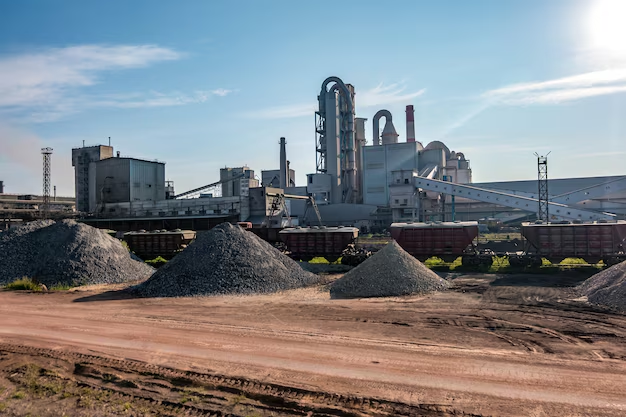
The ACC Cement plant in Barmana, Himachal Pradesh, has come under scrutiny after a joint committee of the National Green Tribunal (NGT) identified several environmental compliance gaps. These lapses have raised significant concerns about air pollution in the region, which has been an ongoing issue for local residents. A team comprising Bilaspur’s Subdivisional Magistrate (SDM) Abhishek Garg, Himachal Pradesh State Pollution Control Board (HPSPCB) regional officer Pawan Sharma, and Central Pollution Control Board (CPCB) scientist Narender Sharma conducted an inspection at the ACC cement facility on January 18, 2025. The inspection uncovered deficiencies in the plant’s environmental safeguards, despite prior directives from the HPSPCB.

Among the most concerning issues was the emission of dust from clinker, ash, and cement silos, which contributed to pollution in the area. Although the plant had installed metal sheets and nets near a local residence to mitigate dust, the height of these barriers was deemed insufficient for effective dust control. Furthermore, while the facility had implemented a truck wheel washing system to reduce dust dispersion, the committee found that the system lacked a mechanism to remove oil and grease from wastewater before it was recycled for washing purposes. One of the key environmental measures that the cement plant failed to implement was a three-layer tree plantation system, which is required to mitigate air and noise pollution. The absence of this system further highlighted the plant’s insufficient efforts to address environmental concerns.

The report also acknowledged the installation of 111 air pollution control devices at the plant, including 109 bag filters and two electrostatic precipitators. These devices were meant to capture dust generated during the production process. However, despite these measures, the plant had received seven complaints over the past three years related to environmental violations. In April 2022, the HPSPCB imposed an environmental compensation penalty of ₹1.29 crore on the company due to air pollution and untreated wastewater discharge. ACC Cement paid the fine, but concerns about ongoing compliance remain. Additionally, a previous ruling by the NGT in 2015 had resulted in a ₹50 lakh fine for similar violations at the Barmana plant, highlighting a pattern of environmental issues at the site. At the time of the most recent inspection, the plant was undergoing its annual maintenance shutdown and operating at only 25% capacity, with mining and crushing activities halted. The committee has requested an additional eight weeks to conduct a follow-up inspection when the plant is fully operational.

The NGT’s investigation was triggered by a petition from Kashmir Thakur, a resident of Barmana, who alleged that airborne dust from the cement plant was contaminating local roads, pathways, and residential areas. Thakur further claimed that ACC Cement had failed to manage emissions effectively, despite the plant’s years of operation. The tribunal is now set to review the findings and is expected to make further decisions on the matter in the coming weeks. As the plant’s environmental record continues to come under the spotlight, local residents and environmental groups are calling for stricter measures to ensure the protection of the region’s air quality and overall environmental health. The ongoing case serves as a reminder of the challenges in balancing industrial growth with environmental protection, especially in areas that host high-polluting industries. The outcome of the NGT’s review could pave the way for stronger regulatory measures to ensure that companies like ACC Cement adhere to environmental norms and safeguard the health of surrounding communities.

Bollywood Stars Reap Riches from Mumbai Property Boom

0
Bollywood Stars Reap Riches from Mumbai Property Boom

Bollywood Stars Reap Riches from Mumbai Property Boom

The Mumbai real estate market continues to be a lucrative investment avenue, particularly for Bollywood’s top stars, who have capitalised on significant property appreciation over the years. In January 2025, Amitabh Bachchan, Akshay Kumar, Sonakshi Sinha, and Subhash Ghai collectively sold luxury apartments worth ₹122.42 crore, marking an average appreciation of 118% on their initial investments. These high-profile transactions have reignited discussions on the viability of residential real estate as an investment option versus alternative assets such as commercial properties, equities, gold, and bonds. Experts suggest that while Mumbai’s luxury housing segment has demonstrated robust growth, returns depend on factors like location, market cycles, and taxation policies.

Among the standout deals, Amitabh Bachchan’s duplex in Andheri saw a staggering 174% appreciation, fetching ₹83 crore against its ₹31 crore purchase price in 2021. Akshay Kumar’s Borivali apartment recorded a 78% gain, while Sonakshi Sinha’s Bandra residence appreciated by 61%. Meanwhile, director Subhash Ghai offloaded his Andheri apartment at a 47% premium, reinvesting ₹24 crore in a Bandra property. This trend underlines Mumbai’s evolving property dynamics, where high-net-worth individuals frequently engage in asset churn to capitalise on capital appreciation and reinvest in premium locations. While these returns may seem attractive, real estate experts caution that property investments come with associated costs such as stamp duty, registration fees, capital gains tax, and ongoing maintenance expenses, all of which impact net profitability.

From a sustainability perspective, the luxury housing boom raises questions about urban planning and environmental impact. The development of high-end residential towers often comes at the cost of green spaces and places additional strain on city infrastructure. Increased demand for premium locations has led to land scarcity, pushing developers to construct high-rises that contribute to higher energy consumption and carbon emissions. Experts advocate for sustainable urban planning initiatives, such as eco-friendly buildings, solar energy integration, and water conservation measures, to balance luxury developments with environmental responsibility. Moreover, urban congestion due to unchecked real estate expansion continues to be a pressing civic concern, necessitating better policy interventions.

For potential investors, these celebrity transactions offer valuable insights into Mumbai’s real estate market dynamics. While property investments have historically delivered substantial returns, factors such as market cycles, liquidity concerns, and taxation policies must be carefully evaluated. The real estate sector has seen a 60% price surge in major cities between 2019 and 2024, making residential properties a favourable asset class. However, with alternative investment options offering greater flexibility and lower entry costs, individuals must assess their risk appetite before making financial commitments. As Mumbai’s housing market continues its upward trajectory, sustainable and well-planned investments remain the key to long-term profitability.

Shree Cement Expands Premium Portfolio with Bangur Marble Cement

Shree Cement Expands Premium Portfolio with Bangur Marble Cement

Shree Cement Expands Premium Portfolio with Bangur Marble Cement

Shree Cement has introduced its latest premium offering, Bangur Marble Cement, under its flagship Bangur Cement brand. This Portland Slag Cement (PSC) is engineered for superior brightness, enhanced strength, and crack resistance, making it the ideal choice for exposed concrete structures and high-end construction projects.

The product was officially launched today in Ranchi, Jharkhand, marking the first step in its phased rollout across Bihar, West Bengal, and other Indian states. Over 2,000 retailers in these regions will soon stock Bangur Marble Cement, with dedicated in-store product demonstrations to showcase its unique advantages. Speaking at the launch, Neeraj Akhoury, MD of Shree Cement, stated, “Bangur Marble Cement is a testament to our commitment to innovation and quality. This product is engineered to meet the evolving needs of modern construction, offering brightness, strength, and durability. With this launch, we continue reinforcing our mission of providing cutting-edge building materials that set new industry standards.”

Apart from its high-performance properties, Bangur Marble Cement incorporates Ground Granulated Blast Furnace Slag (GGBS), a by-product from steel manufacturing. This eco-friendly composition enhances durability while reducing the environmental impact, aligning with sustainable construction practices. Bangur Marble Cement joins Shree Cement’s premium lineup, which includes Jungrodhak, Rockstrong, Powermax, Magna, and Roofon. With a digital-first strategy, Shree Cement aims to revolutionise the cement industry by enhancing consumer outreach and offering state-of-the-art building materials. With its strategic launch and eco-friendly advantages, Bangur Marble Cement is set to redefine construction quality in India’s growing infrastructure sector.

Odisha RERA Faces Criticism from Developers Over Arbitrary Decisions in Real Estate Disputes

    0
    Odisha RERA Faces Criticism from Developers Over Arbitrary Decisions in Real Estate Disputes
    Odisha RERA Faces Criticism from Developers Over Arbitrary Decisions in Real Estate Disputes

    Odisha RERA Faces Criticism from Developers Over Arbitrary Decisions in Real Estate Disputes

    The Odisha Real Estate Regulatory Authority (ORERA) has come under fire from several local developers who allege that the authority has been issuing “arbitrary” orders in real estate disputes. This criticism follows a recent case in which ORERA issued a suo motu order regarding a property project in Phulnakhara, stipulating that the developer could not proceed with further bookings until completed units were handed over to allottees.

    The order, which came as a result of a case filed against the developer, prohibits further collection of payments from buyers, registering an association of allottees, obtaining occupancy certificates for completed units, and handing over common areas to the association. The developer, however, disputed the order, claiming that it was unjust, and challenged the decision in the Orissa High Court, where they obtained a status quo on the matter. Ashish Garg, managing director of the real estate firm involved in the case, expressed his dissatisfaction with the ORERA process, highlighting that the authority did not convene a proper bench to hear the matter. “ORERA is harassing the developers. They do not have a proper bench to hear any case,” Garg said, noting that the authority typically consists of a three-member bench, but only two members were present in his case. He described the order as “completely arbitrary,” and this prompted his firm to seek a stay on the order from the High Court.

    This isn’t the first time that developers have voiced concerns over ORERA’s actions. In a similar case, a developer in Puri challenged ORERA’s demolition order regarding a residential project. The authority had found that the developer had extended the project without obtaining due plan approval from the Puri Konark Development Authority (PKDA). However, the developer alleged that the order lacked signatures from all the members of the bench and raised concerns about ORERA’s stance on hearing grievances from activists rather than aggrieved buyers themselves. While developers have voiced their concerns, ORERA maintains that its decisions are made to protect the interests of homebuyers. A senior ORERA official defended the authority’s actions, emphasising that the orders are intended to prevent fraudulent activities in the real estate sector. “We are not biased at all. The orders are meant to safeguard homebuyers from unscrupulous practices,” the official stated. The tension between ORERA and developers highlights the growing complexities in the real estate sector in Odisha, as the regulatory body seeks to enforce compliance and address issues that affect consumers. Developers, on the other hand, argue that such arbitrary actions can disrupt business operations and cause unnecessary delays.

    The legal battle between developers and ORERA is ongoing, with the real estate sector closely watching the outcomes of these disputes. Both sides seem to have a clear objective: developers want to operate without undue interference, while ORERA is determined to ensure that property transactions in the state are transparent and protect buyers’ interests. This clash between developers and the regulatory authority raises important questions about the balance of power in the Odisha real estate market. It underscores the need for clear processes and fair hearings to ensure that all parties involved, be they developers or buyers, can trust in the system that governs property transactions. For now, the focus remains on how the courts will resolve these disputes and whether ORERA’s approach to safeguarding consumers will stand up to the scrutiny of the judiciary and the real estate community. Developers are hoping for a more structured and transparent process, while ORERA is firm on its commitment to preventing fraudulent activities in the housing sector.

    Bengaluru Set to Launch 1,000 E-Khata Kiosks to Simplify Property Documentation

    0
    Bengaluru Set to Launch 1,000 E-Khata Kiosks to Simplify Property Documentation
    Bengaluru Set to Launch 1,000 E-Khata Kiosks to Simplify Property Documentation

    Bengaluru Set to Launch 1,000 E-Khata Kiosks to Simplify Property Documentation

    Bengaluru is set to launch 1,000 e-khata kiosks across the city. This initiative comes at a time when only 1.6 lakh of the 22 lakh properties in Bengaluru have availed of the e-khata, a crucial document for property registration. Another 1.4 lakh applications are currently pending, underscoring the need for a more efficient and user-friendly system.

    The e-khata is an essential document for property owners, as it provides digital records of land ownership and enables smoother transactions and access to government services. However, the complexity of the process has led to a backlog, leaving many property owners without the vital document. To address this, the Bruhat Bengaluru Mahanagara Palike (BBMP) is taking proactive steps to ease the procedure for residents. Munish Moudgil, the Special Commissioner (Revenue) of BBMP, announced that the city will set up 1,000 kiosks throughout Bengaluru, aiming to make the e-khata process more accessible and efficient. These kiosks will be equipped with the necessary technology, and the BBMP will provide tech support to ensure smooth operation. The kiosks will be located in strategic areas across the city to ensure maximum reach and convenience for property owners.

    In addition to setting up these kiosks, BBMP is hoping to involve local residents in the initiative. Property owners who have already obtained their e-khata and are familiar with the necessary documentation can volunteer to help their neighbours navigate the process. These volunteers will be provided with a BBMP login ID to upload required documents and facilitate the e-khata application process. By using BBMP servers and following the prescribed procedures, the volunteers will help ensure that the entire process remains secure and transparent. A nominal fee will be charged for the services provided at the kiosks. The first e-khata kiosk is expected to be launched in HRBR Layout next week, with plans to operationalise the remaining 999 kiosks across Bengaluru in the near future. This project is a significant step towards making property documentation more accessible and improving the overall efficiency of Bengaluru’s property registration system. The introduction of e-khata kiosks aligns with the broader vision of digitalising municipal services in Bengaluru. By engaging local volunteers and leveraging technology, BBMP aims to reduce the backlog of pending applications and ensure that more property owners can easily access the e-khata.

    The initiative also has the potential to alleviate the burden on BBMP staff, allowing for a smoother and faster processing of property-related services. For Bengaluru residents, this project could significantly improve their experience with property registration. Many property owners have faced challenges in navigating the bureaucracy involved in obtaining their e-khata. The introduction of these kiosks and the engagement of local volunteers offer a promising solution to these issues, making the process more efficient and user-friendly. As the project rolls out, it is expected that more and more property owners will be able to take advantage of the e-khata system, leading to a more streamlined and digitalised approach to property documentation in Bengaluru. With the BBMP’s efforts to simplify the process, this initiative will likely play a pivotal role in transforming the city’s property registration landscape for the better.

    VMRDA Unveils Plans for Zonal Development with New Maps for Visakhapatnam’s Expanded Area

      0
      VMRDA Unveils Plans for Zonal Development with New Maps for Visakhapatnam's Expanded Area
      VMRDA Unveils Plans for Zonal Development with New Maps for Visakhapatnam's Expanded Area

      VMRDA Unveils Plans for Zonal Development with New Maps for Visakhapatnam’s Expanded Area

      The Visakhapatnam Metropolitan Region Development Authority (VMRDA) has begun preparations for zonal development with the creation of base maps and land use maps for its newly expanded jurisdiction. Covering an area of 2,456 square kilometres, the new maps will be pivotal in laying the groundwork for a master plan that will shape the city’s growth for years to come.

      The VMRDA’s jurisdiction has been significantly expanded in recent years. It now includes 13 rural mandals from Anakapalli and Merakamudidam in Vizianagaram district, areas previously outside its purview. This expansion was part of the state government’s effort to accommodate Visakhapatnam’s growing population and urbanisation, necessitating an updated approach to infrastructure and planning. To ensure the accuracy and reliability of the information, the maps will be created using state-of-the-art technologies, such as Differential Global Positioning System (DGPS) and topographic surveys. These cutting-edge methods will help gather crucial data on land parcel boundaries, roads, railway lines, water bodies, and agricultural lands. The VMRDA will also digitise cadastral maps, which provide detailed information at the revenue village level, to ensure a precise understanding of land use and ownership.

      One of the key challenges of this large-scale project will be incorporating data on existing and proposed utilities and services. The maps will provide insights into the current and future plans for water supply, sewerage and drainage systems, electricity, telephone/fibre optics, and gas pipelines. By compiling this information, the VMRDA aims to create a comprehensive blueprint for managing the region’s infrastructure and utilities. Visakhapatnam’s growth is tied to the evolving role of the VMRDA. Since the Visakhapatnam Urban Development Authority (VUDA) was upgraded to VMRDA in 2018, the body has been tasked with overseeing a more expansive jurisdiction. The addition of 41 villages in Merakamudidam mandal in 2020, covering around 175 square kilometres, and a further 13 mandals from Anakapalli district in 2021, totalling 2,280 square kilometres, made it clear that Visakhapatnam needed an integrated plan that could guide its future development.

      The maps will serve as the foundation for the city’s master plan, which will be developed with a focus on efficient land use and sustainable urbanisation. A key aspect of this process will be ensuring that the data reflects both approved layouts and ongoing or proposed developments. With the involvement of local authorities, the VMRDA will also gather information on permissions, structures, and land use discussions that have already been committed to, helping them anticipate future trends and demands. The increased scope of the VMRDA’s work is not just about expanding the city’s boundaries but also ensuring that its growth is carefully managed. As Visakhapatnam continues to grow as an industrial, tourism, and trade hub, it’s crucial to have well-designed plans that take into account land use patterns, infrastructure needs, and environmental concerns. The creation of these base and land use maps marks the beginning of an ambitious effort to shape the future of Visakhapatnam. By leveraging modern surveying techniques and gathering comprehensive data on land use and utilities, the VMRDA is laying the foundation for a more organised and sustainable city. As these plans evolve, Visakhapatnam is poised for growth that balances development with the preservation of its unique environment and character.

      India Remains Net Importer of Steel as Imports Surge Over 20% in Apr-Jan 2024

      India Remains Net Importer of Steel as Imports Surge Over 20% in Apr-Jan 2024
      India Remains Net Importer of Steel as Imports Surge Over 20% in Apr-Jan 2024

      India Remains Net Importer of Steel as Imports Surge Over 20% in Apr-Jan 2024

      India has continued to rely on steel imports as the country recorded a significant rise of over 20% in inbound shipments from April to January 2024. The country’s steel imports reached 8.29 million tonnes (MT) during this 10-month period, compared to 6.89 MT during the same period last year. Meanwhile, India’s steel exports faced a decline, shrinking by nearly 29% to 3.99 million tonnes from 5.62 million tonnes in the previous fiscal year. Industry players are raising concerns over the surge in imports, especially from select countries like China, which has affected the competitiveness of domestic steel producers.

      Government’s Role in the Surge and Concerns from Industry

      The surge in imports has prompted industry leaders to call for action from the government. Steel Secretary Sandeep Poundrik emphasized that India must add 100 million tonnes (MT) of steel-making capacity by 2030 to reduce dependence on imports. However, the finance ministry has rejected a proposal from the steel ministry to establish a central organization for bulk procurement of green steel. The rejection was based on the fact that most steel purchased for government projects is typically done through contractors, with limited direct involvement from the central government. Tata Steel CEO T.V. Narendran raised concerns about the future of India’s steel industry, warning that the growing reliance on imports could harm long-term competitiveness. Jindal Stainless (JSL) MD Abhyuday Jindal also called on the government to raise the basic customs duty on stainless steel products from non-free trade agreement countries to 15% to protect domestic manufacturers.

      Challenges and the Need for Strategic Action

      Despite India’s growing steel production capacity, the industry is facing challenges due to global market conditions. Sluggish steel demand and oversupply in global markets have led to the ongoing struggles within the domestic industry. Steel makers have been urging the government to take steps to curb steel imports, ensure fair competition, and boost domestic production capacity to meet growing demand. The Indian steel industry’s continued reliance on imports and the corresponding decline in exports underscore the need for a strategic approach in balancing domestic production and international trade.


      Nippon Steel’s $14.9 Billion U.S. Steel Acquisition Bid Still On Track

      Nippon Steel's $14.9 Billion U.S. Steel Acquisition Bid Still On Track
      Nippon Steel's $14.9 Billion U.S. Steel Acquisition Bid Still On Track

      Nippon Steel’s $14.9 Billion U.S. Steel Acquisition Bid Still On Track

      Tokyo: Japanese steel giant Nippon Steel has not withdrawn its $14.9 billion bid to acquire U.S. Steel, despite comments made by former President Donald Trump suggesting that the company would “invest” in U.S. Steel but not pursue a full acquisition. Two sources close to the deal confirmed that Nippon Steel remains committed to its acquisition offer.

      Trump’s remarks earlier in the week had raised speculation about Nippon Steel’s future intentions, as he mentioned that the Japanese company would instead focus on making an investment rather than taking over U.S. Steel entirely. However, those familiar with the matter have clarified that Nippon Steel’s interest in the U.S. steelmaker is still ongoing, and the company has not retracted its original offer. The $14.9 billion bid, first announced by Nippon Steel earlier this year, is part of the company’s strategic effort to expand its presence in the U.S. market and gain a larger foothold in the global steel industry. This deal is seen as a critical step for Nippon Steel as it seeks to strengthen its portfolio and compete with other global steel producers. Nippon Steel has yet to publicly comment on the deal, but sources have emphasized that the Japanese steelmaker is actively working to move forward with its acquisition plans, which are still subject to regulatory approval and market conditions.