Home Blog Page 328

Italy’s Steel Production Declines by 5% in 2024

Italy's Steel Production Declines by 5% in 2024

Italy’s Steel Production Declines by 5% in 2024

Italy’s steel production experienced a significant downturn in 2024, with output dropping by 5 percent year-on-year, reaching a total of 20 million tons, according to the Italian Federation of Steelworkers, Federacciai. This decline is part of a broader trend affecting Europe’s steel industry, which has faced a range of pressures, from weak demand to increased competition from imports.

The reduction in production was primarily driven by a sharp drop in the production of flat products, which saw a decline of 9.7 percent year-on-year, amounting to just 8.6 million tons. In contrast, long products production, which accounted for 11.7 million tons, experienced only a modest decline of 0.2 percent, highlighting the ongoing resilience of the construction sector, a key consumer of long steel products. The automotive sector, however, struggled, significantly impacting the demand for flat products. The sector faced weakened demand, coupled with high levels of competitive imports, which reached 5.58 million tons between January and October 2024. This combination of factors placed substantial pressure on the Italian steel industry’s flat product output.

December 2024 saw a particularly sharp decline in steel production, with output falling by 8.8 percent compared to December 2023, and a staggering 33.4 percent month-on-month drop, amounting to 1.199 million tons. In the long products category, production was down 4.7 percent year-on-year, reaching 682 thousand tons, and decreased by 38 percent from the previous month. Conversely, flat products showed a slight increase of 3.2 percent compared to the previous year, reaching 639 thousand tons, though it also saw a monthly decline of 14.4 percent. The seasonal slowdown in construction activity likely contributed to the drop in long products production, reflecting weaker demand from this crucial sector.

This decline in steel production in 2024 follows a similar trend observed in 2023, when Italy’s steel output fell by 2.5 percent year-on-year to 21.06 million tons. Both years have been marked by high energy costs, sluggish global demand, and competition from lower-cost steel imports. On a broader scale, the European Union’s steel production also faced challenges. In 2023, EU production dropped by 7.4 percentyear-on-year to 126.3 million tons. However, December 2023 saw a slight improvement, with EU steel production rising by 2.7 percent compared to the same month in the previous year, reaching 9.1 million tons. Italy’s steel industry faces a difficult year ahead as it contends with persistent challenges from both domestic and global economic pressures. While long products have shown some resilience, the flat steel sector remains under considerable strain, reflecting broader challenges facing European steelmakers in 2024.

JSW Plans Steel City in Gadchiroli with ₹3 Lakh Crore Investment

JSW Plans Steel City in Gadchiroli with Rs 3 Lakh Crore Investment

JSW Plans Steel City in Gadchiroli with ₹3 Lakh Crore Investment

In a major boost to Maharashtra’s industrial landscape, the state government signed multiple memorandums of understanding (MoUs) on the first day of the World Economic Forum (WEF) in Davos, securing investment commitments worth over ₹3.35 lakh crore for Vidarbha. Among the most significant deals, JSW Group emerged as a key player with investment proposals amounting to ₹3 lakh crore, which is expected to generate around 10,000 jobs.

The JSW Group’s ambitious plans involve setting up multiple projects in Maharashtra, with a significant focus on Vidarbha, particularly in Nagpur and Gadchiroli. JSW’s Chairman, Sajjan Jindal, confirmed that the company would invest in a wide array of sectors including steel, solar energy, and electric vehicles (EVs), with a steel plant to be located in Gadchiroli. The state government has ambitious plans to transform Gadchiroli into a steel city, positioning it as a key industrial hub in the region. Alongside the steel plant, JSW’s proposal includes a solar mechanism unit in Nagpur and an EV manufacturing plant in Chhatrapati Sambhajinagar (Aurangabad). This MoU is part of Maharashtra’s broader strategy to attract industrial investments, with Vidarbha being the prime beneficiary of this investment wave. The state government has signed MoUs worth over ₹4.9 lakh crore across Maharashtra, with Vidarbha receiving the lion’s share. These projects are expected to generate more than 92,000 jobs across the state, with 21,000 positions projected for Vidarbha alone.

In addition to JSW, other major players are showing interest in Maharashtra. The Kalyani Group, known for its stakes in defence and steel industries, has also signed an MoU for a significant investment in Gadchiroli, potentially establishing a defence production unit in the region. Chief Minister Devendra Fadnavis, while applauding JSW’s decision to invest in Maharashtra, emphasised the state’s favourable business environment. Sajjan Jindal, in his address, echoed similar sentiments, highlighting that Maharashtra offers a stress-free atmosphere for industrial growth, which is a key reason why JSW is committing large-scale investments to the state. JSW’s plans also include investments in renewable energy, cement, lithium-ion batteries, and solar water heating systems.

The company’s diverse portfolio is expected to provide a comprehensive development plan for the region, positioning Maharashtra as a key player in multiple high-growth sectors. Following JSW’s signing, another notable MoU was inked with Waaree Energies Ltd for an investment of ₹30,000 crore, focused on solar panel manufacturing. Furthermore, the Kalyani Group committed to a ₹5,200 crore investment, expected to create 4,000 jobs in the region. This surge in industrial investment is poised to transform Vidarbha, with Nagpur and Gadchiroli at the forefront of this industrial renaissance. As Maharashtra continues to attract high-value investments, the state’s economic landscape looks set to undergo a significant transformation, creating thousands of new job opportunities and enhancing its position as an industrial powerhouse in India.

China’s Steel Industry Faces Softening Outlook

China's Steel Industry Faces Softening Outlook

China’s Steel Industry Faces Softening Outlook

China’s steel industry, the world’s largest producer of the key industrial metal, is exhibiting signs of softening yet displaying remarkable resilience in the face of mounting economic pressures. As the global economic landscape continues to evolve, China’s steel sector finds itself at a crossroads, caught between the persistent effects of the COVID-19 pandemic and the challenges of a changing geopolitical and domestic environment.

Since peaking at 1.065 billion metric tons in 2020, China’s steel production has been on a steady decline, with output expected to hit around 1.005 billion tons by 2024. This marks a significant decrease, yet it’s important to note that production levels have remained within a 70-million-ton range since 2019, highlighting a certain degree of stability despite external pressures. The reduction in output is a clear indicator of the sector’s response to broader economic slowdowns, particularly the ongoing struggles within China’s real estate sector. While some may view this decline as a symptom of weakness, a closer analysis reveals the industry’s resilience. Even amidst sluggish economic growth, China’s steel production has held steady at relatively high levels over the last five years.

Looking ahead to 2025, the trajectory of the steel industry is shrouded in uncertainty. Several critical factors will play a role in shaping the future. First, the evolving trade landscape, particularly with the United States, could have profound implications for China’s steel exports. New tariffs under President Trump’s administration could disrupt global supply chains and dampen China’s competitive edge. Moreover, the recovery of China’s residential property sector will be pivotal. If construction activity picks up and demand for steel surges, the sector may find itself on a firmer footing. Conversely, if property developers remain mired in financial difficulties, domestic steel consumption may continue to stagnate.

A key factor that will influence the industry in the coming year is China’s steel export strategy. With exports reaching a nine-year high of 110.72 million tons in 2024, an increase of 22.7 percent year-on-year, China’s steel mills have managed to offset some of the losses in domestic consumption. However, with countries like India ramping up their own steel production, China may face greater challenges in maintaining export growth. Notably, certain countries with limited domestic steel production will continue to rely on China for their steel imports. In an optimistic scenario, if global trade tariffs remain manageable and the domestic economy stabilises, China’s steel production could hover around 1 billion tons in 2025. This would likely ensure steady demand for iron ore, though the record-high imports of 2024 may not be replicated. Stockpiles are unlikely to surge again, which could limit the growth of iron ore imports, unless a significant dip in prices entices traders to replenish stock.

Cement Demand in Saudi Arabia to Surge as Major Projects Drive Growth

Cement Demand in Saudi Arabia to Surge as Major Projects Drive Growth

Cement Demand in Saudi Arabia to Surge as Major Projects Drive Growth

The cement industry in Saudi Arabia is poised for significant growth over the next seven years, with demand projected to surpass current levels. According to Mohammed Almatrafi, CEO of United Cement Industrial Company, the Kingdom’s cement demand is expected to increase as major infrastructural projects unfold.

Currently, Saudi Arabia’s total cement production stands at around 80 million tonnes annually, while the demand ranges between 50 and 53 million tonnes per year. However, with the hosting of the 2034 FIFA World Cup, Expo 2030, and ambitious development projects like Central Jeddah, the Red Sea project, NEOM, and Qiddiya, the demand for cement is set to rise significantly. Almatrafi referred to the next several years as the “golden years” for Saudi Arabia’s cement sector, driven by these large-scale projects. The developments not only highlight the Kingdom’s commitment to infrastructure and urban growth but are expected to provide a major boost to cement consumption in the country, further accelerating the demand for building materials. With increasing demand expected to outpace supply, the cement industry is set to play a critical role in supporting Saudi Arabia’s ambitious plans for urban and economic expansion in the years leading up to 2030 and beyond.

Cement Ozarów Reduces CO2 Emissions with Qlar’s Schenck Process Technology Upgrade

Cement Ozarów Reduces CO2 Emissions with Qlar’s Schenck Process Technology Upgrade

Cement Ozarów Reduces CO2 Emissions with Qlar’s Schenck Process Technology Upgrade

Cement Ozarów, part of the CRH Group, is leading the way in reducing CO2 emissions in the cement production process by adopting Qlar’s innovative MULTICELL MIN XR technology. This upgrade to their existing plant is helping the Polish cement producer enhance the use of alternative fuels (AFs), reduce reliance on coal, and improve the precision of coal dosing—all while contributing significantly to environmental sustainability.

Historically, the plant used fossil fuels, including coal, to fire its kilns. However, over the last two decades, Cement Ozarów has gradually shifted to using more alternative fuels, such as hard-to-recycle household waste, as a primary energy source. This change has notably decreased their coal consumption, and the implementation of Qlar’s system takes the process further by enabling more accurate and smaller-scale coal dosing. Qlar’s MULTICELL MIN XR technology is ideal for retrofitting existing infrastructure, allowing the plant to modernize its coal feeding system without requiring a complete overhaul. The new system supports precise coal dosing at low feed rates while ensuring high throughput during start-up processes. This helps maintain stability in the kiln even when the quality of alternative fuels fluctuates.

The system’s design also reduces coal usage, enabling significant fuel cost savings—up to €900,000 annually. The upgraded technology is seamlessly integrated with the existing equipment and has already shown results that exceed expectations. Cement Ozarów has reduced coal feed rates to as low as 0.3 t/h, surpassing the original specifications, which enhances sustainability and operational efficiency. The upgrade not only supports the plant’s efforts to meet emission targets but also delivers a quick return on investment due to the substantial savings on fuel costs. As of November 2023, the new system has been in full operation, marking a significant milestone in Cement Ozarów’s environmental strategy. This successful implementation demonstrates how incremental technological upgrades can provide both operational and environmental benefits, reducing CO2 emissions while optimizing production processes.

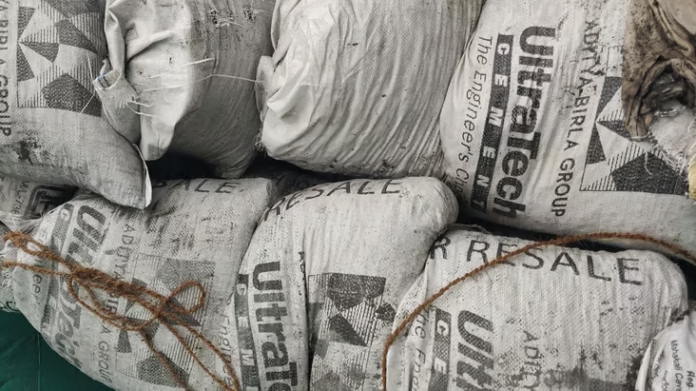
UltraTech Cement Delivers 137% Return to Shareholders, Despite Stable ROCE

UltraTech Cement GST Dispute Raises Compliance Questions

UltraTech Cement Delivers 137% Return to Shareholders, Despite Stable ROCE

When evaluating UltraTech Cement’s (NSE:ULTRACEMCO) performance, it’s essential to take a balanced view. Over the last five years, the company has employed 27 percent more capital, but its return on capital employed (ROCE) has remained steady at 11 percent. While this might not be an exciting figure, the consistency and ability to reinvest in profitable initiatives at this rate are noteworthy.

Although the trend of ROCE does not stand out as exceptional, it signifies that UltraTech Cement is successfully reinvesting its capital at a moderate but stable return. This level of consistency can provide long-term value for shareholders, as it has with a remarkable 137 percent return to those holding stock over the last five years.

The key takeaway here is that UltraTech Cement has demonstrated its ability to reinvest in its business at respectable rates, which, combined with strong stock performance, makes it an appealing option for further research, even as the stock price might appear higher than before. Given the solid fundamentals, UltraTech Cement continues to be a noteworthy player in the cement industry.

Dalmia Bharat’s Q3 Profit Falls 75% Amid Cement Price Slump, Sees Growth Momentum Ahead

Dalmia Bharat's Q3 Profit Falls 75% Amid Cement Price Slump, Sees Growth Momentum Ahead

Dalmia Bharat’s Q3 Profit Falls 75% Amid Cement Price Slump, Sees Growth Momentum Ahead

Cement maker Dalmia Bharat reported a significant 75 percent decline in its profit after tax for the third quarter ending December 31, 2024, with the profit dropping to ₹66 crore from ₹266 crore in the same period last year. Revenue from operations also saw a decrease of 12 percent year-on-year, amounting to ₹3,181 crore compared to ₹3,604 crore in the previous year. The company faced a challenging environment with a sharp dip in cement prices.

Volume sales also experienced a slight 2 percent year-on-year decline, and the company’s EBITDA (earnings before interest, taxes, depreciation, and amortization) fell 34.5 percent year-over-year to ₹511 crore. Puneet Dalmia, Managing Director & CEO of Dalmia Bharat, expressed confidence that cement demand growth would regain momentum. “Our capacity expansion plans are on track, as we will reach 49.5 million tonnes (MnT) by the end of this year,” he said. Dharmender Tuteja, CFO of Dalmia Bharat, attributed the weaker-than-expected cement demand growth during Q3 to persistent softness in cement prices. However, he noted that cement demand was gaining traction, and the company had observed signs of optimism in the pricing trend.

Steel and Cement Cartels Hurt Infrastructure Gadkari Calls for Change

Steel and Cement Cartels Hurt Infrastructure Gadkari Calls for Change

Steel and Cement Cartels Hurt Infrastructure Gadkari Calls for Change

Union Minister for Road Transport Nitin Gadkari has highlighted the challenges posed by “cartels” in the steel and cement industries, which are essential for the country’s infrastructure development. Gadkari, speaking at the IECRP 2025 exhibition, stated that these industries are dominated by a few key players who control pricing and are detrimental to India’s infrastructure progress.

“Steel and cement industries are in the hands of a few people. They always decide the rates. Their cartelism is a big problem for the country,” Gadkari remarked, emphasizing the need for intervention. To address this issue, Gadkari has advocated for Fiber-Reinforced Plastic (FRP) as a viable alternative to steel and cement. He offered support to the FRP industry, which he believes can break the dominance of entrenched players. FRP can be utilized across various sectors, including infrastructure, aviation, shipping, road construction, and metro rail. However, Gadkari urged the FRP industry to reduce prices by 20-25 percent compared to steel and cement, making it more competitive and cost-effective.

He emphasized that the FRP industry must invest in research and development, especially in identifying the right raw materials and focusing on domestic production to ensure its success. “If you can reduce the rate by 20-25 percent, it can be a really good thing for the country,” Gadkari said, addressing the FRP industry participants. In his speech, Gadkari also expressed his ambitions for the country’s energy sector, aiming to bring down the cost of hydrogen production to USD 1 per kg, a move that could potentially transform India into a net exporter of energy. Additionally, he reiterated his goal of making India the largest global auto hub within the next five years, building on the country’s current position as the third-largest automotive producer.

Macquarie Upgrades Cement Sector Amid Recovery, Targeting 20% Gains

Macquarie Upgrades Cement Sector Amid Recovery, Targeting 20% Gains

Macquarie Upgrades Cement Sector Amid Recovery, Targeting 20% Gains

Macquarie has issued a positive outlook for India’s cement sector, forecasting a demand recovery and price hikes that will likely boost margin expansion in the second half of calendar year 2024 (2H CY24). The brokerage expects these factors, combined with an emphasis on cost management and capacity consolidation, to strengthen the industry’s medium-term earnings profile. In a recent report, Macquarie upgraded its stance on several leading cement stocks, signalling strong growth potential.

Stock Upgrades and Target Prices

Macquarie raised its target price for Ultratech Cement to ₹11,868, suggesting a potential upside of 12% from Monday’s closing price. The stock rose by over 3 percent on Tuesday, peaking at ₹10,950. Ambuja Cements also received an upgrade, with a target price set at ₹618, offering a more than 15 percent upside from its previous closing price. The stock gained 2.6 percent on Tuesday, touching an intraday high of ₹548.5. For ACC Ltd, Macquarie set a target price of ₹2,425, indicating a potential upside of over 20 percent from its prior close. ACC’s shares increased by 2.5 percent on Tuesday, reaching ₹2,061 on the BSE. All three cement stocks were upgraded to an “Outperform” rating, reflecting Macquarie’s confidence in their ability to outperform the broader market in the coming months.

Ramco Cement and Shree Cement Outlooks

However, the brokerage downgraded Ramco Cement to “Underperform,” setting a target price of ₹785, a potential downside of 12 percent from Monday’s closing level. The downgrade is attributed to concerns about Ramco Cement’s near-term performance, despite the overall positive outlook for the industry. On Shree Cement, Macquarie maintained a “Neutral” rating, with a target price of ₹25,710, indicating a modest upside of over 2% from the previous close. This more cautious stance reflects the current market conditions and the stock’s recent performance.

Sector Outlook

Macquarie’s report underscores the positive prospects for the cement sector, citing factors such as the recovery in demand, ongoing cost efficiency measures, and the consolidation of production capacities. These developments are expected to support margin growth and foster earnings improvements over the medium term. The brokerage’s bullish stance on key cement stocks suggests confidence in their ability to weather market challenges and benefit from the anticipated industry tailwinds.

Dhanbad to Get Major Upgrade with Six-Lane Bypass Extension and Elevated Road

    0
    Dhanbad to Get Major Upgrade with Six-Lane Bypass Extension and Elevated Road
    Dhanbad to Get Major Upgrade with Six-Lane Bypass Extension and Elevated Road

    Dhanbad to Get Major Upgrade with Six-Lane Bypass Extension and Elevated Road

    Dhanbad, a key industrial hub in Jharkhand, is set to witness significant improvements in its road infrastructure with the announcement of a six-lane bypass extension and elevated road along a 20-km stretch of National Highway 19 (NH-19), connecting Govindpur to Nirsa. This ambitious project, aimed at reducing congestion in these densely populated areas, promises to provide smoother traffic flow and better connectivity across the region.

    Union Minister for Road Transport and Highways, Nitin Gadkari, unveiled the plan in a recent post on X, noting that the project will be a game-changer for transportation in Dhanbad. The total investment for the project is estimated at Rs 1,130.54 crore, a considerable sum that highlights the government’s commitment to improving infrastructure in Jharkhand.

    The stretch of NH-19 between Govindpur and Nirsa is notorious for traffic jams, particularly in the heavily populated areas of Govindpur. The introduction of a six-lane bypass and elevated road will allow vehicles to bypass the crowded localities, resulting in faster and more efficient travel. This is expected to reduce travel time significantly and ease the movement of goods and people in the region, which is vital for the area’s economic growth. As part of the larger upgrade to NH-19, also known as GT Road and NH-02, the new infrastructure will cater to the growing traffic demands of the area. Dhanbad, known for its coal mines and industrial centres, has long struggled with inadequate transportation options, and this development is seen as a step towards addressing these issues. The Rs 1,130 crore investment in the Dhanbad-Nirsa bypass is part of a broader effort to boost infrastructure across Jharkhand. Gadkari’s announcement follows the laying of foundations for several highway projects in the state worth Rs 2,500 crore in March 2024. These projects are expected to have a significant positive impact on the region’s connectivity, facilitating smoother travel between Jharkhand and neighbouring West Bengal, as well as enhancing the overall economic potential of the area.

    State BJP president, Babulal Marandi, expressed his gratitude to Prime Minister Narendra Modi and Nitin Gadkari for their role in securing these projects for Jharkhand. Marandi pointed out that the new flyover and bypass would be especially beneficial for the people of Koylanchal, a region historically dependent on the coal mining industry. By improving road access, the project will make commuting easier and safer, fostering economic growth and better living standards for local communities. Dhanbad is a vital city for Jharkhand’s economy, being home to several coal mines, industries, and educational institutions. However, its infrastructure has struggled to keep pace with the growing demands of its population and the surrounding industrial areas. The new flyover and bypass will address these challenges, creating a modern, well-connected transportation network that can support both commercial and residential growth. Moreover, improved road connectivity will make it easier for businesses to transport goods, boosting trade and industry in Dhanbad and the surrounding regions. This project aligns with the government’s focus on enhancing India’s transportation infrastructure to drive economic growth and reduce bottlenecks that hinder productivity.

    The new flyover and bypass are being viewed as key projects for the future of Dhanbad and the larger Jharkhand region. According to Gadkari, the project is vital not only for alleviating traffic congestion but also for fostering the region’s development in terms of both industry and connectivity. He stated that once completed, the six-lane road will provide an essential route for faster travel between Dhanbad, Ranchi, and other important industrial hubs in Jharkhand. The completion of this project will enhance the region’s role as an industrial powerhouse while simultaneously improving the daily lives of its residents. With work set to begin soon, local officials are optimistic that the project will make Dhanbad a more accessible and prosperous region in the years to come. The Dhanbad-Nirsa six-lane bypass and elevated road project marks an important step in the development of the region’s infrastructure. With the backing of Nitin Gadkari and the central government, the project will not only ease traffic congestion but also support Dhanbad’s industrial and economic growth. As the construction progresses, residents and businesses alike can look forward to a smoother, faster, and more efficient transportation network that will transform the way they travel and conduct business.