Home Blog Page 336

CRS Approves Katra-Reasi Section for Jammu-Srinagar Train Services

    0
    CRS Approves Katra-Reasi Section for Jammu-Srinagar Train Services
    CRS Approves Katra-Reasi Section for Jammu-Srinagar Train Services

    CRS Approves Katra-Reasi Section for Jammu-Srinagar Train Services

    The Commissioner for Railway Safety (CRS) has approved the recently laid Katra-Reasi section of the Udhampur-Srinagar-Baramulla (USRBL) rail project. This marks a significant step towards the introduction of regular train services connecting Jammu and Srinagar. The new section, which forms part of a larger vision to improve connectivity in the region, is expected to play a crucial role in easing travel for both locals and tourists while providing a safe and efficient transportation option for the region.

    The Katra-Reasi stretch of the rail network has been a long-awaited project, and with the CRS approval, it is now cleared to operate with several important operational stipulations. While the final official date for the inaugural run has not been confirmed, sources indicate that it is expected to occur within the month. The CRS green-light is a critical milestone that opens the path to the commencement of regular train services, which are expected to enhance connectivity in Jammu and Kashmir and support the region’s economic and tourism growth. For security reasons, trains running on the Jammu-Srinagar route will operate exclusively during daylight hours. This decision reflects the need for heightened security in the region and aims to ensure the safety of passengers. In addition, special security measures will be implemented, particularly at Katra, where separate boarding arrangements will be made for Srinagar-bound trains. Passengers will undergo stricter security checks to ensure the smooth and secure operation of services.

    A notable aspect of this phase is that non-stop trains from major cities like Delhi to Srinagar will not be available immediately. For now, passengers will need to board trains to Srinagar via Katra, where they will undergo a separate security screening before continuing their journey. Although these operational restrictions may seem limiting, they are essential for ensuring passenger safety in a region that requires additional vigilance. In terms of operations, the Katra-Reasi section is set to allow trains to run at a maximum speed of 85 km/h on the normal track, and 15 km/h on the loop line of the station. This speed limit ensures a safe and reliable service, taking into account the geographical and topographical challenges of the region. The CRS has outlined specific conditions that must be met before regular operations commence, including adherence to safety protocols and infrastructure standards.

    The approval of this section will likely play an essential role in improving the overall connectivity between Jammu and Srinagar, two vital cities in the region. The ability to travel by rail will reduce the travel time between these locations, providing a convenient alternative to road transport. Additionally, this development is expected to enhance the overall economic activity, as improved transportation links foster trade, tourism, and local commerce. This clearance from the CRS marks a turning point in the decades-long effort to provide a modern and efficient rail service between Jammu and Srinagar. The Udhampur-Srinagar-Baramulla rail project has been one of the most ambitious infrastructure initiatives in Jammu and Kashmir, and the Katra-Reasi section is a key part of this larger vision. Once fully operational, the rail network will provide a seamless connection, reducing the dependence on roadways and increasing accessibility to the picturesque Kashmir Valley.

    With the introduction of this new train service, the region will not only gain an important mode of transport but will also benefit from enhanced safety measures. As train travel becomes more accessible, it will offer a new avenue for tourism, allowing visitors to experience the region’s natural beauty without the difficulties posed by road travel. The new services are expected to attract more tourists, contributing to the region’s economy and providing a much-needed boost to local industries. The approval of the Katra-Reasi rail section is a significant step in the broader development of the region’s infrastructure. While the path to regular train services is accompanied by additional security checks and daytime operations, the benefits to the local economy, tourism, and overall connectivity are undeniable. As the CRS clears the way for regular operations, it is expected that future developments will bring further improvements to the rail network, including non-stop trains and more extensive services. This is a landmark moment for the people of Jammu and Kashmir, setting the stage for greater integration into the national rail network and contributing to the region’s growth and prosperity.

    Indian Railways Earnings Reach Rs 2 Lakh Crore with Record Freight Loading

      0
      Indian Railways Earnings Reach Rs 2 Lakh Crore with Record Freight Loading
      Indian Railways Earnings Reach Rs 2 Lakh Crore with Record Freight Loading

      Indian Railways Earnings Reach Rs 2 Lakh Crore with Record Freight Loading

      Indian Railways has recorded impressive earnings of Rs 2.04 lakh crore in the current fiscal year, a significant 4% increase over the same period last year. The surge is largely attributed to higher freight loading and a substantial increase in the number of special trains during peak demand periods. This milestone marks a crucial moment for the national transporter, which has consistently worked towards enhancing operational efficiency and expanding its services.

      A major contributor to this record-breaking figure is the freight segment, which has seen an uptick of nearly 2%, with Indian Railways handling almost 1.18 billion tonnes of goods from April to December 2024. This growth is expected to continue, with a senior official stating that Indian Railways is exploring adjustments to freight rates to increase revenue even further. “We estimate higher goods earnings if fares on certain commodities are rationalised,” the official said, highlighting that freight operations are likely to remain at the core of their revenue model. The rise in earnings also reflects a broader increase in the number of train services, with the total number of mail, express, passenger, and other trains rising by 3%, reaching a historic total of more than 2.07 million runs. This achievement comes at a time when passenger demands are surging, and Indian Railways has responded by introducing a higher frequency of special trains. The number of special trains run during periods of high demand surged by an extraordinary 54% year-on-year, reaching a total of 57,169 special trains during the nine-month period.

      In line with its ongoing expansion efforts, Indian Railways is also rolling out a new timetable that includes 62 pre-scheduled special trains on popular routes. This move is designed to ensure that train availability meets rising demand, especially during peak travel periods. The new timetable will also feature the introduction of 74 new services, including 34 pairs of Vande Bharat trains, which are expected to enhance the speed, comfort, and convenience of passenger travel. Vande Bharat trains are at the heart of Indian Railways’ modernisation strategy. These semi-high-speed trains are designed to significantly reduce travel times between major cities and improve passenger comfort. With the introduction of more Vande Bharat trains, the railways hopes to attract more passengers and compete with other modes of transport in terms of speed and reliability. Looking ahead, Indian Railways is setting its sights on more ambitious projects. One of the key goals for the coming year is to continue improving infrastructure, including commissioning upgraded railway stations, launching more modern trains, and decongesting the track network. These efforts are designed to address the growing demand for rail services and ensure that the infrastructure is capable of supporting India’s expanding economy.

      As part of this long-term vision, the Indian government is expected to allocate an additional 15-20% increase in capital expenditure (capex) for FY26, which could see the overall allocation rise from Rs 2.65 lakh crore in the current fiscal year to over Rs 3 lakh crore. This increased budget will likely be directed towards the development of railway stations, procurement of new trains, and the enhancement of signalling and track systems. According to officials, nearly 80% of the current year’s capex has already been spent, and the target for this fiscal year is expected to be met well before its conclusion. As Indian Railways continues to grow, its focus is not only on expanding services and revenues but also on improving safety and sustainability. The introduction of new trains, the focus on decongesting tracks, and an increased capex allocation reflect a commitment to long-term growth and operational excellence.

      The increased earnings are a testament to Indian Railways’ evolving strategies and its ability to meet the transportation needs of a rapidly growing nation. By modernising its fleet, improving infrastructure, and adjusting freight rates, the railways is positioning itself for future success. With a target operating ratio of 98.22% by the end of the fiscal year, the national transporter is optimistic about its financial health and its capacity to reinvest in further enhancing railway infrastructure through the Development Fund and Rashtriya Rail Sanraksha Kosh (RRSK). Indian Railways’ strong financial performance in the current fiscal year underscores the progress made by the national transporter in enhancing its operations, freight services, and passenger offerings. With an ambitious vision for modernising its services, increasing train frequencies, and expanding infrastructure, Indian Railways is set to continue playing a pivotal role in driving the country’s economic growth. The upcoming budget will likely provide the financial muscle needed for these ambitious plans, ensuring that the railways remains a key player in India’s future.

      Amit Shah to Launch Major Development Projects in Vadnagar, Gujarat

        0
        Amit Shah to Launch Major Development Projects in Vadnagar, Gujarat
        Amit Shah to Launch Major Development Projects in Vadnagar, Gujarat

        Amit Shah to Launch Major Development Projects in Vadnagar, Gujarat

        Union Home and Cooperation Minister Amit Shah will be in Vadnagar, a historic city in Gujarat’s Mehsana district, to inaugurate a series of significant development projects aimed at transforming the city into a major cultural and tourism hub. With an estimated cost running into crores, these initiatives focus on preserving Vadnagar’s rich heritage while improving infrastructure and promoting tourism.

        Vadnagar, with a history spanning over 2,500 years, has always been a melting pot of diverse cultures. It has witnessed the rule of multiple dynasties and stood as a vital trade centre along ancient routes. Notably, Vadnagar is the birthplace of Prime Minister Narendra Modi, whose vision has highlighted the city’s heritage potential. His efforts have brought Vadnagar into the spotlight, and the city is now poised for rapid growth as a tourist destination. Under the leadership of Amit Shah and Gujarat Chief Minister Bhupendra Patel, the state government is focusing on the preservation and development of Vadnagar’s cultural landmarks. Shah’s visit will mark the inauguration of the Archaeological Experience Museum, India’s first such facility, which showcases the city’s deep-rooted cultural history. Built at a cost of Rs 298 crore, this four-story structure spans 12,500 square metres and will house over 5,000 artefacts, ranging from sculptures to inscriptions, reflecting Vadnagar’s diverse heritage.

        The museum is more than just a static display; it offers an interactive experience with audio-visual films and exhibits, immersing visitors in the city’s fascinating past. A permanent shed will also showcase artefacts from ongoing archaeological excavations in the city. This development represents a step forward in making Vadnagar a focal point for cultural tourism in Gujarat. Alongside the museum, Shah will inaugurate Prerna Sankul, a Rs 72 crore project dedicated to preserving the historic primary school where Narendra Modi received his early education. The school, established in 1888, has been renovated by the Archaeological Survey of India to combine modern educational practices with moral teachings. It serves as an inspiring landmark for students, with a curriculum developed by IIT Gandhinagar, offering value-based education.

        Amit Shah’s visit will also include the inauguration of a Sports Complex in Vadnagar, built at a cost of Rs 33.5 crore. This state-of-the-art facility is designed to foster new athletic talent, providing world-class amenities for various sports, including an 8-lane, 400-metre synthetic athletic track, an astroturf football field, and dedicated spaces for kabaddi, kho-kho, and volleyball. The complex aims to identify and nurture emerging sports talent, with a special emphasis on para-sports programmes for Divyang athletes. A hostel for 200 students (100 boys and 100 girls) is also under construction, providing athletes with accommodation and the necessary resources to excel. This modern sports infrastructure is expected to benefit the local community by encouraging a strong sports culture and creating opportunities for youth to pursue their athletic dreams.

        Amit Shah will also review ongoing efforts to preserve Vadnagar’s heritage. The development plan includes the conservation of four key complexes, including façade restoration, building repurposing, and road construction. These upgrades aim to enhance the pedestrian experience with improved signage, street furniture, and the creation of a heritage trail, allowing visitors to explore Vadnagar’s rich cultural tapestry. Prerna Sankul will act as a central landmark, with all heritage routes converging here. In addition to these landmark projects, Shah will also visit the Hatkeshwar Temple, a 17th-century temple dedicated to Hatkeshwar Mahadev. This visit highlights the importance of preserving Vadnagar’s spiritual and architectural heritage, further reinforcing its status as a cultural gem.

        Vadnagar’s transformation is an example of how heritage can be preserved while also fostering growth. With the inauguration of these key projects, including the Archaeological Museum, Prerna Sankul, and the Sports Complex, Vadnagar is set to become a major hub for both cultural tourism and local talent development. Amit Shah’s visit marks a pivotal moment in the city’s evolution, as it seeks to celebrate its rich history while embracing the future. The city’s new infrastructure projects will not only attract tourists but also inspire a new generation of students and athletes, shaping Vadnagar into a prosperous and dynamic cultural destination.

        Air India Express Launches Daily Flights from Patna to Key Cities

          0
          Air India Express Launches Daily Flights from Patna to Key Cities
          Air India Express Launches Daily Flights from Patna to Key Cities

          Air India Express Launches Daily Flights from Patna to Key Cities

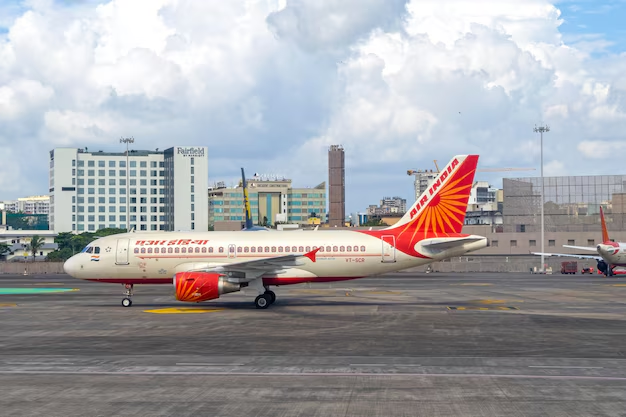
          Air India Express has launched daily flights connecting the city to Bengaluru, Bhubaneswar, and Hyderabad. This significant step is part of the airline’s broader strategy to improve connectivity between emerging cities and key destinations across India, as well as its expanding network to international locations.

          The announcement, made on Wednesday, marked a key moment for Patna as it gains improved access to some of the most important cities in India. The launch was celebrated with an event at Jay Prakash Narayan Airport, where senior officials from Air India Express, the Airports Authority of India, and other key stakeholders gathered to mark the occasion. The first flights took off with great enthusiasm, and passengers on board were given special boarding passes to commemorate the milestone. The new routes from Patna to Bengaluru, Bhubaneswar, and Hyderabad reflect Air India Express’ commitment to enhancing air connectivity within India. Bengaluru, known as the tech hub of the country, and Hyderabad, another major metropolitan city, will offer travellers in Patna better access to business and tourism opportunities. Bhubaneswar, the capital of Odisha, is a growing centre for culture and commerce, and its inclusion in these new routes will help connect Patna with yet another important city in Eastern India.

          These flights are part of Air India Express’ broader vision to enhance regional connectivity and cater to the increasing demand for air travel. The airline has also been adding new destinations to its network in recent months, further solidifying its position in the Indian aviation market. Recent additions include cities like Dimapur, Dibrugarh, and Sri Vijay Puram (Port Blair), and international destinations like Bangkok and Phuket. The introduction of these daily flights is not only a boost for air travel but also contributes to the region’s economic growth by enhancing connectivity between important business hubs and tourism centres. With the addition of Patna to this expanded network, local businesses and residents will benefit from easier access to markets, job opportunities, and other key sectors in Bengaluru, Bhubaneswar, and Hyderabad. The connectivity also opens up new travel possibilities for leisure travellers who can now explore these bustling cities with greater convenience. Bengaluru, known for its vibrant culture and tech industry, and Hyderabad, a major centre for business, technology, and cuisine, will be appealing destinations for many.

          Air India Express, a subsidiary of Air India, is expanding rapidly, with its growing fleet approaching the significant milestone of 100 aircraft. The airline’s recent expansion in both domestic and international markets highlights its commitment to serving an increasingly diverse and expanding customer base. Its winter schedule this year has seen a 30% increase in operations compared to last year, with over 400 daily flights now in operation, up from around 325 last year. This growth comes in tandem with an expansion of services to new destinations. Internationally, Air India Express is enhancing its presence in Southeast Asia, with destinations like Bangkok and Phuket now accessible from various parts of India. Domestically, the airline continues to fill gaps in regional connectivity, linking smaller cities to major metropolitan hubs.

          To celebrate the launch of these new flights, Air India Express offered special boarding passes to the first passengers on the inaugural flights. These small touches help create an engaging experience for travellers and mark the airline’s continued focus on customer service. The airline’s expansion also aims to ensure that passengers enjoy a seamless, reliable, and comfortable travel experience across its growing network. Air India Express’ latest move is a clear indication of the growing demand for air travel in India and the airline’s dedication to meeting this demand. With the addition of these new daily flights from Patna to Bengaluru, Bhubaneswar, and Hyderabad, the airline is making it easier for both business and leisure travellers to explore and connect with key destinations. This expansion, combined with the airline’s growing fleet and enhanced regional connectivity, positions Air India Express for continued success in the highly competitive aviation industry. As the airline continues to grow and extend its reach, passengers can expect more routes and better connectivity across India and beyond. This expansion plays a key role in the development of India’s aviation infrastructure, ensuring that regional cities like Patna are better connected to the rest of the country.

          CRISIL Calls for Policy Support to Boost Green Energy Demand in Budget 2025

            0
            CRISIL Calls for Policy Support to Boost Green Energy Demand in Budget 2025
            CRISIL Calls for Policy Support to Boost Green Energy Demand in Budget 2025

            CRISIL Calls for Policy Support to Boost Green Energy Demand in Budget 2025

            As India gears up for its Union Budget 2025, CRISIL, the prominent ratings agency, has made a compelling call for the government to drive demand for emerging renewable energy technologies. According to Rahul Prithiani, Senior Director & Global Head of Energy and Sustainability at CRISIL, a clear policy focus on these emerging technologies, especially green hydrogen, is crucial to creating a conducive environment for growth in the renewable sector.

            “Creating demand is key to driving the renewable energy sector forward,” Prithiani stated. He emphasised the need for government intervention to support the adoption of green energy technologies through incentives and strategic policy measures. Green hydrogen, for example, requires not only technological innovation but also a supportive framework to encourage its widespread use, which remains underdeveloped in India.

            CRISIL forecasts a massive surge in green energy investments, predicting a fivefold increase by 2030, totalling over Rs 31 lakh crore. This significant leap will be crucial for India’s clean energy goals, which align with the country’s commitment to the Paris Agreement on climate change. A large portion of the investment, Rs 19 lakh crore, will be allocated to storage and renewable energy, while Rs 4.1 lakh crore will focus on the transportation and automotive industries, including electric vehicles (EVs). Around Rs 3.3 lakh crore is expected to go into the oil and gas sector as part of India’s broader decarbonisation strategy. This comprehensive investment will aid in meeting the nation’s energy demands while transitioning to a cleaner, more sustainable future. Amish Mehta, Managing Director & CEO of CRISIL, elaborated on the necessity of government action in his remarks at the India Infrastructure Conclave 2025. “Accelerating grants and incentives, scaling up blended finance initiatives, and providing policy support are essential to drive initiatives for carbon market development and industrial decarbonisation,” he said, reinforcing the urgency of robust government backing.

            For emerging renewable technologies such as green hydrogen, carbon capture, utilisation and storage (CCUS), and energy storage solutions, the Indian government must create a policy landscape that provides clarity and security for investors. The development of these technologies is capital-intensive, and while debt financing is readily available for established sectors like solar and wind energy, high-risk technologies face challenges in securing adequate funding. Government funding and incentives are pivotal for de-risking investments in high-tech solutions. CRISIL highlighted that blended finance, which combines public and private capital, could play a crucial role in bridging the gap for high-risk, high-investment projects. Moreover, international collaboration through organisations like the International Solar Alliance can help with technology transfers, concessional funding, and expertise sharing. India’s commitment to decarbonisation under the Paris Agreement demands investments of approximately $10 trillion by 2070. The country has pledged to raise the proportion of power generated from non-fossil fuel sources to 50% and reduce the carbon intensity of its GDP by 45% by 2030. This ambitious plan relies heavily on the scaling up of renewable energy technologies and the decarbonisation of industrial processes.

            However, financing large-scale investments remains a challenge. CRISIL notes that while solar, wind, and EV projects have access to relatively lower-risk financing, newer technologies like green hydrogen and CCUS require substantial government backing to make them viable. This support will be critical in enhancing project feasibility and attracting private sector investments. The financing landscape for emerging green technologies can be divided into low-risk and high-risk categories. For low-risk projects, there is significant debt financing available, driven by strong capital markets and development finance institutions. For high-risk ventures, however, government support and incentives will be critical to attracting private investments, particularly from specialised climate and venture funds.

            Moreover, as green technologies evolve, international partnerships and funding schemes will become increasingly important. CRISIL’s report stressed the importance of cooperation between public and commercial sectors, as well as international stakeholders, to accelerate the transition to a greener economy. As India strives to meet its renewable energy and decarbonisation targets, the role of emerging technologies cannot be overstated. The upcoming Union Budget presents a crucial opportunity for the government to set the tone for the future of India’s energy transition. With the right policies in place, including the scaling of financial support and fostering innovation, India can lead the way in green energy while simultaneously driving economic growth. Through the concerted efforts of the public and private sectors, alongside international collaboration, India can meet its ambitious climate goals and establish itself as a global leader in sustainability.

            Sarla Aviation to Launch Electric Flying Taxis in India by 2028

              0
              Sarla Aviation to Launch Electric Flying Taxis in India by 2028
              Sarla Aviation to Launch Electric Flying Taxis in India by 2028

              Sarla Aviation to Launch Electric Flying Taxis in India by 2028

              Sarla Aviation, an electric flying taxi startup, is poised to launch its revolutionary air taxi services in India by 2028, promising to transform the future of urban mobility. The company, which focuses on electric vertical takeoff and landing (eVTOL) aircraft, plans to start its services in Bengaluru, one of the world’s most congested cities, and expand to Delhi, Mumbai, and Pune. These electric flying taxis, designed to ease urban congestion, aim to provide a faster, more efficient mode of transportation.

              Adrian Schmidt, the co-founder and CEO of Sarla Aviation, is optimistic about the Indian market. In an interview, he highlighted India as the largest market for flying taxis globally, citing the country’s rapidly expanding urban population and significant transportation challenges. For Schmidt, the key to success in India is pricing, and he believes that flying taxis could eventually be as affordable as an auto-rickshaw ride. This pricing model would make eVTOLs accessible to a wide range of commuters, from business professionals to everyday travellers.

              Sarla Aviation’s flying taxis will accommodate up to six passengers and carry a maximum load of 680 kg. These eVTOLs will offer services similar to premium ride-hailing options such as BluSmart, Ola SUV, or UberXL, with initial costs likely to be comparable to that of an UberXL ride. For example, a 50-kilometre journey from Bengaluru’s Electronic City to its international airport, which costs around Rs 2,000 by UberXL, would be priced similarly for an air taxi. Over time, the company plans to reduce ride costs, aiming to make flying taxis an affordable alternative to other transport modes. These air taxis will primarily cater to travellers between airports and commercial hubs, such as IT parks in Bengaluru, where traffic congestion is a daily challenge. By utilising airspace, these taxis promise to bypass ground traffic entirely, offering a much-needed solution for overcrowded cities.

              Sarla Aviation is not alone in pursuing this ambitious vision. US-based competitor Archer Aviation also has its eyes set on India as its largest market. Archer’s eVTOL, named “Midnight,” is expected to begin its commercial launch in 2026. The company has already partnered with IndiGo’s parent firm, InterGlobe Enterprises, and plans to offer a seven-minute ride between Connaught Place in Delhi and Gurugram, with ticket prices between Rs 2,000 and Rs 3,000. Archer is slated to begin its certification process with the Directorate General of Civil Aviation (DGCA) this year, with similar processes in place with the US Federal Aviation Administration (FAA). Meanwhile, Sarla Aviation plans to unveil its first flying taxi prototype, “Shunya,” on Friday at the Bharat Mobility Global Expo in New Delhi, marking a major milestone in its journey.

              Sarla Aviation’s commitment to electric flying taxis stems from a desire to address India’s significant mobility challenges. Schmidt notes that India is at a pivotal point in its history, with the potential to become a global superpower. However, achieving this vision requires a modern, efficient mobility system that can drive economic productivity across various sectors. Flying taxis, Schmidt believes, will be a game-changer, offering uncongestible, capital-efficient solutions to India’s urban transport issues. One of the major advantages of flying taxis is the relatively low infrastructure requirements compared to traditional modes of transport. Unlike metros or roads, which demand extensive infrastructure investments such as tunnels or rail systems, flying taxis only need a flat landing area. This makes them particularly suitable for high-density cities like Bengaluru, where tall buildings already have helipads for fire safety purposes, providing a natural landing space for eVTOLs.

              Sarla Aviation has just raised $10 million in Series A1 funding, led by Accel, with additional participation from prominent angel investors like Flipkart’s Binny Bansal and Swiggy’s Sriharsha Majety. This funding will be used to build two additional prototypes of their flying taxis, establish an R&D centre in Bengaluru, and expand its workforce from 30 to around 100-120 people in the next six to ten months. The successful roll-out of flying taxis in India could lead to an entirely new mode of urban transport, offering benefits not only for commuters but also for the broader economy. Sarla’s focus on affordable pricing and scalability could help realise the dream of a congestion-free future for India’s rapidly growing cities. As Sarla Aviation prepares to unveil its first prototype, “Shunya,” the Indian market is set to witness the birth of a new era in air mobility. With flying taxis providing a solution to urban congestion, the future of transportation in India could be transformed, making it faster, more efficient, and more accessible for millions of people. The investment in infrastructure and technology will be crucial in bringing this vision to life, but with substantial funding and strategic partnerships, Sarla Aviation is on track to make electric flying taxis a reality for India’s cities by 2028.

              Mumbai to Launch Affordable Bike Taxis for Faster Commutes

                0
                Mumbai to Launch Affordable Bike Taxis for Faster Commutes
                Mumbai to Launch Affordable Bike Taxis for Faster Commutes

                Mumbai to Launch Affordable Bike Taxis for Faster Commutes

                Mumbai, India’s bustling financial capital, is preparing for a revolution in urban transport with the introduction of bike taxis. Following approval from the central government two years ago, this move aims to ease the city’s chronic traffic congestion while offering a cost-effective and faster commuting solution. With fares starting as low as Rs 3 per kilometre, bike taxis are set to transform the way people travel across the city.

                Already operational in cities like Bangalore, Hyderabad, and Chennai, bike taxis are now making their way into Maharashtra, promising to be a convenient way to navigate the crowded streets of Mumbai. This service allows commuters to hail a bike and get to their destinations quickly, bypassing traffic jams that often plague conventional transport methods like cars and buses. The introduction of bike taxis is expected to benefit both regular commuters and occasional travellers, making it easier to get around. Abhay Kamath, a commuter who has experienced bike taxis in other states, shared his positive views on the new service. “You can comfortably ride with a small backpack from the airport or railway station. It’s so much better, quicker, and cheaper than other transport options,” he said. This is an essential factor in a city like Mumbai, where every minute saved in traffic is valuable.

                The state’s transport minister, Pratap Sarnaik, recently announced that ride-hailing aggregators like Ola, Uber, and Rapido would soon operate under a unified regulatory framework. The aim is to streamline operations, ensure passenger safety, and implement measures for better oversight, such as a “complaint mechanism” for addressing concerns about safety, carpooling, licensing, and traffic violations.

                The introduction of bike taxis has not been without controversy. Auto and taxi unions in Maharashtra initially raised objections, citing concerns over road safety, passenger welfare, and the environmental impact of allowing bike taxis to operate without the same permit requirements as autorickshaws and traditional taxis. In 2022, when the Pune Regional Transport Office (RTO) denied Rapido authorization to operate, the company challenged the decision in court. Although the Bombay High Court dismissed the petition, it did highlight the need for proper licensing and adherence to state regulations. However, the Maharashtra government is moving forward with a regulatory framework that will address these concerns while making bike taxis a viable transport option. A draft transport policy is being finalised, which will prioritise vehicle maintenance, helmet usage, and the safety of female passengers and riders. The policy will include measures such as the registration of bike taxi companies, the issuance of licenses for a set fee, and a unified set of transport regulations that cover all passenger transport providers, from cars to bikes.

                One notable aspect of the new policy is its focus on female participation. The state government has proposed safety measures such as partitions to separate female riders from pillion passengers. This initiative aims to encourage more women to become bike riders, addressing both the gender gap in transportation and enhancing safety.

                Autorickshaw unions have voiced their concerns regarding the operational model for bike taxis, urging the state to adopt stricter regulations. Thampy Kurien, a union leader, has called for bike taxis to be restricted to vehicles with yellow number plates, similar to those used by traditional taxis and autorickshaws. He also stressed the need for state-approved fare structures, calibrated fare meters, and compliance with the Motor Vehicle Rules, including the mandatory carrying of transport-related documents by riders. These concerns highlight the balancing act the government must perform: promoting innovation in transportation while ensuring the safety, legality, and fairness of the system for all stakeholders involved.

                As Mumbai gears up for the launch of bike taxis, the new service promises a fresh perspective on urban mobility. Not only will it offer a faster and more economical way to travel across the city, but it will also contribute to the ongoing effort to tackle traffic congestion. With proper regulatory measures in place and safety standards upheld, bike taxis could become a staple mode of transport in Mumbai’s crowded streets, offering residents and visitors a quick, affordable, and convenient option. This move aligns with global trends in urban transport, where cities are increasingly turning to alternative methods of commuting to reduce congestion and emissions. As the regulatory framework continues to develop, the success of bike taxis in Mumbai may serve as a model for other metropolitan cities across India and beyond.

                BMRCL Receives New Train Prototype to Boost Bengaluru Metro Services

                  0
                  BMRCL Receives New Train Prototype to Boost Bengaluru Metro Services
                  BMRCL Receives New Train Prototype to Boost Bengaluru Metro Services

                  BMRCL Receives New Train Prototype to Boost Bengaluru Metro Services

                  The Bangalore Metro Rail Corporation Limited (BMRCL) has received a prototype of a new train from China Railway Rolling Stock Corporation (CRRC). This development is part of the ongoing effort to expand the metro’s fleet and increase the frequency of services on the city’s Yellow, Purple, and Green lines.

                  The new train prototype arrived at the Peenya depot on January 12, 2025, after being shipped from China. Over the next six to eight months, BMRCL will conduct various tests to ensure that the trains meet all operational standards before they are deployed for passenger services. This includes static, electrical, and dynamic tests, which are crucial for meeting the statutory requirements of the Indian rail industry. Bengaluru’s metro network, popularly known as Namma Metro, has seen a steady increase in ridership over the past few years. The operational network spans 77 kilometres, connecting key areas of the city with efficient rail transit. However, due to a shortage of trains, particularly during peak hours, passengers have often expressed frustration over overcrowded coaches. This new addition of train sets is expected to ease congestion, particularly for commuters travelling during busy periods. The trains are part of a larger contract awarded to CRRC in 2019, under which 216 metro cars (or 36 train sets) are being supplied for the Yellow Line (RV Road to Bommasandra) and operational Purple and Green Lines. A total of 21 six-coach trains are set to be deployed for these two lines, significantly improving service capacity.

                  BMRCL’s Chief Public Relations Officer, Yeshwanth Chavan, mentioned that the upcoming six to eight months will be crucial for testing the prototypes, including mainline tests to ensure the trains are ready for the operational lines. These tests will determine whether the trains can meet the demands of a high-volume urban transport network. Once these tests are successfully completed, the new rolling stocks will be approved for use in passenger services, improving the overall experience for commuters. While BMRCL currently operates 57 train sets, of which 33 are dedicated to the Purple Line, the new arrivals will provide the necessary infrastructure to meet the growing demand for services. Bengaluru’s population continues to rise, and with it, the pressure on the city’s transport systems. The metro network is a vital part of Bengaluru’s public transport infrastructure, and the addition of new trains will help alleviate some of the pressure on the city’s roads. A significant milestone for the Yellow Line is the arrival of the prototype for a driverless train, expected to undergo tests later in 2024. As of now, the metro network operates with manual trains, but the integration of driverless technology will pave the way for more automated, efficient services in the future.

                  The delivery of the train prototype is part of an ongoing collaboration between CRRC and the Titagarh Rail System. CRRC has been tasked with manufacturing the trains in China, while Titagarh is responsible for overseeing the local manufacturing of additional units. The first batch of trains, including those intended for the Yellow Line, is expected to arrive in the coming days. The local manufacturing partnership aims to boost India’s capabilities in metro rail production, creating more jobs and technological expertise. Additionally, the collaboration supports the Make in India initiative, as it helps facilitate the creation of advanced, indigenous rail systems capable of meeting the needs of rapidly growing cities like Bengaluru. BMRCL is committed to improving metro services for Bengaluru’s residents. As the city continues to expand and more people turn to public transport, the metro network will play a crucial role in ensuring smoother, faster, and more efficient commutes. With plans to introduce new train sets and even driverless trains in the near future, the metro system is set to keep up with the growing needs of Bengaluru’s commuters.

                  The increased frequency of services, alongside the ongoing infrastructure development, should significantly reduce overcrowding on the metro network. This will not only enhance the overall passenger experience but also contribute to reducing traffic congestion and pollution, aligning with Bengaluru’s sustainability goals. The arrival of the new train prototype marks an important step in the ongoing development of Namma Metro. As BMRCL continues to test and integrate the new trains, passengers can expect a significant improvement in service frequency and capacity. With Bengaluru’s growing population and increasing demand for efficient urban transport, these enhancements are critical in ensuring that the metro network can keep pace with the city’s evolving needs. By investing in new technology, expanding its fleet, and focusing on passenger convenience, BMRCL is poised to make Bengaluru’s metro system one of the most advanced and user-friendly networks in the country. This project serves as a promising example of how cities can adapt to modern transportation challenges, paving the way for more sustainable and accessible urban mobility in the future.


                  Namma Metro Receives Prototype Train from CRRC, Boosting Bengaluru’s Metro Capacity

                    0
                    Namma Metro Receives New Prototype Train to Enhance Bengaluru’s Public Transport
                    Namma Metro Receives New Prototype Train to Enhance Bengaluru’s Public Transport

                    Namma Metro Receives Prototype Train from CRRC, Boosting Bengaluru’s Metro Capacity

                    Bengaluru’s Namma Metro (BMRCL) has received a prototype train manufactured by China Railway Rolling Stock Corporation (CRRC). The new train, which will be tested over the coming months, is set to address the growing demand for metro services in the city. The arrival of this prototype marks a crucial step towards enhancing the metro network, particularly along the Yellow Line, as well as the operational Purple and Green Lines.

                    In 2019, CRRC secured a contract to supply a total of 216 metro cars, which are divided into 36 train sets. These trains will serve the Yellow Line (RV Road to Bommasandra) and the operational Purple and Green Lines. Of the 36 sets, 21 are six-coach trains that will bolster the services on these existing metro lines. The new trains are expected to increase the frequency and capacity of services, addressing the growing needs of commuters in Bengaluru.

                    Namma Metro has been experiencing a surge in ridership, with the operational network now spanning 77 km. Despite the increasing patronage, the Bengaluru Metro Rail Corporation Limited (BMRCL) has struggled to meet the demand for more frequent services. The shortage of trains has left passengers, especially during peak hours, grappling with overcrowded coaches. The prototype train, which was shipped from China, arrived at the Peenya depot on January 12, 2025. Over the next six to eight months, BMRCL will conduct various tests, including static, electrical circuit, and dynamic tests, to ensure the trains meet safety and operational standards. Yeshwanth Chavan, Chief Public Relations Officer of BMRCL, explained that all new rolling stock must undergo comprehensive testing and approval before being put into passenger service. Due to the complexity of the tests, including mainline testing on operational tracks, the process could take longer than initially expected.

                    The current fleet of Namma Metro consists of 57 train sets, with 33 deployed on the Purple Line, while the remaining trains serve the Green Line. The delay in receiving additional trains has compounded the problem of overcrowding during peak travel times. In February 2024, BMRCL had received another prototype train for the Yellow Line, and tests for that train are already underway. Another train, manufactured by Titagarh Rail Systems, is expected to reach Bengaluru by January 20, further contributing to the city’s metro fleet expansion. The arrival of these new trains comes at a time when the city is seeing a consistent increase in metro ridership. The expansion of the metro network is a much-needed solution to the city’s traffic woes, providing a more efficient and sustainable mode of transport. However, the shortage of trains has been a bottleneck in meeting passenger expectations for a reliable and frequent service. Once these trains pass all necessary tests and regulatory approvals, BMRCL expects them to significantly improve operational efficiency, offering better service and reducing overcrowding. The introduction of these trains will be a step forward in Namma Metro’s ongoing effort to modernise Bengaluru’s urban transport system and enhance the commuting experience for its citizens.

                    Maharashtra Real Estate Developers Push for Stamp Duty Reduction and Green Building Incentives

                    0
                    Maharashtra Real Estate Developers Push for Stamp Duty Reduction and Green Building Incentives
                    Maharashtra Real Estate Developers Push for Stamp Duty Reduction and Green Building Incentives

                    Maharashtra Real Estate Developers Push for Stamp Duty Reduction and Green Building Incentives

                    In a bid to stimulate the property market and encourage sustainable development, the National Association of Real Estate Developers Organisation (NAREDCO) Maharashtra has called upon the state government to implement significant policy changes that would boost homebuyer interest and foster green building initiatives. In a recent meeting with Maharashtra’s Revenue Minister, Chandrashekhar Bawankule, NAREDCO put forth a series of proposals aimed at making property transactions more attractive and facilitating sustainable urban growth.

                    Among the key proposals was a request for a temporary reduction in the state’s stamp duty, bringing it down to 3% for a year. Currently, stamp duty rates in Maharashtra range from 5% to 7%, depending on the city, with women homebuyers receiving a 1% discount. This reduction is expected to stimulate demand by lowering the financial burden on homebuyers, making it easier for people to enter the real estate market. Additionally, the body has urged the government to freeze land rates in the Ready Reckoner for the upcoming financial year (2025-26), which would offer stability to developers and homebuyers alike.

                    NAREDCO’s proposal also advocates for incentives aimed at promoting environmentally friendly housing. In particular, the body has recommended providing financial incentives to homebuyers who opt for certified green buildings. This aligns with the growing global emphasis on sustainable urban development, as eco-friendly homes offer long-term benefits such as energy efficiency, reduced carbon footprints, and improved health outcomes for residents. The association’s members have argued that such incentives could act as a catalyst for the adoption of green technologies, benefiting both developers and the wider community.

                    The real estate sector has long been viewed as a critical pillar in Maharashtra’s economic development, yet it faces significant challenges. The state’s rapidly growing population and the pressures of urbanisation have led to a demand for more sustainable solutions. NAREDCO’s proposals reflect an urgent need to rethink the state’s policies around property ownership, ensuring that development is in sync with environmental goals. The emphasis on green buildings, in particular, speaks to a broader, global movement towards sustainability in construction, with India increasingly focusing on reducing its carbon emissions and enhancing energy efficiency across all sectors.

                    From a civic perspective, these proposals hold significant implications. By stabilising land rates and incentivising sustainable projects, the state could address long-standing issues of affordability and environmental impact. The reduced stamp duty, if implemented, would lower the barrier to entry for potential homeowners, making it easier for people to buy properties in an often overburdened and costly market. This aligns with the vision of creating a more equitable and sustainable urban environment, where both the economy and the ecosystem can thrive side by side.

                    In conclusion, NAREDCO’s proposals represent a forward-thinking approach to addressing the challenges facing Maharashtra’s real estate market. The focus on green building certification, alongside financial incentives like reduced stamp duty, shows the industry’s commitment to aligning with sustainability goals while making homeownership more accessible. If the Maharashtra government takes these recommendations seriously, it could be the beginning of a new era for the state’s real estate sector—one that balances development with responsibility.