
Home Blog Page 338

Karnataka homebuyers await ₹667 crore refunds

    0
    Karnataka homebuyers await ₹667 crore refunds
    Karnataka homebuyers await ₹667 crore refunds

    Karnataka homebuyers await ₹667 crore refunds

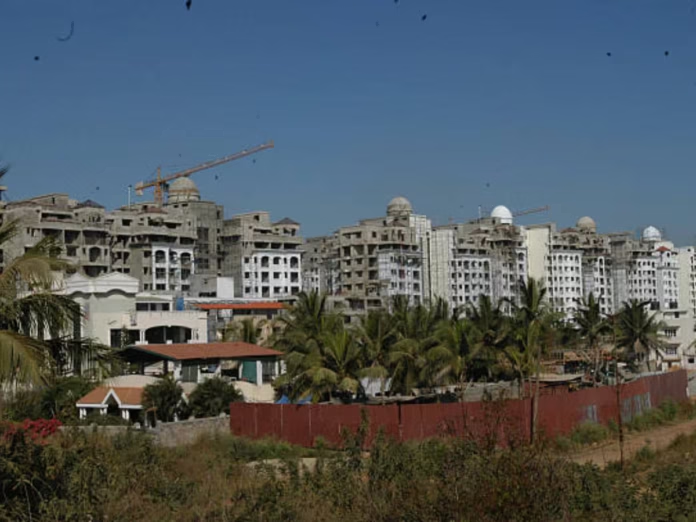
    Karnataka’s real estate sector faces a mounting crisis, with homebuyers struggling to recover ₹667 crore in refunds for delayed projects. According to Karnataka Real Estate Regulatory Authority (KRERA), only ₹92 crore has been recovered across 233 cases from a total of 1,660 recovery orders passed. This amounts to a mere 14% success rate, leaving over 1,400 cases unresolved. Legal and administrative challenges exacerbate the issue, raising questions about the efficiency of the current recovery mechanism.

    KRERA is empowered under the Real Estate (Regulation and Development) Act, 2016, to issue revenue recovery certificates (RRCs) directing the district administration to recover money from defaulting builders. However, systemic inefficiencies have slowed the process, with ₹486 crore pending recovery as of January 2024—a figure that has since surged by 37% to ₹667 crore. Legal experts attribute the delay to projects being categorised as land arrears, making auctioning a challenging and often unfeasible option. This bureaucratic bottleneck leaves affected buyers without a definitive timeline for relief.

    The human cost of these delays is evident. Homebuyers are grappling with severe financial stress, compounded by the uncertainty surrounding their investments. Dhananjaya Padmanabhachar, Director of the Karnataka Homebuyers’ Forum, highlighted the devastating impact of developers’ non-compliance with KRERA orders. “This erodes trust in the regulatory framework and deepens the financial struggles of homebuyers,” he noted. Another buyer, awaiting ₹40 lakh from a delayed project, voiced frustration over the lack of decisive action, urging the government to blacklist defaulters to safeguard buyers’ rights.

    From a sustainability perspective, stalled real estate projects contribute to urban sprawl and waste of resources, while incomplete developments burden local infrastructure. Resolving these disputes efficiently is essential to maintain a sustainable urban landscape. Promoting accountability among developers not only protects homebuyers but also ensures judicious use of land and resources, aligning with broader goals of sustainable urban growth.

    The Karnataka real estate sector’s predicament underscores the urgent need for stronger enforcement mechanisms, transparent processes, and government intervention to safeguard homebuyers and restore confidence in the market.

    Family Feud Disrupts Lodha Real Estate Legacy

      0
      Family Feud Disrupts Lodha Real Estate Legacy
      Family Feud Disrupts Lodha Real Estate Legacy

      Family Feud Disrupts Lodha Real Estate Legacy

      The long-standing Lodha family dispute over its illustrious real estate brand has reached a pivotal juncture. Macrotech Developers, helmed by elder sibling Abhishek Lodha, recently sought legal intervention from the Bombay High Court to bar the younger brother’s firm, House of Abhinandan Lodha, from using the Lodha name in its branding. The case highlights the growing discord within one of India’s most influential real estate dynasties, showcasing the challenges of separating familial bonds from corporate strategies.

      Macrotech Developers, with an extensive portfolio of 40 projects across the Mumbai Metropolitan Region (MMR), Pune, and Bengaluru, has emphasised its 40-year investment in building the Lodha name. It claims to have achieved business worth ₹91,000 crore in the last decade alone, backed by an advertising spend of ₹1,700 crore. The company argued that the unauthorised usage of the Lodha name by the younger sibling’s firm risks diluting the brand’s value and confusing customers. However, Abhinandan Lodha has countered these claims, attributing the dispute to the success of his plotted development ventures, which he insists do not compete directly with Macrotech’s high-rise projects.

      Family Ties Strained in a High-Stakes Real Estate Feud

      The disagreement over intellectual property stems from a settlement made during the division of the family business three years ago. While Macrotech Developers was excluded from this division, Abhinandan was allocated businesses like Lodha Ventures and Lodha FinServ. Despite this, he asserts that his real estate arm, The House of Abhinandan Lodha, adheres to the understanding by avoiding standalone use of the Lodha name in traditional real estate. He added a poignant touch by lamenting how his mother has been caught in the crossfire of this prolonged family discord.

      Macrotech Developers, in contrast, remains focused on safeguarding the interests of its global investors and stakeholders, including charitable entities. The legal dispute comes at a time when Macrotech’s public listing has elevated its market capitalisation to ₹1,20,365 crore, making it one of India’s top real estate firms. Meanwhile, the House of Abhinandan Lodha, founded in 2021, has carved a niche with its plotted developments in Maharashtra, Goa, and Ayodhya, creating a new competitive dynamic in the sector.

      Sustainability Amidst Corporate Rivalry

      While the legal clash dominates headlines, both entities face a broader responsibility—sustainability in urban development. Macrotech Developers, a major player in high-density urban real estate, has been striving for environmentally friendly practices, reflecting the industry’s shift towards sustainable housing. Meanwhile, the House of Abhinandan Lodha, operating in plotted developments, has an opportunity to integrate green infrastructure and renewable energy solutions into its projects.

      The challenge remains for both firms to align their growth trajectories with global sustainability goals, especially as urbanisation surges in India. The rivalry underscores how brand identity and business strategies intersect with the need for eco-conscious real estate solutions.

      Civic Implications and Urban Development

      Beyond its impact on the family, the dispute sheds light on India’s urban development narrative. As both firms expand their portfolios, ensuring clarity in branding is essential to maintaining consumer trust in the real estate sector. This battle over intellectual property serves as a reminder of the civic implications of business ethics and transparency. For homebuyers, who often rely heavily on brand reputation, the outcome of this feud could shape perceptions of accountability in Indian real estate.

      As the Lodha siblings vie for legal resolution, the case highlights broader questions of legacy, ethics, and the delicate balance between family and business.

      Civic Failures Amplify Bengaluru Homebuyers Agony

      0
      Civic Failures Amplify Bengaluru Homebuyers Agony
      Civic Failures Amplify Bengaluru Homebuyers Agony

      Civic Failures Amplify Bengaluru Homebuyers Agony

      Bengaluru’s real estate sector has been marred by troubling revelations, with the Ozone Group topping the Real Estate Regulatory Authority’s (RERA) defaulters list. The group, facing 201 cases filed by homebuyers, owes ₹178.83 crore in compensation. Among the most affected are buyers of Ozone Urbana, a massive residential project in Devanahalli, where over 65 flats were allegedly double sold. The project, initially promised for delivery in 2018, remains partially complete, leaving buyers grappling with mounting financial and emotional distress.

      Flat owners like Bipul Bhattacharya, who invested ₹87 lakh in 2017, have been left disillusioned. “Only 55% of the construction is done, and work stopped in 2018. The builder even acknowledged the resale of 65 units in an email,” he lamented. Other buyers face equally grim scenarios, with payments fully made for properties that were resold without consent. Some have been offered alternative flats, but the lack of occupancy certificates, electricity, and water connections has made habitation a challenge for nearly 200 residents. Such civic lapses underline the systemic gaps in urban planning and accountability in Bengaluru’s housing sector.

      The sustainability angle brings another dimension to the crisis. Stalled projects like Ozone Urbana reflect not only financial mismanagement but also environmental neglect. Incomplete housing complexes often result in wasted materials, disrupted ecosystems, and unutilised land resources. Sustainable real estate practices necessitate accountability from developers, ensuring timely project completion and efficient resource utilisation. By integrating sustainability into regulatory policies, authorities can mitigate future risks and prioritise eco-conscious urban development.

      Civic inaction compounds the woes of Ozone Urbana buyers. Despite a tahsildar’s order in December 2024 to recover ₹109.98 crore from the builder, no tangible action has followed. Buyers, paying EMIs for undelivered homes, are further burdened by legal battles and uncertainty. Ozone Group’s official statement claims proactive measures to secure project financing and potential investors. Yet, the lack of a RERA extension and delays in obtaining funding underscore the challenges buyers face. The need for systemic reform to protect citizens from such predicaments has never been more urgent.

      This ongoing saga serves as a stark reminder of the importance of ethical practices and strong oversight in real estate. Sustainable development, coupled with civic responsibility, can pave the way for a more transparent and equitable housing market in Bengaluru and beyond.

      Mumbai-Pune Expressway Missing Link to be Completed by August 2025 with 92% Work Done

      0
      Mumbai-Pune Expressway Missing Link to be Completed by August 2025 with 92% Work Done
      Mumbai-Pune Expressway Missing Link to be Completed by August 2025 with 92% Work Done

      Mumbai-Pune Expressway Missing Link to be Completed by August 2025 with 92% Work Done

      The long-awaited missing link project of the Mumbai-Pune Expressway, which has been plagued by several delays, has now been given a new deadline: August 2025. The Maharashtra State Road Development Corporation (MSRDC) announced the extension, as the remaining work, particularly the completion of a cable-stayed bridge near Lonavala, has faced significant challenges.

      Currently, 92% of the project has been completed, with only the final stretch—the cable-stayed bridge near Tiger Valley at Lonavala—remaining. The bridge, with towering pylons reaching an impressive 180 metres, is the project’s final hurdle. This ambitious Rs 6,695 crore project, initially targeted for completion in March 2024, was first delayed to January 2025, and now its final completion is expected in August 2025. Anilkumar Gaikwad, Vice-Chairman and Managing Director of MSRDC, confirmed that the construction of 12.4 km of the total 13 km stretch of the missing link has been completed. The superstructure of the cable-stayed bridge is almost finished, but the remaining work at high altitudes has posed some difficulty. The viaducts, which are integral to the project, have been particularly impacted by extreme wind pressure at heights of nearly 100 metres, slowing down progress.

      The new route, once operational, will significantly reduce travel time between Khopoli and Sinhgad Institute by over 6 km and save commuters about 25 minutes on their journey. It is expected to ease the bottleneck at the Adoshi tunnel and Khandala exit, where traffic often merges with NH-4, causing considerable congestion. The project aims to cater to 85% of the current traffic on the expressway, which should provide much-needed relief for commuters. Despite the anticipated benefits of the project, many daily commuters have voiced their frustration with the continuous delays. Traffic jams on the expressway have been a longstanding issue, and with the completion date pushed further into 2025, impatience has been growing. “It’s been years since this project started, and every time we hear that it will be completed soon, there is another delay. It’s frustrating,” said Ramesh Kumar, a daily commuter from Pune who uses the expressway regularly.

      MSRDC officials, however, maintain that the delays are necessary for ensuring the safety and durability of the infrastructure. “The project is progressing cautiously, and safety remains our top priority, especially with the construction of the cable-stayed bridge at high altitudes,” said Gaikwad. Officials also highlighted that the complex nature of the project and the challenging terrain around Lonavala have been factors contributing to the delays. In addition to the missing link project, MSRDC is also working on a proposal to widen the Mumbai-Pune Expressway from six lanes to eight. This Rs 5,000-6,000 crore project, aimed at further alleviating congestion, is currently pending approval. If it proceeds, the project would involve the acquisition of approximately 100 hectares of land, with an estimated cost of Rs 800 crore just for the tunnels. Construction is expected to take another three years, once cleared.

      The extension of the expressway and the completion of the missing link will also result in an additional 15 years of toll collection beyond the current contract period, which was originally set to end in 2030. The missing link project has been a beacon of hope for many commuters, but the constant delays have taken a toll on their patience. While the end result promises a faster, smoother journey for thousands of travellers, the delays have made the wait an increasingly difficult one for those who depend on the expressway for their daily commute. As MSRDC pushes forward with the final stages of construction, many are hopeful that the August 2025 deadline will bring the much-needed relief. The Mumbai-Pune Expressway’s missing link project is a key part of improving the connectivity between the two cities, but its prolonged delays have tested the patience of commuters. With significant progress made and only the final bridge left to complete, the hope remains that the August 2025 deadline will be the final one. Once finished, the new route will ease traffic, cut travel time, and provide a smoother, more efficient experience for commuters in the region.

      Bengaluru Metro Set for Massive Expansion with 143 Km and 95 New Stations in Five Years

        0
        Bengaluru Metro Set for Massive Expansion with 143 Km and 95 New Stations in Five Years
        Bengaluru Metro Set for Massive Expansion with 143 Km and 95 New Stations in Five Years

        Bengaluru Metro Set for Massive Expansion with 143 Km and 95 New Stations in Five Years

        Bengaluru, one of India’s fastest-growing cities, is preparing for a massive metro expansion that will revolutionise urban transport. The Bangalore Metro Rail Corporation Limited (BMRCL) has announced plans to add 143 kilometres of new metro lines and 95 stations to the city’s existing metro network over the next five years.

        This ambitious project, which is part of Phase 2 and 3 of Bengaluru Metro, is set to improve connectivity, reduce traffic congestion, and boost the city’s overall infrastructure. At present, Bengaluru’s metro network spans 77 kilometres, which includes the Whitefield-Challaghatta Purple Line (43.49 km) and the Nagasandra-Silk Institute Green Line (33.5 km). However, the city’s metro expansion plans are far-reaching, with six new routes, expected to be operational by 2026, that will transform public transport in Bengaluru.

        The most significant additions will include the Phase 3 corridors, particularly the Hebbal-Sarjapur Red Line (36.585 km), which will further integrate the city. While the state government has committed to operationalising these new routes, the Red Line will be the exception. Meanwhile, the Blue and Pink Lines, currently under construction, are on track to be operational by the end of 2026. The Yellow Line, which will connect Electronic City, is expected to be operational by March or April 2025. This route is set to ease daily commutes for many IT professionals and residents of the city’s southern suburbs. According to a BMRCL official, “The construction work for the Phase 2 Blue Line (58.19 km) and Pink Line (21.26 km) is progressing well. We are targeting completion by 2026. Currently, the civil work on the Blue Line sections between Central Silk Board to Krishnarajapuram and KIA is 45% complete, and 10% of track installation is done between the Outer Ring Road and the airport. For the Pink Line, 13 kilometres of tunnelling from Kalena Agrahara to Nagawara is already completed, and track installation is progressing rapidly.”

        New Routes and Stations: A Game-Changer for Bengaluru

        The six new routes will add much-needed capacity to the city’s metro system. These include:

        • Yellow Line (RV Road-Bommasandra, 19.15 km): With 16 stations, this line will provide much-needed access to the industrial area of Bommasandra.
        • Pink Line (Kalena Agrahara-Nagawara, 21.26 km): Featuring 18 stations, this line will connect southern Bengaluru to its northern suburbs, easing commuter flow across the city.
        • Blue Line-1 (Central Silk Board-KR Puram, 19.75 km): This 13-station stretch will help decongest the busy IT corridor along Outer Ring Road.
        • Blue Line-2 (KR Puram-Kempegowda International Airport, 38.44 km): Connecting the airport to key parts of Bengaluru, this 16-station route promises smoother travel for both locals and tourists.
        • Orange Line-1 (JP Nagar 4th Phase-Kempapura, 32.15 km): Linking the southern and northern business hubs of Bengaluru with 23 stations, this route will ease congestion in the city’s commercial areas.
        • Orange Line-2 (Hosahalli-Kadabagere, 12.5 km): With 9 stations, this route will provide crucial connectivity to Bengaluru’s western suburbs.

        In total, these six new lines will add over 143 km to Bengaluru’s metro system, improving access to key areas and connecting more of the city’s dense population centres.

        For Bengaluru’s residents, the expansion comes as a much-needed relief. Commuters have often complained about overcrowding and long travel times during peak hours. Shruthi Reddy, a tech professional who travels daily from Whitefield, shared, “The metro expansion will definitely ease daily commutes. Right now, the wait times are long, and the trains are packed. With more stations and routes, I hope the city will see a smoother, faster commute.” Another resident, Ramesh Kumar, who works in the city’s southern industrial belt, said, “The Yellow Line will be a game-changer. I currently spend more than an hour in traffic. Once the new line is up and running, I’ll be able to reach my workplace much quicker.” Bengaluru’s metro expansion is not just about improving commuting; it’s about setting the stage for sustainable urban growth. The expansion will help reduce traffic congestion, cut down on pollution, and offer a more reliable public transport option for a city that is rapidly growing. As construction continues and new routes open, Bengaluru is on track to become a model for metro systems in other cities across India.

        Assam Cabinet Allocates Rs 292 Crore for Infrastructure Development in Morigaon District

          0
          Assam Cabinet Allocates Rs 292 Crore for Infrastructure Development in Morigaon District
          Assam Cabinet Allocates Rs 292 Crore for Infrastructure Development in Morigaon District

          Assam Cabinet Allocates Rs 292 Crore for Infrastructure Development in Morigaon District

          The Assam Cabinet has approved a comprehensive financial package of Rs. 292 crore. This funding is set to address various developmental needs across the district, ranging from transportation to education, sports, and cultural infrastructure. The announcement was made by Assam Chief Minister Himanta Biswa Sarma during a media briefing after the Cabinet meeting, which was held at the Deputy Commissioner’s conference hall.

          The Cabinet’s approval includes a variety of key projects aimed at improving the living conditions and fostering growth in the region. One of the major allocations is for the construction of the Balimukh-Sildubi connecting road (via Bhuragaon), which will receive Rs. 70 crore. This road project is expected to enhance connectivity within the district, easing travel and trade for residents. Addressing the increasing need for improved urban facilities, Rs. 55 crore has been earmarked for the Morigaon Town drainage system. The project aims to tackle drainage issues, ensuring better sanitation and reducing the risk of flooding, particularly during the monsoon season. In line with the development of the region’s civic amenities, Rs. 15 crore has been approved for the construction of a new Circuit House in Morigaon, a key infrastructure project that will provide accommodation facilities for government officials and dignitaries visiting the district.

          The cultural and sporting landscape of Morigaon is also set for a major boost. The Chief Minister announced Rs. 5 crore for the construction of a stage at the Junbeel Mela site, one of Assam’s significant cultural festivals. This stage will be a much-needed upgrade to the venue, facilitating the smooth conduct of the festival and attracting greater participation. Another Rs. 5 crore will be invested in completing the remaining galleries and other infrastructure at the Morigaon Stadium. These improvements are expected to make the stadium more functional, hosting larger events and contributing to the district’s sporting culture. Morigaon will also see the construction of a project in the name of Ilram Das Bap at Jaluguti, for which Rs. 5 crore has been approved. Additionally, an auditorium in Morigaon town, named after the same cultural figure, will be built with Rs. 20 crore. This venue will support local events, performances, and public gatherings, becoming a cultural hub for the district.

          The Cabinet also approved smaller but impactful projects, including the construction of the Tiwa Sahitya Sabha Bhawan and a guest house at Mikirbheta, with an allocation of Rs. 1 crore. These initiatives will preserve and promote the cultural heritage of the Tiwa community while offering better facilities for visitors. In education, the state government has sanctioned Rs. 8 crore each for nine schools in Morigaon that have reached their centenary year. These funds will support infrastructure improvements in these schools, ensuring better learning environments for students. Similarly, eight colleges in the region will receive Rs. 5 crore each for infrastructural development, further enhancing the quality of education. The Chief Minister highlighted that these projects are a part of the state’s ongoing efforts to improve infrastructure across Assam, ensuring that Morigaon benefits from modern facilities and services. “This development package reflects our commitment to ensuring that all districts, including Morigaon, have the necessary infrastructure to support economic and social growth,” said Himanta Biswa Sarma.

          Locals have welcomed these projects with optimism. “The improvements to roads and drainage systems will make daily life much easier. Also, the cultural initiatives, such as the new stage at Junbeel Mela, will help preserve our traditions,” said Rahul Kumar, a resident of Morigaon. As these projects unfold, Morigaon is poised for significant growth, with enhanced infrastructure that will benefit both the current generation and future residents of the district. The Assam Cabinet’s approval marks a pivotal step in the state’s mission to foster balanced development across its regions.

          BMRCL Enhances Purple Line Operations to Address Overcrowding and Delays

            0
            BMRCL Enhances Purple Line Operations to Address Overcrowding and Delays
            BMRCL Enhances Purple Line Operations to Address Overcrowding and Delays

            BMRCL Enhances Purple Line Operations to Address Overcrowding and Delays

            Bengaluru’s Namma Metro Purple Line, one of the city’s busiest routes, is set to undergo significant upgrades to address issues of overcrowding and delays, much to the relief of daily commuters. The Bangalore Metro Rail Corporation Limited (BMRCL) has initiated a series of infrastructure improvements, including the introduction of new trains, to enhance the frequency and operational efficiency of the line.

            One of the key upgrades is the extension of the shunting neck at the Whitefield Metro station. This 40-metre extension will enable trains to reverse directly on the viaduct, eliminating the need for them to travel to the Whitefield depot, located a distance away. Currently, trains are required to reverse at the depot before starting their next trip, causing delays. With this infrastructure change, the turnaround time will be significantly reduced, ensuring smoother operations. A BMRCL official explained, “The extension of the shunting neck will allow trains to reverse directly at Whitefield Metro station without having to go all the way to the depot, thus streamlining the process and improving overall efficiency.”

            Another crucial upgrade at Whitefield station involves increasing the space between the platform and the tracks. This modification will allow trains to maintain higher speeds when approaching the station, reducing the time spent slowing down from 40 km/h to 5 km/h. “With an additional 400 metres of space being created, trains will no longer need to slow down as drastically. This will reduce travel time and improve the overall operational efficiency of the Purple Line,” the official added. The introduction of new trains is also a significant development. BMRCL recently received its first Distance To Go (DTG) train from the China Railway Rolling Stock Corporation Limited (CRRC). The six-coach DTG train will undergo a series of rigorous tests before being put into service on the Purple Line. The first of 21 such trains, ordered by BMRCL, will enhance train frequency and alleviate overcrowding. CRRC, which has been awarded the contract to supply new coaches for Phase 2 of the Metro project, is responsible for providing 216 new coaches, with 126 allocated for the Purple and Green Lines.

            Once operational, the new DTG trains will provide much-needed relief to commuters who have long struggled with congestion. Commuters like Shruthi Naik, a software engineer who travels daily between Kengeri and Whitefield, are hopeful that the improvements will ease their travel woes. “The overcrowding and delays have been a persistent issue on this stretch for the last two years. If these changes reduce waiting times and make travel smoother, it will be a huge relief,” she said. Swagath Krishnan, a regular commuter from Indiranagar, also expressed optimism. “Sometimes, the waiting time on the Purple Line exceeds eight minutes, and during peak hours, the trains are overcrowded, leaving no space to breathe. The new trains and faster turnaround at Whitefield are much-needed improvements.”

            The new trains, manufactured by Titagarh Rail Systems Ltd (TRSL) at its Uttarpara facility in Kolkata, will be delivered by the first quarter of 2027. The first locally manufactured DTG train is expected to arrive by the end of this year. The arrival of these trains is seen as a crucial step in reducing travel times and improving the overall experience for Purple Line passengers. With these upgrades, Bengaluru’s metro system is poised to provide a more efficient and comfortable commuting experience, addressing long-standing concerns and ensuring smoother travel for the city’s ever-growing population. BMRCL’s efforts to modernise and enhance the Purple Line are a testament to the city’s commitment to improving public transport and easing the daily struggles of its commuters.

            Why Infrastructure Bonds Are Gaining Popularity as a Stable and Tax-Advantaged Investment for India’s Future

              0
              Why Infrastructure Bonds Are Gaining Popularity as a Stable and Tax-Advantaged Investment for India's Future
              Why Infrastructure Bonds Are Gaining Popularity as a Stable and Tax-Advantaged Investment for India's Future

              Why Infrastructure Bonds Are Gaining Popularity as a Stable and Tax-Advantaged Investment for India’s Future

              India’s infrastructure sector has witnessed significant growth, with major developments in highways, metros, and high-speed trains connecting cities across the nation. Despite the strides made, there remains much work to be done in enhancing the country’s infrastructure. Amidst this demand, infrastructure bonds, or infra bonds, have become an increasingly popular financial tool, enabling both the government and private players to fund large-scale public projects.

              Infrastructure bonds are long-term debt instruments, typically issued by private companies, state-owned entities, or public sector undertakings. These bonds raise capital to finance the construction of vital infrastructure such as roads, tunnels, bridges, and public transportation systems. Not only do these bonds ensure that essential projects continue to move forward, but they also provide investors with stable and consistent returns over a long period. One of the biggest advantages of infrastructure bonds lies in their long-term nature. With maturities typically ranging from 10 to 15 years, these bonds are an ideal option for investors seeking stability and steady income. The Reserve Bank of India (RBI) has also enabled banks to issue infrastructure bonds with a minimum maturity of 7 years, making them an attractive choice for many.

              “Over the past few years, infrastructure bonds have experienced strong growth,” says Swapnil Aggarwal, Director at VSRK Capital. “In FY 2024 alone, around Rs 51,000 crore was raised through these instruments, and projections indicate that the total could reach Rs 1.3 lakh crore by the end of FY 2025.” This growth reflects not only the rising demand for infrastructure projects but also investor confidence in these bonds as a safe, long-term investment. Investors are increasingly drawn to infra bonds for several reasons, including the tax-saving benefits they offer. Many of these bonds come with tax incentives, making them an appealing option for individuals looking to reduce their taxable income while simultaneously benefitting from capital preservation and consistent returns.

              Vishal Goenka, co-founder of IndiaBonds.com, explains that these bonds often carry quasi-sovereign backing, reducing the default risk associated with other corporate debt instruments. “These bonds are typically backed by essential government projects, offering a layer of safety that many other corporate bonds don’t,” he says. Furthermore, the predictable revenue streams of the infrastructure projects funded by these bonds provide steady coupon payments for investors. However, infrastructure bonds are not without their challenges. While offering low risk compared to other corporate instruments, they can be subject to interest rate, liquidity, and concentration risks. Harpreet Punj, Director at Anand Rathi Wealth Limited, warns that these bonds typically offer yield-to-maturity (YTM) between 5-10% and may only provide returns of 4-7% after taxes. He suggests diversifying through infrastructure sector-based equity mutual funds as an alternative.

              Despite these risks, experts agree that infrastructure bonds remain a strong investment option, particularly in the context of India’s ongoing infrastructure boom. With initiatives like the National Infrastructure Pipeline and the Gati Shakti project focusing on improving key sectors such as highways, rail networks, and energy corridors, the demand for funding infrastructure projects will only continue to grow. This, in turn, is expected to further boost the attractiveness of infrastructure bonds.

              “The growth prospects for infrastructure bonds are substantial,” says Goenka. “With the government’s focus on modernising core sectors and encouraging private participation, these bonds offer a valuable opportunity for investors to be part of India’s development story.” He also notes that with rising FD rates, corporates and government-backed entities may turn to debt capital markets for competitive funding, increasing the volume of infrastructure bond issuances. Infrastructure bonds are set to play an instrumental role in shaping India’s future, contributing to both the country’s development and offering a reliable investment avenue. Whether for individual investors seeking stable returns or corporations aligning with CSR goals, infra bonds represent a critical piece of India’s economic growth puzzle, making them a promising investment choice for the future.

              ₹11440 Crore Package for Vizag Steel Plant to Secure Future Says Andhra CM

                0
                ₹11440 Crore Package for Vizag Steel Plant to Secure Future Says Andhra CM
                ₹11440 Crore Package for Vizag Steel Plant to Secure Future Says Andhra CM

                ₹11440 Crore Package for Vizag Steel Plant to Secure Future Says Andhra CM

                Andhra Pradesh Chief Minister N Chandrababu Naidu declared that the issue of privatising the Vizag Steel Plant (VSP) will no longer be a concern, thanks to the Centre’s approval of a robust Rs 11,440 crore financial revival package. Speaking at a press conference in Undavalli, Naidu reassured the people of Andhra Pradesh that this much-needed support would secure the future of VSP, which has long been a key player in the region’s industrial landscape.

                Naidu stressed that this package, funded by taxpayers’ money, would be used responsibly to revitalise the steel plant, which has faced financial challenges in recent years. “The issue of privatisation of the Vizag Steel Plant is resolved. With the revival package now in place, we can focus on making it a successful, self-sustaining operation,” Naidu said. He emphasised the importance of utilising the funds effectively and urged all stakeholders to work towards the common goal of restoring VSP to its former glory.

                The chief minister also called on the Centre to swiftly appoint a professional management team to oversee the plant’s operations and bring in a capable CEO to guide its revival. “For VSP to succeed, we need an experienced management team. The appointment of a qualified CEO is vital,” he stated. In a bid to ensure the supply of raw materials required for the steel plant, Naidu revealed that the state government would collaborate with the National Mineral Development Corporation (NMDC). This partnership will focus on securing a steady flow of iron ore and other essential resources for VSP, ensuring that the plant can operate at full capacity once revived. One of the highlights of the announcement was Naidu’s mention of the plant’s enormous land bank, covering 20,000 acres, a unique advantage that sets VSP apart from other steel plants in India. This vast land reserve, Naidu pointed out, holds significant potential for future development and could play a crucial role in the plant’s growth and profitability.

                “The land bank is an asset that no other steel plant in India possesses. It can be a cornerstone for VSP’s long-term success. We are committed to transforming VSP into a strong and sustainable organisation,” Naidu added. He also appealed to the workers of VSP to support the efforts being made to revive the plant and contribute to its successful future. In addition to the VSP revival, Naidu highlighted several other significant developments in the state, such as the allocation of Rs 15,000 crore for Amaravati’s greenfield capital and Rs 12,157 crore for the Polavaram Project. These investments reflect the state government’s broader commitment to infrastructure development and economic growth.

                The announcement of the Rs 11,440 crore package for VSP has been welcomed by local stakeholders. MP Chhatarpal Gangwar from Bareilly, in a show of support, echoed Naidu’s sentiments, acknowledging that the revival plan could prove transformative for the region’s economy and employment landscape. Naidu also highlighted several ongoing initiatives aimed at boosting North Andhra’s economy, including the ongoing construction of a 14 MT ArcelorMittal steel plant in Anakapalli and the upcoming Google data centre. These projects are expected to enhance the region’s industrial footprint and attract significant investments, further bolstering the state’s growth. With the government’s commitment to reviving the Vizag Steel Plant and transforming it into a powerhouse of industry, Andhra Pradesh is poised for a bright economic future. With crucial steps being taken towards ensuring the plant’s success, it is hoped that VSP will once again become a major contributor to both the state’s economy and the nation’s steel production capacity.

                ₹ 2100 Crore Southern Bypass Announced for Bareilly to Ease Traffic and Boost Connectivity

                  0
                  ₹ 2100 Crore Southern Bypass Announced for Bareilly to Ease Traffic and Boost Connectivity
                  ₹ 2100 Crore Southern Bypass Announced for Bareilly to Ease Traffic and Boost Connectivity

                  ₹ 2100 Crore Southern Bypass Announced for Bareilly to Ease Traffic and Boost Connectivity

                  Union Minister for Road Transport and Highways, Nitin Gadkari, recently announced the approval of a 30-kilometre southern bypass at a cost of 2,100 crore. This strategic project is set to significantly ease the congestion in the city, improving the daily commute for residents and travellers alike. The bypass, which will span from Jhumka Chauraha in Dhantia village to Invertis University, will link two crucial national highways — NH-24 (Moradabad-Bareilly) and NH-530B (Budaun-Bareilly). The project is designed to provide an efficient and seamless route for vehicles, bypassing the city centre and thus reducing traffic bottlenecks.

                  Minister Gadkari shared the details of the project on social media platform X, emphasising the bypass’s importance for better traffic flow and improved road safety. “The 30-km-long bypass will feature a four-lane divided carriageway, with six-lane structures at key junctions, including a trumpet interchange at Invertis University on NH-30,” he said. He further mentioned that the construction of grade separators along this route will ensure smoother, faster, and safer travel through the region. The bypass is expected to benefit a wide range of commuters, from local residents to those travelling between major cities like Delhi and Lucknow. For the people of Bareilly, who have long struggled with traffic congestion, this project comes as a major relief. The city, which has faced persistent traffic jams, especially at key intersections, will experience a significant reduction in gridlock, making daily commutes faster and more efficient.

                  Aonla Member of Parliament (MP) Neeraj Maurya, a Samajwadi Party member, welcomed the announcement, calling it a long-overdue improvement for Bareilly and the surrounding districts. “This bypass will help ease the traffic jams that have been a major issue for years. It is a huge relief for everyone living in the area,” Maurya said. Similarly, Chhatarpal Gangwar, the BJP MP from Bareilly, expressed his optimism about the project, noting that it will not only reduce travel time but also catalyse the city’s development. “This bypass will greatly benefit travellers going between Delhi and Lucknow, enabling them to bypass Bareilly entirely. This will not only speed up travel but will also help in enhancing the city’s overall development,” Gangwar added.

                  The bypass will be a critical addition to Bareilly’s infrastructure, particularly as the city has been grappling with rapid urbanisation and increasing traffic volumes. With the bypass in place, it is expected that travel times for long-distance commuters will be reduced significantly, offering a faster route between the northern and central regions of Uttar Pradesh. While the announcement has been met with widespread approval, there have been no official comments from the National Highways Authority of India (NHAI) Bareilly officials regarding the timeline for the project’s completion or its potential challenges. However, the government’s focus on easing traffic congestion and improving road safety has been reiterated by officials across the board. The approval of the 30-km southern bypass for Bareilly is a promising development for the city and the state of Uttar Pradesh. Once completed, it will not only improve the daily commute for locals but also serve as a critical route for intercity travel, helping to alleviate congestion and accelerate the region’s economic growth.