Home Blog Page 342

Hyderabad real estate sees evolving buyer preferences

0
Hyderabad real estate sees evolving buyer preferences

Hyderabad real estate sees evolving buyer preferences

Hyderabad’s real estate market closed 2024 with a mix of optimism and caution. While annual home sales registrations grew by 7%, the month of December marked a 20% year-on-year dip, with 5,805 properties registered compared to 7,254 in December 2023. The transaction value in December also declined by 14% to ₹3,590 crore from ₹4,191 crore the previous year. Despite the year-end slowdown, the overall residential market showed resilience, as the annual transaction value rose sharply by 23% year-on-year, signalling steady demand and buyer confidence in the city’s long-term prospects.

The city witnessed a shift towards premiumisation, with homes priced above ₹1 crore increasing their share of total registrations from 10% in 2023 to 14% in 2024. Simultaneously, properties priced below ₹50 lakh accounted for 60% of registrations, a decrease from 68% the previous year. This shift underscores Hyderabad’s evolving buyer preferences, with a growing segment of purchasers seeking higher-value and larger properties. Additionally, mid-sized homes ranging from 1,000 to 2,000 sq. ft. remained the most preferred, contributing to 69% of total registrations.

Sustainability continues to play a critical role in Hyderabad’s real estate landscape. The districts of Medchal-Malkajgiri and Rangareddy emerged as key contributors, accounting for 42% and 41% of registrations, respectively, while Hyderabad city contributed 17%. Urban planners emphasise the importance of integrating green infrastructure and optimising urban spaces, especially in emerging hubs like Medchal-Malkajgiri, to balance the increasing population density and ensure a sustainable urban environment.

Shishir Baijal, Chairman and Managing Director of Knight Frank India, highlighted the changing dynamics in Hyderabad’s real estate market. “Properties valued above ₹50 lakh now represent 40% of registrations, up from 32% in 2023. This upward trend demonstrates the growing aspirations and purchasing power of homebuyers,” he said. While the December slowdown reflects seasonal market fluctuations, the overall growth indicates Hyderabad’s robustness as a real estate destination driven by infrastructural advancements, job creation, and a strong cultural appeal.

Pune real estate market hits ₹7,098 crore milestone

0
Pune real estate market hits ₹7,098 crore milestone

Pune real estate market hits ₹7,098 crore milestone

The Pune real estate market has witnessed an impressive resurgence in 2024, marked by a 25% increase in property registrations and a 33% rise in stamp duty revenue. According to data from the Maharashtra Inspector General of Registration (IGR), a total of 190,025 property registrations were recorded in 2024, up from 152,323 in 2023. Revenue collections surged to ₹7,098 crore, compared to ₹5,352 crore the previous year. In December alone, property registrations rose by 18% year-on-year, with 17,348 transactions generating ₹620 crore in revenue, an 11% increase compared to ₹560 crore in December 2023.

The demand for larger homes and premium properties was a standout trend, driven by shifting buyer preferences post-pandemic. Properties priced above ₹1 crore saw their market share rise from 12% in December 2023 to 15% in December 2024, reflecting a trend of premiumisation. Homes priced between ₹50 lakh and ₹1 crore remained the most sought-after, commanding 34% of the market share. Additionally, the share of apartments larger than 800 sq ft grew from 28% in December 2023 to 30% in December 2024, underscoring the sustained demand for spacious housing. This shift is largely attributed to buyers prioritising comfort and quality of life, especially as hybrid work models become the norm.

Sustainability remains a crucial perspective in Pune’s real estate growth. Central Pune, comprising Haveli Taluka, Pune Municipal Corporation (PMC), and Pimpri Chinchwad Municipal Corporation (PCMC), contributed 82% of residential transactions in December 2024. While this marked a slight decline from 2023, the emergence of projects in other regions, such as West Pune, hints at a broader, more inclusive development approach. Integrating green building practices and optimising urban infrastructure in these expanding zones could enhance long-term sustainability and reduce urban congestion.

The rise in demand for premium and spacious homes also highlights Pune’s growing reputation as an attractive destination for high-value investments. Shishir Baijal, Chairman and Managing Director of Knight Frank India, emphasised the economic stability of Pune as a driving factor. “The return to office culture has significantly influenced housing demand. The rise in premium home purchases reflects buyers’ confidence in Pune’s economic growth and development,” he stated. Furthermore, developments in suburban areas like Mawal and Mulshi demonstrate the city’s adaptability to evolving buyer preferences, ensuring a balanced urban expansion.

BWSSB inaction leaves building illegally occupied

0
BWSSB inaction leaves building illegally occupied

BWSSB inaction leaves building illegally occupied

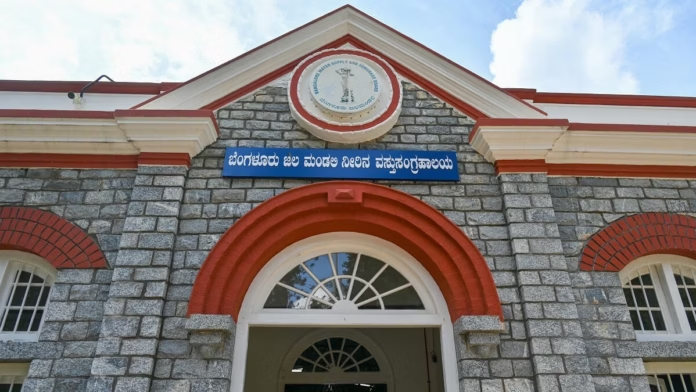
A Bangalore Water Supply and Sewerage Board (BWSSB) facility in Ambedkar Nagar, a Dalit colony near Whitefield, has been illegally occupied by private individuals for the past two years, raising civic and urban governance concerns. The building, originally constructed to support water supply operations, has become the centre of unauthorised activities, allegedly under the influence of a local real estate goon. Despite repeated complaints by residents, including government school teacher Sonnappa T., no substantial action has been taken by the BWSSB or Bruhat Bengaluru Mahanagara Palike (BBMP).

The structure, built in 2002, includes a water tank on the ground floor with two rooms above it designated for housing water pumps and accommodation for the waterman. However, as the tank, with a 2-lakh-litre capacity, has fallen into disuse, private persons broke open the locks to occupy the rooms. These spaces now serve as offices for real estate dealings, with at least five people operating from the premises daily. Residents claim the misuse reflects the negligence of civic authorities and a lack of accountability in addressing unauthorised occupations.

The incident highlights broader urban governance issues, particularly the failure to optimise public infrastructure for community benefit. Residents argue that the abandoned BWSSB facility could be repurposed for various public utility projects. Instead, the unauthorised occupation not only breaches civic trust but also underlines the loopholes in law enforcement. While a local BWSSB official assured action, his efforts so far have been limited to superficial visits. The continued inaction has deepened frustration among residents, who feel their grievances are being overlooked.

From a sustainability perspective, such cases of public infrastructure misuse undermine the principles of resource efficiency and equitable urban development. The water tank, which could have bolstered water conservation efforts in a drought-prone city like Bengaluru, remains idle. Mismanagement of public resources not only exacerbates urban challenges but also diminishes opportunities for building sustainable cityscapes. Activating unused infrastructure for rainwater harvesting or community water storage could significantly benefit areas like Ambedkar Nagar.

Property Deals in Purandar Struggling Despite Push for New Airport

    0
    Property Deals in Purandar Struggling Despite Push for New Airport
    Property Deals in Purandar Struggling Despite Push for New Airport

    Property Deals in Purandar Struggling Despite Push for New Airport

    Despite the Maharashtra government’s renewed focus on developing the Purandar airport, property transactions in the region remain sluggish, showing only marginal growth over the past year. Official data reveals that 3,602 sale documents were registered in 2024, a slight increase from the 3,315 recorded in 2023. While the numbers indicate some growth, they are far from the surge expected after the airport project received its necessary technical clearances over a year ago.

    The primary reasons for the sluggishness in property deals are attributed to two major factors: an ongoing land acquisition process and resistance from local villagers. “Even though the project has been in discussion for the last two years, property deals are not high. Once the Maharashtra Industrial Development Corporation (MIDC) issues a formal notification on land acquisition, transactions are expected to gain momentum,” said a registration department official.

    This anticipation is linked to the government’s recent steps, including a meeting led by Maharashtra’s Chief Minister, Devendra Fadnavis, where the MIDC was designated as the project’s nodal agency. The push for the airport comes as the Navi Mumbai international airport is set to begin operations this year, further highlighting the need for a second airport to meet the growing demand in the region. However, despite the government’s push, property developers and investors remain cautious, taking a ‘wait and watch’ approach, especially in the seven villages directly affected by the land acquisition. These villages — Pargaon Memane, Ekhatpur, Munjwadi, Kumbharvalan, Udachiwadi, Vanpuri, and Khanavadi — are slated to provide the land for the airport project, but the uncertainty surrounding land acquisition is deterring both developers and potential buyers.

    Local sentiment also adds to the delay, with many villagers voicing their opposition to the land acquisition. Some villagers have expressed their desire to sell their land but are waiting for a formal discussion. One local resident, who owns around 5,000 sqft in Pargaon Memane, said, “We are among a group of villagers who want to sell their land. We are awaiting a formal discussion.” However, there are others who are strongly against giving up any land and had even openly voiced their discontent during the assembly elections. Newly elected MLA Vijay Shivtare has been cautious in addressing the issue with locals, likely to avoid further alienating them. The resistance from villagers could create additional challenges for the project, further slowing the pace of land transactions. An official from the MIDC stated that once the land acquisition notification is issued, the government will enforce directives to stop transactions in the notified villages. However, this has not yet occurred, leaving developers and residents in a state of uncertainty.

    A Pune-based builder, who had previously announced a project in Purandar, echoed the sentiment, stating that without a clear timeline from the state government regarding land acquisition, developers would be hesitant to invest in the area. “Until we know when land acquisition will occur, we are not looking at investments,” the builder said. In general, land transactions in Purandar taluka, which consists of 108 villages, typically range between 3,000 and 3,500 annually. The government had initially planned to establish Pune district’s second international airport in the taluka in 2018, approximately 50 km from Pune city, to cater to the growing demand for air travel in the region. However, despite the promise of the airport bringing economic benefits, the slow pace of property transactions and local opposition highlight the challenges that still lie ahead for this ambitious project. As the Maharashtra government pushes forward with its plans, the real estate market in Purandar will remain in flux, waiting for key milestones in land acquisition and project development to unlock potential growth.

    Former Dharavi Land Tenants Included in Redevelopment Project, No One Will Be Homeless

      0
      Former Dharavi Land Tenants Included in Redevelopment Project, No One Will Be Homeless
      Former Dharavi Land Tenants Included in Redevelopment Project, No One Will Be Homeless

      Former Dharavi Land Tenants Included in Redevelopment Project, No One Will Be Homeless

      A step towards transforming Dharavi, one of Mumbai’s most iconic slum areas, former tenants of the cancelled Vacant Land Tenure (VLT) scheme have been included in the multi-crore redevelopment plan. This decision, made by the Dharavi Redevelopment Project (DRP) and Slum Rehabilitation Authority (SRA), ensures that the former land owners from areas like Kumbharwada will benefit from the ambitious initiative without the fear of displacement.

      SVR Srinivas, CEO of DRP/SRA, reassured the community, saying, “No one from Dharavi will be rendered homeless under this scheme as every tenement holder is going to get a home of their dreams.” This statement aims to alleviate concerns regarding the impact of the redevelopment on the residents, especially those who were previously part of the VLT scheme.

      The VLT scheme was initially designed to protect vacant land from encroachment, with the intention of reclaiming it when necessary. However, with the formation of the DRP, the land under the VLT automatically falls under the Dharavi Notified Area (DNA) and is now covered within the redevelopment plan. This means there is no need for separate redevelopment of these areas, and they are now integrated into the larger project. The Adani Group, which emerged as the winner of the Dharavi redevelopment project through an open international bidding process, has partnered with the Maharashtra government to deliver this monumental project. The redevelopment, spearheaded by Adani’s joint venture company, Navbharat Mega Developers Private Ltd (NMDPL), will see the construction of both residential and commercial tenements. These properties will then be handed over to the DRP/SRA for allocation based on a comprehensive survey of existing residents and businesses.

      Srinivas further highlighted the importance of cooperation in this process, stating that the ongoing survey is receiving tremendous support from the residents of Dharavi. “I am very confident that the former VLT owners will also participate in the ongoing process at the earliest,” he said. This initiative is vital for the long-term success of the redevelopment, ensuring that all stakeholders are considered and included in the transition. Dharavi’s redevelopment project, which is part of a broader initiative to rejuvenate Mumbai’s urban landscape, also focuses on creating sustainable infrastructure and providing vocational training to empower the local youth. These efforts aim to equip them with eco-friendly job skills, improving their earning potential and contributing to a more prosperous community. Additionally, the land freed up by the redevelopment will be used to create affordable housing for Dharavi’s residents. Eligible individuals will receive flats of up to 350 square feet at no cost as part of the government’s commitment to transforming this iconic slum into a vibrant, world-class district.

      With a budget estimated at $3 billion, the Dharavi redevelopment project is expected to radically change the area’s landscape. The project’s long-term vision includes building not just homes, but a sustainable urban ecosystem that provides opportunities for economic and social growth. By addressing the needs of both the residents and businesses, the redevelopment aims to create a model for urban regeneration that can be replicated across the country. In closing, Srinivas also made an appeal to other private landowners within Dharavi, urging them to join the initiative. “There are a few private ownership areas in Dharavi, and I invite them to be part of the world’s largest urban rejuvenation project,” he said, emphasising the collaborative nature of this transformative endeavour. As the redevelopment project progresses, it promises to offer a better quality of life for Dharavi’s residents while also contributing to Mumbai’s urban development, making it a beacon for slum rehabilitation in India.

      Reforms in Bengal Real Estate Sector Urged Before Union Budget

      0
      Reforms in Bengal Real Estate Sector Urged Before Union Budget
      Reforms in Bengal Real Estate Sector Urged Before Union Budget

      Reforms in Bengal Real Estate Sector Urged Before Union Budget

      As the Union Budget 2025 approaches, real estate stakeholders in West Bengal have voiced a compelling call for policy reforms aimed at catalysing growth in the sector. Acknowledging real estate as India’s second-largest employment generator, industry leaders emphasised the need for initiatives that balance housing affordability, urban development, and infrastructure growth. This comprehensive push for change reflects the sector’s pivotal role in the country’s economic framework, with stakeholders like Sushil Mohta, President of CREDAI West Bengal and Chairman of Merlin Group, highlighting sustainable infrastructure development as a national priority.

      Developers have proposed revising the definition of affordable housing to expand its benefits. This includes raising the price cap for affordable units from ₹45 lakh to ₹90 lakh, with an annual 5% increment to align with inflation. Another key recommendation involves introducing a credit guarantee scheme for housing loans up to ₹70 lakh, covering 80%-90% of property value, and home improvement loans up to ₹30 lakh. To ease financial burdens on homebuyers, industry experts called for an increase in the interest deduction limit for first-time homeowners from ₹2 lakh to ₹5 lakh and exempting annual rental income up to ₹20 lakh from taxation. Simplifying the GST structure to a single rate of 1% for all housing units also remains a priority for builders.

      From a sustainability angle, the sector has urged for the reintroduction of the Credit-Linked Subsidy Scheme (CLSS) under the Pradhan Mantri Awas Yojana (PMAY), particularly for the youth below 40 years. Providing subsidies of 3%-4% on housing loans would make homes more accessible while fostering community development. Reducing long-term capital gains tax to 10% and lowering the holding period for property eligibility to 12 months were also highlighted as critical measures. Additionally, stakeholders recommended standardising and reducing stamp duty rates across states, offering rebates to first-time homebuyers to stimulate growth.

      Civic and urban development advocates have underscored the importance of these reforms to ensure housing remains a fundamental right rather than a luxury. Reducing tax burdens and simplifying GST structures would empower middle-class families to invest in homes while creating a ripple effect on job creation and economic progress. Furthermore, a unified approach to stamp duty and infrastructural expansion would enhance urban mobility and environmental sustainability. With real estate integral to achieving India’s growth ambitions, the proposed reforms align with long-term economic and ecological goals.

      Empowering Women in Real Estate Drives Growth

        0
        Empowering Women in Real Estate Drives Growth
        Empowering Women in Real Estate Drives Growth

        Empowering Women in Real Estate Drives Growth

        The Indian real estate industry is awakening to the untapped potential of gender inclusion as a driver of growth and innovation. A groundbreaking report, Concrete Change: A Study of the Economic Impact of Better Pay Parity & Inclusion of Women in Real Estate, reveals that addressing gender disparities in the sector could significantly enhance productivity, profitability, and sustainability. Despite employing 57 million workers, only 7 million are women, highlighting the sector’s need for greater inclusivity.

        Industry leaders such as Max Estates are championing this transformation. Sahil Vachani, MD and Vice Chairman of Max Estates, emphasised the critical role women can play in shaping India’s real estate future. “To achieve India’s Viksit Bharat vision, women’s inclusion is paramount. Real estate, poised to contribute $5-6 trillion to the economy by 2047, requires their insights, creativity, and resilience. At Max Estates, we’re committed to creating an inclusive industry that thrives on diversity,” he stated. The report underscores the importance of policies fostering equitable pay, workplace diversity, and collaborative initiatives to bridge the gender gap.

        From a sustainability perspective, gender inclusion aligns with global Sustainable Development Goals (SDGs), enhancing community-focused urban planning. Women bring unique perspectives on empathy, collaboration, and environmental consciousness, reshaping real estate practices. However, achieving this requires a concerted effort from policymakers and industry players. The report recommends integrating gender-inclusive strategies, such as upskilling women for skilled roles and fostering workplace cultures rooted in equity and respect.

        Civic and urban development stakeholders are also recognising the economic and social benefits of gender parity. As real estate contributes significantly to India’s GDP, closing the gender gap could unlock unprecedented opportunities for innovation and community development. Max Estates is taking the lead with initiatives such as academic partnerships to incorporate real estate modules, creating a future workforce attuned to diversity and equity. By prioritising inclusivity, the sector can set a benchmark for other industries while paving the way for holistic growth.

        L&T and CCTE Join Forces to Lower Nuclear Power Costs with Thorium-Based Fuel Technology

          0
          L&T and CCTE Join Forces to Lower Nuclear Power Costs with Thorium-Based Fuel Technology
          L&T and CCTE Join Forces to Lower Nuclear Power Costs with Thorium-Based Fuel Technology

          L&T and CCTE Join Forces to Lower Nuclear Power Costs with Thorium-Based Fuel Technology

          India’s nuclear energy sector is on the cusp of a transformative shift thanks to a strategic partnership between Larsen & Toubro (L&T) and Clean Core Thorium Energy (CCTE), a US-based firm. Together, they aim to develop and implement ANEEL, a cutting-edge thorium-based nuclear fuel technology, which promises to significantly reduce the cost of electricity generated from India’s nuclear plants by up to 30%.

          Currently, nuclear reactors in India that rely on natural uranium generate power at a cost of approximately Rs 6 per kilowatt-hour (kWh). However, with the introduction of the ANEEL fuel technology, this cost could drop by 20-30%, creating an economically viable path for expanding India’s nuclear power capacity. Thorium, the core element of the ANEEL fuel, is not only more abundant than uranium but also provides several key advantages, including enhanced safety features, greater resistance to nuclear proliferation, and a reduction in nuclear waste by over 85%.

          The collaboration between L&T and CCTE is critical in ensuring the successful deployment of the ANEEL technology in India. L&T’s extensive experience in the country’s nuclear sector, combined with its manufacturing capabilities, will ensure the smooth production and distribution of the new fuel. Meanwhile, CCTE’s thorium-based fuel is in the advanced testing stage at the Idaho National Laboratory in the US. This fuel, a blend of thorium and a small quantity of enriched uranium, is perfectly suited for India’s Pressurised Heavy Water Reactors (PHWRs) and is expected to significantly improve reactor efficiency. India’s nuclear energy expansion is a central part of the nation’s strategy to meet its growing energy demands while reducing carbon emissions. The country aims to increase its nuclear power capacity to 22 GW by 2032, up from 8.2 GW. This growth is supported by the government’s push for small modular reactors (SMRs), which will be integrated into industrial sectors like steel plants, refineries, and cement plants, as well as data centers and infrastructure projects. The collaboration between L&T and CCTE aligns perfectly with India’s vision to decarbonize and diversify its energy sources.

          Additionally, the recent US-India nuclear cooperation, bolstered by high-level diplomatic exchanges, is expected to facilitate the importation of advanced nuclear technologies, such as the thorium-based fuel, into India. The renewed focus on clean energy in both countries further accelerates the progress toward utilizing thorium fuel to create a safer, more efficient nuclear energy future. While challenges remain, such as the Civil Liability for Nuclear Damage Act of 2010, which imposes supplier liability in the event of a nuclear accident, CCTE’s role as a fuel technology supplier, rather than a reactor system supplier, allows for a smooth integration of the ANEEL technology into India’s nuclear framework. As the law continues to evolve, this partnership will set the stage for a safer, more sustainable nuclear energy future. With the ongoing focus on clean, reliable energy, the use of thorium-based fuel in India’s nuclear plants is poised to revolutionize the nation’s energy landscape. The partnership between L&T and CCTE promises not only to reduce power costs but also to place India at the forefront of the next generation of nuclear technology.

          30 Floating Pontoon Bridges at Maha Kumbh Provide Vital Infrastructure Using Ancient Persian Technique

            0
            30 Floating Pontoon Bridges at Maha Kumbh Provide Vital Infrastructure Using Ancient Persian Technique
            30 Floating Pontoon Bridges at Maha Kumbh Provide Vital Infrastructure Using Ancient Persian Technique

            30 Floating Pontoon Bridges at Maha Kumbh Provide Vital Infrastructure Using Ancient Persian Technique

            The Maha Kumbh Mela in Prayagraj, one of the largest spiritual gatherings in the world, attracts millions of pilgrims every 12 years. To facilitate the smooth movement of people across the sacred confluence of the Ganga, Yamuna, and Saraswati rivers, the construction of 30 massive floating pontoon bridges has been a key infrastructure achievement. These bridges, inspired by a 2,500-year-old Persian technique, play a crucial role in ensuring the safety and efficiency of the event.

            The pontoon bridges, also known as pipa bridges, connect the Sangam area to the sprawling akhada zones. Made with over 2,200 black iron pontoons, each weighing five tonnes, these structures are capable of supporting up to five tonnes of weight. A workforce of more than 1,000 laborers worked for over a year to complete the project, often putting in long hours to ensure its timely construction. The bridges utilize Archimedes’ principle to stay afloat, with the pontoons displacing water to create an upward force equal to their weight. These bridges have been equipped with rigorous safety measures, including CCTV surveillance, to monitor their stability and performance throughout the event. Additional District Magistrate of Mahakumbh Nagar, Vivek Chaturvedi, emphasized the importance of the bridges in maintaining order and providing safe passage for millions attending the Kumbh.

            Historically, pontoon bridges have been used since ancient times, notably by Persian King Xerxes I during his invasion of Greece in 480 BC. While India saw the first pipa bridge built in 1874, the Maha Kumbh Mela project surpasses all past endeavors in terms of scale and complexity. The bridges can also accommodate heavy vehicles, including elephants, horses, and chariots, particularly during major events like the Amrit Snan. The total cost of constructing these 30 pontoon bridges amounted to Rs 17.31 crore. Some of the larger bridges, such as the one connecting the Shri Nagvasuki Temple to Jhusi, were built at a cost of Rs 1.13 crore each. After the event, the bridges will be dismantled and repurposed, either stored for future use or redeployed in other parts of Uttar Pradesh. These floating bridges are a testament to the ingenuity of ancient engineering, reimagined for modern use to accommodate the logistical needs of the world’s largest spiritual gathering.

            Noida International Airport Poised to Revolutionise Air Travel in Delhi-NCR

            0
            India Airport Corridors Fuel Residential Land Demand
            India Airport Corridors Fuel Residential Land Demand

            Noida International Airport Poised to Revolutionise Air Travel in Delhi-NCR

            As Noida International Airport (NIA) prepares for its operational debut, CEO Christoph Schnellmann has shared exciting insights into its vision to redefine air travel across Delhi-NCR and Western Uttar Pradesh. Located near the Yamuna Expressway, the airport is set to offer superior connectivity, becoming a central transportation hub with access to major regions, including Noida, Greater Noida, and Delhi.

            The airport’s initial phase, featuring a single runway and terminal, will accommodate up to 12 million passengers annually. However, once all four development phases are completed, the airport will handle up to 70 million passengers per year, positioning itself as a major player in the region’s aviation sector. The airport’s strategic location ensures excellent road access, with travel times as short as 25 minutes to Greater Noida and 45 minutes to central Delhi. Adding to the airport’s connectivity is the integration with the Delhi-Varanasi high-speed rail corridor, enhancing the airport’s role as a key transport hub. Christoph Schnellmann revealed that major airlines, including IndiGo and Akasa Air, are on board, with several international carriers from the Middle East and Southeast Asia expressing interest in launching services from NIA, thus enhancing its potential as a global gateway.

            The airport is also focusing on its cargo operations, with a dedicated Multi-Modal Cargo Hub (MMCH) being developed in partnership with Air India SATS. This hub will initially handle 200,000 tonnes annually, with the capacity to scale up to 2 million tonnes in the future. It is expected to be a vital logistical facility for businesses in Delhi NCR and Uttar Pradesh. In line with sustainability goals, NIA is committed to eco-friendly development. Over 580 trees have been transplanted, and the airport will feature over 133 hectares of green space. Sustainable initiatives like solar and wind energy, rainwater harvesting, and electric ground support equipment reflect the airport’s focus on reducing its environmental impact. Additionally, a premium all-electric taxi service, in partnership with Mahindra Logistics Mobility, will contribute to greener travel options for passengers. Set to open in April 2025, Noida International Airport is poised to revolutionize the region’s air travel landscape, offering enhanced connectivity, modern amenities, and a green footprint to support sustainable growth and economic development.