Home Blog Page 344

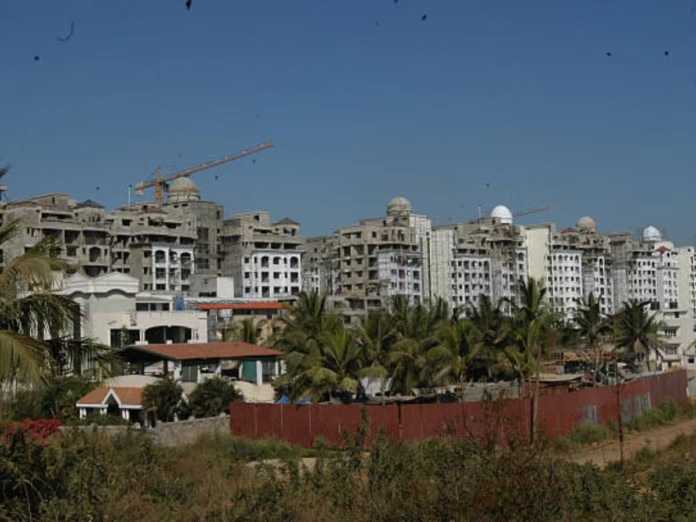
Century Real Estate LIVA sparks demand in Bengaluru

0
Century Real Estate LIVA sparks demand in Bengaluru

Century Real Estate LIVA sparks demand in Bengaluru

Century Real Estate has made a significant mark with its latest residential project, Century LIVA, strategically located along Yelahanka-Doddaballapur Road (SH-9). With over 80 per cent of its inventory sold during the pre-launch phase, the project has already achieved sales exceeding ₹200 crore, demonstrating robust demand for high-quality, modern housing in Bengaluru. Targeting a total revenue of ₹270 crore, Century LIVA is poised to capitalise on the city’s burgeoning real estate market, driven by aspirational buyers seeking a blend of convenience, lifestyle, and investment potential.

Spanning 4.6 lakh square feet, the project comprises 247 meticulously designed 3BHK and 4BHK units. Starting at ₹1.54 crore for 3BHK apartments and reaching ₹4 crore for luxury penthouses, LIVA caters to a diverse clientele seeking spacious and premium living options. The development boasts a remarkable 70 per cent allocation to open spaces and over 40 amenities tailored to varied lifestyles. From active zones like jogging tracks and basketball courts to tranquil spaces like hammock gardens, the project emphasises creating a vibrant community. Its family-oriented amenities, including a modern pool, kids’ play zones, and barbecue corners, further enhance its appeal.

Situated in Yelahanka, a rapidly transforming region in Bengaluru, Century LIVA benefits from exceptional connectivity and proximity to key landmarks, including Kempegowda International Airport, which is just 30 minutes away. The area is witnessing dynamic growth, with major infrastructure projects such as the Satellite Town Ring Road (STRR), the Bengaluru Business Corridor (BBC), and a planned 150-acre central park boosting its value. These developments, coupled with investments from global giants like Foxconn, are fuelling a surge in demand for quality housing in northern Bengaluru.

From a sustainability perspective, Century LIVA aligns with the growing demand for eco-conscious development. By dedicating a substantial portion of its area to open spaces and integrating energy-efficient designs, the project contributes to Bengaluru’s green urbanisation goals. Sustainable planning and community-driven layouts ensure that the project resonates with the evolving priorities of modern homebuyers who value environmental responsibility alongside premium living.

Maninder Chhabra, Director of Sales, Marketing, and CRM at Century Real Estate, highlighted the shifting dynamics in Bengaluru’s real estate market. “Post-pandemic, there’s a clear preference for larger, well-designed spaces that cater to holistic lifestyles. Century LIVA embodies this demand with its focus on premium amenities, expansive layouts, and quality construction,” he noted. The project’s success reflects not just the city’s appetite for luxury housing but also the evolving aspirations of a diverse buyer base.

As Bengaluru continues to be a magnet for migrants drawn by its thriving IT and start-up ecosystem, the demand for innovative and sustainable housing solutions is on the rise. Century LIVA, with its modern design, strategic location, and focus on community living, exemplifies the city’s transformative journey towards urban excellence.

Thane Metro 4A Route Delayed by a Year, Costs Surge by Rs 63 Crore

    0
    Thane Metro 4A Route Delayed by a Year, Costs Surge by Rs 63 Crore
    Thane Metro 4A Route Delayed by a Year, Costs Surge by Rs 63 Crore

    Thane Metro 4A Route Delayed by a Year, Costs Surge by Rs 63 Crore

    The much-anticipated Kasarwadavli-Gaimukh Metro 4A route in Thane has encountered significant delays, pushing its completion date to April 2025, over a year later than initially planned for March 2024. The delay has resulted in an increase of Rs 63 crore in the overall project costs, according to the Mumbai Metropolitan Region Development Authority (MMRDA). This revelation came after an RTI (Right to Information) query filed by Mumbai-based activist Anil Galgali, who raised concerns about the impact on commuters, particularly due to the ongoing traffic disruptions in the area.

    The Metro 4A route is a key component of Mumbai’s expanding metro network, connecting South Mumbai with its northern suburbs. The project was initially approved in 2019, and work orders were issued for the 2.7 km stretch in September 2019, with the completion date set for March 2024. However, multiple challenges have caused delays, pushing the timeline back to April 2025. Though MMRDA has confirmed that various factors contributed to the delay, they have not disclosed specifics. In response to the missed deadlines, the contractor involved has been fined Rs 22 lakh. The delay in the project is not the only concern. As construction progresses along Ghodbunder Road, one of Thane’s busiest thoroughfares, commuters have been experiencing significant traffic jams. These congestion issues are exacerbated by the lack of a quick resolution, leaving daily travellers frustrated. Activist Anil Galgali has voiced his concerns, urging authorities to expedite the process to alleviate the burden on commuters.

    The original budget for the Kasarwadavli-Gaimukh Metro 4A route was Rs 440 crore. However, with the delay and additional project management expenses, the total cost has increased by Rs 63 crore, raising concerns about cost overruns. As Mumbai’s infrastructure projects continue to face budget challenges, the cost hike has added to the public’s anxieties, particularly as taxpayers bear the brunt of these additional expenses. Once completed, the Metro 4A route is expected to ease traffic congestion and improve connectivity between Thane and South Mumbai. The project is a part of a larger vision that aims to improve the city’s overall transportation infrastructure. The metro corridor, which spans 56 km, will include Line 4 (Wadala-Kasarwadavli) and the Gaimukh extension of Line 4A, and will eventually link to Mira Road’s Shivaji Chowk via Line 10. The new metro lines will help reduce the growing traffic bottlenecks, especially along Ghodbunder Road, and serve millions of commuters, improving daily travel experiences for residents.

    In an effort to manage the delay, MMRDA officials are exploring ways to expedite construction, including reviewing work processes and addressing contractor-related issues. Adjustments to the construction schedule are being considered to minimise further disruptions. Although the extended timeline has caused frustration, the MMRDA assures that the final outcome will be worth the wait, providing better infrastructure and easing the city’s traffic problems. For now, commuters must continue to navigate the construction-related challenges, but officials remain focused on ensuring that the completed metro line delivers long-term benefits by enhancing connectivity and reducing traffic congestion. As the city eagerly awaits the completion of the project, it remains essential that the authorities maintain efficient execution to meet the revised deadline.

    Women could reshape Indian realty landscape

      0
      Women could reshape Indian realty landscape
      Women could reshape Indian realty landscape

      Women could reshape Indian realty landscape

      The Indian real estate sector, despite its stature as a significant employment generator, grapples with glaring gender disparities. A recent report revealed that out of 7.1 crore workers employed in the sector, only 70 lakh are women, representing a Female Labour Force Participation Rate (LFPR) of just 25.1 per cent. This striking imbalance highlights the deep-rooted challenges women face in securing equal opportunities in a traditionally male-dominated industry.

      The study, jointly conducted by Max Estates and In Tandem Global Consulting, titled Concrete Change: A Study of the Economic Impact of Better Pay Parity & Inclusion of Women in Real Estate, emphasised the transformative potential of addressing these disparities. Women comprise 48.5 per cent of India’s population, yet only 1.2 per cent of this demographic is employed in real estate. The sector’s underrepresentation of women, coupled with unequal pay structures across roles, poses a significant barrier to achieving its full economic potential.

      Leadership voices from the industry have called for proactive measures to bridge this gap. Sahil Vachani, Vice Chairman and Managing Director of Max Estates, underscored the importance of shifting mindsets at the leadership level to champion inclusivity. Shormishtha Ghosh, Founder and Managing Director of In Tandem Global Consulting, highlighted the economic and societal benefits of greater gender parity. She believes empowering women through targeted upskilling and leadership opportunities could redefine the workforce composition, driving innovation and profitability.

      From a sustainability perspective, inclusive workforce practices in real estate align with long-term goals of equitable growth and societal well-being. Enhancing female participation ensures diverse perspectives, which are critical in developing urban spaces that are sustainable and attuned to community needs. By integrating technology and fostering leadership roles for women, the sector can address its pressing challenges while contributing to a more balanced and resilient urban development narrative.

      As India’s real estate sector stands on the cusp of unprecedented growth, the journey towards inclusivity demands strategic focus. Addressing gender disparity is not only a social imperative but also a pathway to unlocking untapped economic potential and fostering innovation that reflects the aspirations of a progressive society.

      Hyderabad Real Estate Records 7% Growth in 2024

      0
      Hyderabad Real Estate Records 7% Growth in 2024
      Hyderabad Real Estate Records 7% Growth in 2024

      Hyderabad Real Estate Records 7% Growth in 2024 

      Hyderabad’s residential real estate market has shown resilience in 2024, registering a 7% year-on-year (YoY) increase in home sales and a significant 23% YoY surge in transaction value. A total of 76,613 residential units were sold during the year, up from 71,912 in 2023 and 68,519 in 2022, indicating sustained demand despite economic challenges. The growth underscores Hyderabad’s reputation as a burgeoning hub for real estate activity, driven by affordability, connectivity, and robust infrastructure.

      The December 2024 performance offered a mixed picture, with 5,805 properties registered, representing a 5% month-on-month (MoM) increase but a 20% YoY decline. The total value of homes registered in December stood at ₹3,590 crore, reflecting a modest 2% MoM growth but a 14% YoY drop. Geographically, Medchal-Malkajgiri emerged as the most active district, accounting for 42% of registrations, followed by Rangareddy at 41% and Hyderabad at 17%. This distribution highlights the growing preference for suburban districts offering larger homes and competitive pricing.

      Price segmentation revealed that properties under ₹50 lakh dominated, accounting for 45,605 registrations. The mid-segment homes priced between ₹50 lakh and ₹1 crore contributed 19,964 registrations, while high-end properties exceeding ₹1 crore recorded 11,044 sales. Notably, a majority of transactions were for homes sized between 1,000 and 2,000 square feet, reflecting a preference for family-oriented living spaces among buyers. These figures underline Hyderabad’s appeal to a broad spectrum of buyers, from budget-conscious individuals to affluent investors.

      From a sustainability perspective, Hyderabad’s planned urban expansion and focus on developing suburban areas reduce congestion in the city’s core while promoting eco-friendly living. By dispersing housing demand, districts like Medchal-Malkajgiri and Rangareddy help alleviate urban pressure, paving the way for sustainable growth. Encouraging such decentralisation can lead to better resource utilisation, lower commute times, and improved quality of life for residents.

      Hyderabad’s robust performance in 2024 cements its position as a key real estate destination in India. As affordability and infrastructure remain focal points, the market’s ability to cater to diverse buyer needs while driving sustainable urbanisation sets a benchmark for other cities.

      Karnataka homebuyers await ₹667 crore refunds

        0
        Karnataka homebuyers await ₹667 crore refunds
        Karnataka homebuyers await ₹667 crore refunds

        Karnataka homebuyers await ₹667 crore refunds

        Karnataka’s real estate sector faces a mounting crisis, with homebuyers struggling to recover ₹667 crore in refunds for delayed projects. According to Karnataka Real Estate Regulatory Authority (KRERA), only ₹92 crore has been recovered across 233 cases from a total of 1,660 recovery orders passed. This amounts to a mere 14% success rate, leaving over 1,400 cases unresolved. Legal and administrative challenges exacerbate the issue, raising questions about the efficiency of the current recovery mechanism.

        KRERA is empowered under the Real Estate (Regulation and Development) Act, 2016, to issue revenue recovery certificates (RRCs) directing the district administration to recover money from defaulting builders. However, systemic inefficiencies have slowed the process, with ₹486 crore pending recovery as of January 2024—a figure that has since surged by 37% to ₹667 crore. Legal experts attribute the delay to projects being categorised as land arrears, making auctioning a challenging and often unfeasible option. This bureaucratic bottleneck leaves affected buyers without a definitive timeline for relief.

        The human cost of these delays is evident. Homebuyers are grappling with severe financial stress, compounded by the uncertainty surrounding their investments. Dhananjaya Padmanabhachar, Director of the Karnataka Homebuyers’ Forum, highlighted the devastating impact of developers’ non-compliance with KRERA orders. “This erodes trust in the regulatory framework and deepens the financial struggles of homebuyers,” he noted. Another buyer, awaiting ₹40 lakh from a delayed project, voiced frustration over the lack of decisive action, urging the government to blacklist defaulters to safeguard buyers’ rights.

        From a sustainability perspective, stalled real estate projects contribute to urban sprawl and waste of resources, while incomplete developments burden local infrastructure. Resolving these disputes efficiently is essential to maintain a sustainable urban landscape. Promoting accountability among developers not only protects homebuyers but also ensures judicious use of land and resources, aligning with broader goals of sustainable urban growth.

        The Karnataka real estate sector’s predicament underscores the urgent need for stronger enforcement mechanisms, transparent processes, and government intervention to safeguard homebuyers and restore confidence in the market.

        Family Feud Disrupts Lodha Real Estate Legacy

          0
          Family Feud Disrupts Lodha Real Estate Legacy
          Family Feud Disrupts Lodha Real Estate Legacy

          Family Feud Disrupts Lodha Real Estate Legacy

          The long-standing Lodha family dispute over its illustrious real estate brand has reached a pivotal juncture. Macrotech Developers, helmed by elder sibling Abhishek Lodha, recently sought legal intervention from the Bombay High Court to bar the younger brother’s firm, House of Abhinandan Lodha, from using the Lodha name in its branding. The case highlights the growing discord within one of India’s most influential real estate dynasties, showcasing the challenges of separating familial bonds from corporate strategies.

          Macrotech Developers, with an extensive portfolio of 40 projects across the Mumbai Metropolitan Region (MMR), Pune, and Bengaluru, has emphasised its 40-year investment in building the Lodha name. It claims to have achieved business worth ₹91,000 crore in the last decade alone, backed by an advertising spend of ₹1,700 crore. The company argued that the unauthorised usage of the Lodha name by the younger sibling’s firm risks diluting the brand’s value and confusing customers. However, Abhinandan Lodha has countered these claims, attributing the dispute to the success of his plotted development ventures, which he insists do not compete directly with Macrotech’s high-rise projects.

          Family Ties Strained in a High-Stakes Real Estate Feud

          The disagreement over intellectual property stems from a settlement made during the division of the family business three years ago. While Macrotech Developers was excluded from this division, Abhinandan was allocated businesses like Lodha Ventures and Lodha FinServ. Despite this, he asserts that his real estate arm, The House of Abhinandan Lodha, adheres to the understanding by avoiding standalone use of the Lodha name in traditional real estate. He added a poignant touch by lamenting how his mother has been caught in the crossfire of this prolonged family discord.

          Macrotech Developers, in contrast, remains focused on safeguarding the interests of its global investors and stakeholders, including charitable entities. The legal dispute comes at a time when Macrotech’s public listing has elevated its market capitalisation to ₹1,20,365 crore, making it one of India’s top real estate firms. Meanwhile, the House of Abhinandan Lodha, founded in 2021, has carved a niche with its plotted developments in Maharashtra, Goa, and Ayodhya, creating a new competitive dynamic in the sector.

          Sustainability Amidst Corporate Rivalry

          While the legal clash dominates headlines, both entities face a broader responsibility—sustainability in urban development. Macrotech Developers, a major player in high-density urban real estate, has been striving for environmentally friendly practices, reflecting the industry’s shift towards sustainable housing. Meanwhile, the House of Abhinandan Lodha, operating in plotted developments, has an opportunity to integrate green infrastructure and renewable energy solutions into its projects.

          The challenge remains for both firms to align their growth trajectories with global sustainability goals, especially as urbanisation surges in India. The rivalry underscores how brand identity and business strategies intersect with the need for eco-conscious real estate solutions.

          Civic Implications and Urban Development

          Beyond its impact on the family, the dispute sheds light on India’s urban development narrative. As both firms expand their portfolios, ensuring clarity in branding is essential to maintaining consumer trust in the real estate sector. This battle over intellectual property serves as a reminder of the civic implications of business ethics and transparency. For homebuyers, who often rely heavily on brand reputation, the outcome of this feud could shape perceptions of accountability in Indian real estate.

          As the Lodha siblings vie for legal resolution, the case highlights broader questions of legacy, ethics, and the delicate balance between family and business.

          Civic Failures Amplify Bengaluru Homebuyers Agony

          0
          Civic Failures Amplify Bengaluru Homebuyers Agony
          Civic Failures Amplify Bengaluru Homebuyers Agony

          Civic Failures Amplify Bengaluru Homebuyers Agony

          Bengaluru’s real estate sector has been marred by troubling revelations, with the Ozone Group topping the Real Estate Regulatory Authority’s (RERA) defaulters list. The group, facing 201 cases filed by homebuyers, owes ₹178.83 crore in compensation. Among the most affected are buyers of Ozone Urbana, a massive residential project in Devanahalli, where over 65 flats were allegedly double sold. The project, initially promised for delivery in 2018, remains partially complete, leaving buyers grappling with mounting financial and emotional distress.

          Flat owners like Bipul Bhattacharya, who invested ₹87 lakh in 2017, have been left disillusioned. “Only 55% of the construction is done, and work stopped in 2018. The builder even acknowledged the resale of 65 units in an email,” he lamented. Other buyers face equally grim scenarios, with payments fully made for properties that were resold without consent. Some have been offered alternative flats, but the lack of occupancy certificates, electricity, and water connections has made habitation a challenge for nearly 200 residents. Such civic lapses underline the systemic gaps in urban planning and accountability in Bengaluru’s housing sector.

          The sustainability angle brings another dimension to the crisis. Stalled projects like Ozone Urbana reflect not only financial mismanagement but also environmental neglect. Incomplete housing complexes often result in wasted materials, disrupted ecosystems, and unutilised land resources. Sustainable real estate practices necessitate accountability from developers, ensuring timely project completion and efficient resource utilisation. By integrating sustainability into regulatory policies, authorities can mitigate future risks and prioritise eco-conscious urban development.

          Civic inaction compounds the woes of Ozone Urbana buyers. Despite a tahsildar’s order in December 2024 to recover ₹109.98 crore from the builder, no tangible action has followed. Buyers, paying EMIs for undelivered homes, are further burdened by legal battles and uncertainty. Ozone Group’s official statement claims proactive measures to secure project financing and potential investors. Yet, the lack of a RERA extension and delays in obtaining funding underscore the challenges buyers face. The need for systemic reform to protect citizens from such predicaments has never been more urgent.

          This ongoing saga serves as a stark reminder of the importance of ethical practices and strong oversight in real estate. Sustainable development, coupled with civic responsibility, can pave the way for a more transparent and equitable housing market in Bengaluru and beyond.

          Mumbai-Pune Expressway Missing Link to be Completed by August 2025 with 92% Work Done

          0
          Mumbai-Pune Expressway Missing Link to be Completed by August 2025 with 92% Work Done
          Mumbai-Pune Expressway Missing Link to be Completed by August 2025 with 92% Work Done

          Mumbai-Pune Expressway Missing Link to be Completed by August 2025 with 92% Work Done

          The long-awaited missing link project of the Mumbai-Pune Expressway, which has been plagued by several delays, has now been given a new deadline: August 2025. The Maharashtra State Road Development Corporation (MSRDC) announced the extension, as the remaining work, particularly the completion of a cable-stayed bridge near Lonavala, has faced significant challenges.

          Currently, 92% of the project has been completed, with only the final stretch—the cable-stayed bridge near Tiger Valley at Lonavala—remaining. The bridge, with towering pylons reaching an impressive 180 metres, is the project’s final hurdle. This ambitious Rs 6,695 crore project, initially targeted for completion in March 2024, was first delayed to January 2025, and now its final completion is expected in August 2025. Anilkumar Gaikwad, Vice-Chairman and Managing Director of MSRDC, confirmed that the construction of 12.4 km of the total 13 km stretch of the missing link has been completed. The superstructure of the cable-stayed bridge is almost finished, but the remaining work at high altitudes has posed some difficulty. The viaducts, which are integral to the project, have been particularly impacted by extreme wind pressure at heights of nearly 100 metres, slowing down progress.

          The new route, once operational, will significantly reduce travel time between Khopoli and Sinhgad Institute by over 6 km and save commuters about 25 minutes on their journey. It is expected to ease the bottleneck at the Adoshi tunnel and Khandala exit, where traffic often merges with NH-4, causing considerable congestion. The project aims to cater to 85% of the current traffic on the expressway, which should provide much-needed relief for commuters. Despite the anticipated benefits of the project, many daily commuters have voiced their frustration with the continuous delays. Traffic jams on the expressway have been a longstanding issue, and with the completion date pushed further into 2025, impatience has been growing. “It’s been years since this project started, and every time we hear that it will be completed soon, there is another delay. It’s frustrating,” said Ramesh Kumar, a daily commuter from Pune who uses the expressway regularly.

          MSRDC officials, however, maintain that the delays are necessary for ensuring the safety and durability of the infrastructure. “The project is progressing cautiously, and safety remains our top priority, especially with the construction of the cable-stayed bridge at high altitudes,” said Gaikwad. Officials also highlighted that the complex nature of the project and the challenging terrain around Lonavala have been factors contributing to the delays. In addition to the missing link project, MSRDC is also working on a proposal to widen the Mumbai-Pune Expressway from six lanes to eight. This Rs 5,000-6,000 crore project, aimed at further alleviating congestion, is currently pending approval. If it proceeds, the project would involve the acquisition of approximately 100 hectares of land, with an estimated cost of Rs 800 crore just for the tunnels. Construction is expected to take another three years, once cleared.

          The extension of the expressway and the completion of the missing link will also result in an additional 15 years of toll collection beyond the current contract period, which was originally set to end in 2030. The missing link project has been a beacon of hope for many commuters, but the constant delays have taken a toll on their patience. While the end result promises a faster, smoother journey for thousands of travellers, the delays have made the wait an increasingly difficult one for those who depend on the expressway for their daily commute. As MSRDC pushes forward with the final stages of construction, many are hopeful that the August 2025 deadline will bring the much-needed relief. The Mumbai-Pune Expressway’s missing link project is a key part of improving the connectivity between the two cities, but its prolonged delays have tested the patience of commuters. With significant progress made and only the final bridge left to complete, the hope remains that the August 2025 deadline will be the final one. Once finished, the new route will ease traffic, cut travel time, and provide a smoother, more efficient experience for commuters in the region.

          Bengaluru Metro Set for Massive Expansion with 143 Km and 95 New Stations in Five Years

            0
            Bengaluru Metro Set for Massive Expansion with 143 Km and 95 New Stations in Five Years
            Bengaluru Metro Set for Massive Expansion with 143 Km and 95 New Stations in Five Years

            Bengaluru Metro Set for Massive Expansion with 143 Km and 95 New Stations in Five Years

            Bengaluru, one of India’s fastest-growing cities, is preparing for a massive metro expansion that will revolutionise urban transport. The Bangalore Metro Rail Corporation Limited (BMRCL) has announced plans to add 143 kilometres of new metro lines and 95 stations to the city’s existing metro network over the next five years.

            This ambitious project, which is part of Phase 2 and 3 of Bengaluru Metro, is set to improve connectivity, reduce traffic congestion, and boost the city’s overall infrastructure. At present, Bengaluru’s metro network spans 77 kilometres, which includes the Whitefield-Challaghatta Purple Line (43.49 km) and the Nagasandra-Silk Institute Green Line (33.5 km). However, the city’s metro expansion plans are far-reaching, with six new routes, expected to be operational by 2026, that will transform public transport in Bengaluru.

            The most significant additions will include the Phase 3 corridors, particularly the Hebbal-Sarjapur Red Line (36.585 km), which will further integrate the city. While the state government has committed to operationalising these new routes, the Red Line will be the exception. Meanwhile, the Blue and Pink Lines, currently under construction, are on track to be operational by the end of 2026. The Yellow Line, which will connect Electronic City, is expected to be operational by March or April 2025. This route is set to ease daily commutes for many IT professionals and residents of the city’s southern suburbs. According to a BMRCL official, “The construction work for the Phase 2 Blue Line (58.19 km) and Pink Line (21.26 km) is progressing well. We are targeting completion by 2026. Currently, the civil work on the Blue Line sections between Central Silk Board to Krishnarajapuram and KIA is 45% complete, and 10% of track installation is done between the Outer Ring Road and the airport. For the Pink Line, 13 kilometres of tunnelling from Kalena Agrahara to Nagawara is already completed, and track installation is progressing rapidly.”

            New Routes and Stations: A Game-Changer for Bengaluru

            The six new routes will add much-needed capacity to the city’s metro system. These include:

            • Yellow Line (RV Road-Bommasandra, 19.15 km): With 16 stations, this line will provide much-needed access to the industrial area of Bommasandra.
            • Pink Line (Kalena Agrahara-Nagawara, 21.26 km): Featuring 18 stations, this line will connect southern Bengaluru to its northern suburbs, easing commuter flow across the city.
            • Blue Line-1 (Central Silk Board-KR Puram, 19.75 km): This 13-station stretch will help decongest the busy IT corridor along Outer Ring Road.
            • Blue Line-2 (KR Puram-Kempegowda International Airport, 38.44 km): Connecting the airport to key parts of Bengaluru, this 16-station route promises smoother travel for both locals and tourists.
            • Orange Line-1 (JP Nagar 4th Phase-Kempapura, 32.15 km): Linking the southern and northern business hubs of Bengaluru with 23 stations, this route will ease congestion in the city’s commercial areas.
            • Orange Line-2 (Hosahalli-Kadabagere, 12.5 km): With 9 stations, this route will provide crucial connectivity to Bengaluru’s western suburbs.

            In total, these six new lines will add over 143 km to Bengaluru’s metro system, improving access to key areas and connecting more of the city’s dense population centres.

            For Bengaluru’s residents, the expansion comes as a much-needed relief. Commuters have often complained about overcrowding and long travel times during peak hours. Shruthi Reddy, a tech professional who travels daily from Whitefield, shared, “The metro expansion will definitely ease daily commutes. Right now, the wait times are long, and the trains are packed. With more stations and routes, I hope the city will see a smoother, faster commute.” Another resident, Ramesh Kumar, who works in the city’s southern industrial belt, said, “The Yellow Line will be a game-changer. I currently spend more than an hour in traffic. Once the new line is up and running, I’ll be able to reach my workplace much quicker.” Bengaluru’s metro expansion is not just about improving commuting; it’s about setting the stage for sustainable urban growth. The expansion will help reduce traffic congestion, cut down on pollution, and offer a more reliable public transport option for a city that is rapidly growing. As construction continues and new routes open, Bengaluru is on track to become a model for metro systems in other cities across India.

            Assam Cabinet Allocates Rs 292 Crore for Infrastructure Development in Morigaon District

              0
              Assam Cabinet Allocates Rs 292 Crore for Infrastructure Development in Morigaon District
              Assam Cabinet Allocates Rs 292 Crore for Infrastructure Development in Morigaon District

              Assam Cabinet Allocates Rs 292 Crore for Infrastructure Development in Morigaon District

              The Assam Cabinet has approved a comprehensive financial package of Rs. 292 crore. This funding is set to address various developmental needs across the district, ranging from transportation to education, sports, and cultural infrastructure. The announcement was made by Assam Chief Minister Himanta Biswa Sarma during a media briefing after the Cabinet meeting, which was held at the Deputy Commissioner’s conference hall.

              The Cabinet’s approval includes a variety of key projects aimed at improving the living conditions and fostering growth in the region. One of the major allocations is for the construction of the Balimukh-Sildubi connecting road (via Bhuragaon), which will receive Rs. 70 crore. This road project is expected to enhance connectivity within the district, easing travel and trade for residents. Addressing the increasing need for improved urban facilities, Rs. 55 crore has been earmarked for the Morigaon Town drainage system. The project aims to tackle drainage issues, ensuring better sanitation and reducing the risk of flooding, particularly during the monsoon season. In line with the development of the region’s civic amenities, Rs. 15 crore has been approved for the construction of a new Circuit House in Morigaon, a key infrastructure project that will provide accommodation facilities for government officials and dignitaries visiting the district.

              The cultural and sporting landscape of Morigaon is also set for a major boost. The Chief Minister announced Rs. 5 crore for the construction of a stage at the Junbeel Mela site, one of Assam’s significant cultural festivals. This stage will be a much-needed upgrade to the venue, facilitating the smooth conduct of the festival and attracting greater participation. Another Rs. 5 crore will be invested in completing the remaining galleries and other infrastructure at the Morigaon Stadium. These improvements are expected to make the stadium more functional, hosting larger events and contributing to the district’s sporting culture. Morigaon will also see the construction of a project in the name of Ilram Das Bap at Jaluguti, for which Rs. 5 crore has been approved. Additionally, an auditorium in Morigaon town, named after the same cultural figure, will be built with Rs. 20 crore. This venue will support local events, performances, and public gatherings, becoming a cultural hub for the district.

              The Cabinet also approved smaller but impactful projects, including the construction of the Tiwa Sahitya Sabha Bhawan and a guest house at Mikirbheta, with an allocation of Rs. 1 crore. These initiatives will preserve and promote the cultural heritage of the Tiwa community while offering better facilities for visitors. In education, the state government has sanctioned Rs. 8 crore each for nine schools in Morigaon that have reached their centenary year. These funds will support infrastructure improvements in these schools, ensuring better learning environments for students. Similarly, eight colleges in the region will receive Rs. 5 crore each for infrastructural development, further enhancing the quality of education. The Chief Minister highlighted that these projects are a part of the state’s ongoing efforts to improve infrastructure across Assam, ensuring that Morigaon benefits from modern facilities and services. “This development package reflects our commitment to ensuring that all districts, including Morigaon, have the necessary infrastructure to support economic and social growth,” said Himanta Biswa Sarma.

              Locals have welcomed these projects with optimism. “The improvements to roads and drainage systems will make daily life much easier. Also, the cultural initiatives, such as the new stage at Junbeel Mela, will help preserve our traditions,” said Rahul Kumar, a resident of Morigaon. As these projects unfold, Morigaon is poised for significant growth, with enhanced infrastructure that will benefit both the current generation and future residents of the district. The Assam Cabinet’s approval marks a pivotal step in the state’s mission to foster balanced development across its regions.