Home Blog Page 353

India’s Real Estate Sees 6% Growth in PE Investment

    0
    India’s Real Estate Sees 6% Growth in PE Investment
    India’s Real Estate Sees 6% Growth in PE Investment

    India’s Real Estate Sees 6% Growth in PE Investment

    Private equity (PE) investment in Indian real estate surged by 6% in the April-December 2024 period, reaching an impressive $2.82 billion, according to the latest data from real estate consultancy firm Anarock. Despite a slight dip in the number of PE deals, from 30 deals in the same period the previous year to 24 deals in 2024, the overall investment value experienced an uptick. This reflects continued investor confidence in the sector, especially in industrial and logistics parks, which have become the dominant asset class for PE investments.

    Anarock’s data reveals that foreign funds accounted for a substantial 82% of total PE investments during the first nine months of this fiscal year. This demonstrates the strong interest from global investors in the Indian market, despite the fluctuations in domestic economic conditions. The top 10 deals alone accounted for a staggering 93% of the total PE transactions, highlighting the fact that large-scale deals are continuing to drive the overall growth in the sector.

    Notably, the industrial and logistics sector emerged as the clear leader, attracting 62% of the total PE investments. Housing, office, and mixed-use projects followed, with 15%, 14%, and 9% of the total share, respectively. Among the standout deals in this space was the $1.54 billion warehousing deal between Reliance, ADIA, and KKR, which significantly boosted the logistics and warehousing market. The logistics sector has become an increasingly attractive option for investors, driven by the growth of e-commerce, supply chain optimisations, and demand for modern warehousing facilities. Another major deal was the $204 million Blackstone-LOGOS equity deal, further affirming the sector’s appeal to investors.

    The performance of the Indian real estate sector, especially in the PE domain, paints a picture of shifting investment priorities. While housing and office spaces traditionally captured significant portions of PE investments, industrial real estate – particularly logistics parks – has seen an unparalleled rise in demand. This shift can be attributed to the rapid digitalisation and growth of online retail, alongside evolving infrastructure development, which has enhanced the attractiveness of logistics as an asset class.

    From a sustainability perspective, the focus on industrial and logistics parks aligns with growing environmental and urban planning concerns. The emphasis on creating smart, sustainable logistics hubs that minimise their carbon footprint and incorporate green practices is crucial in reducing the environmental impact of urbanisation. In this context, investors are showing increasing interest in green building certifications, sustainable architecture, and energy-efficient systems for new developments.

    While the growth in PE investment reflects an optimistic outlook for the real estate market, challenges remain, particularly around the long-term sustainability of urban spaces. As India’s cities continue to expand, balancing economic development with environmental concerns will be key to ensuring that urban growth does not come at the cost of ecological damage. For now, the trajectory of PE investments into India’s real estate sector seems to be on a steady path, especially with industrial and logistics parks continuing to dominate the market.

    Government Infrastructure Investments to Boost Growth into FY 2026

      0
      Government Infrastructure Investments to Boost Growth into FY 2026
      Government Infrastructure Investments to Boost Growth into FY 2026

      Government Infrastructure Investments to Boost Growth into FY 2026

      The Union government’s increased investments in infrastructure across key sectors such as railways, defence, power, and data centres are poised to drive economic growth into FY 2026 and beyond, according to a recent report by financial services firm Prabhudas Lilladher (PL). The government’s accelerated capital expenditure (capex) initiatives are expected to play a significant role in spurring economic revival and sustaining growth momentum.

      The report highlights that the total capital expenditure for FY25 was budgeted at Rs 11.1 trillion, indicating the government’s commitment to infrastructure development. As these projects begin to take shape, the report suggests that sectors such as railways, defence, power, and data centres are already seeing increased order activity, signalling a potential for faster project execution. This surge in infrastructure investments is seen as a catalyst for broader economic recovery, which is expected to gain traction in FY 2026 and beyond. With food inflation having peaked at 10.9% in October 2024, the government’s push to accelerate infrastructure spending is seen as a positive step towards stabilising the economy. “We are already witnessing an uptick in ordering momentum in railways, defence, power, and data centres. The execution of these projects will significantly contribute to growth in FY26 and beyond,” the report states.

      The upcoming Union Budget is expected to play a pivotal role in supporting this recovery, with a focus on growth-driven measures aimed at boosting middle-class spending while maintaining fiscal discipline. Although revenue collection may fall short of targets, the government’s efforts to stimulate demand through infrastructure investments are likely to provide the necessary push for long-term growth. The report also notes that the evolving economic landscape offers promising opportunities for investors, particularly in sectors benefiting from India’s capital expenditure boom. Key growth areas include capital goods, infrastructure, emerging technologies, healthcare, tourism, discretionary consumption, and financialization.

      According to PL, some of the most attractive long-term investment themes include:

      1. India Capex Story: Capital goods, infrastructure, ports, emerging energy sectors, data centres, railways, and defence.
      2. Healthcare: Hospitals and pharmaceuticals.
      3. Tourism: Aviation, hotels, and travel accessories.
      4. Discretionary Consumption: E-commerce, jewellery, food services, and retail.
      5. Financialization: Capital market entities and digital public infrastructure.

      As the government continues to ramp up its infrastructure spending, these sectors are expected to play a significant role in India’s recovery and long-term growth trajectory. By prioritising infrastructure development, the government is not only addressing immediate economic needs but also setting the stage for sustained economic prosperity in the years to come.

      Godrej Properties Expands Horizons with Its Maiden Project in Hyderabad

      0
      Godrej Properties Expands Horizons with Its Maiden Project in Hyderabad
      Godrej Properties Expands Horizons with Its Maiden Project in Hyderabad

      Godrej Properties Expands Horizons with Its Maiden Project in Hyderabad

      In a significant move to strengthen its presence in the southern real estate market, Godrej Properties (GPL) has launched its first-ever residential project in Hyderabad – Godrej Madison Avenue. The project, located in the vibrant Kokapet locality, marks a key milestone in the company’s expansion strategy. This development signifies not only the company’s growing footprint but also the increasing investor interest in Hyderabad’s real estate sector, which has been witnessing a boom in recent years.

      The Godrej Madison Avenue project spans approximately three acres of land, with an estimated booking value of around Rs 1,300 crore. With a total saleable area of 1.2 million square feet, this project offers an exciting mix of luxury living with 3 and 4 BHK apartments aimed at both high-end homebuyers and investors. The project has been designed to cater to the growing demand for premium residential spaces in Hyderabad, particularly in the rapidly developing Kokapet region, which has seen a surge in commercial and residential developments. According to Gaurav Pandey, MD and CEO of Godrej Properties, the launch of this project “represents a significant step in our growth journey” and highlights the company’s commitment to expanding its presence in key markets across India.

      Godrej Properties, known for its focus on premium residential developments, has seen consistent growth in its portfolio. The company’s recent acquisition of a 24-acre land parcel in Indore, which will be developed into plotted residential units, is an example of its diversified approach. The Indore project will cover an estimated 6.20 lakh square feet of saleable area, demonstrating Godrej’s commitment to catering to various segments of the real estate market, from luxury homes to plotted developments. The company’s approach continues to be one of innovation and diversification, aiming to meet the evolving demands of modern homeowners and investors.

      From a sustainability standpoint, Godrej Properties has been at the forefront of integrating green building practices in its developments. The Godrej Madison Avenue project is expected to incorporate sustainable design elements such as energy-efficient systems, rainwater harvesting, and eco-friendly building materials. This focus on sustainability aligns with the growing demand for green real estate in India, where urbanisation is rapidly increasing, and environmental concerns are becoming more pressing. Projects like Godrej Madison Avenue highlight the industry’s shift towards greener and more responsible construction practices, ensuring that luxury living and sustainability go hand-in-hand.

      As the real estate market in Hyderabad continues to flourish, driven by infrastructure development and a growing workforce, Godrej Properties’ entry into the city further consolidates the city’s position as a real estate hub. However, while the city’s growth prospects are promising, it also presents challenges in terms of sustainable urban planning, transportation, and infrastructure. Real estate developments like Godrej Madison Avenue, with their focus on green building practices, are crucial in ensuring that Hyderabad grows in an environmentally sustainable manner, addressing both housing demand and ecological considerations.

      DeKalb School Board to Approve $7 Million in Furniture Purchases

      DeKalb School Board to Approve $7 Million in Furniture Purchases
      DeKalb School Board to Approve $7 Million in Furniture Purchases

      DeKalb School Board to Approve $7 Million in Furniture Purchases

      The DeKalb County School Board is set to review several significant contracts at its upcoming meeting, with a focus on infrastructure upgrades aimed at improving the learning environment and embracing sustainability. Among the key agenda items are the approval of contracts for $7 million in new furniture purchases and a $9.4 million contract for electric school buses, marking a progressive shift towards environmental responsibility.

      The school district seeks to replace outdated and damaged furniture across 138 buildings, including schools and administrative offices. A contract renewal with Ernie Morris Enterprises, Lakeshore Learning Materials LLC., and School Specialty LLC. will account for $5 million of this expenditure, while a further $2 million is requested to cover backorders of essential student and office furniture. The backlog includes 104 schools waiting for student desks, chairs, and tables, alongside 21 schools awaiting office furniture for administrative staff. The updated budget aims to address these shortages and support the operational needs of DeKalb County Schools (DCSD). In addition to the furniture investments, the board will consider a $9.4 million contract with Yancey Bus Sales and Service to procure 25 electric school buses. This purchase is part of the district’s ongoing efforts to modernize its transportation fleet and reduce carbon emissions.

      Funded in part by an EPA Electric School Bus Rebate Grant worth $8.7 million, the initiative also leverages ESPLOST VI funding to cover the remaining costs. This environmentally friendly move is part of a broader push to enhance sustainability within the district’s operations. Other agenda items include the election of board leadership for 2025, the renewal of service contracts for asphalt paving, tree trimming, and support vehicles, as well as budget approvals for various educational resources. The district also plans to allocate funds for the purchase of musical instruments and band uniforms for several high schools, further promoting arts education. The meeting, scheduled for 13th January at 11:30 a.m. at the Robert R. Freeman Administrative Complex, will also cover several other logistical and infrastructure-related proposals. These decisions will have a long-lasting impact on both the physical environment and the educational experience for students and staff in DeKalb County.

      Sustainable Business Carbon & Whale’s Eco-Conscious Furniture

      Sustainable Business Carbon & Whale's Eco-Conscious Furniture
      Sustainable Business Carbon & Whale's Eco-Conscious Furniture

      Sustainable Business Carbon & Whale’s Eco-Conscious Furniture

      In a world increasingly concerned with environmental sustainability, Carbon & Whale, a young yet ambitious company founded by 29-year-old Alvin George and his partner Sidharth A K, is making waves by turning plastic waste into functional, eco-friendly furniture. What began as a small venture driven by a passion for ecological conservation has swiftly evolved into a company with grand goals and a substantial market presence.

      Alvin George, having worked in the education and digital sectors, took a bold decision to pivot into the field of sustainability. Motivated by a desire to combat carbon emissions, he co-founded Carbon & Whale with a clear vision: to create value from what society typically discards. By leveraging the principles of a circular economy, the company aims to reduce plastic waste while simultaneously producing attractive, durable furniture pieces, such as stools and benches. Since its inception, Carbon & Whale has gathered considerable momentum, gaining recognition not just from environmentally-conscious consumers but also from corporate entities eager to adopt more sustainable practices. Through strategic partnerships, the company has expanded its operations, manufacturing benches for public spaces like parks and open areas. The company’s innovative approach to recycling plastic waste has played a crucial role in its business growth, with sales steadily increasing since its launch.

      In the 2022-23 financial year, Carbon & Whale reported a modest revenue of Rs 69,447. However, with ambitious plans for the future, it projects its revenue to reach Rs.5 crores by the end of 2024-25. This trajectory demonstrates the company’s potential for expansion as it scales its operations. The company’s boldest ambition, however, lies in its target to process and recycle one billion kilograms of plastic waste into functional furniture. To achieve this, Carbon & Whale is collaborating with local communities and volunteers, further broadening its environmental impact. Alvin George views the company’s mission as not just a business venture but a larger movement aimed at raising awareness about plastic waste disposal. “My aim is to create awareness about the importance of proper plastic waste disposal for the future of humanity,” Alvin stated, emphasising that the company’s work goes beyond commercial success.

      Before diving into entrepreneurship, Alvin honed his leadership skills with renowned edu-tech companies such as Byju’s, where he led a team to launch the first Byju’s Tuition Centre in Ernakulam, enrolling over 300 students in less than a year. These experiences shaped his approach to managing Carbon & Whale, blending his background in business with his passion for sustainability. In an era where sustainability is becoming a driving factor for business, Carbon & Whale is positioning itself as a forerunner in the green revolution. Through its innovative approach to waste management and design, the company is not just offering eco-friendly products but is also reshaping the way consumers think about waste, sustainability, and functional design.

      Galaxy Furniture and Electronics Inaugurated in Surathkal

      Galaxy Furniture and Electronics Inaugurated in Surathkal
      Galaxy Furniture and Electronics Inaugurated in Surathkal

      Galaxy Furniture and Electronics Inaugurated in Surathkal

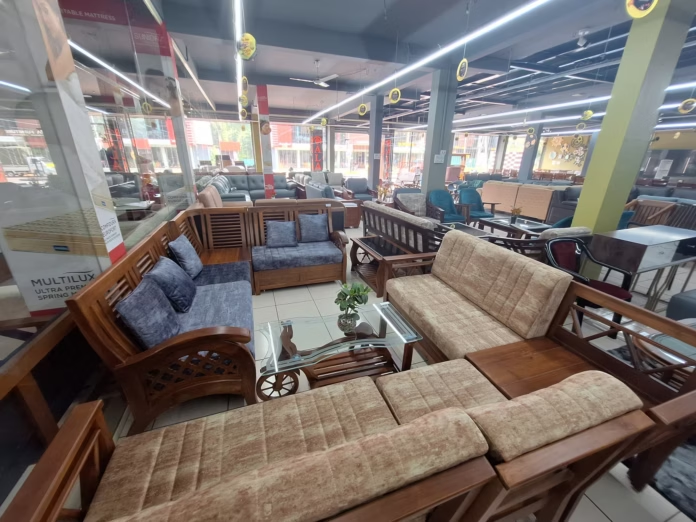
      Surathkal, a thriving locality on the outskirts of Mangaluru, has witnessed a significant retail development with the inauguration of the Galaxy Furniture and Electronics outlet on Sunday, 12th January, 2025. The new store, situated at Chokkabettu, aims to capitalise on the growing demand for modern retail experiences in the area, which has long seen limited shopping options.

      The inauguration ceremony attracted a host of local dignitaries, including former MLA Mohiudeen Bava, KPCC General Secretary Mithun Rai, Surathkal Police Inspector Mahesh Prasad, and several prominent community leaders. Their presence highlighted the importance of this new venture in not only catering to consumer demand but also contributing to the socio-economic growth of Surathkal. Former MLA Mohiudeen Bava remarked on the rapid transformation of Surathkal, underscoring that the area, once overshadowed by Mangaluru, has witnessed significant infrastructural progress. “In the past, residents had to travel to Mangaluru for their shopping needs. Now, Surathkal is evolving into a retail hub, and outlets like Galaxy Furniture and Electronics are pivotal in driving this change,” he said.

      The new store, spanning 1,300 square feet across four floors, offers a wide variety of furniture and electronics, catering to the growing affluence and diverse needs of Surathkal’s residents. With a strong focus on value proposition, the outlet has launched a series of promotional offers, including discounts of up to 50 percent throughout its inaugural month. Customers will also receive lucky coupons with every purchase, which will enter them into a draw to win prizes such as a Honda Activa 6G, a corner sofa, and a four-seater dining set. Additionally, the store provides attractive EMI options with zero down payment, making it an accessible shopping destination for a broad demographic. The significance of Galaxy Furniture and Electronics in Surathkal cannot be understated. With the retail sector in the region continuing to grow, the outlet stands as a testament to the increasing demand for modern, high-quality products close to home.

      The development also speaks to the larger retail trend in smaller towns and suburban areas, where the convenience of proximity and competitive pricing is becoming a driving force for consumer behaviour. Surathkal has long been known for its industrial presence, but with this new addition to its retail landscape, it is positioning itself as a diverse and dynamic destination for both shopping and living. The positive response to this launch signals that the area is ready for more such developments, which in turn will contribute to its overall economic growth.

      Nippon Steel-US Steel Deal Faces Extended Delay Amid Legal Battle

      Nippon Steel-US Steel Deal Faces Extended Delay Amid Legal Battle
      Nippon Steel-US Steel Deal Faces Extended Delay Amid Legal Battle

      Nippon Steel-US Steel Deal Faces Extended Delay Amid Legal Battle

      The Biden administration has granted an extension until June for the enforcement of its decision to block the $14.9 billion acquisition of US Steel by Japan’s Nippon Steel. The delay allows the court time to assess the legal objections raised by the steelmakers against the president’s order. This prolonged pause could have significant ramifications for both the American steel sector and diplomatic relations between the United States and Japan.

      On 3rd January, President Joe Biden had moved to block the acquisition, citing national security concerns. This move was based on a thorough review by the Committee on Foreign Investment in the United States (CFIUS), which examined the potential risks the deal posed. Treasury Secretary Janet Yellen confirmed that the transaction underwent an exhaustive review process, but the enforcement delay now grants the companies involved time to mount a legal challenge against the order. Both Nippon Steel and US Steel have expressed optimism following the delay. In a joint statement, the two companies voiced their satisfaction with the extension, saying they were pleased with the opportunity to continue pursuing the deal. The steelmakers remain hopeful that the transaction can still be completed, believing it would be beneficial for all parties involved, including the future of the American steel industry.

      The current acquisition contract between Nippon Steel and US Steel is set to expire on June 18, 2025—the same date that marks the extended deadline given by CFIUS to abandon the deal. No comments have been provided by the White House, the Treasury Department, or representatives of the United Steelworkers union on the development. In response to the delay, US Steel and Nippon Steel have filed a lawsuit, alleging that the CFIUS review was biased, pointing out President Biden’s long-standing opposition to the deal. The steelmakers argue that this prejudiced the review process and have appealed to a federal appeals court to overturn the decision, which would prompt a new review of the proposed acquisition. Meanwhile, Japanese Foreign Minister Takeshi Iwaya has expressed regret over the decision to block the sale, stressing the importance of maintaining a strong US-Japan alliance. Iwaya has urged for a resolution to the issue that does not disrupt bilateral relations, particularly as Japan is one of the largest investors in the US.

      70 Companies Showcase Innovations at Iran’s Steel Structures Exhibition

      70 Companies Showcase Innovations at Iran’s Steel Structures Exhibition
      70 Companies Showcase Innovations at Iran’s Steel Structures Exhibition

      70 Companies Showcase Innovations at Iran’s Steel Structures Exhibition

      Over 70 domestic and international companies are exhibiting their cutting-edge products, innovations, and services at the second International Exhibition of Steel Structures, Related Engineering Industries, and Services (Iran Steel FAB). The event, scheduled from 13th to 16th January, 2025, is being held at the Tehran International Permanent Fairground, under the theme: “Safe and Sustainable Structures for Everyone, Everywhere.”

      Zare Haghighi, Head of the Steel Structures Cooperative Company of Iran (CAMSI), spoke about the strategic significance of the steel sector in national development. He emphasized the pivotal role that steel production plays across various industries, including machinery, mining, construction, defense, petrochemicals, energy, and transportation. “Steel production is a cornerstone of national development, and Iran’s position as one of the world’s leading steel producers highlights the importance of shifting from raw material sales to the production of finished products,” Haghighi noted. As Iran continues to climb the ranks of global steel production, Haghighi stressed the need to focus on producing value-added products, which are crucial for expanding domestic and international markets. He underscored the importance of forging connections in regional and global markets to boost sales, create jobs, and advance technology in construction and engineering.

      The exhibition serves as a platform to support several key objectives promoting exports, attracting investments, facilitating knowledge exchange, and fostering networking among professionals. It also aims to introduce Iran’s steel structure producers, showcase export-ready products, and engage the public in learning about the latest technologies in steel structures. Iran’s steel industry currently boasts a production capacity of 5 million tons, with 2 million tons being produced annually. Haghighi highlighted the industry’s self-sufficiency, noting that the country has achieved significant independence in steel structure production. However, he also pointed out the challenges facing the sector, including the integration of steel structures into large-scale housing projects. The high initial capital required for steel structures compared to traditional concrete structures has limited their adoption despite their faster construction timelines and cost-effectiveness for large-scale projects. The exhibition also provides opportunities for researchers to access scientific studies, while facilitating interaction between business leaders, government officials, and private sector stakeholders. It is a key initiative in strengthening Iran’s position in the global steel market while contributing to economic growth and technological advancement.

      India Eyes 300 Million Ton Steel Goal by 2030

      India Eyes 300 Million Ton Steel Goal by 2030
      India Eyes 300 Million Ton Steel Goal by 2030

      India Eyes 300 Million Ton Steel Goal by 2030

      India is set to exceed its ambitious target of 300 million tons of steel production by the year 2030, with the government expressing optimism regarding the ongoing capacity expansion in the country’s steel sector. According to Steel Secretary Sandeep Poundrik, major integrated steel producers (ISPs) such as JSW Steel, Tata Steel, and Steel Authority of India Limited (SAIL) are leading the charge in boosting domestic production capacity. JSW Steel, for instance, aims to increase its capacity from 33 million tons to 50 million tons by 2030. Similarly, Tata Steel and SAIL are pursuing expansion plans targeting capacities of 40 million tons and 35 million tons, respectively. Collectively, ISPs are looking to add an additional 85 million tons of capacity by the end of the decade, bringing total ISP capacity to an impressive 213 million tons.

      “The projected capacity growth, when combined with the anticipated expansion in secondary steel production, will ensure that India surpasses its 300 million tons target by 2030,” Poundrik stated. This optimistic outlook reflects the country’s rapidly growing demand for steel, particularly in the housing, infrastructure, and engineering sectors, where steel-intensive projects are becoming increasingly common. However, this robust growth in capacity is not without its challenges. Poundrik acknowledged that the current pricing environment, especially in the flat product segment, poses significant challenges for the industry. Imports and global market fluctuations have led to price pressures on domestic steel, especially flat products, which are predominantly manufactured by ISPs. If these pricing conditions persist, there could be delays in the execution of some of the planned projects, particularly those in the early stages of development.

      To address these challenges, the Indian government is exploring fiscal measures to support the domestic steel industry. Among the options being considered is an increase in the Basic Customs Duty (BCD) on steel imports, which currently stands at 7.5 percent. However, due to existing Free Trade Agreements (FTAs) that exempt many steel imports from this duty, its effectiveness may be limited. Additionally, the Directorate General of Trade Remedies (DGTR) is examining proposals to impose safeguard duties on imported steel, with recommendations expected by February. Poundrik also highlighted the government’s proactive stance in combating steel dumping practices, particularly those involving cheap imports from countries like China. Although he refrained from labelling these exports as dumping, he noted that they were largely driven by subdued global demand rather than deliberate undercutting. China, with its massive steel production capacity of around 1,100 million tons, has faced declining domestic demand, prompting it to increase exports, which has affected international steel prices, including in India.

      The steel sector’s importance to India’s economic aspirations cannot be overstated. From a production capacity of 137 million tons in 2018-19, the industry has surged to 196 million tons in 2023-24, marking a growth of nearly 59 million tons. This expansion is crucial for India’s ambitions of becoming a $5 trillion economy, with the steel industry serving as a cornerstone of both infrastructure development and broader economic growth. On the global front, India remains the only major economy to experience consistent annual growth in steel demand, with over 10 percent growth year-on-year. This stands in contrast to developed economies like the United States and Europe, where steel demand has stagnated. Meanwhile, China’s oversupply situation has put downward pressure on international steel prices, impacting the Indian market, where hot-rolled coil (HRC) prices have dropped by over ₹6,000 per ton in the past year.

      Further complicating matters are state-level taxation policies. In Karnataka, for example, a new tax on public sector companies like NMDC, which has already increased iron ore production, has led to concerns. NMDC now faces a tax burden equivalent to 150 perceof royalties, which could affect its profitability and its plans for capacity expansion, including its steel plant in Nagarnar, Chhattisgarh, which is currently slated for disinvestment. Despite these hurdles, the steel sector remains a key driver of India’s economic growth. Poundrik expressed confidence in the industry’s ability to meet its targets, provided the government and stakeholders work together to safeguard the sector’s interests. India’s position as a global steel producer continues to solidify, reinforcing the country’s critical role in the international steel market.

      SECR Upgrades Level Crossings with Modern Infrastructure to Boost Safety and Efficiency

        0
        SECR Replaces Level-Crossings with New Infrastructure to Improve Safety and Efficiency
        SECR Replaces Level-Crossings with New Infrastructure to Improve Safety and Efficiency

        SECR Upgrades Level Crossings with Modern Infrastructure to Boost Safety and Efficiency

        South East Central Railway (SECR) has replaced three level-crossings with modern railway infrastructure. This initiative is part of the railway’s ongoing mission to achieve “Zero Level-Crossing” and to improve the operational efficiency of the network.

        In the last few months, SECR has focused on replacing level-crossings on key railway sections, including the Durg-Gondia and Gondia-Nagpur routes. The replacement strategy includes constructing road over bridges (RoBs), road under bridges (RuBs), and limited height subways (LHS). These upgrades aim to eliminate the risks associated with level-crossings, which have been a significant cause of accidents and disruptions in train services. The SECR has already completed the replacement of two level-crossings in the Durg-Gondia section. A new RoB was constructed between Paniajob and Bortalao, and a RuB replaced the level-crossing between Darekasa and Salekasa. Additionally, an LHS was built at the Gondia yard, further enhancing safety in the region.

        These changes have had a positive impact on both rail and road traffic. By eliminating level-crossings, trains can now pass through these locations without interruptions, reducing delays and ensuring smoother and faster services. As a result, the trains experience improved speed management, contributing to better on-time performance. This infrastructure upgrade not only improves train operations but also provides benefits to road users. The removal of level-crossings significantly reduces traffic congestion and eliminates the risk of accidents at these locations. Furthermore, the replacement of level-crossings contributes to environmental benefits, such as fuel savings, reduced pollution, and less honking, as vehicles no longer need to wait for trains to pass. The SECR has ambitious plans for 2024-2025, setting a target to construct four RoBs and 21 LHS across various divisions. Currently, one RoB and two LHS are under construction, with further replacements planned throughout the year.

        The push for replacing level-crossings gained momentum after a serious incident in July 2024 at Khaparkheda, where a school bus and a car became trapped at a level-crossing as a train approached, nearly endangering the lives of 40 students. This alarming event highlighted the need for swift action to replace level-crossings with safer alternatives. In response, SECR has accelerated its efforts to replace level-crossings across its network, especially in the Nagpur division, where the authorities have prioritised such safety measures. These actions are part of a broader railway-wide effort to improve freight and passenger transport efficiency while reducing the likelihood of accidents. By replacing level-crossings with RoBs, RuBs, and LHS, SECR is not only enhancing safety but also contributing to the economic viability of the railway sector. These improvements are vital for meeting growing demand, ensuring quicker train services, and making railway travel a safer and more efficient mode of transportation for everyone.