Home Blog Page 377

Local Cement Sales Fall by 10.4% in FY25’s First Half, Exports Rise

Local Cement Sales Fall by 10.4% in FY25’s First Half, Exports Rise

Local Cement Sales Fall by 10.4% in FY25’s First Half, Exports Rise

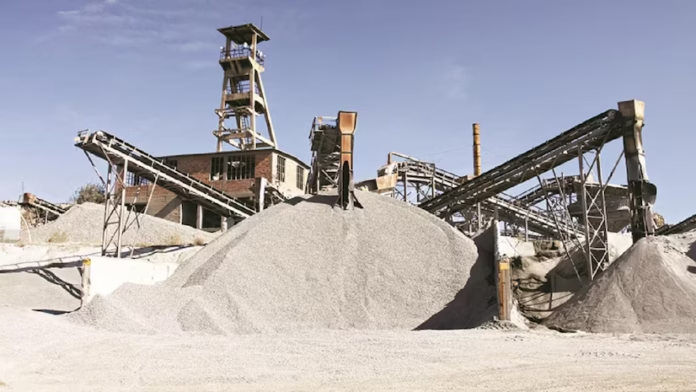
Pakistan’s cement sector faced a challenging first half of fiscal year 2025 (FY25), as local sales saw a significant decline of 10.4 percent, dropping from 20.228 million tonnes in the same period last year to 18.122 million tonnes. This contraction reflects the ongoing struggles within the domestic market, exacerbated by economic pressures and fluctuating demand.

However, the sector found some respite in the form of a sharp 32 percent increase in cement exports, which rose to 4.810 million tonnes from 3.655 million tonnes in the previous year. This export surge helped mitigate the overall decline in total cement despatches, which fell by 3.9 percent, reaching 22.933 million tonnes, compared to 23.881 million tonnes during the corresponding period in FY24. December 2024 saw a 5 percent drop in local cement despatches, with only 3.370 million tonnes dispatched, down from 3.539 million tonnes in December 2023. Despite this, exports surged by 49.35 percent, reaching 783,550 tonnes from 524,656 tonnes in the same month last year.

As a result, total cement despatches for December saw a modest increase of 2.23 percent, rising to 4.154 million tonnes from 4.063 million tonnes in December 2023. The All Pakistan Cement Manufacturers Association (APCMA) has expressed growing concern over the continuous decline in local cement demand. The association has called on the government to take immediate action by reducing duties and taxes on cement, arguing that such measures would not only stimulate demand but also help the industry better utilise its idle capacity. The cement industry has been under pressure due to rising production costs, as well as macroeconomic factors that have dampened local demand. However, with exports offering a lifeline, the sector hopes that a more supportive domestic policy environment could help reinvigorate the local market. The APCMA’s appeal for government intervention highlights the urgent need for measures that can stabilise the sector, ensuring that Pakistan’s cement manufacturers can maintain competitiveness both at home and abroad.

Kazakhstan Mining Sector Gains Boost with Martin Engineering

Kazakhstan Mining Sector Gains Boost with Martin Engineering

Kazakhstan Mining Sector Gains Boost with Martin Engineering

Martin Engineering, a global leader in bulk material handling solutions, has inaugurated a new business unit in Kazakhstan. The new facility, located in Almaty—Kazakhstan’s largest city and economic centre—marks a pivotal expansion as the company seeks to tap into the rapidly growing mining sector of the region.

Kazakhstan, the world’s ninth-largest country, is rich in diverse metal ores and mineral resources, making it a key player in global mining and mineral production. Mining is the cornerstone of Kazakhstan’s economy, contributing substantially to the nation’s export revenues. Given its strategic location and abundant resources, the country has seen a surge in demand for cutting-edge technologies that ensure efficiency, safety, and sustainability in mining operations. Martin Engineering’s decision to establish a business unit in Kazakhstan is driven by the firm’s strong track record in the country. The company has previously supplied advanced conveyor belt cleaning solutions to one of Kazakhstan’s largest copper producers, significantly boosting plant efficiency and productivity.

With this new unit, Martin Engineering is now positioned to offer a broader portfolio of products and services, which include its innovative CleanScrape® belt cleaners, Orion SQC2S™ Secondary Belt Cleaner, and high-performance Air Cannons featuring SMART™ Series Nozzles. These products are designed to enhance material flow, reduce downtime, and optimise the overall performance of mining operations. The new business unit will also provide a host of value-added services to Kazakh customers, including faster service response times, improved supply chain logistics, and bespoke training programmes such as Walk The Belt™ and Foundations™ to help local maintenance teams enhance their skills. These services will not only support Kazakhstan’s established players in the mining sector but also help emerging companies navigate the complexities of bulk material handling in the industry.

Oleg Glukhov, the new General Manager of the Kazakhstan unit, brings with him over seven years of experience at Martin Engineering. His leadership will play a crucial role in driving the company’s expansion efforts across the region. According to Glukhov, “Kazakhstan holds a prominent position as a global source of metals and industrial minerals. The mining industry’s focus on safe, efficient, and profitable processing is where Martin Engineering’s solutions can make a significant difference.” Martin Engineering, known for its industry-leading innovations, has pioneered solutions that improve safety, reduce operational costs, and optimise production efficiency across several key sectors, including mining, steel, cement, and fertiliser production. The company’s decision to expand in Kazakhstan highlights its confidence in the region’s growth potential and its commitment to supporting the country’s mining sector with world-class technological solutions.

Saudi Arabia’s Al Jouf Cement Green Product to Be Used in NEOM City

Saudi Arabia's Al Jouf Cement Green Product to Be Used in NEOM City

Saudi Arabia’s Al Jouf Cement Green Product to Be Used in NEOM City

Al Jouf Cement, one of Saudi Arabia’s leading cement manufacturers, has received approval to use its innovative ‘green’ cement for construction projects within the high-profile NEOM city. This development marks a significant milestone for both the company and the sustainable construction sector. The ‘green’ cement has been developed in collaboration with Asas Al-Muhailb, a prominent ready-mix concrete producer in the region.

The green cement offers a range of benefits that enhance concrete’s performance. One of its most notable features is its ability to improve the durability and longevity of concrete structures. The product is designed to reduce water absorption and permeability, which are key factors that can affect the integrity of concrete over time. Additionally, the green cement is resistant to sulphate and chloride salts, common elements that contribute to the degradation of concrete in harsh environments. What sets this cement apart from traditional alternatives is its superior thermal properties. The green cement provides enhanced heat insulation and fire resistance, making it an ideal choice for projects that require materials capable of withstanding extreme conditions. The product also boasts compressive strength that is equal to or greater than that of ordinary Portland cement (OPC), ensuring its reliability and structural integrity in large-scale construction projects.

The approval for use in NEOM is a major win for Al Jouf Cement, as NEOM is a futuristic city being developed in northwestern Saudi Arabia with a focus on sustainability and advanced technology. The city, which is part of Saudi Vision 2030, aims to become a global hub for innovation, smart cities, and sustainable living. The inclusion of green cement in NEOM projects aligns perfectly with these goals, supporting the development of environmentally responsible and resilient infrastructure. Al Jouf Cement’s move to incorporate sustainable practices into its products comes at a time when the construction industry globally is shifting toward more eco-friendly and energy-efficient solutions. With NEOM poised to set a global example in sustainable urban development, the approval of Al Jouf Cement’s green product underscores the increasing demand for sustainable building materials in the region. As Saudi Arabia continues its push towards sustainability, Al Jouf Cement’s green cement is expected to play a pivotal role in shaping the future of construction in NEOM and beyond.

JK Lakshmi Cement Receives Go-Ahead from BSE and NSE for Amalgamation Plan

JK Lakshmi Cement Receives Go-Ahead from BSE and NSE for Amalgamation Plan

JK Lakshmi Cement Receives Go-Ahead from BSE and NSE for Amalgamation Plan

JK Lakshmi Cement has received approval from leading stock exchanges, the NSE and BSE, for its plan to merge three of its subsidiaries into the company. The amalgamation involves Udaipur Cement Works, Hansdeep Industries and Trading, and Hidrive Developers and Industries, with the goal of simplifying the company’s structure and creating a more commercially meaningful entity focused on cement and cement products.

As per the filing made with BSE on 1 January 2025, the exchanges issued their Observation Letters, confirming that there were no adverse observations or objections regarding the proposed scheme. This approval follows the approval of the merger by JK Lakshmi Cement’s board on 31 July 2024. As part of the merger terms, shareholders of Udaipur Cement Works Ltd (UCWL) will receive four shares of JK Lakshmi Cement for every 100 shares they hold in the company. The merger is expected to streamline operations and improve operational efficiencies in the cement sector.

The company’s combined capacity for FY24 stands at 16.5 million tonnes per annum (MTPA), and its revenue for the same year was ₹6,319.77 crore. UCWL, which is set to be merged, reported a revenue of ₹1,163.59 crore in FY24. JK Lakshmi Cement aims to expand its production capacity to 30 MTPA by 2030 through brownfield and greenfield expansion projects. The company currently has ongoing expansion projects totaling 10.80 MTPA, set for completion by FY27. The merger with these subsidiaries is expected to enhance JK Lakshmi Cement’s position in the industry and boost its growth prospects.

Steel Ministry Seeks 15% Customs Duty on Finished Steel Imports to Protect Domestic Industry

Steel Ministry Seeks 15% Customs Duty on Finished Steel Imports to Protect Domestic Industry

Steel Ministry Seeks 15% Customs Duty on Finished Steel Imports to Protect Domestic Industry

The Ministry of Steel has formally requested the Ministry of Finance to increase the basic customs duty on imported finished steel products from 7.5 percent to 15 percent in the upcoming Union Budget for 2025–26. This move aims to curb the adverse effects of growing steel imports, particularly from China, which has seen a notable rise in the current financial year.

Official data reveals that imports from China now account for 32 percent of the total steel imports in India, putting significant pressure on domestic steel producers. The Steel Ministry believes that raising the import duty will help protect the Indian steel industry from unfair competition, particularly from cheaper Chinese steel products that have flooded the market. The proposed increase in customs duty would act as a safeguard for local manufacturers and allow them to remain competitive in the face of rising imports. It is expected to bolster India’s domestic steel industry, encourage local production, and safeguard jobs in the sector.

The Ministry’s proposal comes as part of a broader strategy to reduce dependency on steel imports and strengthen India’s industrial capabilities. With the domestic steel sector struggling against cheaper imports, particularly from China, the Steel Ministry’s push for a higher customs duty is seen as a critical measure to ensure the industry’s long-term sustainability.

India Takes Steps to Regulate Steel Imports with BIS Standards for All Steel Grades

India Takes Steps to Regulate Steel Imports with BIS Standards for All Steel Grades

India Takes Steps to Regulate Steel Imports with BIS Standards for All Steel Grades

The Indian government has expanded the Bureau of Indian Standards (BIS) quality control norms to cover all steel grades, ensuring that only steel meeting the relevant BIS specifications is produced domestically or imported into the country. The Steel Ministry, which issues the Quality Control Order (QCO), has mandated that steel products conform to BIS standards, effectively raising the bar for steel quality.

As part of this initiative, steel grades not yet covered by BIS standards will require a No Objection Certificate (NOC) from the Steel Ministry for import. This move is aimed at preventing the entry of substandard steel into the market, which could negatively impact the quality of infrastructure and products in India. A senior official from the Steel Ministry stated, “We are working towards bringing all steel grades under BIS standards within the next year. This will help regulate imports and ensure that poor-quality steel does not flood the market. It’s a non-tariff barrier that we are implementing to protect the domestic industry and ensure its competitiveness.”

The decision to extend quality control to all steel grades aligns with the government’s broader efforts to safeguard the domestic steel industry from unfair trade practices and to promote the use of high-quality materials in infrastructure development. This move is expected to provide a boost to the domestic steel sector and help it remain competitive in the global market.

Global Steel Industry Faces Profitability Challenges as India Sees Rising Demand

Global Steel Industry Faces Profitability Challenges as India Sees Rising Demand

Global Steel Industry Faces Profitability Challenges as India Sees Rising Demand

Tata Steel CEO and Managing Director T.V. Narendran highlighted the significant challenges facing the global steel industry, citing shrinking profit margins due to aggressive pricing by China. In his address at a New Year gathering, Narendran explained how 2023 and 2024 were difficult years for steelmakers worldwide, as the industry struggled with reduced margins and the aftereffects of China’s COVID-19 restrictions. Narendran emphasized that while global geopolitical events have an indirect impact on India, the primary concern remains China’s economic slowdown, which has led to unfair competitive pricing. He urged the Indian government to adopt protective measures, similar to those in place in the US, Canada, and Europe, to safeguard domestic producers from the influx of cheaper steel imports.

Despite these global challenges, Narendran pointed to India’s steel demand, which is growing at a rate of 8 percent. Tata Steel has thrived in this environment, thanks to its competitive positioning and strong domestic market. However, he acknowledged the pressure on margins and stressed the importance of value addition and innovation within the sector to maintain profitability. He also emphasized the potential of India’s mineral-rich states such as Jharkhand, Odisha, and Chhattisgarh. These regions offer untapped opportunities for creating industries that can drive wealth and employment. Narendran called for further incentives to attract investment into these areas, noting that the steel sector in India already invests between ₹40,000 crore and ₹50,000 crore annually.

Among Tata Steel’s notable achievements, Narendran highlighted the commissioning of the country’s largest blast furnace at the Kalinganagar plant in Odisha, despite the challenging global environment. He also praised the company’s ongoing initiatives to improve employee and community welfare, such as the construction of housing and schools for staff and their families. Narendran also noted that Tata Steel is engaged in discussions with the new government in Jharkhand to explore ways to leverage the state’s vast reserves of iron ore and coal. He emphasized Jharkhand’s potential to become a hub for steel and automotive industries, supported by focused efforts on value addition and creating sustainable industries that benefit local communities.

Thane Civic Body Takes Action Against 39 Builders for Violating Air Pollution Norms

    0
    Thane Civic Body Takes Action Against 39 Builders for Violating Air Pollution Norms
    Thane Civic Body Takes Action Against 39 Builders for Violating Air Pollution Norms

    Thane Civic Body Takes Action Against 39 Builders for Violating Air Pollution Norms

    Thane Municipal Corporation (TMC) has issued show cause notices to 39 builders for failing to adhere to air pollution control norms. The builders, who were initially directed to follow dust pollution control guidelines, have been warned that their work could be halted if they do not provide satisfactory responses to these notices.

    The TMC’s efforts to combat construction-related air pollution are part of an ongoing campaign to safeguard the environment and reduce harmful emissions. As part of this initiative, the TMC had earlier instructed 297 builders to comply with guidelines designed to limit dust pollution at construction sites. Out of the total, 31 builders have fully complied, while fines totalling Rs 4 lakh have been imposed on 151 builders for minor violations.

    The notices were issued after a comprehensive review by the TMC’s environmental department, which is led by the Additional Municipal Commissioner Sandeep Malvi. The meeting, attended by TMC engineers, representatives from the Maharashtra State Road Development Corporation (MSRDC), metro rail officials, and the police, evaluated the effectiveness of the measures in place. In an effort to track air quality more closely, the TMC has installed air quality measuring devices at 50 construction sites across the city. This initiative is part of the broader plan to reduce pollution levels and ensure compliance with air quality norms. Additionally, the TMC has taken action against the burning of plastic and garbage, imposing fines of Rs 20,000 following nine complaints. The use of firewood in restaurants and hotels has also been banned as part of the efforts to control air pollution. Between March and November 2024, the TMC successfully collected and recycled 7,414 tonnes of construction and demolition debris as part of its waste disposal project. Builders are now required to transport debris in vehicles equipped with GPS tracking systems to ensure transparency and accountability.

    In addition to the construction site measures, the TMC, in partnership with the Regional Transport Offices (RTOs), has acted against over 5,900 vehicles carrying debris without proper coverage and has fined 4,008 vehicles for lacking valid pollution under control (PUC) certificates. Chief Environment Officer Manisha Pradhan has stated that all builders must use green nets at construction sites to further control dust. In total, fines of Rs 1.7 lakh have been imposed on various entities following complaints related to air pollution. This decisive action taken by the TMC highlights its commitment to improving air quality in the city and holding builders accountable for environmental regulations. As part of its long-term vision for a greener and cleaner Thane, the municipal corporation is intensifying its efforts to enforce pollution control measures across various sectors, from construction to transportation.

    Tata Steel CEO Foresees Growth in India as Global Steel Faces Profits Decline

    Tata Steel CEO Foresees Growth in India as Global Steel Faces Profits Decline
    Tata Steel CEO Foresees Growth in India as Global Steel Faces Profits Decline

    Tata Steel CEO Foresees Growth in India as Global Steel Faces Profits Decline

    The global steel industry is grappling with significant profit challenges, primarily driven by China’s aggressive pricing strategies, according to Tata Steel’s CEO, TV Narendran. The surge in Chinese exports, along with the slow recovery of the Chinese market, has led to tighter margins across the global steel sector, especially in 2023 and 2024. Despite these hurdles, Narendran remains optimistic about India’s steel demand, which is growing at an impressive 8 per cent annually, presenting substantial opportunities for value addition and job creation within the sector.

    Narendran highlighted the importance of India’s mineral-rich states, such as Jharkhand and Odisha, as key regions for steel production expansion. He emphasised that these states not only provide abundant raw materials but also present opportunities for building industries that can drive job creation and economic growth. “The growth of the steel industry in India is deeply tied to the potential of these resource-rich states,” he remarked. Tata Steel, one of the largest steel producers in India, has consistently benefited from these local advantages, with strong domestic demand contributing to the company’s profitability despite global challenges.

    He also called for greater government support to shield domestic producers from unfair competition, similar to the measures undertaken by nations like the US and Canada. These protections, he argued, would enable Indian producers to maintain a competitive edge in a market that is increasingly affected by global price pressures and fluctuating demand. Tata Steel’s continued profitability in India has also been supported by its ongoing investments, including a significant ₹40,000–50,000 crore annually into the steel industry. One of the standout achievements was the commissioning of India’s largest blast furnace at Tata Steel’s Kalinganagar plant, marking a major milestone in the company’s commitment to expanding production capacity and improving efficiency.

    Further reinforcing Tata Steel’s positive trajectory in India, Narendran pointed to the company’s contributions to local communities through infrastructure projects that support employee and community well-being. These initiatives include staff housing, schools, and other social infrastructure. Tata Steel is also in discussions with the newly-formed Jharkhand government to tap into the state’s resources, aiming to bolster growth in the steel and automotive sectors.

    AI Revolutionises Real Estate – Discover the Future of Property Market Innovations

      0
      AI Revolutionises Real Estate – Discover the Future of Property Market Innovations
      AI Revolutionises Real Estate – Discover the Future of Property Market Innovations

      AI Revolutionises Real Estate – Discover the Future of Property Market Innovations

      The housing market is undergoing a seismic shift, with artificial intelligence (AI) at the forefront of this transformation. As technology continues to revolutionise industries, real estate is embracing AI-powered tools and systems that promise to redefine how we buy, sell, and manage properties. From smart contracts to virtual reality tours, AI is not just enhancing the efficiency of transactions but also offering greater transparency, security, and convenience for everyone involved.

      Traditionally, property appraisals have been a manual process, often subject to human error and bias. With AI, however, home valuations are becoming more accurate and consistent. Advanced AI models now factor in numerous variables, such as neighbourhood trends, infrastructure developments, and economic conditions, offering real-time, data-driven insights. This means property buyers and sellers can make more informed decisions, with valuations that are faster, unbiased, and based on comprehensive datasets.

      Another groundbreaking development in real estate is the integration of blockchain technology. Through smart contracts, the buying and selling of homes can now be completed with unprecedented speed and security. These digital contracts automatically execute predefined terms once all conditions are met, reducing the need for intermediaries and minimizing human error. Blockchain also ensures that all transactions are transparent, tamper-proof, and securely stored, significantly reducing the chances of fraud. Virtual reality is changing how we experience real estate. Potential buyers can now take immersive, 360-degree tours of properties without leaving their homes. VR allows them to explore different rooms, assess property layouts, and even interact with the surrounding neighbourhoods, all through digital simulations. This technology enhances convenience and accessibility, making it easier for long-distance buyers to evaluate properties before scheduling an in-person visit.

      One of the most valuable aspects of AI in real estate is its ability to predict market trends. By analysing massive amounts of data, AI systems can identify patterns that help forecast shifts in demand, price fluctuations, and investment opportunities. Investors and buyers now have a competitive edge, with insights that enable them to make more strategic decisions based on predictive analytics. In addition to transforming the buying and selling process, AI is also reshaping property management. Smart sensors and data analytics now enable property managers to optimise maintenance schedules, automate resource usage, and predict when repairs are needed. This not only lowers operational costs but also improves the living experience for tenants, increasing property value over time. Beyond streamlining transactions, blockchain provides an added layer of security. By decentralising property data, blockchain reduces the risk of breaches and unauthorised access, ensuring that personal and financial information remains secure. Property-related data, such as ownership and transaction history, can now be stored safely, with full transparency for all parties involved.

      Augmented reality is enhancing the property viewing experience in a new way. While VR offers immersive tours, AR enables buyers to visualise changes they could make to a property before committing to any alterations. Through AR, buyers can see how different furniture or paint colours would look in a space, helping them make better decisions about potential renovations or purchases. The mortgage approval process, often a time-consuming and complicated procedure, is being expedited by AI. Advanced algorithms now analyse credit histories, financial information, and other relevant factors with precision, enabling quicker and more personalised loan decisions. This streamlines the home-buying process and reduces the waiting time for approvals. While AI offers enormous potential, the adoption of these technologies is not without challenges. For smaller real estate firms or individual buyers, the initial costs of setting up AI tools, VR systems, and blockchain infrastructure can be significant. However, as these technologies become more widespread, the costs are expected to decrease, leading to broader adoption across the industry. Moreover, AI’s ability to predict market trends and offer insights also raises questions about data privacy and the ethical use of algorithms. Ensuring that AI systems are transparent, fair, and free from bias will be crucial for building trust in these new technologies