India Kenstar Unveils Energy Efficient Air Cooler Campaign
Home appliance maker Kenstar has rolled out a strategic marketing campaign to spotlight its newly introduced 5‑Star Bureau of Energy Efficiency (BEE) rated air cooler range, amplifying messaging around energy savings and long‑term reliability as households brace for warmer temperatures ahead of summer. Featuring well‑known industry ambassadors in its video roll‑out, the initiative reflects a broader market shift toward energy‑efficient appliances that align with both economic savings and environmental stewardship.
The campaign leverages high‑visibility storytelling to convey the brand’s promise of superior cooling performance coupled with reduced electricity consumption — an increasingly important buying criterion for Indian consumers facing climbing utility costs and climate variability. Central to the narrative is the positioning of this new range as an “India‑first” set of air coolers with a 5‑Star BEE rating and an industry‑leading five‑year warranty, signalling durability and performance confidence rarely seen in this segment. Industry analysts note that as heatwaves become more intense and frequent across India’s urban and peri‑urban regions, demand for cooling solutions that balance affordability, energy usage and environmental impact is growing. By foregrounding energy efficiency and longevity, Kenstar appears to be tapping into a consumer trend that favours appliances designed around sustainability principles rather than pure upfront cost. This resonates with broader climate‑responsive consumption patterns emerging in cities and smaller towns alike.
The campaign — broadcast through digital channels and mass media — features notable ambassadors whose presence is intended to enhance brand recall and mass appeal. Their inclusion underscores how recognisable voices can drive resonance around product attributes such as efficiency, trust and everyday reliability, all of which are critical when shoppers weigh options in a crowded home appliance market. Kenstar’s expanded portfolio now includes more than 50 air cooler models catering to a spectrum of residential and commercial needs, from personal room coolers to larger tower and desert‑style units. Available across e‑commerce platforms, direct‑to‑consumer channels and traditional retail outlets, this range aims to serve diverse climatic conditions and spatial requirements.
For urban households, the strategic emphasis on 5‑Star energy performance dovetails with increasing regulatory and social focus on reducing electricity demand peaks and lowering household carbon footprints. Experts point out that appliances with higher energy ratings not only help consumers cut utility bills but also contribute to broader sustainability goals by easing load pressures on grids during peak heat cycles. Kenstar’s senior leadership has suggested that the campaign’s objective extends beyond product promotion to building long‑term awareness around efficient cooling as a lifestyle choice — one that foregrounds quality, durability and responsible consumption. Should this narrative gain traction, it could help shift buying patterns toward sustainable appliances in mid‑market and aspirational segments of India’s household appliance landscape.
As urban India continues adapting to hotter summers and living costs, such campaigns may influence how brands and consumers prioritise efficiency, reliability and environmental considerations in everyday household decisions.
India RR Decor Launches Heritage Thai Silk Textiles
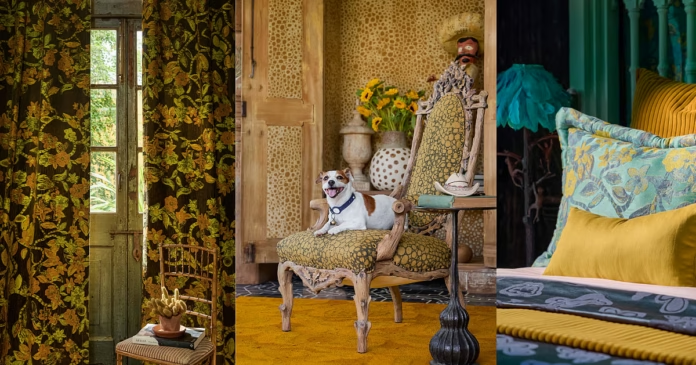
The Indian home décor and textiles segment is witnessing a notable expansion in luxury offerings as Jim Thompson, the iconic Thai silk house, makes its official debut in the Indian market through a strategic partnership with RR Décor. This launch introduces premium handwoven Thai silk fabrics into India’s interior design landscape, signalling growing consumer demand for culturally rich, artisanal materials that elevate residential and hospitality spaces.
With roots in traditional Thai weaving techniques, Jim Thompson’s textiles are celebrated globally for their unique texture, vibrant palettes and artisanal depth — qualities that distinguish handwoven silk from mass‑produced alternatives. RR Décor’s move to bring these fabrics to India aligns with broader shifts in the home design sector, where discerning buyers and interior designers are increasingly looking beyond commodity materials toward curated pieces with narrative value and craftsmanship provenance. Textiles have long been central to India’s own design heritage, with rich silk traditions such as those from Kanchipuram and other Indian handloom clusters deeply embedded in cultural aesthetics. These domestic craft legacies resonate with similar artisanal values in Thai silk weaving, offering an intriguing cross‑cultural dialogue for designers and homeowners alike.
Industry experts note that the introduction of globally recognised heritage brands like Jim Thompson into India supports a rising premiumisation trend in the interiors market. Urban residential projects in tier‑1 and tier‑2 cities alike are increasingly integrating statement textiles — from upholstery to drapery — that act as focal points in curated spaces. Indian designers suggest that such luxury textiles are not mere decorative accents but integral elements that define spatial character and sensory experience. For developers and hospitality operators, sourcing elevated textile portfolios enhances property positioning, particularly in luxury and experiential segments. “Statement textiles lend depth to interiors in both private residences and premium hospitality environments,” notes an industry consultant. This reflects a broader demand for richly textured materials that contribute to spatial identity, sustainability and long‑term value over purely trend‑led purchases.
RR Décor’s curated launch features a range of collections, including artisanal weaves and bold visual narratives designed to complement India’s eclectic interior design vocabulary. Pricing at a premium tier reflects the craftsmanship involved, positioning these fabrics in the high‑end market segment and catering to affluent homeowners, designers and boutique hospitality projects seeking distinctive materials. This strategic entry could also have ripple effects on local craft ecosystems. As global and Indian textile traditions intersect, there’s potential for cross‑pollination in design thinking, material experimentation and market reach — benefits that can enrich both domestic and international craft communities. Nevertheless, adoption of premium textiles remains constrained by consumer awareness and pricing sensitivity in broader segments. For meaningful scale, industry players will need to balance aspirational luxury with education on material longevity, craft heritage and sustainable sourcing — themes increasingly valued in urban design markets.
As the Indian interior design landscape continues to mature, blending heritage textiles with contemporary spatial needs represents both aesthetic and economic opportunity. The arrival of heritage Thai silk marks a step toward deeper global engagement in India’s design narrative.
India Divine Décor Blends Craft With Contemporary Interiors
In a notable shift within the home décor and design sector, Divine DeCor has positioned itself at the forefront of merging India’s rich artisanal heritage with contemporary interior aesthetics, reflecting broader trends in sustainable and culturally rooted design. The brand’s latest collections foreground traditional Indian craftsmanship — from hand‑carved motifs to ethnic textures and indigenous materials — reinterpreted for modern homes and commercial spaces. This strategy underscores a rising demand for décor that is both authentic and adaptable to today’s urban living environments.
Founded with the intent to preserve and elevate India’s craft traditions, the company collaborates with skilled artisans from regional craft hubs, integrating age‑old techniques into products tailored for current lifestyle preferences. By doing so, Divine D Cor taps into a growing consumer segment that values craftsmanship integrity alongside functional design, bridging the customary with the contemporary. This blend supports artisans’ livelihoods while aligning with market shifts towards meaningful, sustainable interiors.Across its range, the brand showcases pieces that take cues from classical Indian artistic elements — symbolic motifs, intricate carving, natural finishes and tactile detailing — and pairs them with modern design principles such as minimalism, modularity and refined material palettes. Products are curated to suit diverse interior contexts, including living rooms, pooja spaces, offices and hospitality environments. These items exemplify how traditional craftsmanship can be reimagined to complement contemporary architectural language without losing cultural resonance.
Industry observers say this approach resonates particularly in India’s expanding urban markets, where design choices increasingly reflect personal narratives and cultural context. Urban homeowners and interior designers alike are seeking décor that carries heritage value while fitting into open‑plan, multi‑functional spaces. In this sense, offerings like those from Divine D Cor demonstrate how indigenous crafts can be positioned as lifestyle assets rather than niche artefacts.Importantly for India’s design ecosystem, this model intersects with sustainable consumption trends. By emphasising handcrafted production and material transparency, the brand contributes to reduced reliance on mass‑produced décor — a key consideration as cities confront waste and resource management challenges. This ethos aligns with a broader shift seen across design industries where longevity, repairability and emotional value are increasingly prioritised over disposable aesthetics.
Economic outcomes for craft communities are also significant. Collaborations between brands and artisans can introduce stable demand and access to broader markets, fostering economic equity in regions historically reliant on manual craft. Observers note that when traditional skills are integrated into commercially viable products, it strengthens cultural continuity while offering artisans new opportunities for creative expression.Nevertheless, scaling such models poses challenges, including balancing bespoke production timelines with urban consumers’ expectations for quick delivery, and ensuring that authenticity is preserved even as design language evolves. For the wider sector, success will depend on how effectively brands like Divine D Cor navigate these tensions while reinforcing people‑centred and climate‑responsive approaches to décor.
As India’s real estate and urban interiors continue to grow, demand for décor that reflects both heritage and modern living needs is likely to expand. The next phase for craft‑infused brands will involve deepening design innovation, expanding market reach and maintaining ethical, sustainable production standards that honour both people and place.
Pune Saheel Properties Launches Homebuying Festival
In a distinctive bid to energise residential property demand in one of India’s most dynamic tier‑1 urban markets, Saheel Properties has rolled out a city‑wide homebuying initiative dubbed the Mother of All Deals. Designed as a large‑scale purchasing festival, the campaign weaves substantial incentives into the homebuying journey, aiming to influence buyer behaviour and bolster sales momentum across its portfolio of Pune developments.
The multi‑layered campaign layers traditional property marketing with experiential and reward‑based elements, offering prizes with an aggregate value approaching ₹8 crore. Buyers participating in the initiative are eligible for a Scratch & Winformat that features high‑value rewards ranging from electric vehicles to luxury motorcycles, positioned to amplify aspirational appeal. This move comes at a time when Pune’s residential sector is navigating mixed signals — strong infrastructure growth, rising prime neighbourhood values and demand from end‑users contrast with cautious transaction speeds in some segments. Urban planners and market analysts suggest that blending promotional tactics with core value propositions may help counter price sensitivity among first‑time buyers and investors alike.
Industry officials note that competitive incentives — if aligned with transparent pricing and regulatory compliance — can help compress decision cycles, particularly for quality projects in well‑connected micro‑markets like Hinjawadi, Baner and Tathawade, where recent absorption and infrastructure upgrades have been notable. However, success depends on whether such campaigns translate into durable demand rather than short‑term sales spikes.Beyond raw incentives, the festival’s structuring hints at a larger shift in how developers engage with prospective buyers in mature urban markets. Real estate professionals observe that gamified buying experiences and lifestyle‑integrated value additions are increasingly used to differentiate offerings in a crowded market. This trend dovetails with a broader real estate marketing evolution, where digital engagement, financing flexibility and personalised buyer journeys are becoming table stakes.
A senior Pune property broker pointed out that these promotional campaigns often yield mixed results. While enticing headline rewards garner visibility, underlying affordability and financing conditions remain primary drivers of transaction closure. In an environment where mortgage rates and regulatory compliance add layers of scrutiny for buyers, festivals like these serve as catalysts rather than complete solutions.Sustainability and community integration also play into longer‑term performance. Experts emphasise the need for projects to embed climate‑responsive design, public green spaces and pedestrian‑oriented streetscapes alongside promotional pushes, ensuring that new supply contributes to people‑first urban growth rather than isolated enclaves.
For Pune’s urban growth trajectory, such initiatives offer insights into demand stimulation strategies. The next phase will likely turn on how effectively developers balance incentive‑led marketing with genuine value delivery — be that through infrastructure connectivity, quality of life enhancements, or cost‑efficient homeownership pathways.
Leading online furniture and home marketplace Pepperfry has unveiled a dedicated business‑to‑business arm, Pepperfry for Business, targeting the fragmented commercial interior solutions market with integrated design, build and execution services. The initiative seeks to streamline how corporate offices, retail chains, hospitality spaces and institutions conceptualise and deliver interior projects across India. This move signals a shift towards end‑to‑end turnkey solutions in a sector poised for sustained infrastructure and real estate growth.
In India’s nearly $30 billion commercial fit‑out industry, projects often involve separate vendors for interior design, procurement, logistics and civil works, leading to coordination delays and cost overruns. Pepperfry for Business aims to simplify these complexities by consolidating planning, manufacturing, procurement, installation and on‑site services under one platform supported by in‑house project teams. The new vertical leverages Pepperfry’s existing nationwide logistics footprint—which covers more than 500 cities—and its partner ecosystem of over 1,100 manufacturers. It also draws on its own manufacturing facility capable of producing both modular and bespoke furniture solutions to support diverse commercial requirements.
Industry experts suggest that such integrated offerings could be especially relevant for urban centres where office space demand is rebounding and retail formats are upgrading their physical presence. With remote and hybrid work models influencing workspace design, organisations are increasingly seeking flexible, scalable interiors that enhance employee experience and operational efficiency. Pepperfry’s move aligns with this shift, potentially adding efficiency and transparency to project delivery cycles. A senior executive heading a design consultancy remarked that clients are often frustrated by disjointed vendor coordination that disrupts project timelines. By contrast, a single‑platform approach can reduce friction and uncertainty, crucial in large metropolitan markets where real estate costs are high and project delays directly impact financial outcomes.
Pepperfry’s initiative also comes against the backdrop of broader business strategy shifts following interest from institutional investors and industry consolidation conversations. Recent developments in ownership structures and strategic partnerships have underscored the importance of diversified revenue streams beyond pure‑play e‑commerce. However, analysts caution that execution risk remains significant in commercial interiors, where quality control, adherence to regulatory codes and effective on‑site project management are critical. Pepperfry for Business will need to demonstrate consistent delivery performance to gain trust among corporate and institutional clients. This includes maintaining sustainability standards, minimising material waste and designing spaces that are both energy‑efficient and inclusive.
As India’s urban infrastructure landscape continues to expand—with growing demand for office, healthcare and educational facilities—the entry of digitally enabled full‑service interior platforms could reshape how built environments are conceived and delivered. The next phase will likely hinge on execution excellence, strategic partnerships and responsiveness to evolving design expectations.
India Interiors Market Welcomes Blum Universal 105 Hinge
Blum, a leading manufacturer of furniture fittings, has launched a universal 105° hinge designed to optimise cabinet space and enhance usability in Indian homes and offices. The new hardware combines a soft‑close mechanism with versatile installation, enabling smoother access in kitchens, wardrobes, and storage units. With urban living spaces shrinking and demand for modular furniture rising, the introduction marks a significant step in modernising interior hardware.
The hinge, suitable for a wide range of cabinet designs, allows doors to open at an optimal angle without compromising on compact layouts. Its integrated soft‑closing feature ensures quieter operation and reduces wear, making it appealing to both designers and homeowners seeking long‑lasting functionality. A senior Blum official highlighted that the product targets Indian urban environments, where efficient use of space and durable fittings are critical.India’s urban interiors market is experiencing rapid growth, driven by high-rise apartments, co-living spaces, and premium modular kitchen trends. Industry experts note that hardware components, often overlooked, are increasingly considered key to delivering convenience and longevity in cabinetry. The Blum universal 105° hinge addresses these needs by offering three-dimensional adjustment options, which allow precise alignment even on irregular surfaces.
For interior contractors, the hinge reduces installation complexity, saving time and labour costs. Designers appreciate the combination of functional engineering with minimal visual impact, which supports contemporary aesthetics while maintaining practicality.The adoption of soft-close and space-saving hinges aligns with broader urban development trends, including efficient use of materials and lifecycle-oriented furniture design. As apartments grow smaller and modular solutions proliferate, components that enhance durability while improving user experience become economically significant for manufacturers and end-users alike. Blum’s expansion into India reflects growing confidence in the market for high-quality, reliable interior fittings.
Hardware innovations like Blum’s universal 105° hinge highlight how subtle design improvements can create measurable gains in functionality and sustainability for the urban built environment. As modular furniture becomes standard, such fittings ensure that homes remain adaptive, user-friendly, and long-lasting, setting the stage for more resilient and efficient urban interiors.
India’s largest steelmaker by production capacity has taken a strategic step to secure critical inputs for its domestic operations, announcing the acquisition and development rights to a coking coal mining project in Mozambique’s Tete Province. The project — known as Minas de Revuboè (MdR) — will provide JSW Steel with long‑term access to premium hard coking coal, a key raw material for high‑grade steelmaking that domestic sources cannot sufficiently supply.
The decision to invest in Mozambique comes against a backdrop of rising global commodity volatility and growing industrial demand within India, where steel production is integral to infrastructure, construction and manufacturing growth. Coking coal is essential in blast furnaces, and India remains heavily reliant on imports due to limited indigenous reserves. By securing overseas coal assets, JSW Steel aims to strengthen its supply chain resilience and reduce vulnerability to international market fluctuations. The MdR project is located within the Moatize coal basin and is reported to host substantial reserves of hard coking coal. Early development plans envisage phased ramp‑up to produce millions of tonnes annually, underscoring the company’s commitment to backward integration — bringing key raw material production closer to its steel manufacturing network.
Industry analysts view the move as part of a broader trend among Indian steelmakers to secure strategic resources abroad. With domestic production of coking coal constrained, companies are increasingly looking to Africa, Australia and North America for stable supply partnerships. This strategy not only enhances operational continuity but also supports long‑term planning for capacity expansion, both domestically and globally. However, the market reaction highlights complexity in balancing long‑term resource security with investor expectations. JSW Steel’s share price dipped following the announcement, reflecting concerns over upfront capital costs, mine development challenges and commodity price unpredictability. Such market responses underscore the delicate calculus companies must navigate when pursuing resource‑intensive acquisitions overseas.
For India’s steel sector, which supports vast segments of infrastructure — from housing and transport to energy and urban development — reliable access to coking coal is a structural imperative. Delays or shortages can ripple through supply chains, constraining production and inflating costs for downstream industries like construction and manufacturing. By anchoring a cornerstone raw material source in a stable mining jurisdiction, JSW Steel is positioning itself to mitigate these risks. Nevertheless, sustainability and climate resilience considerations are increasingly shaping investors’ and policymakers’ evaluation of such deals. Coal mining and combustion remain significant sources of greenhouse gas emissions, presenting long‑term challenges in aligning with India’s net‑zero ambitions. Future upstream investments may need to balance raw material security with innovations in cleaner steelmaking technologies — such as hydrogen‑based reduction, carbon capture or increased use of scrap and electric arc furnaces.
As JSW Steel advances its Mozambique project, industry observers will be watching how the integration of overseas coking coal supplies influences cost profiles, production efficiencies and India’s broader industrial competitiveness.
India’s coal industry has reached a noteworthy production and dispatch milestone in the current financial year, underscoring its enduring role in the country’s energy and industrial infrastructure. According to government sources, captive and commercial coal mines cumulatively crossed the 200 million tonnes (MT) production mark, while dispatches also climbed significantly, reflecting strengthened capacity to meet expanding energy and industrial demand.
The Ministry of Coal’s announcement highlights that this output bust, from approximately 182 MT to more than 197 MT in dispatches, represents a year‑on‑year increase of over 7 per cent. This upward trajectory indicates improved operational efficiencies, enhanced mining activity, and better supply chain performance across both public and private sector operators. For decades, coal has been central to India’s energy ecosystem, powering a majority of its electricity generation and serving as a feedstock for key industries such as steel, cement and fertilisers. The recent production milestone underscores the sector’s foundational role in energy security, helping to reduce dependence on imported coal and stabilise domestic supply chains.
Economic analysts point out that rising coal output and dispatch volumes can ease pressures on electricity generation costs and advance industrial competitiveness — particularly in energy‑intensive sectors. However, they also caution that this growth should not eclipse the broader energy transition agenda, which prioritises renewable energy expansion and reduced carbon intensity in line with India’s net‑zero commitments. The performance in the coal sector has been supported by several policy measures introduced over recent years, including the opening up of commercial mining to private players, streamlined regulatory clearances, and targeted investments in logistics infrastructure. Since the introduction of commercial mining auctions in 2020, private participation has gradually strengthened production capacity alongside traditional state‑owned miners.
Coal dispatch trends — a key indicator of demand realisation — also demonstrate resilience. Steady growth in dispatch volumes points to sustained consumption from power utilities and industrial consumers, even as renewable energy capacity continues to expand. This pattern reflects a dual reality: coal remains essential for short‑term energy reliability while India scales up solar, wind and hydropower to diversify its energy mix. But the sector’s climate and sustainability implications are increasingly under scrutiny. Coal production and combustion remain significant sources of greenhouse gas emissions, and balancing growth with environmental responsibility is a major challenge for policymakers and industry stakeholders alike. Cleaner coal technologies, coal‑to‑chemicals projects, and coal gasification are among the strategies being explored to lower the carbon footprint of the sector.
Urban planners and energy experts say the recent milestone should be contextualised within India’s broader energy transition. While coal output growth stabilises energy supply in the near term, accelerated deployment of renewable energy and energy efficiency measures will be critical to achieving long‑term climate goals without compromising industrial and economic growth.
India’s cement sector is increasingly seeking flexible, cost-efficient logistics solutions to meet rising construction demand, as demonstrated by Heidelberg Cement India’s recent bulk procurement of over 100 Apé Xtra Bada 700 three‑wheel cargo vehicles from Piaggio India. The move reflects the company’s strategic pivot toward agile distribution for mid‑range deliveries, particularly in regions with infrastructure constraints and high urban density.
The vehicles will be deployed across key cement distribution corridors in Uttar Pradesh, Madhya Pradesh, and Bihar, enhancing last‑mile connectivity from depots to retail points. Industry analysts highlight that cement manufacturers are under growing pressure to optimise logistics costs, improve delivery speed, and reduce vehicle idle times — all while complying with emerging urban road safety and emissions regulations. The Apé Xtra Bada 700, with its seven-foot cargo deck and payload capacity of roughly 750 kg, is positioned as a bridge between light motorcycles and conventional four‑wheelers. For cement companies, this size and payload flexibility allows smoother navigation through narrow streets and semi-urban roads, making bulk distribution more efficient while lowering fuel and maintenance costs. Logistics experts point out that these vehicles are particularly effective for delivering to smaller construction sites where traditional trucks may be impractical.
Heidelberg Cement’s adoption of three‑wheelers signals a wider industrial trend toward diversified fleet strategies. Medium and heavy trucks remain central for bulk movements from plants to regional depots, but smaller, fuel-efficient cargo units are increasingly integrated for secondary distribution. Urban logistics specialists note that this hybrid fleet model optimises delivery frequency, reduces congestion in densely populated areas, and lowers total cost of ownership. From a sustainability and operational resilience standpoint, three‑wheelers also provide a lower-carbon alternative for short-haul cement deliveries, complementing ongoing industry discussions on electrification of commercial fleets. Companies like Heidelberg Cement are evaluating the balance between diesel-powered performance, payload capacity, and potential integration of battery-electric variants in future procurement cycles.
For the Indian construction sector, efficient last‑mile distribution is critical. By incorporating modern three‑wheeler cargo vehicles into their logistics ecosystem, cement manufacturers can ensure timely deliveries to retail and project sites, reduce operational bottlenecks, and better serve urban and peri‑urban demand. Analysts say that such fleet modernisation could become a blueprint for other large-scale building material suppliers navigating India’s fast-growing, infrastructure-intensive markets.
India Cement Roofing Sheets Market Sees Fast Growth
India’s construction materials landscape is witnessing a significant shift as demand for cement‑based roofing sheets — particularly fibre cement variants — accelerates amid rapid urbanisation, infrastructure investment and a broader sustainability push. Analysts say this trend underscores a deeper real estate and industrial transition toward safer, longer‑lasting building products that align with India’s evolving environmental and resilience priorities.
Market forecasts from recent industry studies indicate that the India fibre cement roofing sheets market could expand at a double‑digit rate over much of the current decade, with some projections estimating the market value rising from roughly USD 185 million in 2024 to more than USD 615 million by 2033. This represents a compound annual growth rate of over 14%, outpacing other traditional roofing materials. This uptick is rooted in several structural drivers. India’s cement sector, a backbone of the construction ecosystem, is itself growing at an estimated 7–8% CAGR on the back of housing projects, highways and industrial development, creating sustained upstream demand for cement‑intensive products. Cement forms the primary raw material in fibre cement sheets, blending with cellulose fibres and sand to deliver durable, fire‑resistant roofing that meets stricter building and safety codes.
Urban development plans such as the Pradhan Mantri Awas Yojana and Smart Cities Mission, backed by expanding municipal and rural infrastructure budgets, are directly influencing material selection. These programmes prioritise affordability and durability, positioning cement‑based roofing as a preferred solution for schemes aiming to deliver both quality housing and long‑term climate resilience. Industry specialists note that the shift away from asbestos‑based roofing — long used in many regions — has created a significant opportunity. Regulatory and health concerns have encouraged developers and homeowners to opt for non‑toxic, sustainable alternatives with comparable performance. Cement roofing sheets now lead in applications spanning residential, commercial and industrial portfolios, particularly in tier‑2 and tier‑3 markets where cost effectiveness and low life‑cycle maintenance are paramount.
Regional data also highlights diverse adoption patterns across India. Western states, buoyed by robust urban and industrial expansion, have emerged as significant consumption hubs. Meanwhile, northern markets tied to major infrastructure corridors also show strong uptake, driven by both affordable housing demand and commercial construction activity. Despite the positive outlook, the sector faces challenges. Competition from metal roofing and alternative materials continues to exert pricing pressure, and raw material costs — notably cement and energy inputs — have fluctuated with broader commodity cycles. Manufacturers are investing in digital sales platforms and distribution networks to improve market reach, while research into lower‑carbon cement blends seeks to reconcile performance with sustainability goals.
For urban planners and real estate developers, the rising prominence of cement‑based roofing sheets reflects a broader pivot to materials that support India’s housing ambitions while meeting fire safety, thermal performance and climate resilience benchmarks. As cities expand and infrastructure networks densify, the industry’s ability to scale responsibly — reducing embodied carbon without compromising durability — will be critical to shaping India’s built environment.