Swedish home furnishings giant IKEA is reshaping its India growth strategy by prioritising smaller urban store formats as it works toward profitability in the country. The retailer plans to open 25 small and medium-sized stores over the next four to five years, part of a broader expansion aimed at improving accessibility for city residents and strengthening its retail footprint.
The company has set an internal target of achieving profitability in India by the end of the 2028 financial year, following several years of heavy investments in large-format stores, supply chains and digital infrastructure. Executives say the next phase of expansion will combine physical retail spaces with online sales, allowing the brand to reach customers across dense metropolitan regions as well as emerging urban markets.Unlike the brand’s traditional warehouse-style outlets, which can span hundreds of thousands of square feet, the upcoming stores will be designed at a smaller scale and located closer to residential districts. The new outlets are expected to range from approximately 27,000 square feet to over 200,000 square feet depending on location, reflecting a shift toward flexible store formats suited to city environments.
Industry analysts say this strategy reflects changing patterns in urban retail and mobility. Large suburban stores require significant travel time for shoppers in crowded cities, whereas compact formats within city centres can integrate more easily with mixed-use developments and public transport networks. As India’s urban population continues to expand, proximity and convenience are becoming increasingly important factors in retail planning.The company’s India operations have grown steadily since the opening of its first store in Hyderabad in 2018. However, high upfront investments in real estate, supply chains and fulfilment centres have delayed profitability. Recent financial filings show that losses widened to over ₹1,200 crore in the last fiscal year, underlining the scale of investment required to build nationwide operations in a complex market.
To improve margins, the company is focusing on multiple operational changes. These include increasing local sourcing of furniture and home products, improving store efficiency and expanding omnichannel capabilities that combine physical stores with digital ordering and delivery services. Executives say such measures will help reduce fixed costs while supporting higher sales volumes.Urban development experts note that the expansion of large global retailers into India’s city centres can reshape local commercial real estate dynamics. Compact retail formats allow international brands to enter dense urban neighbourhoods where large plots are scarce but consumer demand is strong.For India’s growing home furnishings market, the company’s new strategy signals a shift toward accessibility and scale. As cities continue to expand and housing demand rises, retailers focused on home interiors and furniture are increasingly adapting store formats to match the realities of urban living.
If the expansion plan succeeds, the retailer could establish a far broader presence across India’s urban landscape while positioning itself to achieve financial sustainability in one of the world’s fastest-growing consumer markets.
Bengaluru’s premium home furnishings market is seeing fresh expansion as Domicil, a German home lifestyle brand under the HTL Group, introduces a new sleep-focused retail concept in the city. The company has launched Domicil Sleep, a specialised vertical centred on sleep and bedroom wellness, alongside two dedicated experience stores in Bengaluru as part of its initial India rollout.
The newly opened outlets are located on Airport Road and in BTM Layout, marking the brand’s first retail spaces in India dedicated exclusively to mattresses and sleep products. The move reflects growing demand in urban housing markets for wellness-driven home products that prioritise comfort, health and lifestyle quality.Spanning roughly 1,700 square feet, the retail format is designed as an immersive experience rather than a conventional showroom. Instead of displaying products in standard retail rows, mattresses are presented within curated bedroom settings that include beds, side tables, accent walls and soft furnishings. The aim is to allow customers to experience products in a layout that closely resembles a real residential environment.The Domicil Sleep portfolio includes a collection of mattresses engineered with advanced comfort technologies and premium materials. The range currently features 12 mattress variants across five sizes, with offerings incorporating cooling foam layers, natural wool materials and specialised fabrics designed to improve breathability and durability.
The products also integrate features such as antibacterial and anti-mite protection, as well as toxin-free materials intended to support healthier indoor environments. Complementing the mattresses is a line of ergonomically designed pillows aimed at improving neck and spinal support during sleep.Industry analysts say the launch highlights a broader shift in India’s home interiors market, where consumers are increasingly investing in wellness-oriented living environments. In urban apartments—where compact layouts often intensify the need for comfort and restorative spaces—the bedroom is emerging as a critical zone for health and relaxation.The entry of specialised sleep brands also reflects the evolving nature of India’s furniture and lifestyle retail sector. As residential development continues to expand in major cities, furniture retailers are exploring experiential formats that allow customers to engage more directly with products before purchase.
Bengaluru has become a key test market for such retail concepts due to its growing base of urban homeowners and professionals. The city’s expanding residential neighbourhoods and strong technology workforce have supported demand for premium home furnishings, particularly those aligned with lifestyle and wellness trends.The introduction of Domicil Sleep signals HTL Group’s intention to build a larger presence in India’s home lifestyle market. By linking furniture design with sleep technology and experiential retail, the brand is positioning the bedroom as a central component of modern urban living.
As cities across India continue to see rapid housing growth and changing consumer lifestyles, industry experts expect the intersection of wellness, design and home interiors to become an increasingly influential segment within the country’s expanding furniture market.
Jaipur Residence By Studio Timescape Celebrates Craft
In Jaipur, a thoughtfully designed apartment by Studio Timescape demonstrates how contemporary residential interiors can combine modern functionality with deep cultural references. The project, located in Rajasthan’s capital, explores how design rooted in local materials and craftsmanship can shape comfortable living spaces suited to today’s urban families.
Spread across approximately 1,350 square feet, the Jaipur residence was designed for a multigenerational household. The design approach focused on creating a home that reflects individual personalities while maintaining a cohesive spatial language throughout the apartment. Designers framed the interiors as a balance between everyday practicality and emotional connection—an increasingly important consideration in dense urban housing.The entrance foyer sets the tone for the home’s material narrative. Sheesham wood cabinetry, soft ambient lighting and curated shelving introduce a sense of warmth and order before the main living spaces unfold. Designers used the foyer as a transition space, shaping the rhythm of the home while subtly showcasing artefacts and books that reflect the family’s lifestyle.
Moving into the living room, the design emphasises texture and layered detailing rather than decorative excess. Floral wallpaper referencing traditional Indian textiles forms the backdrop, while ivory seating and a handcrafted wooden coffee table add tactile warmth. Everyday objects—such as musical instruments and handcrafted décor—serve as visual anchors, reinforcing the home’s lived-in character.The adjoining dining area continues the narrative through bold colour and natural materials. A deep teal accent wall frames a wooden dining table surrounded by upholstered chairs with woven detailing. Nearby cabinetry blends modern glass finishes with repurposed shelving, illustrating how contemporary furniture elements can coexist with nostalgic references. Natural light filtering through balcony curtains softens the palette and enhances the sense of openness in the shared space.
Private rooms within the residence are tailored to the needs of different family members. The parents’ bedroom adopts a calming palette of olive greens and natural wood tones, while the grandparents’ room introduces lighter colours and cane-woven furniture inspired by traditional craft techniques. In contrast, the children’s bedroom introduces playful themes and vibrant colour schemes to encourage creativity and imagination.Material selection plays a central role throughout the project. Wood varieties such as Sheesham, mango and babool appear across furniture and finishes, supported by natural fabrics, textured wallpapers and soft lighting elements. Designers note that these materials were chosen not only for their durability but also for their ability to convey warmth and familiarity within compact urban interiors.
Architecture professionals say projects like this reflect a broader shift in Indian residential design. As apartments in growing cities become smaller and more multifunctional, designers are focusing on creating homes that are emotionally resonant as well as spatially efficient.The Jaipur residence by Studio Timescape illustrates how urban homes can integrate traditional craftsmanship, storytelling design and modern living requirements—an approach that may increasingly shape how residential interiors evolve in India’s rapidly expanding cities.
Global design influences are increasingly shaping India’s residential interiors, and a new furniture launch signals how international trends are being adapted for evolving urban homes. Italian luxury seating brand Corium, part of the House of HTL, has introduced a new seating portfolio in India that reflects emerging Italian design directions for 2026.
The collection brings together a range of sofas, lounge chairs and modular seating systems designed to respond to changing lifestyle patterns in contemporary homes. Industry observers note that living rooms are increasingly functioning as multi-purpose spaces—used for social gatherings, remote work, relaxation and entertainment—making seating design a central element of residential interiors.The newly introduced portfolio highlights soft silhouettes, curved forms and generous seating proportions, reflecting a broader shift in global interior design toward comfort-led aesthetics. Designers say such sculptural furniture pieces are intended to make living spaces feel more relaxed and inviting while still maintaining a strong visual presence within the room.
Several designs within the collection emphasise modularity and adaptability—features that have gained importance in compact urban homes where furniture often needs to serve multiple functions. Adjustable backrests, configurable sectional arrangements and integrated storage solutions are among the elements incorporated to support flexible everyday use.Products such as Jerome and Delizia focus on plush cushioning and curved profiles aimed at extended lounging, while others introduce architectural forms and minimalist structures suited to contemporary interiors. Some designs integrate additional features including tray tables, concealed storage and powered reclining mechanisms, reflecting a growing demand for technology-enabled comfort in premium furniture.
Industry experts say international furniture brands are increasingly targeting Indian urban markets as disposable incomes rise and homeowners invest more in interior design. Demand for premium furniture has grown in parallel with residential development across metropolitan regions, particularly in cities where new apartment projects emphasise lifestyle-driven amenities and interior aesthetics.From an urban housing perspective, the integration of global design trends into local interiors also reflects how Indian homes are evolving alongside international lifestyles. Living spaces are increasingly expected to support comfort, personal expression and social interaction rather than serve purely functional roles.Design professionals note that Italian design traditions—known for craftsmanship, material detailing and ergonomic comfort—have long influenced global furniture trends. Bringing such design philosophies into Indian homes allows manufacturers to experiment with new spatial layouts and furniture configurations tailored to contemporary urban living.
As India’s residential sector continues to expand, the furniture industry is expected to see growing collaboration between global design approaches and local consumer preferences. New collections like the one introduced by Corium illustrate how the intersection of international craftsmanship and domestic housing trends is reshaping how modern Indian living rooms are designed and experienced.
Pune Home By Studio Arcon Blends Memory And Design
In Pune, a thoughtfully designed residence is demonstrating how personal memories and contemporary design can coexist to create a deeply functional and emotionally resonant living environment. The Maharashtra home design project transforms a 1,550-square-foot apartment into a warm multigenerational space that balances aesthetics with everyday practicality.
The residence was planned for a family spanning three generations, requiring interiors that could adapt to diverse lifestyles while maintaining a cohesive design language. Designers approached the project by prioritising warmth, familiarity and practicality—qualities that allow the house to function as both a private retreat and a shared family environment.Earthy tones and natural materials form the core of the home’s visual identity. Terracotta hues and wood finishes dominate the entry and living areas, immediately setting a calm and grounded tone. The entrance introduces these elements through textured surfaces and practical storage hooks, blending rustic character with contemporary detailing.Inside, the living and dining zones are designed as interconnected spaces while still retaining individual identities. A subtle level difference between the two areas helps define functions without interrupting spatial flow. Wooden furniture elements and warm metallic lighting fixtures provide visual anchors, while east-facing windows allow natural daylight to enhance the interior palette throughout the day.
Design decisions across the home also reflect an effort to simplify construction techniques and reduce unnecessary finishes. For instance, exposed electrical conduits were intentionally incorporated in the ceiling rather than concealed behind heavy decorative plaster, contributing to a minimalist aesthetic while reducing material use.The kitchen introduces a brighter palette, with vibrant colour tones adding energy to the otherwise earthy interior scheme. Built-in storage solutions ensure that the space remains efficient without disrupting the design narrative. Across the apartment, storage has been carefully integrated into wardrobes, wall units and cabinetry to accommodate everyday household items without cluttering living areas.
Private spaces follow distinct themes tailored to different family members. The parents’ bedroom combines wooden textures and traditional elements such as a low-seating prayer area, while the child’s room incorporates softer colours and playful furniture forms to encourage creativity. In contrast, the master bedroom adopts a quieter palette of whites and warm wood accents, emphasising comfort and simplicity.Interior designers increasingly note that homes are evolving beyond visual styling to become repositories of personal stories. Instead of purely decorative spaces, contemporary residential design often integrates family rituals, cultural references and everyday functionality.
Projects like this Pune residence illustrate how thoughtful Maharashtra home design can merge emotional familiarity with modern spatial planning. As urban housing continues to shrink in size but grow in complexity, such approaches may shape how future homes balance memory, efficiency and comfort within compact city apartments.
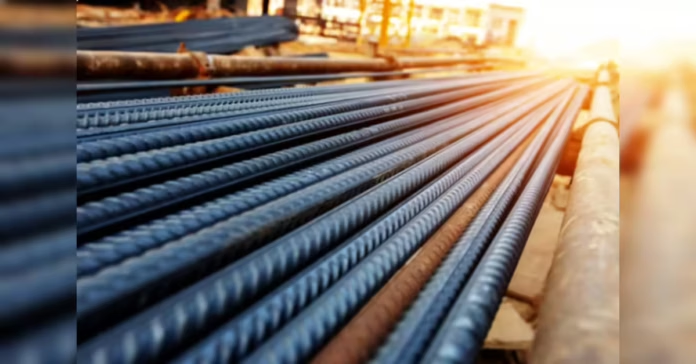
India’s steel sector is witnessing a notable shift in global trade dynamics as exports of finished steel have risen sharply during the current financial year, reflecting stronger overseas demand alongside expanding domestic production capacity. The increase signals growing international competitiveness for Indian steel producers at a time when infrastructure investment and industrial activity are accelerating across several regions.
Provisional government data indicates that finished steel exports increased by 36.6 per cent year-on-year between April and February, reaching 6.02 million metric tonnes during the period. The growth highlights a significant rebound in outbound shipments after earlier fluctuations in global steel demand and trade restrictions.The rise in exports comes as India consolidates its position as the world’s second-largest producer of crude steel, supported by expanded production capacity and rising domestic manufacturing activity. During the same April–February period, crude steel output grew 11.2 per cent to 153.61 million metric tonnes, reflecting strong industrial demand and increased operational capacity across the country’s steel plants.
At the same time, finished steel imports into India fell sharply. Data shows inbound shipments declined 37.4 per cent to 5.6 million metric tonnes, suggesting domestic producers have been able to meet a larger share of local demand while also expanding their presence in export markets.Industry analysts attribute the export growth to multiple factors, including improved price competitiveness, steady production levels and recovering demand in international construction and manufacturing markets. Several economies are currently investing heavily in infrastructure upgrades and industrial expansion, creating fresh demand for steel products used in transport networks, energy systems and urban construction.Domestically, consumption of finished steel has also increased, rising 7.2 per cent to 147.7 million metric tonnes during the same period. The growth reflects ongoing infrastructure projects, housing construction and industrial expansion across the country.
Urban economists note that steel demand is closely linked to the pace of city-building. Materials such as structural steel are fundamental to constructing bridges, rail corridors, commercial buildings and high-density housing developments. As India accelerates investment in transport systems, renewable energy installations and urban infrastructure, the availability of competitively priced domestic steel becomes increasingly important for controlling construction costs.Policy frameworks are also playing a role in shaping the sector’s trajectory. The national steel development strategy aims to strengthen manufacturing capacity, encourage technology upgrades and promote sustainable production practices as India seeks to expand its global share of steel trade.
Looking ahead, analysts say export trends will depend on global demand cycles, energy costs and trade policies in key importing markets. However, the current export momentum suggests India’s steel industry is gaining greater integration with international supply chains while continuing to support domestic infrastructure growth.
SAIL Leadership Race Intensifies Ahead Of April Transition
India’s largest state-owned steel producer is entering a crucial leadership transition as the government prepares to appoint a new chief executive, with the top post scheduled to fall vacant in early April. The selection process for the next chairman and managing director at Steel Authority of India Limited has drawn attention across the country’s industrial ecosystem, where the company plays a central role in supplying steel for infrastructure, housing and manufacturing.
The leadership change comes at a time when India is rapidly expanding construction and industrial capacity, increasing the strategic importance of large domestic steel producers. The incoming head of the public sector steel giant will be responsible for steering production strategy, overseeing large industrial complexes and aligning operations with the country’s long-term infrastructure growth plans.Among the senior executives considered for the role is the current director in charge of the Bokaro Steel Plant, a key facility within SAIL’s manufacturing network. With more than three decades of experience in steel production and operations, the executive has held multiple leadership roles across the organisation, including responsibilities in corporate operations, production planning and strategic management.
Industry observers say the candidate’s experience in plant operations and supply chain coordination could be significant as SAIL focuses on improving efficiency and expanding output capacity. The Bokaro facility, one of the company’s largest production units, plays an important role in supplying flat steel products used in infrastructure, automobiles and engineering industries.The leadership race is expected to involve several senior board members within the organisation, reflecting a succession process that draws from experienced executives already managing major plants and corporate functions. Analysts tracking the selection process say multiple directors currently serving on the board meet the eligibility criteria for the top role, which will be finalised through a government-led appointment mechanism.
The appointment comes at a pivotal moment for the Indian steel sector. Demand for steel is rising alongside large public investments in highways, rail corridors, ports, urban housing and renewable energy infrastructure. For a company like SAIL, which operates integrated steel plants across several states, leadership decisions can influence production strategy, capital investments and supply reliability for national infrastructure projects.Urban planners and infrastructure economists note that steel remains one of the most important materials shaping modern cities. From bridges and transport networks to residential towers and industrial facilities, the availability of competitively produced steel directly affects the pace and cost of urban development.
The next leadership phase at SAIL is therefore likely to extend beyond internal management priorities. Analysts expect the new chief executive to focus on modernisation, operational efficiency and low-carbon production technologies as the global steel industry increasingly adapts to climate commitments and sustainability targets.As the selection process advances, the outcome will determine how one of India’s largest industrial enterprises positions itself within a rapidly evolving steel market—one closely tied to the country’s infrastructure ambitions and long-term urban growth trajectory.
A sudden rise in global crude oil prices is placing fresh cost pressures on India’s paint manufacturing industry, raising concerns about input expenses for products widely used in housing, commercial buildings and infrastructure projects. The development has drawn attention across the construction supply chain, where paints and coatings are essential finishing materials for the built environment.
The pressure stems from the industry’s heavy reliance on petroleum-derived chemicals used in the production of paints, varnishes and industrial coatings. Resins, solvents and additives—core ingredients in paint manufacturing—are largely produced from crude oil derivatives. When crude prices rise sharply in global markets, the cost of these raw materials tends to increase almost immediately, affecting production economics.Industry analysts say that crude-linked inputs account for a substantial portion of manufacturing costs in the paint sector. Even a moderate increase in oil prices can affect operational margins if companies are unable to adjust product pricing quickly. As global energy markets remain volatile, manufacturers may face the challenge of balancing cost pressures while maintaining demand in a competitive market.
The latest surge in oil prices has been linked to geopolitical tensions affecting supply routes in key energy corridors. These disruptions have triggered broader concerns across manufacturing sectors that depend on petrochemical inputs. For India, which imports a large share of its crude oil requirements, fluctuations in international energy prices frequently ripple across industries ranging from plastics and chemicals to construction materials.The implications extend beyond industrial production and financial markets. Paints and coatings form a critical part of urban construction, playing a role not only in building aesthetics but also in durability, corrosion protection and energy efficiency. Rising input costs in the sector can influence project budgets for residential developments, public infrastructure and commercial real estate.
Urban development specialists note that stable supply chains for construction materials are essential for keeping infrastructure projects on schedule and within budget. As India continues to expand housing capacity and upgrade urban infrastructure, price volatility in petroleum-based materials could complicate cost planning for developers and public agencies alike.In response, industry experts suggest manufacturers may increasingly explore efficiency improvements, long-term supply contracts or alternative raw material formulations to reduce dependence on crude-linked inputs. Some companies have already been investing in water-based coatings and environmentally safer chemical compositions, partly to improve sustainability and reduce exposure to oil price fluctuations.
While demand for paints remains closely tied to urban expansion and renovation cycles, the latest crude oil surge illustrates how global energy disruptions can quickly influence industries at the heart of city-building. Ensuring resilient and cost-efficient supply chains for essential building materials will be crucial as India accelerates investment in housing, infrastructure and climate-resilient urban development.
A long-running investigation into alleged collusion among cement manufacturers supplying industrial projects has exposed how pricing coordination may have influenced public procurement in India’s energy sector. The India cement cartel case centres on tenders issued by the country’s largest oil and gas producer, where identical price quotes triggered a competition inquiry that now threatens significant financial penalties and regulatory scrutiny across the construction materials industry.
The probe began after procurement officials reviewing oil-well cement tenders noticed something unusual: competing bids submitted by multiple suppliers listed the exact same price per tonne. The pattern appeared across several tenders, raising concerns that market competitors might have aligned their pricing rather than competing independently. Authorities subsequently referred the matter to the national competition watchdog, which opened a multi-year investigation into the suspected India cement cartel.Investigators reviewing tender records, communications and internal documents concluded that certain cement producers may have coordinated their bids over an extended period. Evidence examined during the inquiry included exchanges between company executives, meetings related to pricing strategies and shared calculations linked to delivery logistics and freight distances. These factors, according to the investigation, suggested a system designed to divide supply volumes and maintain uniform pricing rather than allow open competition.
The alleged cartel activity is believed to have taken place for more than a decade, primarily affecting the supply of specialised cement used in oil well operations. The findings indicate that rival companies may have aligned their offers in a way that distributed contract volumes between them while preventing aggressive price competition in tenders.Regulators are now assessing responses from the companies involved before issuing a final ruling. Under India’s competition law, firms found guilty of cartelisation could face penalties of up to three times the profits earned from the alleged misconduct or as much as 10 per cent of annual turnover for each year of violation.Industry observers say the case reflects a broader shift in regulatory attention toward domestic corporate behaviour in key industrial sectors. While competition authorities have recently investigated several multinational technology companies, enforcement actions in core infrastructure supply chains are gaining momentum as government procurement expands alongside major infrastructure and energy projects.
For India’s rapidly growing construction and infrastructure economy, the outcome of the India cement cartel investigation could carry implications far beyond one set of contracts. Cement remains a foundational input for housing, transport networks and energy infrastructure, and pricing transparency is essential to keeping public project costs predictable.
Urban development experts note that fair competition in building materials markets directly affects the affordability and sustainability of cities. As India accelerates investments in housing, transport corridors and climate-resilient infrastructure, regulators are under increasing pressure to ensure that supply chains for essential materials operate under transparent and competitive market conditions.
Bhubaneswar Builder Moves Toward SME Market Listing
A mid-sized construction contractor headquartered in Bhubaneswar has entered India’s public equity market through an Srinibas Pradhan Constructions SME IPO, signalling how regional infrastructure firms are increasingly tapping capital markets to finance project pipelines and working capital needs.The company’s public offer, currently open on the NSE Emerge, is seeking to mobilise just over ₹20 crore from investors. The offer is scheduled to close on March 10, with listing expected later this week if subscription levels are met.
The Srinibas Pradhan Constructions SME IPO highlights a broader shift within India’s infrastructure ecosystem, where smaller engineering and construction contractors are looking beyond bank credit and government contracts to diversify financing options. Analysts tracking SME listings note that public capital markets have become a viable route for regional builders working on roads, bridges and industrial facilities, particularly in fast-growing states like Odisha.
According to offer documents, the company generates the bulk of its income from civil engineering works, with roads, highways and bridge construction contributing more than two-thirds of its annual revenue. Building and industrial projects form another important segment, while equipment leasing and maintenance activities contribute a smaller share.The infrastructure contractor primarily operates on a business-to-business model, executing projects for corporate clients and industrial developers across the state. Interestingly, company filings indicate that a large proportion of its most recent revenue has come from private sector clients rather than government contracts—an uncommon trend for road-building firms that traditionally depend heavily on public infrastructure programmes.Financial disclosures show the firm reporting income of nearly ₹90 crore for the financial year ending March 2025, with profit after tax rising sharply compared with the previous year. Market observers say such growth patterns are becoming more common among contractors benefiting from expanding industrial corridors, logistics parks and regional highway upgrades in eastern India.The offer price band has been fixed between ₹91 and ₹98 per share, combining a fresh issue of new equity with a smaller offer for sale by existing shareholders. A significant portion of the capital raised will be directed towards working capital requirements—an important factor in the construction sector where contractors must often finance labour, materials and equipment long before project payments are received.
However, early investor response has been cautious. Subscription levels remained modest midway through the bidding period, with retail participation forming the majority of interest while institutional demand was yet to materialise. Market intermediaries also report limited activity in the informal grey market, suggesting investors are waiting for clearer signals on demand and growth prospects.If successfully listed, the Srinibas Pradhan Constructions SME IPO would add another regional infrastructure player to India’s SME exchange ecosystem. Urban economists say the rise of such listings reflects how infrastructure development in tier-two cities is gradually creating investable opportunities tied to logistics networks, industrial expansion and climate-resilient transport corridors.
For cities like Bhubaneswar and the wider eastern region, improved access to capital for local construction firms could play a role in accelerating sustainable urban infrastructure—from transport connectivity to industrial support facilities—provided governance and project delivery standards continue to strengthen.