

Bhubaneswar Expands Permanent Traffic Shelter Network

Bhubaneswar’s municipal administration is preparing to replace fragile temporary structures at busy traffic intersections with permanent shelters, a move aimed at improving commuter safety during extreme summer heat and seasonal storms. The initiative reflects the city’s broader effort to strengthen climate resilience and protect public infrastructure as weather patterns become increasingly unpredictable across eastern India.Officials involved in urban management say several traffic junctions currently rely on makeshift bamboo frames and tarpaulin roofing to shield commuters and traffic personnel from intense sunlight. However, these structures often become hazardous during pre-monsoon thunderstorms and strong winds, commonly known locally as nor’westers, which can damage or uproot lightweight materials.
To address this vulnerability, the municipal corporation has decided to phase out these temporary facilities and construct durable permanent traffic shelters at major intersections. One such structure has already been installed at a central administrative junction in the city, while two additional sites at high-footfall commercial intersections are scheduled for construction during the summer months.Municipal planners indicate that approximately ₹4 crore has been earmarked for the next phase of installations. The structures are intended not only to provide shade for pedestrians and traffic police but also to improve safety and operational efficiency at busy crossroads where large numbers of commuters wait during peak hours.
Urban planners say such infrastructure upgrades are increasingly necessary in Indian cities experiencing rising temperatures and more frequent storm events linked to climate variability. Permanent traffic shelters, if designed with durable materials and proper drainage, can significantly reduce maintenance costs and avoid repeated reconstruction after seasonal weather damage.The decision emerged from a broader municipal review of summer preparedness measures. Alongside the permanent traffic shelters, the city administration is expanding heat mitigation efforts across neighbourhoods, including the establishment of temporary drinking water kiosks in all wards and special medical facilities to treat heat-related illnesses.Officials responsible for public health preparedness have also directed ward-level teams to identify areas where access to drinking water is limited, prioritising those zones for additional kiosks. Educational institutions and childcare centres have been advised to maintain adequate stocks of oral rehydration salts and ensure safe drinking water access for students.In parallel, municipal engineering teams have been tasked with repairing malfunctioning tube wells within a strict timeline and ensuring that ward offices are equipped with basic cooling and hydration facilities for residents seeking assistance during heatwaves.
Urban policy experts say the shift toward permanent traffic shelters highlights a broader evolution in how cities plan micro-infrastructure. While often overlooked, shaded waiting spaces, water access, and heat-safe public facilities are becoming critical components of climate-resilient urban design.As Bhubaneswar prepares for another intense summer season, city authorities appear to be aligning everyday civic infrastructure with long-term resilience goals—ensuring that even small urban interventions contribute to safer, more liveable streets.
Also Read: Delhi NCR Emerges Hub For Cleantech Hiring
Bhubaneswar Expands Permanent Traffic Shelter Network
Goa Astor Goa Introduces Villa in the Sky
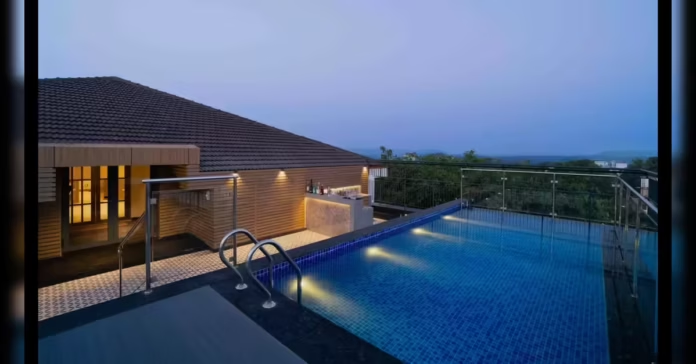
North Goa’s hospitality landscape is witnessing a shift toward experience-driven luxury stays as The Astor Goa introduces a new ultra-premium accommodation category in Candolim. The boutique hotel has unveiled a large-format penthouse residence titled Villa in the Sky, signalling a strategic move to attract high-value travellers seeking privacy, space, and personalised hospitality within established tourist destinations.
Spread across approximately 4,650 square feet, Villa in the Sky is designed as a multi-level penthouse offering flexible residential-style configurations. The accommodation is positioned within the hotel’s suite inventory but operates as a more exclusive hospitality product aimed at families, private groups, and long-stay visitors. Industry observers say this format reflects a broader shift in luxury tourism where travellers increasingly seek private, home-like environments within serviced hotel settings. The penthouse introduces residential features that are relatively uncommon in traditional hotel rooms. It includes a double-storey layout, multiple bedrooms, a fully equipped kitchen and automated home systems, alongside a private plunge pool and indoor gathering spaces designed for small social events. The concept blends the convenience of hotel services with the spatial comfort of a luxury residence.
Hospitality analysts note that developments such as Villa in the Sky illustrate how boutique hotels are experimenting with hybrid hospitality formats. These formats allow operators to diversify their accommodation portfolio while improving revenue performance through higher-value inventory. Premium penthouse units or private residences within hotels typically generate significantly higher average daily room rates compared with standard suites. The introduction of Villa in the Sky also reflects evolving travel patterns in Goa, where demand for private and personalised accommodation has grown steadily over the past decade. Tourism experts attribute this trend partly to changing visitor preferences, with many travellers now prioritising space, privacy and curated in-room experiences rather than traditional hotel amenities alone.
Situated in Candolim, one of North Goa’s most established tourism corridors, The Astor Goa operates as a boutique luxury property with a limited inventory of suites. By adding a signature penthouse category, the hotel aims to strengthen its appeal among high-spending leisure travellers who often look for exclusive accommodation options within prime coastal destinations.
The hospitality sector in Goa has increasingly moved toward experiential tourism models in recent years. Hotels and resorts are incorporating in-residence dining, private events, culinary experiences and personalised services to create longer and more immersive stays. These offerings help hospitality operators increase per-guest spending while differentiating themselves in a highly competitive tourism market. Urban planners observing coastal tourism markets say such hospitality innovations also influence surrounding real estate trends. Premium tourism infrastructure can raise demand for high-end residential and mixed-use developments nearby, particularly in locations like Candolim that already host a blend of resorts, holiday homes and lifestyle-driven commercial spaces. With Villa in the Sky, The Astor Goa is testing a hospitality model that merges private residential living with boutique hotel services. As travel preferences continue to evolve, similar hybrid accommodation formats could become more common across India’s leading tourism destinations.
Goa Astor Goa Introduces Villa in the Sky
•
Mumbai Arnya Real Estate Fund Raises Equity Capital

A new institutional investment platform focused on urban housing redevelopment has secured more than ₹1,000 crore in early investor commitments, signalling growing confidence in Mumbai’s redevelopment-driven property market. The Arnya Real Estate Fund has completed the first close of its equity strategy aimed at financing residential redevelopment projects across Mumbai and Pune, two cities where land constraints and ageing housing stock are accelerating the need for urban renewal.
Structured as a Category II Alternative Investment Fund, the Arnya Real Estate Fund is targeting a total corpus of approximately ₹1,250 crore. The fund will deploy equity capital in redevelopment-led housing developments located in established neighbourhoods where older residential buildings are being replaced with modern apartment complexes. Investment managers associated with the fund say the initiative seeks to combine institutional capital with on-ground development expertise to support complex redevelopment projects that require long-term financial backing. The platform is working in partnership with a residential developer experienced in redevelopment projects in Mumbai and Pune, creating a structure designed to align capital investment with project execution.
Industry observers note that the emergence of equity-led real estate funds marks a gradual shift in how redevelopment projects are financed in India’s largest metropolitan markets. Historically, developers relied heavily on debt funding to finance construction activity. However, equity investment allows projects to begin with stronger capital structures and can reduce financial pressure during long construction cycles. Mumbai’s housing sector offers significant opportunities for such investment strategies. Large parts of the city’s residential stock were constructed several decades ago, particularly in cooperative housing societies that are now reaching the stage where structural upgrades or rebuilding become necessary. Redevelopment agreements allow developers to reconstruct buildings while providing existing residents with upgraded apartments and generating additional units for sale in the open market.
The Arnya Real Estate Fund is expected to focus primarily on these redevelopment opportunities, where demand for modern housing remains strong due to the city’s limited availability of greenfield land. Urban economists say redevelopment enables cities like Mumbai to expand housing supply without extending the urban footprint outward, helping maintain access to established infrastructure such as transport systems, schools and commercial centres. Investors participating in the fund include domestic and overseas family offices along with high-net-worth individuals seeking exposure to India’s urban real estate markets. Analysts tracking institutional investment trends say residential property in major Indian cities continues to attract capital because of steady end-user demand and improving transparency under regulatory frameworks.
Beyond financial returns, redevelopment projects often contribute to broader urban transformation. Reconstructed housing societies typically incorporate updated building technologies, improved safety standards, modern utilities and better energy efficiency compared with older structures. With a multi-year investment horizon, the Arnya Real Estate Fund aims to back several redevelopment projects over the coming years. Market participants say such capital pools could become increasingly important in supporting the large-scale renewal of housing across dense urban districts where redevelopment is emerging as the primary mode of real estate growth.
Mumbai Arnya Real Estate Fund Raises Equity Capital
Noida Max One Project Gets RERA Clearance

A long-delayed real estate project in Noida is moving toward construction after receiving regulatory clearance, offering relief to homebuyers who have waited nearly a decade for progress. The upcoming Max One project, planned in Sector 16B near an existing commercial tower cluster, is expected to transform a stalled development into a mixed-use urban district combining residences, offices and retail activity. Regulatory approval from the state’s real estate authority enables construction to begin on the Max One project, which is spread across roughly 10 acres of land. Developers estimate the site could accommodate around 2.5 million square feet of built-up area, positioning it as a substantial mixed-use development within Noida’s central business zone.
Urban development officials note that the site previously housed an incomplete project that had remained stalled for several years, leaving buyers uncertain about the fate of their investments. The revival of the site is therefore being closely watched as a test case for how delayed real estate developments can be restructured and completed through new ownership and regulatory oversight. The Max One project is expected to combine residential and commercial functions within a single campus-style environment. Planned components include serviced residential units, office spaces, retail areas and private recreational facilities, creating a mixed-use neighbourhood designed to support both living and working within the same district.
Real estate analysts say such integrated developments have become increasingly common in large urban centres, where land constraints and rising demand encourage developers to combine multiple functions within a single site. In cities like Noida part of the broader National Capital Region these mixed-use districts often emerge near key business corridors and transport networks.
Industry observers estimate that the project could generate significant economic activity once completed, with potential property sales and long-term rental income from office and retail spaces contributing to the development’s financial viability. Such hybrid revenue models are increasingly used in large projects to balance the cyclical nature of residential sales with steady commercial leasing income. Beyond the financial implications, urban planners say the redevelopment could help restore confidence among homebuyers affected by stalled projects across the region. Over the past decade, delays in several large developments in the National Capital Region left thousands of buyers awaiting possession of homes. Projects that successfully restart construction are often seen as important signals of recovery within the real estate sector.
The redevelopment site is also located close to major employment centres and transport links, including metro corridors connecting Noida with Delhi and other parts of the National Capital Region. Urban mobility experts say such proximity to public transport can help reduce dependence on private vehicles and support more compact urban development patterns.
Sustainability specialists note that new mixed-use districts present opportunities to incorporate energy-efficient building systems, improved water management and pedestrian-friendly public spaces features that are increasingly expected in large urban developments.
With regulatory approval now secured, construction activity at the site is expected to begin in the near future. For homebuyers awaiting progress and for the wider real estate market in Noida, the revival of the Max One project may signal a broader shift toward completing stalled developments and reactivating underutilised urban land across the National Capital Region.
Noida Max One Project Gets RERA Clearance
Delhi West Midtown Housing Project Redefines Urban Living
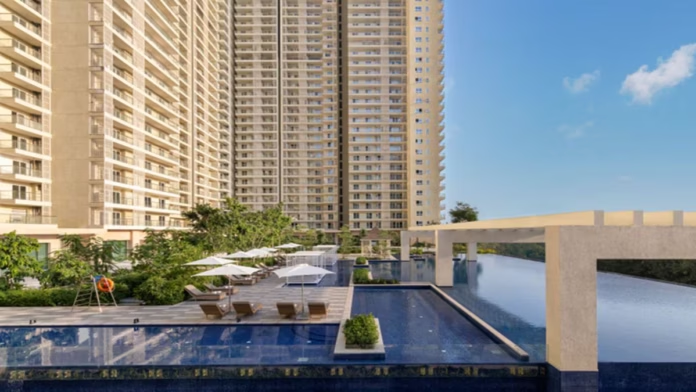
West Delhi is witnessing a gradual shift in its residential landscape as a new high-rise development in Moti Nagar introduces vertical housing and community-focused design to an area traditionally dominated by low-rise neighbourhoods. The project, known as DLF Midtown, reflects a broader transformation in how residential districts within the capital are being redeveloped to accommodate growing demand while preserving access to open spaces and shared amenities.
Located along Shivaji Marg, the residential complex forms part of a larger master-planned district that combines housing, commercial offices and community infrastructure. Urban planners say developments like DLF Midtown illustrate how underutilised urban land in established neighbourhoods is increasingly being reimagined as higher-density residential clusters within city limits. The latest phase of the project includes four residential towers rising close to 40 storeys, offering more than 900 apartments designed with larger windows and open layouts intended to maximise natural light and views. The development primarily consists of two-, three- and four-bedroom units, targeting families seeking modern housing within central urban areas rather than in distant suburban townships.
A defining feature of the complex is the emphasis on shared outdoor spaces integrated into the residential environment. Rooftop terraces, landscaped areas and community zones are intended to create social spaces where residents can gather, dine or relax outside their apartments. In a city where accessible green areas are limited, architects and urban designers say such features have become increasingly important in residential planning. The housing towers form part of the broader DLF Midtown ecosystem, a large mixed-use neighbourhood that already includes several residential communities and office developments. The wider district covers a substantial land parcel in Moti Nagar and integrates housing with workplaces, retail activity and public spaces an approach often described as transit-oriented urban development.
Real estate analysts note that West Delhi has historically seen fewer luxury residential towers compared with areas in South Delhi or emerging satellite cities. However, improving transport connectivity and redevelopment opportunities along major corridors such as Shivaji Marg have begun attracting new residential investments. High-rise developments in established neighbourhoods can also help reduce urban sprawl by bringing more housing into well-connected city zones. By increasing residential density near employment hubs and public transport routes, such projects can shorten commuting distances and support more efficient urban infrastructure.
Industry experts say the next phase of growth in Delhi’s residential sector will likely focus on similar redevelopment models transforming ageing industrial or institutional land parcels into integrated neighbourhoods that combine housing, offices and community facilities.
However, urban planners caution that vertical residential growth must be accompanied by strong environmental and infrastructure planning. Sustainable water management, efficient energy systems and well-designed public spaces are increasingly seen as essential elements in high-density housing projects.As construction and occupancy continue across the DLF Midtown district, the development is expected to contribute to the gradual transformation of Moti Nagar into a mixed-use urban neighbourhood, reflecting wider shifts in how Delhi’s built environment adapts to rising population density and changing lifestyle patterns.
Delhi West Midtown Housing Project Redefines Urban Living
Delhi Government Housing Redevelopment Adds Thousands Of Flats

Delhi has taken another step in a large-scale transformation of government residential districts with the delivery of thousands of newly constructed flats and the launch of additional housing projects across several central neighbourhoods. The latest phase of the GPRA redevelopment programme introduces new residential units in Kasturba Nagar and Sarojini Nagar while initiating construction of thousands more across multiple government housing colonies.
The newly completed homes are part of the General Pool Residential Accommodation system, which provides housing for central government employees posted in the national capital. Urban development officials confirmed that more than 2,700 apartments have now been completed and handed over, while construction has been initiated for over 6,600 additional units in Netaji Nagar, Sarojini Nagar, Kasturba Nagar and Sriniwaspuri. The broader GPRA redevelopment initiative is among the largest public housing modernisation projects undertaken in Delhi. When completed, the programme will deliver nearly 25,000 housing units, replacing around 13,000 ageing government residences that were originally built decades ago. Many of these older quarters had limited infrastructure and lower housing density, prompting authorities to redesign the colonies to accommodate modern living standards and better land use.
Urban planners say the redevelopment reflects a shift in how government housing is designed in dense metropolitan environments. The new projects involve mid- and high-rise apartment blocks integrated with improved civic infrastructure, including upgraded internal roads, utilities, green areas and community amenities. Higher residential density allows authorities to utilise valuable urban land more efficiently while modernising public housing. The initiative is being implemented through a self-financing model led by the Central Public Works Department, with commercial development playing a role in funding residential construction. Under this structure, certain parcels of land within the redevelopment zones are being used for commercial office complexes developed by a public sector construction firm. Revenue generated from leasing or selling these commercial properties helps offset project costs.
One such project under development is a large office complex known as Bharat Business Park, designed to create modern workspaces in central Delhi. The planned development will include several office towers with a built-up area exceeding 200,000 square metres. Officials say the commercial district is intended to provide contemporary office infrastructure with energy-efficient building systems and updated workplace facilities. Real estate analysts note that redevelopment of older government colonies has increasingly become a key element of Delhi’s urban renewal strategy. Many of these neighbourhoods occupy prime locations close to transport corridors, diplomatic zones and commercial districts. By rebuilding them with higher-density housing and modern utilities, planners aim to support both housing demand and improved urban infrastructure.
Experts also point out that projects under the GPRA redevelopment programme can influence surrounding property markets. Upgraded infrastructure and new office developments often attract retail activity, services and improved transport links in nearby areas.
As construction continues across multiple colonies, policymakers face the challenge of ensuring that redevelopment balances housing density with open space, environmental performance and liveability. Urban designers argue that integrating energy-efficient buildings, pedestrian-friendly layouts and green infrastructure will be critical to ensuring these redeveloped districts contribute to a more sustainable and resilient Delhi.
Delhi Government Housing Redevelopment Adds Thousands Of Flats
Bengaluru East Corporation Auctions Properties To Recover Tax Arrears

The Bengaluru East City Corporation has taken decisive action to recover pending property tax dues, auctioning two properties in the KR Puram zone with outstanding amounts totalling ₹2.83 crore. Officials emphasise that this step is part of a broader effort to ensure compliance with municipal tax obligations, strengthen urban revenue systems, and promote equitable contribution to civic infrastructure funding.
Authorities initially identified six properties for auction under enforcement provisions of the Greater Bengaluru Governance Act 2025, targeting defaulters with arrears exceeding one year. During the proceedings, four owners cleared their dues, leaving two properties to be auctioned through competitive bidding. The first property, in B Narayanapura near Hoodi Road, owed ₹1.08 crore and spans roughly 3,600 square feet. The second property, measuring 1,950 square feet, had arrears of approximately ₹1.75 crore and remained unsold after repeated notices failed to elicit payment. Municipal officials note that all recovery actions follow the Property Tax Assessment, Collection and Management Rules 2024, which include issuing show-cause notices, demand notices, and reminders via electronic communication. Enforcement through property auctions is intended as a last-resort mechanism, ensuring that long-standing defaulters contribute fairly to the city’s revenue base, which supports urban services, sanitation, and infrastructure maintenance.
A senior GBA official highlighted that similar measures have been undertaken in other zones, including North Bengaluru, where 81 properties were scheduled for auction over pending dues exceeding ₹1.94 crore. However, in that instance, insufficient bidder participation delayed the process, illustrating the challenges authorities face in balancing enforcement with market engagement. Industry experts and urban finance analysts note that robust property tax collection is critical for sustainable urban governance. “Consistent enforcement of tax obligations strengthens municipal budgets and ensures equitable urban service provision,” said an urban planning specialist. Recovering overdue taxes contributes to funding infrastructure upgrades, public amenities, and climate-resilient city projects, which are increasingly important for rapidly growing metropolitan areas like Bengaluru.
Data from the municipal authority indicates that the city has roughly 7,000 properties with accumulated tax arrears of ₹437 crore, highlighting systemic gaps in collection and the need for proactive enforcement. Officials also stress that all properties listed for auction remain under municipal custody and can be re-auctioned, reinforcing the legal framework available to recover dues. As Bengaluru continues to expand, the Greater Bengaluru Authority is signalling that property tax compliance will remain a priority. Continuous monitoring, transparent processes, and public awareness campaigns are expected to improve payment adherence while supporting the city’s broader goals of equitable, sustainable, and well-resourced urban development.
Bengaluru East Corporation Auctions Properties To Recover Tax Arrears
Centre Approves Delhi Housing And Infrastructure Upgrades

The central government has unveiled development projects worth ₹33,500 crore in Delhi, covering government housing modernisation, metro expansion, and urban infrastructure upgrades. Officials highlight that the initiative aims to replace ageing General Pool Residential Accommodation (GPRA) colonies with modern residential and office complexes, while integrating sustainable urban planning measures to support Delhi’s growing population and economic activity.
Under the programme, more than 2,700 newly constructed government flats and office spaces have been inaugurated, with foundation stones laid for an additional 6,600 units under the proposed Bharat Business Park in Sarojini Nagar. Urban planners note that the redevelopment is structured to optimise land use, enhance density without compromising quality, and generate commercial revenue to fund housing initiatives. The project covers seven GPRA colonies—Mohammadpur, Thyagraj Nagar, Kasturba Nagar, Sriniwaspuri, Nauroji Nagar, Sarojini Nagar, and Netaji Nagar—with a total projected built-up area exceeding 65 lakh square metres. Implementation is split between NBCC (India) Ltd and the Central Public Works Department (CPWD), with NBCC managing redevelopment in Sarojini Nagar, Netaji Nagar, and Nauroji Nagar, and CPWD overseeing Kasturba Nagar, Thyagraj Nagar, Sriniwaspuri, and Mohammadpur.
Experts indicate that modern construction techniques, energy-efficient systems, and green building features incorporated in office and residential towers—such as solar rooftops, rainwater harvesting, and electric vehicle charging—could serve as a model for climate-resilient urban infrastructure. The initiative aligns with broader national urban development goals, emphasising compact, sustainable, and technologically enabled cityscapes. Economists and urban development specialists point out that the self-financing model, which monetises commercial space to fund residential redevelopment, supports long-term fiscal sustainability while creating employment opportunities. Official data show that the redevelopment programme has already generated roughly 3.55 crore man-days of employment, highlighting its impact on both construction activity and local labour markets.
In addition to housing, the central government has advanced transport infrastructure with metro network expansion and the deployment of electric buses, signalling an integrated approach to sustainable urban mobility. A senior official noted that the combination of upgraded housing, office infrastructure, and low-carbon transport facilities is designed to reduce urban congestion, improve liveability, and strengthen Delhi’s resilience to climate stressors. As Delhi prepares for the next phase of urban redevelopment, experts stress the importance of continued monitoring, adoption of sustainable construction standards, and engagement with residents to ensure equitable access to housing and amenities. The programme could redefine government housing delivery and establish a benchmark for integrated, climate-conscious urban planning in India’s capital.
Centre Approves Delhi Housing And Infrastructure Upgrades
Maharashtra Homebuyers May See Relief As Recovery Warrants Are Enforced
