India Co Living Real Estate Reshapes Rental Market
India’s residential rental market is witnessing the rapid rise of co living real estate, as developers and institutional investors increasingly view the segment as a scalable solution to urban rental demand among young professionals and mobile workforces.
Major metropolitan regions including Bengaluru, Hyderabad, Pune and Gurugram are emerging as key growth hubs for co-living developments. The format typically combines compact private rooms with shared amenities such as lounges, kitchens and collaborative workspaces, allowing operators to optimise space while offering flexible rental options for tenants.For the real estate sector, the appeal lies in the evolving structure of urban demand. Cities with expanding technology, financial services and startup ecosystems continue to attract thousands of professionals relocating from smaller towns each year. Many of these migrants prefer rental accommodation with lower upfront deposits and shorter lease commitments compared to traditional apartments.
Industry experts say co living real estate has begun to fill a gap between conventional rental housing and informal paying guest accommodation. Professionally managed facilities offer furnished units, bundled utilities and community amenities, enabling operators to standardise services while maintaining higher occupancy rates.From a developer perspective, the segment is also changing asset strategies in urban residential markets. Instead of selling individual apartments, some builders are exploring purpose-built rental projects designed specifically for co-living operators. This shift aligns with the broader emergence of rental housing as an institutional real estate asset class in India.
Real estate consultants indicate that shared living formats can deliver stronger rental yields in dense urban districts where land costs remain high. By configuring multiple private rooms within a single property while maintaining common amenities, developers can improve revenue per square foot compared to traditional apartment layouts.Institutional capital has also begun to track the segment more closely. Property investors increasingly view co-living platforms as an extension of the growing alternative residential asset categories that include student housing and senior living. Together, these formats represent a diversification of India’s residential real estate beyond ownership-driven housing markets.
Urban planners note that the rise of co living real estate also reflects changing lifestyle expectations among younger urban residents. Proximity to workplaces, public transport and social infrastructure is becoming a stronger priority than larger private living spaces. Shared housing developments located in transit-connected neighbourhoods therefore hold increasing relevance in city planning discussions.However, the sector’s long-term growth will depend on regulatory clarity and integration with broader urban infrastructure. Experts suggest that clearer frameworks for rental housing, safety standards and community management will be essential as more developers enter the space.
As India’s urban population continues to expand, co-living developments are likely to become an increasingly visible component of the country’s rental housing ecosystem—offering developers a new real estate model while addressing the accommodation needs of a highly mobile urban workforce.
A rapidly developing micro-market on Hyderabad’s western edge is drawing increasing attention from both homebuyers and investors, with Kokapet emerging as one of the most prominent residential growth corridors near the city’s financial and technology districts.
Located close to the Financial District, Gachibowli and the Outer Ring Road, the locality has evolved into a major destination for premium residential projects. Real estate analysts say the rise of the Hyderabad Kokapet real estate corridor reflects a broader shift in housing demand toward areas that combine employment proximity with planned urban infrastructure.Over the past five years, Kokapet has witnessed significant price appreciation and large-scale residential launches. Property research indicates that average housing prices in the area rose sharply between 2019 and 2024, nearly doubling from around ₹4,750 per sq ft to about ₹9,000 per sq ft, making it one of Hyderabad’s fastest-growing residential markets.Industry observers attribute the momentum largely to the locality’s strategic location near Hyderabad’s IT employment hubs. Technology campuses, multinational offices and financial institutions operating in nearby areas such as Gachibowli and the Financial District have created strong demand for housing within commuting distance. Improved connectivity through the Outer Ring Road has further strengthened Kokapet’s accessibility to the city’s international airport and other major commercial zones.
The growing interest in Hyderabad Kokapet real estate is also evident in land transactions. Government land auctions in the Neopolis layout have attracted aggressive bidding from developers, with certain parcels fetching more than ₹137 crore per acre—among the highest land prices recorded in the city.Such high land values indicate strong developer confidence in the long-term prospects of the western growth corridor. Several large residential projects, including gated communities, high-rise apartment towers and luxury villa developments, are currently under construction or in advanced planning stages.Urban planners say Kokapet’s transformation illustrates how infrastructure and employment clusters shape real estate growth in modern cities. Unlike older neighbourhoods that developed organically, the Kokapet corridor has expanded alongside planned infrastructure such as arterial roads, radial connectivity corridors and large township developments.
However, experts caution that rapid expansion also brings challenges. As residential density rises, the availability of public transport, water supply systems and green spaces will become increasingly important to ensure the area develops as a sustainable urban district rather than a purely speculative property market.The evolution of Hyderabad Kokapet real estate also reflects a wider trend visible across India’s major metropolitan regions—where new growth corridors emerge around technology hubs and transport infrastructure, gradually reshaping urban boundaries.
For Hyderabad, Kokapet’s rise signals the continued westward expansion of the metropolitan economy. With ongoing infrastructure projects and sustained corporate investment in the surrounding IT corridor, the locality is expected to remain a key centre of housing development in the years ahead.
Rajasthan Kota Airport Project Set To Transform Connectivity
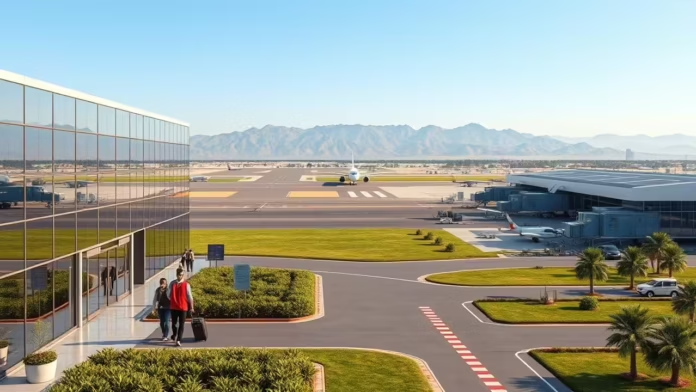
A major aviation infrastructure project is set to reshape connectivity in southern Rajasthan after the foundation stone for a new airport serving the Kota–Bundi region was laid this week, marking one of the largest recent investments in the state’s transport network.
The ₹1,500-crore greenfield facility, planned near Kota in Rajasthan’s Hadoti region, is expected to strengthen regional air connectivity and support economic activity across Kota, Bundi, Baran and Jhalawar districts. The project will be developed by the Airports Authority of India and is positioned as a key infrastructure upgrade for a region known for its industrial base and its status as a national education hub.Kota has long been recognised as an important manufacturing centre in Rajasthan and a major destination for students preparing for engineering and medical entrance examinations. Despite its economic importance, the city’s existing aviation infrastructure has remained limited, prompting calls for a new airport capable of handling modern aircraft and supporting scheduled commercial operations.
The upcoming airport is expected to be built on more than 400 hectares of land and will include a runway of approximately 3,200 metres, a passenger terminal, an air-traffic control tower and supporting infrastructure. In its initial phase, the terminal is designed to manage hundreds of passengers per hour, with the capacity to scale up as air traffic demand grows in the region.Infrastructure specialists say improved air connectivity could significantly alter the economic landscape of the Hadoti belt. The region hosts chemical industries, power generation facilities and educational institutions, but transport links have historically relied heavily on road and rail networks. Direct air connections could make the area more attractive for business investment, tourism and logistics operations.
Urban development experts also view the project as part of a broader national push to expand aviation access beyond major metropolitan centres. Over the past decade, India has witnessed a rapid rise in airport infrastructure, with the number of operational airports increasing significantly as the government emphasises regional connectivity and economic decentralisation.Connectivity improvements around Kota are already underway through parallel infrastructure projects, including upgrades to railway stations and the construction of expressway links passing through the region. Combined with the new airport, these developments could position Kota as a more accessible economic node within northern and western India’s transport network.However, urban planners note that the long-term impact of such infrastructure investments will depend on coordinated regional planning. Airports can stimulate urban growth, but complementary investments in public transport, land-use planning and environmental safeguards are often required to ensure that development remains sustainable and inclusive.
For Rajasthan, the project represents a strategic effort to strengthen economic connectivity in a region with significant educational, industrial and tourism potential. As construction progresses, policymakers will be watching closely to see whether the new aviation gateway can translate improved infrastructure into wider regional development and employment opportunities.
Chennai’s property market is beginning to experiment with artificial intelligence in buyer engagement, as a residential developer unveiled a multilingual digital assistant designed to guide prospective homebuyers through property exploration at a major real estate exhibition.
The technology was introduced during the recent CREDAI Fairpro property showcase in Chennai, where developers present residential projects to potential buyers. The new tool functions as an interactive digital guide, allowing visitors to obtain information about housing projects, pricing, unit configurations and amenities through an automated interface. It also enables users to schedule property site visits directly through the system.Industry observers say the move signals an emerging shift toward AI in real estate sales, particularly in markets where large exhibitions remain a key channel for connecting developers with homebuyers. Property fairs in Indian metros often attract thousands of visitors seeking to compare multiple projects within a short time frame. Digital assistants capable of answering queries instantly can help reduce waiting times and provide buyers with faster access to verified information.
CREDAI Fairpro, one of Chennai’s prominent real estate events, typically features dozens of developers and hundreds of residential projects across price segments. Such exhibitions offer a snapshot of the city’s housing demand, with mid-range and premium residential units attracting significant interest from end-users and investors.The newly introduced system is designed to communicate with users in multiple languages, reflecting the linguistic diversity of the city’s homebuyer base. By integrating multilingual capabilities with automated responses, developers aim to make property information more accessible to a broader group of potential buyers, including first-time homeowners and migrants moving to Chennai for employment.
Urban development analysts say AI in real estate sales could reshape how property transactions begin in India’s urban housing markets. Traditionally, buyers rely on sales teams, site visits and printed brochures to evaluate projects. AI-driven interfaces may complement these methods by offering immediate responses to common questions, allowing sales professionals to focus more on advisory roles and complex negotiations.Another notable aspect of the initiative is the plan to deploy similar digital assistants in high-footfall public locations such as shopping centres and airports. By placing property discovery tools in everyday urban spaces, developers may attempt to broaden their outreach beyond conventional marketing channels.Proptech specialists note that automation and artificial intelligence are gradually entering India’s real estate ecosystem, from virtual property tours and data-driven valuation tools to digital sales platforms. While adoption remains uneven across cities, such experiments highlight how technology is beginning to influence housing marketing strategies.
For Chennai’s expanding metropolitan region, where residential development continues to spread along new infrastructure corridors, digital tools that simplify property discovery could play a role in improving transparency and buyer awareness. As developers test these technologies, the intersection of urban housing markets and digital innovation may become an increasingly important feature of India’s evolving real estate landscape.
Pune Inclusive Housing Project Strengthens Care Support
A purpose-built residential community in Pune designed for individuals with developmental disabilities is expanding its support ecosystem through a structured partnership aimed at strengthening long-term care planning and resident assessment.
The initiative centres on Swaniketan inclusive housing, a specialised residential community located within a township near Pune that has been conceived as a lifelong living environment for individuals with special needs and their families. The project’s developers have partnered with a nonprofit organisation specialising in disability support to introduce formal screening and long-term care frameworks for prospective residents.The collaboration will focus on assessing families seeking to join the community and ensuring that residents receive consistent support over time. The evaluation process is expected to include health and psychosocial assessments, consultations with families, and planning for financial and legal continuity to support long-term care arrangements.
Urban planners say specialised developments such as Swaniketan inclusive housing represent an emerging segment in India’s residential real estate market—one that combines housing with social infrastructure tailored to specific community needs. Unlike traditional housing projects, the Pune initiative integrates living spaces with therapeutic services, caregiver support and shared facilities designed to help residents maintain independence and participate in community life.The residential ecosystem includes family apartments as well as assisted accommodation facilities supported by shared infrastructure such as therapy spaces, vocational training centres, day-care services and recreational areas. Dedicated caregiver assistance within the residential buildings aims to ensure daily support for residents who require varying levels of supervision and care.
Housing specialists note that inclusive residential models are gaining attention as Indian cities grapple with the long-term needs of families caring for individuals with developmental disabilities. Many parents face concerns about the future wellbeing of their children once they are no longer able to provide direct care. Structured residential communities that combine housing, healthcare and social support are increasingly seen as a potential solution to this challenge.In the case of Swaniketan inclusive housing, developers have reported significant interest from families seeking stable long-term arrangements. Early screening rounds have already engaged hundreds of families, with a number shortlisted for the first phase of the project.
Experts involved in inclusive housing initiatives say projects of this nature reflect a broader shift in the real estate sector toward socially responsive development. As cities grow and populations age, specialised housing formats—from senior living communities to assisted residential ecosystems—are expected to become more prominent in urban planning discussions.
For Pune’s expanding metropolitan region, the initiative highlights how housing design can address both physical infrastructure needs and social inclusion goals. If successful, planners say Swaniketan inclusive housing could serve as a model for future developments that combine accessibility, care services and community living within India’s evolving urban landscape.
Mumbai’s Bandra–Kurla Complex (BKC), the city’s premier financial district, may soon see further institutional expansion as India’s oldest stock exchange explores the possibility of establishing additional operational infrastructure in the business hub.
The financial exchange has formally approached the Mumbai Metropolitan Region Development Authority (MMRDA) to identify and allocate a land parcel within BKC to support its next phase of growth. The proposal signals rising demand for institutional office space in one of India’s most valuable commercial districts, where global corporations, regulators and financial institutions have increasingly concentrated their operations.Urban development experts say the move reflects a broader transformation underway in Mumbai’s commercial geography. While South Mumbai historically hosted the city’s financial institutions, the rise of BKC over the past two decades has reshaped the metropolitan business landscape. Planned as a modern central business district with wider roads, planned commercial plots and upgraded infrastructure, the area has attracted banks, multinational companies and financial regulators seeking larger and more modern office environments.
The proposed expansion comes amid intensifying competition among financial institutions to secure space in the district. In recent years, leading financial entities have expanded their presence in BKC, reinforcing the precinct’s role as the centre of India’s capital market ecosystem.Urban planners note that the concentration of financial infrastructure in BKC reflects deliberate policy choices by city authorities to decentralise commercial activity from the congested southern peninsula. By creating a planned business district in the suburbs, policymakers aimed to distribute economic activity more evenly across Mumbai while improving accessibility for a growing workforce.Today, BKC hosts a dense cluster of banking headquarters, global technology firms, consulting companies and public institutions. Government offices and financial regulators also operate from the district, reinforcing its importance not only as a commercial hub but also as a governance centre for financial markets.
The growing demand for office space is also linked to infrastructure upgrades in the surrounding region. Metro rail corridors, expressways and planned high-speed rail connectivity are expected to further strengthen BKC’s accessibility and attractiveness as a corporate destination. Improved transit links are seen as essential to supporting higher employment density while reducing travel time across the metropolitan region.However, the continued expansion of financial and corporate headquarters in BKC also raises broader questions about urban planning and land use. Experts emphasise that large institutional developments must be integrated with mobility planning, pedestrian infrastructure and climate-resilient urban design to ensure the district remains functional as employment density rises.
For city planners, the proposal underscores the enduring importance of Mumbai’s financial ecosystem in shaping real estate demand. As the metropolitan economy grows and financial markets expand, the ability of districts such as BKC to accommodate institutional investment will play a key role in determining how India’s financial capital evolves in the coming decade.
Maharashtra And Tamil Nadu Lead RERA Registrations
India’s real estate landscape is increasingly shaped by regulatory compliance, with several states emerging as major hubs for registered housing developments under the RERA registered projects in India framework. Since the implementation of the Real Estate (Regulation and Development) Act in 2017, a handful of states have accounted for the bulk of formally registered projects, reflecting where urban expansion, housing demand and institutional oversight intersect.
Industry data compiled by property analytics firms indicates that the top ten states together account for more than 1.19 lakh registered projects, representing nearly 97 lakh housing units across the country. These registrations are considered a key indicator of formal real estate activity because developers must register projects with state regulators before marketing or selling them to buyers.Among these states, Maharashtra remains the clear leader in RERA registered projects in India, with more than 48,000 developments registered under its regulatory authority. This accounts for roughly 40 percent of the projects registered across the leading states, underlining the scale of the housing market across the Mumbai Metropolitan Region, Pune and other rapidly growing urban clusters.
Tamil Nadu ranks second, with nearly 20,000 projects registered under its state regulator, followed by Gujarat with more than 16,000 registered developments. Together, these three states dominate the country’s formal housing supply pipeline and represent the only states with more than 10,000 registered projects each.Other states with significant numbers of registered developments include Telangana, Madhya Pradesh, Andhra Pradesh, Karnataka, Uttar Pradesh, West Bengal and Rajasthan. These markets collectively reflect a broader geographic spread of housing demand, from technology-driven growth corridors in southern India to expanding tier-2 cities in central and northern regions.Urban analysts note that the distribution of RERA registered projects in India also highlights changing patterns in housing demand. Cities such as Pune, Thane and Hyderabad have recorded some of the highest concentrations of projects nationwide, driven by employment growth, infrastructure investments and the availability of developable land.
At the same time, the regulatory framework introduced by RERA has altered how developers approach project launches. Mandatory disclosures, escrow mechanisms and project registration requirements have increased transparency for homebuyers while encouraging more structured project planning across the sector.However, the pace of new registrations has fluctuated in recent years. After a sharp rise between 2020 and 2022, when project registrations grew by more than 140 percent, the number of new projects moderated between 2022 and 2024 as developers adjusted to market conditions and pricing trends.For urban policymakers, the concentration of RERA registered projects in India across certain states offers insights into where housing supply is expanding fastest. It also underscores the importance of coordinated urban planning, infrastructure development and regulatory oversight to ensure that rapid real estate growth translates into sustainable and liveable cities.
As India’s urban population continues to grow, the effectiveness of state regulators and the transparency of project registration systems are expected to remain central to the evolution of the country’s real estate sector.
Mumbai’s most established coastal and central neighbourhoods are emerging as the focal points of the city’s Mumbai luxury housing market, reinforcing the dominance of a handful of elite addresses where demand for high-value residential properties continues to concentrate.
Property analysts note that localities such as Juhu, Malabar Hill, Cuffe Parade, Bandra West, Tardeo, Pali Hill, Worli and Versova remain among the most sought-after destinations for premium homebuyers. These neighbourhoods combine proximity to the Arabian Sea, strong social infrastructure and limited land availability—factors that collectively sustain their position at the top of the Mumbai luxury housing market.Urban planners say these addresses represent more than just prestige. Many of them sit within long-established urban corridors connecting financial districts, entertainment hubs and coastal infrastructure. For instance, South Mumbai locations such as Malabar Hill and Cuffe Parade offer close access to legacy business centres like Nariman Point, while Worli’s skyline has grown rapidly alongside new infrastructure including the Bandra–Worli Sea Link, which improves connectivity across the metropolitan region.
The evolution of these districts illustrates how scarcity of land plays a defining role in the Mumbai luxury housing market. South Mumbai neighbourhoods are characterised by heritage bungalows, sea-facing towers and some of the highest residential prices in the country, with certain areas commanding premium rates per square foot due to restricted supply and high demand from wealthy domestic buyers and non-resident Indians.Meanwhile, western suburbs such as Bandra West, Juhu and Versova reflect a different dimension of luxury living—one shaped by lifestyle appeal. These areas host a mix of high-rise apartments, restored heritage homes and beachside residences that attract professionals from the entertainment, technology and startup sectors. Industry observers say this blend of culture, leisure and connectivity has helped sustain strong buyer interest despite rising property values.
Tardeo and Pali Hill illustrate the redevelopment dynamics reshaping many premium neighbourhoods. As ageing low-rise buildings give way to modern residential towers, developers are increasingly targeting ultra-luxury buyers seeking larger homes, advanced building services and privacy within dense urban environments.However, urban experts caution that the concentration of wealth in a few enclaves also reflects deeper structural challenges. Limited housing supply, ageing infrastructure and uneven distribution of public amenities remain persistent concerns across the metropolitan region. The rapid vertical expansion of luxury towers has also intensified debates about urban density, mobility and equitable access to open space.
Still, the resilience of the Mumbai luxury housing market signals the city’s enduring position as India’s financial and cultural capital. Analysts say continued investment in transport networks, coastal road projects and urban infrastructure will play a decisive role in shaping how these elite neighbourhoods evolve—and whether the next phase of development balances exclusivity with a more inclusive urban future.
Sonipat Karnal Luxury Housing Markets Gain Momentum
Two cities in Haryana—Sonipat and Karnal—are increasingly emerging as unexpected centres of premium residential development, reflecting a broader shift in India’s property market where affluent buyers are looking beyond traditional metropolitan hubs for larger homes and improved quality of life.
The rise of the Sonipat Karnal Luxury Housing Market is linked to changing homebuyer preferences following years of rapid urban expansion in the National Capital Region. Industry observers note that congested metropolitan areas such as Delhi and Gurugram have prompted high-income households to reconsider the meaning of luxury living, placing greater emphasis on space, privacy and liveability rather than just a prestigious address.Developers and real estate consultants say this shift has opened opportunities for smaller urban centres that offer lower land costs, quieter surroundings and proximity to major economic corridors. Sonipat and Karnal, located along the northern stretch of the NCR growth belt, have begun attracting luxury residential projects including villas, gated communities and low-rise independent floors designed for high-net-worth buyers.Connectivity improvements have played a significant role in strengthening the Sonipat Karnal Luxury Housing Market. The region is positioned along major transport routes linking Delhi with northern Haryana and Punjab. Projects such as the Delhi–Chandigarh Expressway are expected to further reduce travel time and strengthen regional economic integration, making these cities more attractive as residential alternatives for professionals and entrepreneurs working in the capital region.
Urban planners say infrastructure expansion is often a key trigger for real estate transformation in emerging cities. In Sonipat’s case, proximity to major highways, industrial zones and educational institutions has helped create a more balanced urban ecosystem where residential, commercial and logistics activity can develop simultaneously. Land values in the city have already risen significantly in recent years as investors anticipate long-term growth linked to NCR expansion.Karnal, traditionally known as an agricultural and administrative centre, is also seeing increased interest in premium residential properties. Market data indicates that property prices in the city vary widely depending on location and project type, with high-end developments commanding considerably higher rates as demand for luxury homes gradually expands.The growth of luxury housing in smaller cities also reflects a wider trend across India’s property sector. Analysts say rising disposable incomes among certain segments of the population and post-pandemic lifestyle changes have boosted demand for spacious homes that offer flexible workspaces, outdoor areas and integrated community amenities.
However, urban policy specialists caution that rapid premium housing growth must be balanced with broader planning goals. As cities like Sonipat and Karnal evolve into satellite urban centres, authorities will need to ensure that infrastructure, public transport and environmental planning keep pace with real estate expansion.If managed carefully, the Sonipat Karnal Luxury Housing Market could illustrate how secondary cities within large metropolitan regions contribute to decentralised urban growth—reducing pressure on overcrowded metros while creating new residential and economic hubs across the wider NCR region.
Goa Housing Project Approvals Shift To Digital Portal
Goa’s real estate approval process is set to become significantly more digital as authorities prepare to launch an online system allowing developers and property owners to seek approvals for smaller residential projects without visiting government offices.
Beginning January 1, applicants planning modest residential developments will be able to submit proposals through a dedicated digital platform under the new Goa Small Housing Project Approvals system. The move is intended to streamline procedures, reduce administrative delays and improve transparency in the way smaller construction projects are regulated.Officials involved in the reform say the online platform will enable applicants to upload building plans, track application status and receive approvals electronically. By replacing the traditional paper-based process, the system aims to reduce the time required for obtaining clearances and limit the need for multiple visits to municipal or planning offices.
Urban policy experts note that digitising planning approvals can have a significant impact on local housing supply. In many Indian cities and towns, small residential projects—including individual houses and small apartment blocks—often face procedural bottlenecks that delay construction. By shifting the Goa Small Housing Project Approvals process online, the state is attempting to simplify compliance for homeowners, architects and smaller developers.The reform also reflects a wider shift in governance across India’s property sector. Several states are investing in digital platforms to handle land records, property registration and building permissions. These systems are expected to reduce paperwork, improve record accuracy and strengthen oversight of urban development.
For Goa, a state experiencing rising demand for residential property due to tourism growth and migration from larger metropolitan areas, smoother approval processes could encourage more regulated housing development. Planners say that enabling transparent approvals for smaller projects can help cities expand in a more organised manner rather than through unregulated construction.Digital approval systems can also improve environmental oversight. When project submissions are centralised on a digital portal, authorities are better able to monitor land-use patterns, enforce zoning regulations and evaluate infrastructure requirements such as drainage, roads and utilities before construction begins.
The shift toward online processing is particularly relevant for smaller housing projects, which are often developed by individual property owners rather than large real estate firms. Simplifying procedures for these projects could reduce compliance costs while ensuring that new construction meets planning norms.Urban governance specialists say the success of the Goa Small Housing Project Approvals initiative will depend on how effectively the digital platform integrates with existing municipal systems, including land records, environmental clearances and building permit databases.
If implemented smoothly, the reform could serve as a model for other states looking to modernise planning permissions and accelerate responsible housing development. As India’s urban population continues to grow, faster yet transparent approval mechanisms may become essential for delivering housing while maintaining regulatory oversight and sustainable city planning.