Bengaluru Real Estate Sees Strong Demand For Grade A Offices
Bengaluru’s commercial real estate sector recorded a notable leasing milestone as a marquee office campus along the Outer Ring Road (ORR) corridor secured large-scale tenancies from two multinational firms, underscoring continued confidence in India’s office market. Real estate developer Brigade Group said it has leased about 156,000 sq ft of premium space at the Brigade Twin Towers in Yeshwanthpur to two global industry leaders — a filtration technology specialist and a laboratory services provider — in deals that reflect sustained tenant interest in Grade A workspaces.
The volume and profile of these leases highlight a broader recovery trend in Bengaluru’s office submarket, where global and domestic companies are increasingly prioritising well-connected, high-quality campuses. Brigade Twin Towers, positioned as a contemporary business address with integrated amenities and strong transport linkages, has emerged as a strategic location for firms seeking to expand operations in India’s innovation and research ecosystem.Urban market analysts note that such large leasing deals help reinforce the credibility of office assets in non-core micro-markets that offer compelling value compared with traditional central business districts. Corporate occupiers are increasingly making location decisions based on hybrid working requirements, access to talent pools and sustainability credentials of buildings — drivers that are shaping office demand across major Indian cities.
The German-headquartered filtration technology company taking space at the campus has emphasised the importance of modern, environmentally attuned infrastructure in supporting its operational footprint in India, particularly as industries address both productivity and environmental performance goals. Similarly, the global lab services provider said the new office environment will support expanded research functions and enhance collaboration for its workforce.For Brigade Group, the leasing achievement comes at a time when developers are seeking to bolster recurring income from annuity assets as part of a diversified portfolio strategy. Office leasing activity has been cited as a stabilising force amid cyclical shifts in the residential market and capital flows, providing long-term visibility on cash flows and investor interest.
In Bengaluru’s broader office landscape, demand patterns have shifted towards flexible, amenity-rich properties that offer sustainability features and employee-centric design. City planners and real estate strategists argue that high-quality office stock also plays a role in urban competitiveness, attracting global firms and supporting job creation beyond the technology sector.Despite mixed performance in company earnings and sector headwinds, marquee leases such as the recent agreements at Brigade Twin Towers signal enduring demand for premium workplaces in major metros like Bengaluru. For investors and occupiers alike, the ability of commercial campuses to integrate sustainability considerations, connectivity and workplace experience will be central to future leasing trajectories.
Looking ahead, continued absorption of Grade A office space — supported by planned infrastructure enhancements and evolving corporate real estate strategies — could contribute to more resilient, inclusive urban job centres across India’s fastest-growing cities.
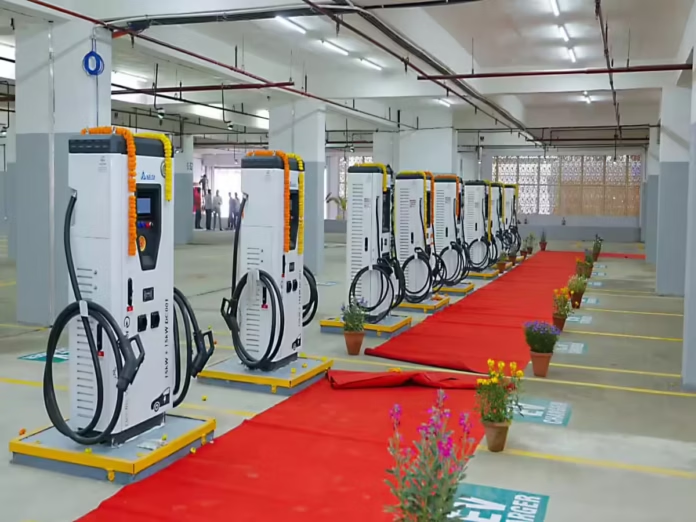
Himachal Pradesh Mandates EV Charging in Real Estate Projects
In a significant regulatory shift aimed at future-proofing urban infrastructure, Himachal Pradesh’s state government has mandated the installation of electric vehicle (EV) charging stations in all new commercial, public and real estate developments under the Himachal Pradesh Town and Country Planning (17th Amendment) Rules, 2026. The requirement extends to semi-public buildings and is designed to align the built environment with the accelerating adoption of electric mobility and the state’s broader climate resilience goals.
The policy update, announced in Shimla by the minister responsible for town and country planning, reflects an effort to integrate sustainable transport infrastructure into the earliest stages of urban development planning. By embedding EV charging infrastructure into building approval norms, Himachal Pradesh is signalling a departure from incremental, piecemeal deployment toward systemic planning that anticipates demand and encourages cleaner mobility options.Under the amended rules, developers will need to provide EV charging facilities as part of their project designs before receiving occupancy certificates from municipal authorities — a step that embeds low-carbon infrastructure into the compliance checklist for new construction. To ensure energy efficiency standards are met, the state has further tied eligibility for additional floor area ratio (FAR) benefits to compliance with the Himachal Pradesh Energy Conservation Building Code (HPECBC) and Rules 2018. Buildings such as hospitals, educational institutions and shopping complexes larger than 750 sq m that meet these codes may be granted an extra 0.25 FAR over the base 1.75.
Urban planners suggest the move could recalibrate development priorities in a state where urban infrastructure has historically lagged behind rapid motorisation. By requiring charging points at the ground-level of real estate projects, local authorities are effectively closing an infrastructural gap that has slowed EV adoption nationally and could deter sustainable transportation uptake in smaller cities and hill towns.Developers are also subject to new economic parameters under the 18th Amendment Rules, with structured fees introduced for premium FAR: ₹3,000 per sq m for up to 0.25 extra FAR and ₹7,000 per sq m for ratios above 0.50. These fees are applicable only to future or ongoing projects, not to properties already issued certificates. The structure gives developers greater flexibility in planning while reinforcing accountability for sustainability compliance.
Industry analysts note that this regulatory evolution places Himachal Pradesh among the early movers in integrating EV infrastructure mandates with urban planning norms, potentially influencing neighbouring states to revisit building codes in the context of electrification. It is also consistent with national model building bye-laws that encourage charging infrastructure across urban centres.For residents and homebuyers, the practical impact could be substantial: better availability of on-site EV charging may increase housing desirability, lower barriers to EV ownership and improve overall urban amenity quality. Yet implementation challenges remain, including grid capacity, site design constraints and ensuring equitable access across housing typologies. Experts argue that accompanying utility engagement and clear technical standards will be critical to translating this policy into meaningful infrastructure on the ground.
Looking ahead, effective enforcement of these rules and industry adaptation could set a precedent for EV-ready cities woven into urban expansion strategies — laying a foundation for resilient, low-carbon mobility in Himachal’s built environment.
Godrej Properties Boosts Gurugram Housing Development Pipeline
Gurugram’s residential real estate market is poised for a significant transformation as a major national developer secures a large land parcel with an expected ₹4,500-crore revenue potential, industry sources say. The acquisition of an 11.36-acre site within Sector 63A on the Golf Course Extension Road—a micro-market noted for strong connectivity and rising housing demand—represents a strategic expansion in one of the National Capital Region’s (NCR) most competitive corridors. This move comes amid broader efforts by listed developers to deepen urban portfolios and respond to sustained end-user and investor interest.
The developer purchased the Gurugram land outright, with regulatory filings indicating that the residential project planned on the parcel could unlock substantial sales value, contributing to the company’s growth ambitions for the current financial year. Sector 63A, serviced by key arterial links such as Golf Course Road, Sohna Road and National Highway 48, has emerged as a preferred location for premium and upper-middle-income housing, reinforcing Gurugram’s position as a core engine of north India’s urban expansion.Market analysts highlight that the estimated revenue figure—projected from future sales rather than upfront investment—signals developers’ confidence in demand resilience even as financing costs and regulatory compliance reshape sector dynamics. “Large-scale acquisitions like this are increasingly common as branded real estate firms seek to anchor long-term pipelines in high-growth urban corridors,” says a senior sector strategist. By integrating both low-rise and high-rise housing formats, these projects can appeal to a broader demographic while improving land use intensity on constrained urban sites.
For Gurugram’s housing ecosystem, the project could help balance supply gaps that have widened as demand rebounds post-pandemic. Data from property consultancies show that while sales volumes surged across several NCR micro-markets in the past year, new inventory in strategic address corridors lagged behind, pushing prices upward. This acquisition, therefore, aligns with a broader push among developers to diversify offerings across segments—unlocking options for first-time buyers as well as investors seeking rental-yield opportunities.Beyond immediate market effects, large-ticket developments can influence urban form and infrastructure planning. Sector 63A lies in proximity to planned metro extensions and civic improvement schemes, factors that often underpin long-term value creation and livability. Urban planners note that such projects, when integrated with public transport planning and sustainable design principles, can reduce congestion and improve access to jobs and services.
The acquisition also contributes to the company’s growing pipeline; regulatory disclosures reveal that this addition forms part of a broader build-out strategy that has substantially increased future booking potential for the developer this fiscal year. As the NCR real estate market continues to evolve, the emphasis on well-located, well-planned residential communities remains central to both investor confidence and broader urban inclusion.
Looking ahead, the success of this Gurugram project will hinge on project execution timelines, alignment with sustainable development norms and integration with expanding urban infrastructure, offering a litmus test for how large developers can shape equitable housing growth in India’s leading metros.
India Real Estate Sees Surge In Platform Partnerships
A structural shift in India’s property investment landscape is emerging as global and domestic capital increasingly allocates through real estate platform partnerships rather than isolated asset buys. Across cities such as Bengaluru, Mumbai and Delhi NCR, developers and institutional investors are forming long-term alliances to jointly build diversified portfolios, marking a departure from traditional one-off transactions that have long characterised the market.
Industry capital strategists say this evolution matters because it aligns investment flows with sustainable urban outcomes and deeper governance frameworks. Platform models—where capital is committed to an ongoing pipeline of assets rather than single projects—are enhancing predictability, transparency and execution discipline in a sector historically challenged by fragmentation and cyclical risk.According to recent investment data, domestic institutional capital has doubled its share of real estate funding, emerging as a primary source of deployment in 2025. In contrast, foreign direct investment (FDI) into real estate assets softened, though cross-border interest showed signs of recovery towards year-end.
Urban planners and finance specialists note that platform partnerships can accelerate infrastructure-linked development across property types including office, logistics and residential portfolios. Office and logistics segments, in particular, are drawing structured capital due to their stable yield profiles and alignment with REIT (real estate investment trust) monetisation strategies.Strategic capital deployment through platforms also dovetails with efforts to professionalise governance across the built environment. Advisory firm leaders highlight improved risk management and enhanced investor confidence as key drivers of the trend, pointing to clearer regulatory frameworks and sector consolidation as enabling factors.
Urban economists observe that these shifts could boost equitable access to housing stock and commercial spaces. By pooling capital and expertise, mid-sized developers with strong balance sheets may attract institutional backing previously accessible only to large groups, potentially diversifying supply across tiers and addressing demand in fast growing secondary markets.Platform strategies also improve tax efficiency and exit planning, helping investors navigate high financing costs by offering phased deployment and asset diversification that mitigates value fluctuations in cyclical environments. This could strengthen resilience across property markets at a time when global investment into Indian real estate remains significant but selective.
However, some market participants caution that platform models require rigorous oversight, robust data infrastructure and collaborative governance to ensure that capital flows are aligned with long-term community and climate resilience goals. Ahmedabad, Pune and other fast expanding urban regions may benefit if these partnerships prioritise inclusive development and sustainable land use.
As the real estate investment ecosystem evolves, the rise of platform partnerships signals a maturation of India’s property capital markets—offering potential for deeper institutional engagement, structured growth pathways and broader urban impact.
Samsung Bespoke AI Appliances See Festive Demand Rise
Samsung Electronics has launched its Holi Hai promotional campaign in India, rolling out special pricing and financing options on its range of Bespoke AI-enabled home appliances, a move that could accelerate adoption of connected and energy-efficient technologies in urban households. The festival-linked campaign — running through March 22, 2026 — pairs cashback incentives, flexible payment schemes and extended support benefits with appliances that integrate artificial intelligence into everyday domestic functions, reflecting shifting consumer preferences in densely populated cities.
The Holi Hai offers cover a broad set of categories including refrigerators, washing machines, air conditioners and microwave ovens equipped with AI-driven features. Eligible buyers can avail up to ₹20,000 cashback on select models, zero down-payment financing and waived EMI fees, alongside free installation and longer warranty terms on some products such as air conditioners.Industry analysts say seasonal promotions like Samsung’s are increasingly important in making higher-end smart appliances more accessible to middle-income urban consumers who face competing priorities in household expenditure. By bundling financial incentives with technology that promises convenience — including smart sensors, app-based controls and predictive maintenance alerts — manufacturers are lowering barriers to upgrading essential home equipment.
The Bespoke AI portfolio taps into broader trends in urban consumption, where connected devices are expected to enhance energy management, reduce waste and improve user experience. For example, Samsung’s AI-enabled refrigerators aim to optimise cooling and inventory tracking, washers adjust cycles based on fabric and load, and intelligent air conditioners adjust cooling dynamically while linking to integrated home health platforms. These functions align with urban households’ growing interest in energy efficiency and smart management of utilities.From a city planning perspective, uptake of smart appliances can dovetail with sustainability goals. Urban homes consume a large share of a city’s energy footprint, and AI-enabled appliances — when widely adopted — can contribute to peak-load reduction and better demand forecasting for electricity grids, particularly in metropolitan clusters like Delhi-NCR, Mumbai and Bengaluru. Experts note that as cities expand and households diversify their energy use, smarter appliances can serve as distributed enablers of more efficient urban ecosystems.
Retailers and consumer-tech strategists also view seasonal campaigns as litmus tests for shifts in buying behaviour. The Holi period — a high-traffic retail window in India — often stimulates sales across categories from electronics to home goods. Connecting promotional incentives with smart features helps brands like Samsung position premium technology as attainable, blurring lines between traditional appliances and the broader Internet of Things (IoT) ecosystem.However, long-term consumer adoption will depend on perceived value beyond festival deals, including after-sales service, product durability and interoperability with existing smart home systems. For city dwellers seeking convenience and energy savings, these factors will shape how quickly AI-first appliances transition from novelty to norm.
KCC Design Cultures Exhibition Elevates City’s Cultural Profile
The city’s creative ecosystem is gaining momentum with the launch of Design Cultures 2026 – The Art of Contemporary Living, a large-scale curated exhibition at the Kolkata Centre for Creativity (KCC) that highlights India’s evolving design landscape and its ties to cultural identity, economic vibrancy and urban aesthetics. The initiative — presented by Raw Collaborative in partnership with a local creative initiative — marks a significant milestone for Kolkata’s cultural infrastructure, offering designers, makers and urban creative enterprises a new platform for exchange and engagement.
Design Cultures 2026 brings together an eclectic mix of established brands, emerging studios and creative practitioners showcasing products ranging from sculptural furniture and experimental lighting to bespoke textiles and material-led installations. Participating names span OBEETEE Carpets & Home, Tilfi, Tectona Grandis, Studio Metallurgy and beyond, signalling not just aesthetic diversity but a convergence of craft, craft-inspired design and innovative production practices.Urban development and creative economy analysts say such curated platforms play an important role in positioning cities as hubs of intangible economic activity, where cultural capital intersects with design thinking to foster innovation, attract investment and strengthen local industries. Kolkata has long been a bastion of artistic heritage, but recent efforts like this exhibition reflect a push to connect traditional creative practices with contemporary design discourse and market dynamics.
The choice of KCC — an urban cultural anchor with exhibition, performance and community spaces — provides strategic civic value. By activating city space with immersive design narratives and inviting public engagement, the showcase deepens the cultural brushstrokes of an urban centre historically defined by literature, craft and visual art, while also tapping into modern design’s economic potential.A notable segment of the exhibition is the specially curated gallery supported by a leading carpet and home brand, which features eight designers reinterpreting the hand-knotted carpet in unexpected ways. This not only highlights artisanal expertise but also demonstrates how traditional craft practices can be reframed for contemporary living environments and new aesthetic markets.
Kolkata’s creative stakeholders view Design Cultures 2026 as more than an isolated art event — it represents a broader effort to stimulate cross-disciplinary collaboration between design, art, architecture, craft and even hospitality. Through what organisers describe as a ‘creative dialogue collective’, voices from multiple creative fields are brought into conversation, fostering networks that can contribute to cultural tourism, educational initiatives and urban placemaking.For the city’s design community, this is also a chance to engage with collectors, interior professionals and enthusiasts who are increasingly looking for homegrown design with global sensibilities. The growing emphasis on contextual design — that is, work grounded in local narratives yet capable of global resonance — aligns with broader movements in urban cultural economies across Asia.
As Design Cultures 2026 continues, Kolkata’s role as a node for contemporary design and creative exchange is likely to strengthen, potentially influencing how the city nurtures talent, attracts cultural tourism and integrates design into its urban regeneration strategies. The event underscores the evolving narrative of Indian cities as sites where creative and cultural vibrancy can translate into sustainable economic opportunity.
Studio Itiara Transforms Gurugram Apartment Design
A compact urban residence in Gurugram has been thoughtfully reimagined to meet the needs and lifestyles of two young professionals, blending contemporary design with purposeful spatial planning in a city where high-density living increasingly demands adaptable, design-driven housing solutions. The project, completed by Studio Itiara and showcased on a leading architecture platform, reflects evolving preferences among urban residents for homes that are not just functional but reflective of personality and social dynamics.
Located in a high-rise neighbourhood of Gurugram, the bachelor pad departs from stereotypical notions of single-occupant dwellings by prioritising versatile, multi-use spaces within a relatively modest footprint. The design responds to the contemporary urban agenda: efficient use of space, seamless integration of living and working zones, and an aesthetic that balances minimalism with warmth.Urban design experts note that such interiors matter beyond aesthetics. With cities like Gurugram experiencing rapid population and employment growth, homes are increasingly double-duty environments — accommodating remote work, social gatherings and personal relaxation, all within constrained floor areas. A design that embraces spatial clarity and flexibility can improve livability while reducing pressure on civic infrastructure.
At the heart of the project is a clear design philosophy that privileges clean lines, material restraint and thoughtful detailing. By avoiding clutter and focusing on well-curated furnishings and finishes, the space feels ordered without being austere. This approach aligns with broader trends in urban residential design in India’s expanding metros, where interior layouts are tailored to the lived realities of younger professionals seeking both comfort and functionality.Critically, the project also reflects a shift toward user-centric design thinking in housing. Instead of imposing a preconceived formal language, the interiors were shaped by the occupants’ routines and habits — an urban design principle that reinforces wellbeing by ensuring spaces support everyday activities from rest to work to social interaction. Analysts say this human-centred approach is essential as living spaces shrink in many Indian cities, pushing designers to craft environments that feel expansive through spatial logic and light manipulation rather than sheer size.
The bachelor pad’s material palette — a considered mix of muted tones and tactile surfaces — further supports a sense of tranquillity amidst the city’s bustle. Strategic lighting design and customised storage solutions demonstrate how interior spaces can contribute to both psychological comfort and functional efficiency, two increasingly important metrics for modern urban housing.From an urban development perspective, projects like this underscore the importance of design quality in mid-rise and high-density residential environments. As India’s cities continue to grow, the interplay between interior spatial planning and broader urban wellbeing outcomes — including energy use, occupant comfort and adaptability over time — will become a defining feature of sustainable housing.
Looking ahead, the industry’s focus on compact, resident-responsive design offers a pathway to more liveable cities, supporting both individual lifestyles and broader sustainability goals.
A recent surge in freight movement on the South Western Railway network has drawn fresh attention to coal handling operations at Mormugao Port, spotlighting the logistical and environmental balancing act facing India’s western coastal infrastructure hubs. The rise in rail freight volumes, particularly coal and other bulk commodities, underscores the role of integrated rail-sea supply chains in connecting hinterland industry demand with coastal trade gateways — a dynamic with wide-ranging implications for urban development, sustainability and regional logistics planning.
Railway operational data from FY 2025-26 shows robust growth in freight performance across key commodities, including coal, iron ore and steel, with the South Western Railway (SWR) handling nearly 47.5 million tonnes of originating freight to February — a year-on-year increase of about 17%. Coal loading figures within this mix were up over 16%, reflecting elevated industrial demand.Mormugao Port, strategically located on India’s southwest coast, operates dedicated berths for coal and other bulk cargoes, serving as a crucial import node for resources that feed power, steel and industrial clusters across Goa, Maharashtra and Karnataka. Its connectivity with rail networks enables large-scale inland transport — a feature that has made the port indispensable for commodity flows but also a flashpoint in discussions around environmental management and coastal urban impacts.
Industry stakeholders say the freight surge reflects broader shifts in India’s commodity logistics ecosystem. As rail operators focus on freight performance and revenue growth — with SWR gross freight earnings rising nearly 18% year-on-year — inland terminals linked with coastal ports are handling higher cargo intensities. This is partly driven by rising demand for coking coal and other inputs for steelmaking and power generation, product segments tightly coupled with urban infrastructure expansion and manufacturing growth.Yet the intensification of coal movements — both by rail and through port facilities — raises concerns for local communities and environmental groups. Coal dust and particulate matter are persistent challenges at bulk handling terminals, touching on urban air quality and public health in port-adjacent towns. This has led to calls for enhanced dust suppression technologies, stricter monitoring and investment in cleaner handling infrastructure, balancing economic throughput with environmental protection.
Urban planners and logistics analysts also highlight the potential benefits of modal integration. Efficient rail-to-port linkages can reduce road congestion and emissions by shifting bulk cargo transit away from highways. The focus on dedicated freight corridors and mechanised cargo handling systems at ports like Mormugao can drive operational resilience while lowering carbon intensity in supply chains tied to urban construction and energy sectors.However, realising these benefits at scale requires coordinated infrastructure investment. Enhancements such as rail yard modernisation, mechanised unloading and improved dust management systems at the port are key to sustainably handling rising volumes without over-burdening local urban environments. Such upgrades dovetail with broader national efforts to decarbonise freight and strengthen urban-industrial logistics ecosystems.
As freight volumes continue to climb, the dialogue around coastal commodity handling — particularly in ecologically sensitive regions — will increasingly influence policy decisions, infrastructure design and sustainability outcomes in India’s growing cities and industrial corridors.
A key raw material acquisition in eastern India’s mineral belt is poised to influence industrial value chains and urban-linked manufacturing growth, as Vedanta Limited has been declared the preferred bidder for the Karnapodikonda bauxite block in Odisha’s Koraput district. The state-run mining auction, conducted by Odisha’s Directorate of Mines and Geology, awarded the 532-hectare block to the diversified metals and energy group, reinforcing a strategic push toward resource security and value-chain integration.
Bauxite — the principal ore used in producing alumina and, ultimately, aluminium — is foundational to sectors that underpin urban growth, including transport infrastructure, building materials and lightweight engineering components for consumer and industrial uses. Urban planners and industry analysts view stable access to bauxite as critical for maintaining cost-effective supplies of aluminium products that are increasingly integral to construction, mobility and renewable energy projects.Vedanta’s preferred bidder status, secured through a transparent e-auction mechanism, places the company in a stronger position to integrate upstream mineral resources with its downstream alumina refining and aluminium smelting operations. This alignment can reduce supply-chain disruptions, lower raw material sourcing costs and improve predictability for manufacturers dependent on aluminium inputs.
Odisha’s mineral wealth has long been a cornerstone of India’s metals and industrial sectors, helping fuel growth in steel, aluminium, power and infrastructure equipment production. The Karnapodikonda block’s G2 classification indicates an intermediate level of geological confidence, suggesting substantial resources that could feed processing facilities once further feasibility and environmental clearances are secured.For cities across India, including rapidly expanding urban corridors in the East and Northeast, access to competitively priced aluminium is strategically significant. Aluminium’s light weight, corrosion resistance and recyclability make it a preferred material for metro rail coaches, airport infrastructure, high-rise facades and energy-efficient building elements. Strengthening domestic raw material pipelines helps cushion such sectors from global price volatility and import dependence.
Economic development experts note that Odisha’s approach to mineral block auctions reflects a broader effort to attract long-term investment into industrial ecosystems while balancing ecological and community considerations. Mining projects must navigate a complex web of environmental assessments, land-use planning and stakeholder engagement before becoming fully operational.From an urban sustainability perspective, integrating resource extraction with downstream processing clusters near industrial nodes can reduce logistics burdens and carbon emissions, provided infrastructure investments such as rail links, power supply and water management systems are coordinated effectively.
Vedanta’s expanded footprint in Odisha — complementing existing operations such as aluminium billet production and related logistics — could also spur ancillary economic activity, from local supply chain services to skills development in mining-adjacent communities. Urban policymakers view such industrial depth as an asset for resilient growth, contributing to jobs, infrastructure demand and regional development.
As India continues to urbanise and decarbonise its industrial base, resource security for critical raw materials like bauxite will remain central to both public and private investment decisions, shaping the interplay between mining policy, urban infrastructure and long-term economic competitiveness.
Textile processing units in South Gujarat’s industrial ecosystem are experiencing a sharp escalation in operating costs as imported coal prices spike, a development with immediate implications for production economics, employment and the wider industrial supply chain in India’s largest man-made fabric hub. The surge in fuel costs — driven by global freight volatility and constrained supply — is forcing local dyeing and printing units to recalibrate pricing and production plans just as export markets remain fragile.
Coal remains a critical energy input for approximately 400 processing units clustered around Surat, where steam generation for dyeing and finishing operations depends on high-calorific imported coal from Indonesia and Australia. Over recent weeks, industry leaders report a 30–35 per cent increase in coal import prices, adding roughly ₹1,500–2,000 per tonne to raw material costs.Domestic processors say the cost shock stems from a combination of higher ocean freight rates, supply chain bottlenecks and tightening global coal markets, influenced by shipping disruptions and demand from East Asian buyers. With freight costs contributing to landed prices, processing pricing structures are being squeezed from both ends.The immediate response among processors has been to pass some of these additional costs onto contract buyers, increasing processing fees by up to ₹1.25 per metre of finished fabric. This pricing shift, while a short-term buffer for margins, risks dampening demand from downstream garment manufacturers and brand suppliers grappling with their own input cost pressures.
Urban development and industrial supply chain experts in Gujarat note that such cost inflation in essential utilities — like energy — can ripple through the wider manufacturing ecosystem. Surat’s textile cluster is not only a domestic supplier but also a significant exporter of processed fabrics; rising fuel costs may weigh on competitiveness in global markets, especially as logistical premiums have surged.For cities like Surat, where industrial clusters are tightly integrated with urban labour markets and ancillary services, volatility in production economics has direct socioeconomic impacts. Processing units employ a large workforce, much of it migrant, and cost-driven production slowdowns can result in reduced shifts, layoffs or deferred investment in technology upgrades that could improve energy efficiency and emissions performance.There are early signs that some processors may scale back operations or delay new bookings until cost pressures stabilise. Such contractions could affect the broader textile value chain — from weaving and dyeing to garmenting clusters — heightening uncertainty for suppliers who already operate on tight margins and just-in-time delivery models.
Energy and sustainability specialists say this moment also underscores the need for textile clusters to accelerate energy diversification, including better access to cleaner fuels and higher-efficiency technologies. Reducing dependence on imported fossil fuels would provide resilience against global market shocks and support climate-aligned urban industrial planning.As the sector confronts these dual pressures of price inflation and competitive stress, stakeholders are calling for coordinated action — including targeted freight support, energy policy interventions and investments in industrial decarbonisation — to shore up one of India’s most important manufacturing anchors.