
UltraTech Cement Strengthens South India Position After Board Resignations

One Bullet, Two War Mongers: How Neo-Colonists Just Assassinated Brand Gulf and Dubai Real Estate

The War Against Iran Is Not Just Against the Islamic Nation. It Is a Western Pivot to Disrupt the Middle East’s Rising Urban Power. The New Battlefield Is Not Territory. It Is Trust. For the last twenty years, a quiet revolution has been underway in the Gulf. It did not involve tanks or troops or coups. It involved zoning laws, tourism infrastructure, and the most aggressive urban branding campaign the modern world has ever seen.
Dubai. Doha. Manama. Abu Dhabi.
These cities did something that Washington, London, and New York had stopped being able to do: they built places where the world’s wealthy actually wanted to live.
Not just visit. Live.
The numbers told the story. High-net-worth individuals fleeing European taxes, American gun violence, British weather. Russian oligarchs after 2022. Indian tech founders after COVID. Chinese money seeking a neutral ground between Beijing and the West. African billionaires who wanted first-world infrastructure without first-world attitude.
They all came to the Gulf. Not because they loved the politics. Because the product was better. Dubai, specifically, became the crown jewel. After London, it was the second-most attractive city on earth for the ultra-wealthy. But unlike London, it offered something the old capitals could not: security without paranoia, luxury without decay, a future that actually looked like the future.
You could walk the Marina at 2 AM. You could start a business in a week. You could buy a villa on the Palm and wake up to a view that made Saint-Tropez look like a parking lot. The police were everywhere but invisible. The taxes were nowhere. The energy was relentless.
Brand UAE became synonymous with a simple promise: Here, the dream works. The West watched this happen. At first with amusement. Then with curiosity. Then with something else.
Envy.
Because cities are the new countries. In the 21st century, nations compete through their urban centers. London vs. New York. Singapore vs. Hong Kong. And now, Dubai vs. everyone. The Gulf cities were winning. Not because they had better history or culture or democracy. But because they had better execution. Better vision. Better delivery.
And that made them dangerous.
The War Against Iran Was Never Just About Iran. When the two men in Washington and Jerusalem decided to strike, they did not calculate based on centrifuges or uranium enrichment alone. They calculated based on something broader.
Iran was the excuse. The region was the target. Think about it. A strike on Iranian territory does not happen in a vacuum. It triggers retaliation. Retaliation that is predictable, almost algorithmic. Iran cannot reach Washington. It can barely reach Tel Aviv reliably. But it can reach Doha. It can reach Abu Dhabi. It can reach Bahrain, Kuwait, Dubai. And when it does, the message is sent:You are not safe. Your city is not an island.Your brand is not immune.
One bullet fired at Iran. And a dozen casualties across the Gulf’s urban miracles. Not military casualties. Brand casualties.Because the one thing a city like Dubai sells above all else is stability. The ultra-wealthy do not park their families and their money in places where missiles fly. They do not buy penthouses in cities that make evening news broadcasts. They do not build their second lives in neighborhoods that might become military targets next week.
The strikes did not have to hit Dubai to destroy Dubai. They just had to remind everyone that Dubai is in the neighborhood. And the neighborhood is on fire. The Numbers Tell the Story. In one single day, the phones stopped ringing. Not all of them. Not permanently. But enough. The off-plan launches that had been oversubscribed for years suddenly had inventory.
The villa deals that had been closing in days suddenly needed “more time.” The family offices that had been moving money into Dubai real estate like clockwork suddenly went quiet. The reason was not economic. It was not regulatory. It was perceptual. Dubai went, in 24 hours, from “the safest place on earth” to “a place where something happened nearby.” That is the difference between a global city and a regional one. That is the difference between London and Beirut. Between Singapore and Manila. Between a brand that endures and a brand that can be broken.
The two men who ordered the strikes understood this. They may not have said it aloud. They may not have even fully admitted it to themselves. But their strategists, their advisors, their planners—they knew. A strong Gulf is a competitor. A disrupted Gulf is a client.
When Dubai is booming, capital flows east. When Dubai is scared, capital flows back to New York, to London, to the old safe havens. The ones that have been losing ground for twenty years. The ones that need the wealthy to stop discovering the Palm and start rediscovering Park Avenue.
The War Is Urban Now
This is the new pivot. Not Cold War. Not Hot War. City War. Nations no longer compete primarily through armies or economies. They compete through urban ecosystems. Through the quality of life they offer the mobile global elite. Through the brand equity of their skylines.
The Gulf spent two decades building brands that rivaled the West’s. Dubai became shorthand for ambition. Doha became shorthand for culture. Abu Dhabi became shorthand for capital with taste. And the West watched. Not with admiration. With calculation. Because if you cannot beat the product, you disrupt the market. If you cannot offer better lifestyle, you make the competitor feel less safe. If you cannot build a Marina that rivals theirs, you remind the world that your Marina is farther from the missiles.
This is not conspiracy. This is geopolitical gravity. Every superpower in history has acted to protect its economic primacy. America is no different. Europe is no different. When a new pole of attraction emerges—especially one that draws capital and talent away from the old centers—the old centers will eventually push back.
The strikes on Iran were not just about nuclear programs. The war for the global elite’s attention. The war for their trust. The war for their real estate and petro dollars.
What Happens Next
In the days ahead, the diplomats will talk. The generals will posture. The news cycles will move on. But the damage to Brand Dubai is already done. Not fatal. Not irreversible. Dubai has survived worse. The fundamentals are still there: the location, the infrastructure, the leadership, the vision. The city will not disappear. The cranes will start moving again eventually.
But something has been lost that may take years to rebuild. The sense of invulnerability. The belief that Dubai existed outside the region’s conflicts, above them, beyond them. That was always a fiction, of course. But fictions matter. They are what the wealthy buy when they choose a second home. They buy the story.
The story just got rewritten. Now Dubai is part of the region again. Subject to its wars. Vulnerable to its chaos. Visible on the same maps that show missile ranges and military bases.
One Bullet, Two War Mongers: How Neo-Colonists Just Assassinated Brand Gulf and Dubai Real Estate
India Coal Sector Advances National Coal Exchange Rollout

India’s dominant coal producer has signalled support for a step-by-step launch of a National Coal Exchange (NCE) — a proposed digital marketplace intended to transform how thermal fuel is traded across the country’s energy and industrial sectors. Coal India Limited (CIL) argues that a phased rollout of the exchange would modernise coal pricing mechanisms while safeguarding fuel supply continuity for critical industries such as power generation and manufacturing.
The NCE is envisioned as a transparent platform for price discovery and market transactions, breaking away from traditional direct supply contracts and bilateral e-auctions that have long dominated India’s coal market. By exposing supply and demand signals to a wider array of participants, the exchange could enhance competitive pricing, reduce regional imbalances and improve planning among buyers — from thermal power plants to cement manufacturers and industrial clusters.CIL’s endorsement of a cautious, staged implementation reflects industry sentiment that wholesale reform could create volatility if introduced too rapidly. Gradual adoption — starting with a limited set of buyers and progressively widening market access — can help regulators and stakeholders refine technical protocols, trading rules and compliance checks without disrupting critical coal flows. Such a transition is particularly salient given India’s ongoing push to reduce dependence on imported coal while meeting seasonal peaks in power demand.
Energy analysts note that an exchange-based mechanism could complement India’s existing procurement systems — including linkage contracts and e-auction platforms — by providing greater clarity on pricing trends and more flexible options for buyers. This is especially relevant as the government aims to cut thermal coal imports significantly in 2026 by encouraging increased use of domestic production. A transparent market structure could also mitigate sharp price spikes that sometimes occur in unregulated or opaque trading environments.However, establishing a robust coal exchange requires careful oversight. Market reforms must ensure that smaller buyers and essential sectors are not priced out or exposed to undue risk during transitional phases, and that price volatility does not translate into instability in power tariffs or industrial input costs. Experts argue for clear regulatory guardrails, real-time data transparency and safeguards against manipulation — especially in a commodity as fundamental to India’s energy security as coal.
The phased choice also allows integration of quality standards and logistics considerations, with opportunities for participants to align trading practices with emerging policy priorities such as reducing emissions and supporting cleaner coal utilisation technologies. For instance, blending requirements and quality certification could be built into exchange contracts to promote more efficient use of domestic grades across the supply chain.India’s power and industrial ecosystem depends on roughly 75 per cent of electricity generation from coal-fired plants, even as renewables expand their share. Adjacent reforms, including plans to reduce coal imports and diversify fuel sources, underscore the need for agile market mechanisms that balance energy security with reform ambitions.
As discussions around the National Coal Exchange advance, policymakers and industry stakeholders will be watching how phased implementation — coupled with regulatory oversight — can reshape coal market dynamics while cushioning the transition for energy-intensive sectors at the heart of India’s economic growth.
Also Read: Coal India Allays Supply Fears As Power Demand Rises
India Coal Sector Advances National Coal Exchange Rollout
Coal India Allays Supply Fears As Power Demand Rises

India’s largest coal producer has stepped in to soothe supply concerns for the power sector even as electricity demand begins to climb ahead of the summer months, signalling confidence in domestic fuel availability and energy planning. Coal India Limited (CIL) on Friday affirmed that current coal inventories across multiple supply points are sufficient to support a likely surge in demand from thermal power plants and other industrial users, underlining the country’s capacity to manage energy continuity in a predominantly coal-dependent grid.
Coal remains the backbone of India’s electricity generation mix, with thermal plants supplying roughly three-quarters of annual power output despite rapid growth in renewables. As temperatures rise and cooling and irrigation needs elevate peak grid loads, utilities typically anticipate higher coal consumption — a pattern beginning to emerge this year. However, CIL’s latest stock figures — including around 115 million tonnes (MT) of coal at pitheads and nearly 55 MT held at coal-based power plants as of late February — represent record levels for this period, creating buffers that analysts say are critical for energy security.Beyond static inventories, the company’s three-layer supply buffer encompasses pithead reserves, stocks at thermal power stations and “in-situ” coal already uncovered and ready for extraction in key mines that together account for around 90 per cent of annual production. This structure, industry officials suggest, allows for flexibility and rapid response to demand spikes without immediate need for imports.
For urban and infrastructure sectors, the reassurance is welcome. Reliable power supply underpins everything from construction site operations to the functioning of data centres and manufacturing hubs. Power disruptions — even minor ones — can stall projects, raise costs and disrupt delivery timelines across India’s expanding cities and industrial corridors. With the country forecasting peak summer demand in excess of 265–270 GW, grid preparedness and dependable fuel supplies are central to maintaining momentum.The domestic assurance also aligns with broader government efforts to reduce dependence on costly imported coal. Authorities are pushing for greater utilisation of local resources and have signalled intentions to trim thermal coal imports by as much as 30 per cent this year, provided power plants adjust equipment and fuel handling practices to accommodate a wider range of domestic coal grades.
Still, challenges persist. Coal quality variations can affect plant efficiency and emissions, making blending and boiler calibration necessary for optimal performance. Meanwhile, India’s dual goals of ensuring energy access and advancing its net-zero by 2070 climate commitment mean that balancing coal production with clean energy growth will remain a policy and operational priority.
For now, Coal India’s assurances provide short-term confidence for the power sector and industries reliant on continuous electricity — but they also reinforce a critical reality: thermal coal will continue to play a central role in India’s energy mix for years, even as the country scales up renewables and grid flexibility.
Also Read: India Decorative Coatings Market Set For Expansion
Coal India Allays Supply Fears As Power Demand Rises
Pune Hadapsar Annexe luxury homes launched
Pune’s eastern growth corridor has added a boutique high-end residential development, with Shapoorji Pallonji Real Estate unveiling a 25-unit luxury enclave in Hadapsar Annexe. The launch reflects sustained demand for low-density housing formats among affluent buyers in the city’s IT-driven micro-markets.
The project, branded The Vastion, comprises a mix of villas and “villaments” hybrid homes that combine the privacy of standalone houses with the structural efficiencies of apartment living. Located near established employment hubs such as Magarpatta IT Park and SP Infocity, the site sits within one of Pune’s most active residential catchments. Hadapsar and its adjoining extensions have evolved over the past decade from peripheral industrial land to a mixed-use urban cluster anchored by IT parks, retail centres and educational institutions. Improved road connectivity and metro expansion have strengthened the area’s integration with the rest of the city. Planned regional infrastructure including a ring road network and airport development near Saswad is expected to further support long-term property values. What distinguishes this launch is its low-density planning. Spread across a mature orchard landscape, the scheme integrates existing trees into private gardens and common spaces. Urban designers observe that such biophilic planning where built form coexists with natural elements is increasingly sought after in high-income housing, particularly in cities facing heat stress and declining green cover.
The villas offer expansive built-up areas exceeding 5,600 sq ft, while the villaments range between roughly 3,400 sq ft and 3,800 sq ft. Pricing places the development firmly in Pune’s premium bracket, signalling confidence in the city’s upper-end absorption capacity. Industry analysts say that while overall residential sales in Pune remain strongest in mid-income segments, the luxury category has shown resilience. High-net-worth professionals employed in technology, manufacturing and financial services are seeking larger homes that offer privacy, landscaped surroundings and space for hybrid work arrangements. However, experts caution that boutique luxury supply must align with infrastructure capacity. Water management, traffic mitigation and sustainable energy integration will be critical to ensuring that such enclaves do not strain civic systems. Incorporating efficient cooling design, rainwater harvesting and waste segregation could set benchmarks for climate-responsive construction in the segment. Pune’s housing market has historically demonstrated steady end-user demand rather than speculative volatility. The addition of limited-inventory, design-led developments in employment-linked corridors suggests a maturing market where differentiation is driven by planning quality and liveability.
As Hadapsar Annexe continues to urbanise, projects of this scale may indicate a shift towards curated, low-density communities within larger metropolitan frameworks balancing exclusivity with the need for responsible urban growth.
Also Read: Delhi staff housing project worth 775 crore
Pune Hadapsar Annexe luxury homes launched
India Decorative Coatings Market Set For Expansion

India’s decorative coatings sector — the market for interior and exterior paints, emulsions and aesthetic finishes — is projected to undergo sustained expansion through the mid-2030s as urbanisation, renovation cycles and sustainability preferences reshape construction material demand. Forecasts indicate the Indian decorative coatings market could grow in tandem with global trends, reflecting the country’s rapid housing and commercial infrastructure development and shifting expectations around healthier, low-emission finishes.
Decorative coatings perform a dual role in the built environment: they protect surfaces and enhance visual appeal while increasingly contributing to indoor environmental quality. In India’s booming urban centres — from Delhi-NCR to Bengaluru and Pune — rising disposable incomes and growing renovation activity in ageing apartments and commercial spaces are driving demand for coatings that offer durability, low odour and enhanced performance attributes.“Aesthetic and health considerations are becoming more decisive factors for developers and homeowners alike,” said an industry expert tracking building material markets. “Low-VOC (volatile organic compound) paints, textured finishes and moisture-resistant formulations are seeing greater uptake, particularly in projects aligned with green building certifications.”
Market expansion is closely tied to India’s broader urbanisation trajectory. Government initiatives such as the Pradhan Mantri Awas Yojana and large-scale metro and institutional projects have spurred housing supply and non-residential construction alike, creating a structural base for higher decorative coating consumption. Moreover, retrofit and renovation projects in existing stock — a segment often overlooked in fast-growth narratives — are emerging as a significant demand driver, particularly in tier-II and tier-III cities where older buildings are being modernised.The manufacturing landscape is adapting accordingly. Paint and coatings producers are broadening portfolios to include eco-friendly, waterborne systems and speciality finishes tailored to regional climates. Some companies are investing in digital colour matching tools, performance-driven coatings with antimicrobial properties for healthcare and educational facilities, and textured systems that reduce surface imperfections in high-humidity zones — all aimed at meeting nuanced requirements of India’s diverse building markets.
Environmental policy is shaping product trends as well. Stricter regulations on indoor air quality and restrictions on hazardous emissions are accelerating the shift away from solvent-based formulations toward sustainable alternatives. This aligns with India’s improving green building ecosystem, where low-VOC products contribute to certifications such as IGBC (Indian Green Building Council) and GRIHA (Green Rating for Integrated Habitat Assessment), increasingly referenced by developers in public and private projects.However, challenges persist. Input price volatility, particularly for raw materials like titanium dioxide and resins, can pressure margins and slow adoption of high-end sustainable offerings in cost-sensitive segments. Regulatory differences across states and uneven enforcement of emissions standards for coatings also complicate industry compliance and quality consistency.
Despite these headwinds, the decorative coatings market’s long-term outlook remains positive, reflecting structural demand from India’s urban growth and evolving consumer behaviour. As cities expand and building quality expectations rise, the material decisions made today — from paint selection to coating technologies — will increasingly influence not just aesthetics, but indoor health outcomes and the sustainability credentials of India’s urban fabric.
Also Read: India Nerolac Paints Moves To Integrate Nerofix Business
India Decorative Coatings Market Set For Expansion
India Nerolac Paints Moves To Integrate Nerofix Business

In a significant operational shift within India’s building materials and finishes sector, Nerolac Paints has secured approval from its stakeholders to absorb Nerofix Private Limited into its core organisational structure. The move — aimed at consolidating brand offerings, service infrastructure and product portfolios — reflects broader trends in India’s construction and real estate markets where integrated solutions are increasingly valued as developers seek simplified supply chains and consistent quality standards.
Nerofix Private Limited has provided specialised services to the paint and coatings ecosystem, including application support, technical services and product customisation for residential and commercial projects. Its amalgamation into the parent company is expected to formalise those capabilities within Nerolac’s operational framework, enabling closer alignment between product development, field deployment and customer experience across markets.Industry analysts say the move makes strategic sense in a maturing market context. India’s urban expansion — from affordable housing corridors to luxury complexes and institutional builds — has heightened demand for coordinated material solutions that ensure durability, environmental compliance and aesthetic performance. Rather than managing separate corporate entities, integrating service-oriented arms into the main organisation can enhance agility, reduce duplication and speed up innovation cycles.
Building finishes like paints and coatings are no longer viewed as simple commodities but as critical elements in achieving energy efficiency, indoor environmental quality and sustainability certifications such as IGBC or GRIHA. Planners and developers increasingly require products with formalised warranties, technical training for applicators and documented performance data — areas where service arms like Nerofix historically added value. Consolidation can thus streamline such offerings under one governance structure.Beyond operational efficiency, the integration may help Nerolac expand its influence in rapidly urbanising regions across India. State and municipal procurement guidelines are gradually prioritising suppliers who can offer holistic systems — including surface preparation, compatible primers and coatings engineered for local climates, humidity profiles and air quality concerns. By embedding these capacities within its organisational core, Nerolac hopes to strengthen project partnerships and long-term contracts with developers, architects and institutional buyers.
Sustainability considerations also underpin the development. Modern paint technologies increasingly incorporate low-VOC (volatile organic compound) formulations, antimicrobial finishes for high-occupancy buildings and coatings designed to improve facade energy performance. Merging Nerofix’s technical services into Nerolac’s product ecosystem could accelerate adoption of such environmentally geared solutions, complementing urban agendas that target healthier indoor environments and reduced lifecycle impact.While financial and regulatory filings are procedural in nature, the business rationale points to a wider industry realignment where value chains are becoming more integrated. From raw material sourcing to distribution and after-sales support, companies are organising to offer end-to-end solutions that align with evolving expectations of builders, regulators and end users.
For India’s cities — where rapid construction continues to shape skylines and housing markets — such consolidation signals that established material providers are refining their capabilities to support more complex, sustainable and quality-driven development demands. The Nerolac-Nerofix integration may be a tactical step, but it reflects a strategic shift toward holistic service delivery that could define building materials innovation in the coming decade.
Also Read: Shree Cement Chairman Emeritus Honoured For Industrial Impact
India Nerolac Paints Moves To Integrate Nerofix Business
Shree Cement Chairman Emeritus Honoured For Industrial Impact

In a notable recognition for India’s industrial leadership, the Chairman Emeritus of Shree Cement Limited has been honoured with the Hurun Industry Achievement Award 2025–26, spotlighting sustained strategic growth and operational discipline in one of the country’s most capital-intensive sectors. The accolade, conferred at the India’s Most Respected Entrepreneurs Awards, underscores the evolving role of long-term vision and sustainability in India’s cement and infrastructure industries.
The award recipient — recognised for decades of steering one of India’s largest cement manufacturers — embodies the sector’s shift toward disciplined capital management, supply-chain resilience and environmental stewardship. Under his guidance, the company has steadily expanded its footprint to reach an installed cement capacity of nearly 69 million tonnes per year, with operations spanning multiple Indian states and select overseas markets.What makes this recognition particularly relevant to India’s urban and infrastructure ecosystem is the cement sector’s centrality to growth and climate goals. Cement production remains crucial for highways, affordable housing, metro rail projects and logistical infrastructure, yet it is also among the most energy-intensive industrial activities. Leadership that combines scale with sustainability has become an important benchmark in a context where urban development must be balanced with environmental performance.
In recent years, the company has not only pursued strategic capacity expansion but also integrated renewable energy into its operational model. More than 60 per cent of its electricity needs are now sourced from renewables, backed by a renewable capacity exceeding 630 MW. Solar and wind generation, along with waste-heat recovery systems at plant sites, are components of its energy transition strategy designed to reduce reliance on fossil fuels and improve resilience against price volatility.This emphasis on sustainable practices aligns with India’s broader policy imperatives as the country charts its path toward net-zero emissions by 2070. Cement manufacturers have been under increasing pressure from institutional investors, lenders and downstream developers to demonstrate measurable progress in reducing carbon intensity. Leaders who successfully embed sustainability into core strategy are now being recognised not just for profitability but for long-term value creation.
Industry observers note that awards like the Hurun Industry Achievement Award serve a dual purpose: they celebrate individual and corporate contributions to economic development while also reinforcing best practices in corporate governance, environmental integration and strategic foresight. For producers of construction materials, such recognition can enhance brand trust among buyers, policymakers and community stakeholders alike.
As India’s urban agenda accelerates with ambitious programmes such as expanded metro networks, expressways and affordable housing targets, the role of industrial leaders in shaping the material supply base becomes increasingly consequential. Cement companies that couple scale with a clear sustainability roadmap are better positioned to support resilient infrastructure and contribute to greener cities in the decades ahead.
Also Read: Karnataka Cement Plant Faces CPCB Pollution Notice
Shree Cement Chairman Emeritus Honoured For Industrial Impact
Delhi staff housing project worth 775 crore

A major public housing renewal initiative is set to reshape two established neighbourhoods in the capital, as state-run developer NBCC (India) Ltd takes up the redevelopment of staff housing owned by the Delhi Development Authority. The project, estimated at around Rs 775 crore, signals a renewed push to modernise ageing government housing stock while unlocking land value within built-up urban areas.
The agreement covers staff quarters located in Old Rajinder Nagar and Safdarjung Development Area both centrally located colonies with established social infrastructure and metro connectivity. Together, the sites account for approximately 1.66 lakh square metres of proposed built-up area across nearly four hectares each. At present, the two colonies house over 260 dwelling units used as staff accommodation. Urban planners note that many such post-independence housing clusters were built at low densities, reflecting planning norms of a different era. Redevelopment offers an opportunity to introduce safer structures, improved services, energy-efficient systems and optimised land use within the existing urban footprint. Under the arrangement, NBCC will function as project management consultant and executing agency, overseeing planning, statutory approvals, design, construction and commissioning. The redevelopment will follow a self-financing model. A portion of the new built-up space will be monetised through transparent sale mechanisms, with proceeds funding construction, while the balance will be retained for staff housing as determined by the planning authority.
Such land-value capture mechanisms are increasingly being used in dense metropolitan areas to reduce fiscal burden while upgrading infrastructure. In Delhi, where developable land is scarce and real estate prices remain elevated, this model allows public agencies to renew assets without direct budgetary outlays. The projects will adhere to provisions of the Master Plan for Delhi 2021 and central public works norms. Experts suggest that the redevelopment could also incorporate green building standards, improved waste management systems and enhanced pedestrian access features critical for climate resilience in a city facing intensifying heatwaves and air pollution. Importantly, the initiative aligns with a broader shift towards in-situ redevelopment rather than outward urban sprawl. By densifying existing government land parcels within serviced areas, authorities can reduce pressure on peripheral expansion while strengthening civic infrastructure where it already exists. However, execution timelines, rehabilitation planning and transparent allocation processes will determine public trust in the model. Past redevelopment efforts in the capital have faced delays linked to approvals and stakeholder coordination.
If delivered efficiently, the project could serve as a template for renewing ageing public housing estates across Delhi demonstrating how land optimisation, fiscal prudence and sustainable design can converge in one of India’s most land-constrained cities.
Also Read: Sonipat Kundli corridor reshapes NCR housing
Delhi staff housing project worth 775 crore
Sonipat Kundli corridor reshapes NCR housing
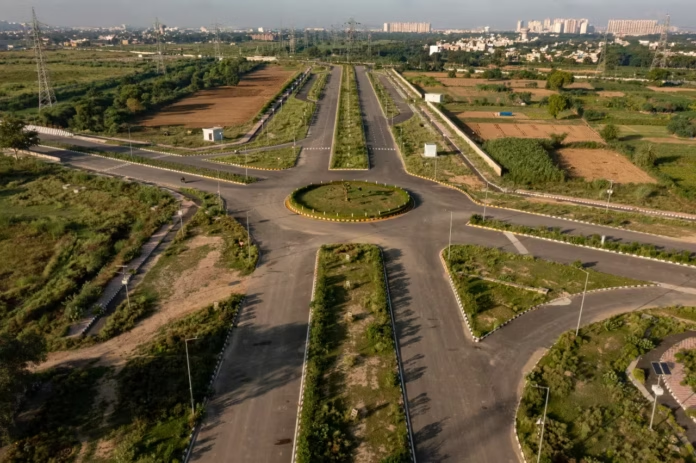
A decisive shift is underway in the National Capital Region’s housing geography. The Sonipat–Kundli belt in Haryana is witnessing accelerated residential interest, driven by transport upgrades, industrial investment and price pressures in core NCR markets. For planners and homebuyers alike, the corridor signals a broader northward rebalancing of growth beyond established hubs.
For over a decade, NCR expansion centred on Gurugram and Noida. However, rising land costs, congestion and stretched civic infrastructure in these cities have pushed both developers and households to reconsider alternatives. Sonipat–Kundli real estate is now emerging as a beneficiary of that recalibration, particularly among mid-income buyers seeking larger homes within commuting distance of Delhi. Connectivity remains the primary catalyst. The Urban Extension Road II project, designed to improve east–west movement across outer Delhi, is expected to ease travel from North-West Delhi to neighbouring Haryana districts. Metro rail expansion towards Narela and adjoining areas is also influencing residential decisions by shortening commute times. Meanwhile, the Regional Rapid Transit System network being developed by the National Capital Region Transport Corporation is reshaping expectations of inter-city mobility across NCR, including the Delhi–Panipat stretch that impacts Sonipat. Strategic highway access through the Kundli–Manesar–Palwal Expressway further integrates the area into logistics and manufacturing corridors. Industrial investments in the wider region, including large-scale automotive manufacturing facilities, are adding employment anchors that strengthen the case for live-work ecosystems rather than purely commuter suburbs.
Urban planners note that Sonipat–Kundli real estate differs from earlier peripheral expansions. Land parcels are comparatively larger, allowing for plotted developments and integrated townships with open spaces and lower density. This offers scope for climate-responsive design, improved ventilation and greener layouts critical considerations as northern India confronts worsening air quality and heat stress. Affordability remains central. Property values are significantly lower than comparable housing in Gurugram or central Delhi, enabling first-time buyers to access larger homes. According to industry experts, this price differential is encouraging genuine end-user demand rather than short-term speculation. The adjacency to Delhi is the silent enabler. As the capital faces land scarcity and rising ticket sizes, peripheral districts are becoming functional extensions of its residential ecosystem. Educational institutions such as Ashoka University and O.P. Jindal Global University further contribute to the area’s social infrastructure, attracting students, faculty and service-sector employment.
Yet challenges remain. Sustained growth will depend on timely completion of transport projects, water and waste infrastructure, and integration with regional planning frameworks. Without coordinated governance, rapid expansion risks replicating the infrastructure strain seen in earlier NCR boom cycles. For now, the evidence suggests that NCR’s next housing chapter may not be vertical densification alone, but measured geographic expansion with Sonipat–Kundli positioned at the forefront of that transition.
Also Read: NCR Namo Bharat reshapes northern housing
Sonipat Kundli corridor reshapes NCR housing