Home Blog Page 88

NCR Namo Bharat reshapes northern housing

    0
    NCR Namo Bharat reshapes northern housing
    NCR Namo Bharat reshapes northern housing

    A transport upgrade originally conceived to ease inter-city travel is beginning to alter real estate patterns across the National Capital Region. As the National Capital Region Transport Corporation rolls out its semi high speed rail network under the Namo Bharat programme, housing interest is steadily expanding towards the Sonipat and Kundli belt in Haryana.

    For years, capital and construction activity in NCR clustered around Gurugram and Noida. With land tightening and prices rising in those hubs, households and developers are reassessing options along new infrastructure spines. The Namo Bharat corridor, designed to compress travel time between regional centres and Delhi, is emerging as a structural catalyst rather than a speculative trigger. Urban planners tracking mobility trends say the significance lies in travel predictability. Faster, dedicated rail systems reduce commute uncertainty, making peripheral districts viable for daily travel. Even before full network completion, the operational Delhi–Meerut stretch has demonstrated how regional rapid transit can recalibrate perceived distance. Sonipat–Kundli is also benefiting from parallel upgrades. Urban Extension Road II is strengthening orbital movement around outer Delhi, while metro expansion towards Narela is widening public transport access to the northern periphery. When combined with the Kundli Manesar Palwal Expressway and national highway connectivity, the belt is becoming integrated into NCR’s logistics and employment grid.

    The housing response reflects this shift. Instead of purely investor driven launches, developers are planning plotted communities and integrated townships that emphasise lower density layouts, green buffers and internal infrastructure. Industry executives say demand enquiries increasingly come from working professionals seeking larger homes within manageable commuting range of Delhi. Affordability remains a decisive factor. Mid income buyers can access larger configurations in Sonipat compared to Gurugram or central Noida, while remaining connected to employment nodes. Analysts argue that this combination of cost efficiency and improved mobility is repositioning the area from fringe to functional extension of the capital. Institutional anchors add weight to the transition. Campuses such as O P Jindal Global University and Ashoka University support a steady rental and service economy. Meanwhile, industrial investments including the upcoming facility by Maruti Suzuki in Kharkhoda are expected to generate employment, strengthening long term housing absorption. Urban economists caution that infrastructure led growth must align with water, waste and energy planning to avoid repeating congestion patterns seen elsewhere in NCR. If transit oriented development is implemented responsibly, the Namo Bharat corridor could distribute opportunity more evenly while reducing carbon intensive commuting.

    As NCR enters its next expansion phase, the northern arc appears poised for gradual, infrastructure anchored growth. The durability of this shift will depend less on headline announcements and more on coordinated land use, transport integration and inclusive housing delivery.

    Also Read: Navi Mumbai CIDCO extends housing deadline

    NCR Namo Bharat reshapes northern housing


    Navi Mumbai CIDCO extends housing deadline

      0
      Navi Mumbai CIDCO extends housing deadline
      Navi Mumbai CIDCO extends housing deadline

      The City and Industrial Development Corporation has extended the application window for its mass housing initiative in Navi Mumbai, following strong public participation. The deadline to submit location preferences and pay the earnest money deposit has now been pushed to March 19, covering 16,876 tenements across multiple nodes of the satellite city.

      The move reflects sustained demand for formally planned, affordable housing in the Mumbai Metropolitan Region, particularly as infrastructure projects reshape Navi Mumbai’s growth trajectory. The scheme, branded “My Preferred CIDCO Home”, offers units primarily targeted at Economically Weaker Section (EWS) and Lower Income Group (LIG) households under the framework of Pradhan Mantri Awas Yojana. The 16,876 homes are distributed across established and emerging nodes including Vashi, Kharghar, Taloja, Panvel and Kalamboli, as well as transit-linked areas such as Bamandongri and Kharkopar. Many of these locations are positioned along key suburban rail corridors and expanding metro routes, and fall within the broader influence zone of the under-construction Navi Mumbai International Airport. Urban economists say the deadline extension suggests a robust appetite for regulated, lottery-based allocation systems amid rising land and rental prices across the region. “Formal affordable housing supply in well-connected nodes remains limited relative to demand. Extensions often indicate that households are actively mobilising finances to participate,” said a housing policy analyst tracking Navi Mumbai’s expansion.

      CIDCO’s housing projects have historically played a catalytic role in shaping the satellite city’s development pattern. By releasing large batches of subsidised units in planned clusters, the authority has aimed to prevent informal sprawl while aligning residential growth with trunk infrastructure such as roads, sewage systems and water supply networks. The emphasis on preference-based allocation in this scheme allows applicants to prioritise locations aligned with workplaces, schools and transport hubs a factor that planners say can reduce commuting burdens and support more balanced urban growth. Officials have advised applicants to rely solely on official communications for scheme updates, cautioning against misinformation. The earnest money deposit requirement, a standard feature in such allotment processes, is intended to ensure serious participation and streamline final allocations. As Navi Mumbai prepares for a new phase of expansion linked to airport operations and multimodal connectivity upgrades, the scale of this affordable housing release underscores the continuing relevance of public-sector intervention in shaping inclusive urbanisation.

      With the revised deadline in place, attention will now turn to how quickly these 16,876 tenements translate into occupied neighbourhoods and whether the model can keep pace with the region’s accelerating demographic and economic growth.

      Also Read: Macrotech expands footprint in South Mumbai

      Navi Mumbai CIDCO extends housing deadline


      Macrotech expands footprint in South Mumbai

        0
        Macrotech expands footprint in South Mumbai
        Macrotech expands footprint in South Mumbai

        A prominent Mumbai developer has secured development rights over a 4.3-acre land parcel in the Malabar and Cumballa Hill division, marking one of the most closely watched transactions in South Mumbai’s ultra-premium housing market this year. The deal signals renewed redevelopment momentum in legacy neighbourhoods where ageing low-rise structures sit on some of the city’s most valuable land.

        Macrotech Developers Limited, formerly known as Lodha Developers, entered into an agreement in early January with a charitable trust that owns the site. Publicly available property records indicate a transaction consideration of just over Rs 106 crore for the development rights. However, the valuation assessed for stamp duty purposes exceeds Rs 620 crore, reflecting the site’s strategic location and development potential. The parcel spans roughly 17,400 square metres and includes a mix of built forms a chawl housing over 40 tenants, a residential building, and multiple bungalows. Among the structures is a well-known private residence long associated with a senior political leader, adding a layer of public visibility to the project. Under the redevelopment framework, the land-owning trust is to receive a defined share of the constructed area in RERA carpet terms, along with dedicated parking and a percentage participation in the overall development component. Regulatory documentation also records the requirement of a substantial bank guarantee and security deposit, signalling the scale and financial complexity of the undertaking.

        Importantly, a portion of the larger landholding is excluded from the development scope, while a sizeable tract is proposed to be handed over to the state housing authority, MHADA. Such allocations are consistent with Mumbai’s redevelopment model, where private projects often intersect with public housing obligations. Urban planners say projects in Malabar Hill and adjoining precincts are not merely luxury real estate plays but also opportunities to upgrade ageing housing stock and infrastructure networks. Much of South Mumbai’s built environment dates back decades, with limited seismic retrofitting, parking, or modern waste and water systems. Sensitive redevelopment can improve building safety, energy efficiency and service integration in these high-density yet infrastructure-stressed areas. At the same time, redevelopment in heritage-adjacent zones requires navigating stringent planning controls, coastal regulation norms and community expectations. Tenant rehabilitation, transit accommodation and equitable distribution of built-up space remain central to avoiding protracted disputes.

        For Macrotech Developers Limited, the acquisition strengthens its pipeline in a micro-market where land supply is scarce and demand remains resilient despite cyclical slowdowns. For the city, the project will test how premium redevelopment can align with broader goals of safer structures, upgraded civic infrastructure and balanced urban growth in one of Mumbai’s most iconic neighbourhoods.

        Also Read: Mumbai civic body reviews INS Shikra high rise

        Macrotech expands footprint in South Mumbai


        Mumbai civic body reviews INS Shikra high rise

          0
          Mumbai civic body reviews INS Shikra high rise
          Mumbai civic body reviews INS Shikra high rise

          Mumbai’s municipal oversight panel has sought detailed explanations from civic officials over two sensitive urban decisions a high-rise project near a key naval air facility and a reduction in land allocated for the Worli Sewage Treatment Plant. The developments raise broader questions about planning transparency, infrastructure resilience and compliance in one of India’s most land-constrained cities.

          At its first meeting this term, the Improvements Committee of the Brihanmumbai Municipal Corporation reviewed concerns regarding a multi-storey structure coming up within close proximity of INS Shikra, the Indian Navy’s air station in South Mumbai. Members questioned whether requisite clearances were obtained and whether coastal and defence buffer norms were adequately considered. The matter has also reached the Bombay High Court, which has reportedly sought clarity from both municipal and defence authorities. Committee members indicated that any lapse in coordination between planning authorities and security agencies could have long-term implications, not only for national security but also for urban land governance. Urban development experts note that Mumbai’s complex overlay of defence land, coastal regulation zones and heritage precincts demands rigorous inter-agency scrutiny. “In dense cities, the margin for planning error is narrow. Height permissions and proximity norms must be transparent and defensible,” said a senior planner familiar with municipal processes. Parallelly, the committee turned its attention to the Worli Sewage Treatment Plant (Worli STP), a core component of Mumbai’s wastewater upgrade programme aimed at improving coastal water quality and climate resilience. Members flagged that the originally reserved plot area for the Worli STP had been significantly reduced, with part of the land reportedly repurposed for transit camp structures.

          The downsizing of land for the Worli STP has triggered concerns about long-term capacity and flood mitigation. Mumbai’s sewage infrastructure is being expanded to meet stricter discharge norms and rising population loads, particularly in low-lying coastal zones vulnerable to monsoon flooding and sea-level rise. Any reduction in operational footprint, experts caution, must be technically justified and publicly documented. Committee members also raised the issue of unauthorised construction in the vicinity, alleging that rule violations could aggravate flooding risks during heavy rainfall. While one structure has reportedly been removed, another remains partly occupied, prompting calls for a comprehensive status report. For a city investing heavily in upgraded treatment plants to curb marine pollution and build climate-resilient infrastructure, the Worli STP land question carries strategic weight. Similarly, scrutiny around development near defence installations highlights the tension between vertical growth and regulatory safeguards.

          The civic administration has assured the panel that detailed responses will be furnished. As Mumbai continues to densify, the episode underscores the need for coordinated planning, clear institutional accountability and infrastructure decisions aligned with long-term urban sustainability.

          Also Read: NCR Growth Shifts Northward To Sonipat Kundli Corridor

          Mumbai civic body reviews INS Shikra high rise


          Maharashtra RERA ruling reshapes Ghatkopar housing dispute

            0
            Maharashtra RERA ruling reshapes Ghatkopar housing dispute
            Maharashtra RERA ruling reshapes Ghatkopar housing dispute

            Mumbai’s housing regulator has intervened in a dispute between flat purchasers and a suburban developer, setting aside termination notices while directing both parties to honour financial commitments with interest. The order, issued by MahaRERA, centres on a residential project in Ghatkopar East and underscores how Maharashtra RERA is shaping accountability in delayed urban housing developments.

            The case concerns two apartments booked in 2019 in a mid-market project in the city’s eastern corridor. Buyers had paid more than half of the agreed consideration, but the developer later issued termination notices citing instalment defaults. The purchasers approached the regulator, arguing that they remained willing to pay but faced inconsistent demand communications and confusion around designated accounts. In its order, Maharashtra RERA restored the agreements, holding that the buyers must be given a final opportunity to clear outstanding dues along with applicable interest. At the same time, the authority directed the developer to pay interest for delayed possession, noting that the project had not secured its Occupation Certificate despite a pandemic-related extension of timelines. The regulator declined to grant compensation under Section 18 of the Real Estate (Regulation and Development) Act, clarifying that compensation typically applies when an allottee exits a project. Since the buyers chose to continue and seek possession, their relief was limited to interest for delay. The ruling also reaffirmed that purchasers are liable to pay interest on delayed instalments under Section 19(7), reinforcing the law’s principle of reciprocal obligations. Urban planners say such decisions are crucial in high-density suburbs like Ghatkopar, where stalled projects affect not just individual families but also broader infrastructure planning and neighbourhood stability. Delays in securing Occupation Certificates can slow down formal habitation, disrupt utility provisioning, and complicate municipal revenue flows.

            For developers, the order signals stricter scrutiny of force majeure claims related to regulatory clearances or aviation height restrictions. While such challenges are not uncommon in Mumbai’s complex approval ecosystem, authorities appear increasingly reluctant to treat them as blanket shields against statutory timelines. Maharashtra RERA has, in recent years, emerged as a central arbiter in balancing liquidity pressures in the real estate sector with homebuyer protection. As construction costs rise and financing tightens, disputes over payment schedules and delivery timelines are becoming more frequent. The Ghatkopar ruling illustrates how Maharashtra RERA is attempting to stabilise trust in urban housing markets without derailing projects.

            By preserving contracts while enforcing financial discipline on both sides, the regulator is signalling that compliance not cancellation remains the preferred path in a city where timely, transparent development is essential to equitable and resilient growth.

            Also Read: Bengaluru leads India office supply surge

            Maharashtra RERA ruling reshapes Ghatkopar housing dispute


            Bengaluru leads India office supply surge

              0
              Bengaluru leads India office supply surge
              Bengaluru leads India office supply surge

              India is set to account for nearly 40 per cent of Asia Pacific’s Grade A office completions in 2026, underlining the country’s expanding role in global corporate real estate as multinational firms deepen their footprint across major metros.

              According to a new market outlook by CBRE South Asia Pvt Ltd, total Grade A office supply across APAC is projected to touch 61.3 million sq ft in 2026, up from 55.3 million sq ft in 2025. India and mainland China together are expected to contribute more than three-quarters of this new supply, reflecting concentrated construction activity in the region’s largest economies. Within India, Bengaluru is forecast to emerge as the leading APAC market for new office completions at 12.1 million sq ft, ahead of Shanghai. Delhi NCR is projected to add 7.1 million sq ft, while Mumbai is expected to see supply nearly double to 5.1 million sq ft. Consultants attribute Bengaluru’s lead to sustained expansion by Global Capability Centres (GCCs), particularly in technology, financial services and research functions. India now hosts over 1,500 GCCs, and several global firms have announced plans to scale up engineering, analytics and AI teams, fuelling demand for high-specification campuses. Office assets have also regained favour among institutional investors in APAC, overtaking industrial and logistics properties for the first time in six years.

              Analysts say this shift reflects stabilising occupancy levels, rental resilience in prime districts and long-term confidence in knowledge-driven sectors. In Mumbai, the financial district of Bandra Kurla Complex recorded the highest rental growth in APAC in 2025, rising over 23 per cent year-on-year. Double-digit growth is expected to continue into 2026, supported by limited Grade A vacancy and strong demand from banking and financial services firms. Urban economists caution, however, that rapid supply expansion must align with infrastructure readiness. Metro rail connectivity, last-mile transport, energy reliability and climate-resilient building standards will play a critical role in sustaining absorption levels. Cities such as Bengaluru and Mumbai already face congestion and flooding risks, underscoring the need for integrated planning alongside commercial expansion.

              The concentration of new office development in India signals the country’s evolution from a back-office destination to a strategic operations hub. If supported by sustainable urban infrastructure and calibrated phasing, the projected 2026 supply wave could reinforce India’s position as a cornerstone of APAC’s corporate real estate landscape.

              Also Read: Mumbai vertical growth signals land pressure

              Bengaluru leads India office supply surge


              Mumbai vertical growth signals land pressure

                0
                Mumbai vertical growth signals land pressure
                Mumbai vertical growth signals land pressure

                India’s financial capital is building higher than ever before, with a new generation of super-tall residential towers redefining land economics, buyer expectations and infrastructure planning. From Worli to Mahalaxmi and Lower Parel, buildings crossing 250 metres are no longer anomalies but part of a structural shift in how the city accommodates growth.

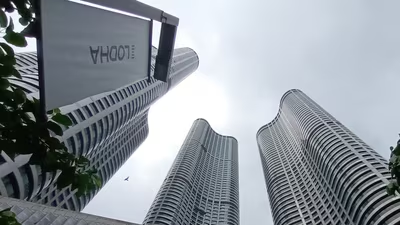
                Among the most prominent is Palais Royale in Worli, rising to approximately 320 metres and positioned to become India’s tallest operational building. Close behind stands Lokhandwala Minerva in Mahalaxmi at over 300 metres, while Lower Parel’s skyline features Lodha World One and Lodha World View. In Worli, Three Sixty West has further cemented the micro-market’s identity as a vertical luxury district. Urban economists argue that Mumbai taller towers are less about spectacle and more about necessity. The city’s peninsular geography restricts outward expansion, while nearly 90 per cent of developable land is already utilised. As land values climb, developers rely on higher floor space index (FSI) allowances and redevelopment frameworks to make projects financially viable. Height enables more saleable area on limited plots, particularly in former mill lands and ageing housing society clusters. Policy changes over the past decade including fungible FSI and incentive-linked redevelopment have provided the regulatory scaffolding for such growth.

                Demand has also evolved. High-net-worth individuals, senior executives and non-resident Indians increasingly seek expansive apartments with sea views, private lifts and hotel-style services. In this segment, elevation translates into exclusivity. Panoramic vistas and controlled access command significant price premiums. However, Mumbai taller towers also intensify infrastructure demands. High-rise clusters generate concentrated traffic, water usage and energy loads. Without parallel investment in transit systems, drainage upgrades and power redundancy, vertical densification risks amplifying urban stress. Planners note that super-tall construction involves longer approval cycles, advanced wind engineering, deeper foundations and higher capital exposure. Financing structures are complex, often dependent on phased sales and strong pre-launch bookings to maintain cash flow. The pipeline remains active. Proposed projects in South and Central Mumbai are expected to cross the 300-metre mark, signalling continued appetite for height. Yet absorption capacity remains a watchpoint. If multiple ultra-luxury towers enter the market simultaneously, inventory build-up could pressure pricing. For a city confronting climate vulnerability and land scarcity, verticality presents both opportunity and responsibility. Properly integrated with transit networks and resilient infrastructure, high-density living can reduce sprawl and shorten commutes. Poorly calibrated, it can strain already fragile systems.

                Mumbai’s skyline is thus more than a display of engineering prowess. It is a reflection of constrained geography, regulatory evolution and concentrated wealth and a test of whether ambition can align with sustainable urban planning.

                Also Read: Mumbai coastal housing sees fresh investment

                Mumbai vertical growth signals land pressure


                Mumbai coastal housing sees fresh investment

                  0
                  Mumbai coastal housing sees fresh investment
                  Mumbai coastal housing sees fresh investment

                  A Rs 10 crore land-and-building transaction in Madh Island has once again spotlighted the western suburb’s niche but steadily appreciating coastal property market, where limited inventory and redevelopment potential continue to attract high-value buyers.

                  Property registration records reviewed by Urban Acres show that a 1,197 sq metre plot within Suchak Cooperative Housing Society in Madh Island changed hands in February 2026. The buyer is Agam Kumar Nigam, father of playback singer Sonu Nigam. The parcel includes an existing ground-plus-one structure known as Mango Villa, comprising a two-level commercial unit of about 2,329 sq ft and an additional 725 sq ft residential component. The transaction was registered on 18 February 2026, with stamp duty of Rs 50 lakh and registration charges of Rs 30,000, according to publicly available documents. The deal size places it among the more significant standalone bungalow-style purchases in the Madh Island micro-market this year. Urban planners note that Madh Island occupies a distinctive position within Mumbai’s real estate landscape. Though geographically within the city’s limits, it retains a semi-rural character, with coastal stretches, low-rise structures and restricted development norms under Coastal Regulation Zone (CRZ) guidelines. These constraints limit supply but also create exclusivity, often driving up land values for buyers seeking privacy and proximity to the Arabian Sea. Industry analysts say plots with existing structures in cooperative societies are particularly sought after because they offer redevelopment flexibility, subject to regulatory approvals. With Mumbai’s mainland neighbourhoods witnessing densification and high-rise proliferation, peripheral coastal pockets like Madh Island appeal to end-users prioritising open space and lower density living.

                  The transaction also reflects a broader pattern of entertainment and creative industry professionals maintaining diversified property portfolios across Mumbai. In recent years, purchases in Andheri, Santacruz and western suburban corridors have indicated continued confidence in the city’s commercial and residential markets, even amid fluctuating sales cycles. However, infrastructure remains a defining variable. Madh Island’s connectivity largely dependent on road access through Malad and ferry services can act as both a deterrent and a draw. While limited accessibility preserves its enclave character, experts argue that any major connectivity upgrade could significantly alter land valuations and development intensity. Environmental resilience is another factor. Being a coastal zone, Madh Island is vulnerable to tidal impacts and extreme weather events. Sustainable construction practices and careful compliance with CRZ norms will be critical if redevelopment proposals emerge on such plots.

                  For Mumbai’s property ecosystem, the Madh Island property deal underscores how constrained land parcels in peripheral but scenic locations continue to command premium valuations. As the city debates balanced growth and climate-sensitive planning, coastal micro-markets will require calibrated development to preserve ecological buffers while accommodating private investment.

                  Also Read: Mumbai MHADA cluster redevelopment to unlock land

                  Mumbai coastal housing sees fresh investment


                  Mumbai MHADA cluster redevelopment to unlock land

                    0
                    Mumbai MHADA cluster redevelopment to unlock land
                    Mumbai MHADA cluster redevelopment to unlock land

                    With nearly nine-tenths of the city’s developable land already built upon and households spending close to half their income on home loan repayments, Maharashtra’s housing authority is preparing a large-scale shift toward cluster redevelopment to ease structural stress in the housing market.

                    At an industry conclave in Mumbai, the vice-president and CEO of Maharashtra Housing and Area Development Authority outlined plans to open up between 800 and 1,000 acres for integrated redevelopment across the island city. The move comes as the Mumbai housing affordability index hovers around 50 per cent, indicating significant strain on middle-income and first-time buyers. Unlike conventional building-by-building reconstruction, the cluster model consolidates fragmented plots often comprising ageing cess buildings into contiguous land parcels ranging from 60 to 100 acres. The approach enables planned layouts with wider internal roads, open spaces, upgraded utilities and community amenities. Officials argue that such township-style planning within city limits could deliver both scale and better infrastructure outcomes. Under the state’s broader roadmap, 2.8 million affordable homes are targeted across the Mumbai Metropolitan Region (MMR) by 2030. MHADA is expected to contribute roughly 0.8 million units through direct construction and policy-backed schemes. In the past two and a half years, about 50,000 units have reportedly been delivered, with a majority of future supply tied to approved or pipeline cluster projects. Urban economists say the scale is ambitious but necessary. Mumbai’s redevelopment landscape has long been constrained by small plot sizes, litigation, and consent thresholds that delay execution. By aggregating land and standardising design frameworks, authorities hope to reduce inefficiencies and accelerate supply particularly for economically weaker sections (EWS) and low-income groups (LIG).

                    Policy reform is also under consideration. Officials indicated that rationalising premiums, development charges and related taxes for affordable housing could reduce end-user prices by as much as 20–25 per cent in select categories. Industry representatives have consistently flagged high statutory levies as a major contributor to elevated ticket sizes. Connectivity remains central to the strategy. The expansion of metro corridors, upcoming airport infrastructure in Navi Mumbai and improved suburban rail capacity are expected to redistribute demand across the MMR. However, officials cautioned that rapid supply expansion must be calibrated to avoid unsold inventory build-up. Housing experts have also called for diversification beyond ownership models. Rental housing, student accommodation, working women’s hostels and industrial housing are being positioned as complementary formats under the state’s 2025 housing policy framework.

                    As Mumbai confronts ageing building stock and rising redevelopment risks, MHADA cluster redevelopment represents a structural pivot from fragmented reconstruction to integrated neighbourhood planning. Its success will depend on execution speed, transparent beneficiary identification and sustained infrastructure upgrades that ensure affordability gains translate into liveable, climate-resilient communities.

                    Also Read: Mumbai Juhu luxury mansion reshapes skyline

                    Mumbai MHADA cluster redevelopment to unlock land


                    Karnataka Cement Plant Faces CPCB Pollution Notice

                      0
                      Punjab Sangrur Cement Plant CLU Cancelled By Court
                      Punjab Sangrur Cement Plant CLU Cancelled By Court

                      Environmental regulators have issued a formal notice to a major cement facility in northern Karnataka after identifying significant deviations from emissions standards — a development that highlights mounting regulatory scrutiny over industrial pollution in India’s rapidly urbanising regions. The Central Pollution Control Board (CPCB) has directed corrective action at Kalaburagi Cement Private Limited in Chatrasala village after an inspection revealed gaps in monitoring and elevated particulate emissions that may pose public health and environmental risks.

                      The integrated plant, licensed for an annual production capacity of 3.6 million tonnes of cement and 2.75 million tonnes of clinker, also operates a 30 MW captive power unit and an 8.4 MW waste heat recovery system. However, the CPCB found that one of the key emission monitoring requirements was unmet: a Continuous Emission Monitoring System (CEMS) for particulate matter (PM), sulphur dioxide (SO₂) and nitrogen oxides (NOx) was not installed on the boiler stack with roughly 130 tonne per hour capacity, despite CEMS being in place on five other stacks.Beyond equipment gaps, the emission levels detected manually at three stacks significantly exceeded the mandated limit of 30 mg per cubic metre — reaching values as high as 357.42 mg/m³ in the clinker cooler stack. The CPCB also noted inconsistencies between real-time CEMS data reported on the national portal and independent manual measurements, and flagged instances of emission data appearing on the system when the corresponding mill was reportedly non-operational.

                      The notice arrives amid growing concerns over air quality in industrial corridors and peri-urban areas, where pollutants from heavy manufacturing often intersect with residential zones. Cement manufacturing is a key economic driver in districts like Kalaburagi, which have attracted investments in plant expansions and new facilities to meet rising infrastructure demand. But its environmental footprint — particularly dust and combustion-related emissions — is also under heightened regulatory and public scrutiny.Experts point out that robust emissions monitoring and transparent real-time data reporting are essential not just for regulatory compliance but also for community trust and environmental management. Poor air quality contributes to respiratory and cardiovascular health risks, impacts visibility, and can undermine ecological integrity in agrarian landscapes surrounding industrial hubs. Analysts note that discrepancies between manual readings and real-time monitoring systems underscore the challenges of data reliability and enforcement in complex manufacturing settings.

                      Regulators rarely publish individual plant findings, but the recent action reflects a systemic emphasis on tightening compliance with the Environment (Protection) Act guidelines and enhancing the accuracy of pollution measurement. “Continuous monitoring systems must be comprehensive and functional where emissions are most significant,” a senior environment official said. Independent monitoring, community feedback, and corrective plans are now expected ahead of a follow-up review.

                      For Kalaburagi’s residents and planners, the incident reinforces the need for integrated urban-industrial air quality strategies that balance economic activity with environmental health. Cement plants are critical to India’s infrastructure supply chain, yet managing their environmental impacts — through effective monitoring, cleaner technologies and transparent reporting — is increasingly core to sustainable and inclusive regional development.

                      Also Read: India Prism Johnson Unveils New Gypsum Plaster

                      Karnataka Cement Plant Faces CPCB Pollution Notice