

Mumbai Juhu luxury mansion reshapes skyline

A nine-storey private residence in Juhu, designed by Italian architect Piero Lissoni, is drawing attention not only for its scale but for what it signals about the evolution of Mumbai’s ultra-premium housing market where standalone vertical mansions are emerging as an alternative to luxury high-rise apartments.
Owned by real estate entrepreneur Vikas Oberoi and his spouse, former actor Gayatri Oberoi, the nine-level structure rises within the coastal neighbourhood of Juhu, one of Mumbai’s most land-constrained and high-value residential pockets. Industry estimates suggest that sea-facing plots in this micro-market command some of the highest per-square-foot rates in the city, reflecting both scarcity and legacy zoning patterns. Spanning multiple levels, the home integrates dual staircases as central architectural elements, alongside expansive entertaining areas and private wellness amenities. Two basement floors are dedicated to parking and leisure infrastructure, including a gym, spa and a 12-seat screening room features increasingly common in top-tier residences where privacy and self-contained living are prioritised. Urban designers observe that such vertical bungalows reflect a broader shift in Mumbai’s luxury housing typology. As traditional horizontal estates become rare due to subdivision and redevelopment pressures, affluent homeowners are building upward within permissible height norms. This approach allows families to retain the exclusivity of an independent residence while accommodating modern requirements such as lifts, service cores and segregated guest areas.
The project also underscores the growing influence of global design firms in India’s residential sector. International architects are being commissioned to craft bespoke homes that double as architectural statements, often blending hospitality-grade planning with private living. The owners have previously showcased a high-end apartment at Three Sixty West in Worli, a super-luxury tower known for large-format residences and hotel-branded services highlighting the overlap between residential and hospitality design languages. However, planners caution that the rise of private vertical mansions raises questions about neighbourhood infrastructure. Juhu, like many coastal suburbs, grapples with traffic congestion, limited drainage capacity and coastal regulation constraints. As individual homes expand in scale and amenity intensity, municipal systems must keep pace with power, water and waste management demands. At the same time, the emphasis on integrated wellness spaces and efficient internal circulation reflects changing post-pandemic priorities, where homes are expected to function as workplaces, leisure zones and social venues.
For Mumbai’s real estate market, such residences represent a niche but influential segment one that shapes architectural trends and land values in prime districts. As the city balances densification with liveability and climate resilience, the future of ultra-luxury housing will depend not only on design ambition but on how sensitively it integrates with its urban surroundings.
Also Read: Mumbai Dharavi redevelopment vision spans 20 years
Mumbai Juhu luxury mansion reshapes skyline
Haryana NGT Orders Report On Panipat Cement Pollution

India’s rapidly urbanising industrial belts are once again under environmental scrutiny after the National Green Tribunal (NGT) directed the Haryana State Pollution Control Board (HSPCB) to submit a detailed compliance report on alleged violations by a cement factory in Khukhrana village, near Panipat. The move reflects growing judicial concern over industrial pollution’s impact on local health and environmental quality at a time when cities nationwide are grappling with air and soil contamination linked to construction supply chains.
The NGT’s order follows a joint inspection by the Central Pollution Control Board (CPCB), HSPCB and the District Magistrate last year that flagged significant breaches of environmental norms at the plant sited barely 10 feet from the village residential cluster. The tribunal has scheduled the next hearing for early May, after giving the HSPCB six weeks to file its findings.According to the interim report, plant operations have been linked to persistent cement dust emissions settling in nearby homes and on vegetation, posing potential respiratory and ecological risks. Although the facility implemented a basic water-sprinkling mechanism and proposed a marginal green-belt expansion, these measures were deemed insufficient to mitigate particulate drift into the community.The context of this development matters in broader urban and industrial policy discussions. Cement production and handling are known contributors to particulate matter in ambient air — a major public health concern in industrial hubs like Panipat and the wider National Capital Region. Recent environmental monitoring around the Panipat Thermal Power Station has detected elevated levels of hazardous pollutants, including nickel and benzene, at several residential locations, prompting separate remedial directives from the NGT.
Urban planners and health experts say such pollution hotspots can have cumulative effects on population well-being, particularly when they intersect with dense housing, schools and informal settlements. As India pursues expansive infrastructure and housing programmes, ensuring that key industrial inputs — from cement to concrete — comply with environmental standards becomes central to both sustainable urban development and long-term climate resilience.The NGT’s insistence on accountability also underscores a wider regulatory challenge in many Indian states, where local pollution control agencies are often criticised for delayed or inconsistent enforcement. Stakeholders point to the need for more systematic emissions monitoring, transparent data sharing and stricter penalties for non-compliance to protect vulnerable communities living on the margins of industrial zones.
For Panipat’s residents and civic authorities, the tribunal’s intervention offers a rare opportunity to benchmark industrial compliance against environmental benchmarks and public health priorities. The upcoming status report will not only clarify the factory’s adherence to norms but also potentially shape future policy on industrial siting, pollution control infrastructure and community health safeguards in rapidly urbanising regions.
Also Read: India Cement Sector Drives Deep Decarbonisation Strategy
Haryana NGT Orders Report On Panipat Cement Pollution
Mumbai Dharavi redevelopment vision spans 20 years
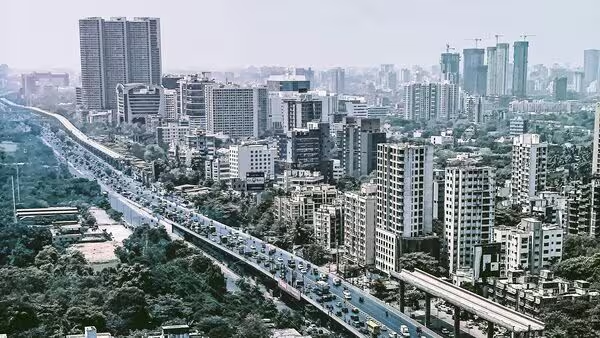
The proposed Dharavi redevelopment is being framed as a multi-decade urban restructuring exercise rather than a conventional housing project, with its backers outlining a 15–20 year roadmap that seeks to reshape one of Asia’s most densely populated informal settlements into an integrated township.
Speaking at a public policy forum in Mumbai, a senior executive from the Adani Group said the Dharavi redevelopment project would unfold in phases, with core construction expected to take about seven years, followed by additional commercial and civic build-outs. The scale is unprecedented: current estimates place Dharavi’s population at around 10 lakh residents, alongside thousands of small-scale industrial and commercial units. Adani Group is leading the special purpose vehicle tasked with executing the redevelopment. The executive described the initiative as a structural reset aimed at improving housing conditions, infrastructure and economic prospects, while retaining the entrepreneurial ecosystem that has historically defined Dharavi. Urban policy experts note that Dharavi’s significance extends beyond its geography. Located between key transport corridors and business districts, the settlement occupies nearly 240 hectares of strategically valuable land in the heart of Mumbai. Any redevelopment effort must therefore reconcile commercial viability with rehabilitation commitments and complex tenancy verification. The executive linked Mumbai’s future growth to infrastructure expansion, pointing to improved intra-city mobility and dual-airport capacity as examples of how connectivity can unlock urban transformation. Analysts agree that transport upgrades including metro lines and arterial road projects will be critical in absorbing the additional density envisioned under the Dharavi redevelopment project.
]Yet the project’s success hinges on social legitimacy. Housing rights advocates argue that transparent eligibility criteria, livelihood protection and phased relocation will determine whether redevelopment delivers genuine upward mobility or merely vertical resettlement. Dharavi’s informal economy from leather workshops to recycling units contributes significantly to Mumbai’s supply chains and must be integrated into any master plan. Planners also emphasise climate resilience. Much of Dharavi is vulnerable to flooding due to low-lying topography and ageing drainage. A comprehensive rebuild offers an opportunity to embed stormwater management, decentralised waste systems and energy-efficient buildings into the new urban fabric interventions aligned with Mumbai’s broader sustainability targets. Described by its proponents as a “city within a city”, the blueprint includes residential towers, retail districts, healthcare facilities and public amenities. However, financing and phasing such a transformation over two decades will require stable regulatory frameworks and sustained political oversight.
For Mumbai, the Dharavi redevelopment project represents both risk and opportunity: a chance to address historic inequities in housing and infrastructure, while testing whether large-scale private-public urban regeneration can be executed without displacing the very communities it seeks to uplift.
Also Read: Mumbai Ajmera Realty enters luxury housing
Mumbai Dharavi redevelopment vision spans 20 years
India Cement Sector Drives Deep Decarbonisation Strategy

India’s cement industry — a cornerstone of the nation’s infrastructure and urban growth — is entering a decisive phase in its climate transition as policymakers and industrial leaders explore technology, regulation and market mechanisms to shrink one of the country’s largest industrial emission footprints. Accounting for roughly 6% of national CO₂ emissions, the sector’s climate performance will shape how India meets its net-zero by 2070 goals while pursuing ambitious urbanisation and housing agendas.
Cement production in India is “hard to abate”: more than half of emissions stem from the calcination process — a necessary chemical transformation of limestone into clinker, cement’s primary binding ingredient — which itself releases CO₂ that cannot simply be eliminated by switching to clean energy. On top of that, 30–35% of emissions arise from fossil fuel combustion to fire kilns at extremely high temperatures.These dynamics pose a structural challenge for industry planners and urban policymakers, because growing demand — driven by massive infrastructure programmes, urban expansion and residential construction — continues to collide with sustainability expectations from investors and global supply chains.To address this, a multi-pronged approach is emerging that spans production and demand levers. On the supply side, reducing the clinker factor — the proportion of clinker in cement — is seen as the single most impactful lever for cutting emissions. India’s clinker ratio has traditionally hovered above the global average, but a shift toward blended cements using supplementary materials like fly ash, ground granulated blast-furnace slag and limestone calcined clay (LC3) presents a tangible emissions reduction pathway of 30–40%.
Lower clinker cement blends are already gaining traction in pilot projects and select infrastructure builds, offering a proof of concept for broader industrial adoption. Meanwhile, optimising energy use — including through waste heat recovery systems, renewable electricity integration and more efficient kiln technologies — promises both environmental and cost benefits, although high upfront capital requirements remain a barrier for many plants.At the policy level, India’s emerging Carbon Credit Trading Scheme (CCTS) and recently notified Greenhouse Gas Emission Intensity Target Rules 2025 mark a shift from voluntary initiatives to measurable compliance frameworks. These rules aim to anchor emission intensity reduction targets for major cement facilities, linking performance with tradable credits and potential penalties — a regulatory nudge essential for long-term transformation.
Still, analysts caution that current incentives and regulatory frameworks must expand beyond baseline targets to catalyse capital flows into cleaner manufacturing technologies. Robust green public procurement policies, fiscal incentives for alternative fuel adoption, and streamlined approvals for carbon capture, utilisation and storage (CCUS) could help unlock broader decarbonisation at scale.For Indian cities and infrastructure planners, these shifts are more than compliance exercises. Cement’s embedded carbon affects lifecycle emissions of buildings, bridges, metros and affordable housing — and lowering that footprint delivers long-term climate resilience and future-proofs public investment.
As India navigates between growth, equity and climate goals, the cement sector’s transition will be a bellwether for how high-emission industries can modernise in a way that supports sustainable urbanisation and economic opportunity.
Also Read: India Cement Sector Engages Global Climate Dialogue
India Cement Sector Drives Deep Decarbonisation Strategy
India Cement Sector Engages Global Climate Dialogue

India’s cement sector is sharpening its focus on climate transition, energy efficiency and future-ready manufacturing as global industry discussions intensify ahead of the World Cement Association Annual Conference 2026. With India now the world’s second-largest cement producer, the outcomes of these global deliberations are increasingly shaping domestic investment strategies, regulatory thinking and infrastructure planning.
The international conference, scheduled for April 2026 in Southeast Asia, is expected to draw senior executives, policymakers and technology providers from across Asia, Europe and Africa. For Indian manufacturers and construction stakeholders, the forum arrives at a pivotal moment — as large-scale infrastructure expansion collides with tightening carbon expectations and rising energy costs.Industry analysts note that India’s cement demand remains structurally strong, driven by highways, housing, metros and industrial corridors. However, this growth comes with mounting pressure to curb emissions in a sector responsible for a significant share of industrial carbon output. As global peers move towards low-clinker formulations, alternative fuels and digital optimisation, Indian producers are under increasing scrutiny from investors, lenders and urban authorities.Conference discussions are expected to focus on market volatility, carbon pricing trajectories and the role of supplementary cementitious materials — themes with direct relevance for India’s construction ecosystem. Urban planners and developers are watching closely as cement costs, material availability and sustainability benchmarks increasingly influence project feasibility and approvals in major cities.
Experts say that India’s cement transition is no longer just an environmental issue but an economic one. Energy efficiency, waste heat recovery and AI-driven plant operations are now viewed as competitiveness tools rather than optional upgrades. As cities pursue climate-resilient infrastructure and lower embodied carbon in buildings, the material supply chain is becoming a strategic concern for municipal and state agencies.Another area of interest for Indian stakeholders is the evolving global conversation around circularity. The use of industrial by-products, construction waste and alternative fuels aligns with India’s broader push towards resource efficiency and reduced landfill dependence. These approaches are particularly relevant for urban regions grappling with waste management and air quality challenges.The conference’s focus on safety, innovation and leadership standards also reflects a shift in how performance is measured across the cement value chain. Recognition frameworks increasingly reward measurable sustainability outcomes — a trend that could influence procurement norms and ESG-linked financing in India.
As India positions itself as a long-term infrastructure growth engine, engagement with global cement dialogues is becoming less about representation and more about readiness. The direction set by international industry platforms over the next few years will play a quiet but decisive role in shaping how India builds — balancing speed, scale and sustainability in the decades ahead.
Also Read: Mumbai Ajmera Realty enters luxury housing
India Cement Sector Engages Global Climate Dialogue
Mumbai Ajmera Realty enters luxury housing

A mid-sized city developer has stepped into Mumbai’s high-end residential bracket with a new project in Versova, signalling sustained appetite for large-format homes in established western suburbs despite rising land and construction costs.
Ajmera Realty & Infra India Ltd has unveiled “Vann” in the 7 Bungalows precinct of Versova, marking its formal entry into the ultra-premium segment. The project comprises 53 residences, including three- and four-bedroom configurations, with indicative pricing beginning at Rs 7 crore and Rs 12 crore respectively. The company has indicated a gross development value of approximately Rs 450 crore. Located in Andheri West’s coastal belt, the site sits within a mature social infrastructure network schools, healthcare facilities, retail corridors and metro connectivity that has increasingly drawn end-users seeking spacious homes within city limits. Property consultants tracking Mumbai Versova ultra luxury housing say supply in this micro-market remains limited due to constrained land parcels and redevelopment complexities. The development spans close to 91,000 sq ft of carpet area. According to project disclosures, more than half of the plot is allocated to open and landscaped zones. While such claims are common in the luxury bracket, planners note that open-space ratios are becoming a differentiator as high-density neighbourhoods confront heat stress, flooding risks and declining tree cover. Marketing material highlights a “forest walk” concept and over 50 lifestyle amenities, including fitness and wellness spaces. Rainwater harvesting and waste management systems are also proposed. In a city where infrastructure strain and monsoon vulnerability are recurring concerns, environmental design elements are increasingly scrutinised by discerning buyers.
Industry observers say the timing aligns with a broader shift in demand. Post-pandemic homebuyers in Mumbai’s premium category have shown preference for low-density floors, enhanced ventilation and access to green pockets. Versova, with its coastal frontage and improving metro access, has seen renewed interest from entrepreneurs, entertainment professionals and senior executives. However, analysts caution that ultra-luxury launches in suburban markets must balance pricing with absorption velocity. Ticket sizes above Rs 7 crore narrow the buyer pool, making brand credibility and construction timelines critical. For the developer, the entry represents both a brand repositioning and a strategic hedge against margin compression in mid-income housing. For the city, projects in the Mumbai Versova ultra luxury housing segment illustrate how established suburbs are transitioning toward boutique, high-value redevelopment rather than expansive greenfield growth.
As Mumbai pursues transit-oriented development and climate-resilient planning, the future of such enclaves will depend not only on exclusivity but also on how effectively they integrate with public infrastructure and neighbourhood ecosystems.
Also Read: Navi Mumbai office demand rises with SBI deal
Mumbai Ajmera Realty enters luxury housing
Navi Mumbai office demand rises with SBI deal

India’s largest public sector lender has leased 1.34 lakh sq ft of office space in Airoli to house a new Global Capability Centre (GCC), reinforcing the node’s emergence as a back-office and digital operations hub within the Mumbai Metropolitan Region (MMR).
Registration documents reviewed by Urban Acres show that the space located at Newa Bhakti Knowledge City in Airoli has been taken on a five-year lease at a starting rent of Rs 125.05 per sq ft per month. The total outgo works out to approximately Rs 1.68 crore per month, inclusive of fit-outs. The agreement includes a 15 per cent escalation clause at renewal and a security deposit exceeding Rs 10 crore. The transaction adds institutional weight to Navi Mumbai’s commercial story. Over the past three years, Airoli has steadily attracted technology firms and financial services back offices seeking large, contiguous floor plates at rentals significantly lower than Bandra Kurla Complex (BKC) or Lower Parel. With improving road and rail connectivity, including proximity to the Eastern Express Highway and suburban rail links, the micro-market has positioned itself as a cost-efficient alternative for data-intensive operations. Industry analysts say the move reflects a broader shift among banks and financial institutions toward consolidating digital, analytics and IT functions within dedicated GCC formats. Such centres typically demand robust power supply, high data redundancy and scalable infrastructure factors that business parks in Navi Mumbai have increasingly been designed to support. The lease also signals confidence in Grade A commercial assets outside Mumbai’s traditional central business districts. According to property consultants tracking MMR leasing trends, Airoli has witnessed multiple transactions exceeding one lakh sq ft over the past year, particularly from IT and multinational corporations. Rental benchmarks in the Rs 110-Rs 140 per sq ft range have helped the node remain competitive while maintaining healthy occupancy.
For Navi Mumbai, the growing GCC ecosystem has wider urban implications. Concentrated employment nodes generate demand for residential housing, public transport upgrades and social infrastructure. Urban planners note that decentralised office growth can reduce commute stress into South and Central Mumbai, provided last-mile connectivity and sustainable mobility systems keep pace. The lender’s latest lease follows earlier commercial real estate activity within the group, including office acquisitions in BKC in 2024. The pivot to Airoli, however, reflects a strategic recalibration toward cost-optimised expansion aligned with digital banking growth. As Indian financial institutions deepen technology investments, secondary business districts like Airoli could see sustained absorption.
The challenge for civic authorities will be ensuring that infrastructure expansion from transit capacity to climate-resilient utilities keeps step with rising commercial density, preserving the liveability dividend that initially drew occupiers to the node.
Also Read: Mumbai Anil Kapoor real estate portfolio grows
Navi Mumbai office demand rises with SBI deal
Mumbai Anil Kapoor real estate portfolio grows

The global property holdings of a veteran Hindi film actor now span four countries, with the combined Anil Kapoor real estate portfolio estimated at over Rs 150 crore, according to a review of publicly available property records and market valuations. The spread across Mumbai, London, Dubai and California reflects how high-net-worth individuals are diversifying residential assets across mature and emerging urban markets.
In Mumbai, the centrepiece of the Anil Kapoor real estate portfolio remains a four-storey bungalow in the JVPD Scheme in Juhu. Property data platforms estimate the 10,000 sq ft structure to be valued at roughly Rs 30 crore, though independent brokers suggest the land component alone in this micro-market commands a premium given supply constraints. The property was reportedly consolidated in phases over several years, illustrating a long-hold acquisition strategy rather than speculative flipping. Urban planners note that JVPD and adjoining Juhu neighbourhoods remain among Mumbai’s most resilient residential zones, supported by coastal connectivity, social infrastructure and consistent redevelopment activity. As Mumbai debates density, transit-oriented growth and coastal regulation norms, legacy bungalow plots in these areas increasingly represent rare, low-rise urban assets. In 2025, additional investment was made in Bandra West, where a 1,165 sq ft apartment was acquired in the Pali Mala Road precinct near Pali Hill for approximately Rs 5 crore, according to registration data reviewed by Urban Acres. The transaction underscores continued investor confidence in Bandra’s established residential clusters, where proximity to business districts and lifestyle infrastructure sustains capital values despite cyclical slowdowns. Beyond India, the portfolio extends to Mayfair in London one of the world’s most tightly held prime residential markets. Apartments along North Audley Street routinely command multi-million-pound valuations, reflecting the city’s position as a global financial and cultural hub. For Indian investors, London property often serves as both a hedge against currency volatility and a base for international professional engagements.
In Dubai, records indicate ownership of a two-bedroom apartment in Al Furjan, a transit-linked community developed near major business corridors. Industry consultants point to Dubai’s comparatively high rental yields and streamlined property processes as factors drawing overseas investors. As Gulf cities accelerate sustainability-linked infrastructure and metro expansion, integrated communities like Al Furjan have gained traction among global buyers. The final asset lies in Irvine, California, in Orange County a planned city known for university-led growth, technology employment and master-planned housing clusters. Luxury two-bedroom units in this market are currently valued between $1.5 million and $2 million, based on 2026 broker estimates. Collectively, the portfolio reflects a preference for established, infrastructure-backed neighbourhoods with long-term appreciation potential. For Indian metros navigating rapid urbanisation, the pattern also signals how global capital even from domestic entertainment sectors increasingly favours stable, transit-connected and regulation-compliant housing markets over speculative expansion.
As Indian cities push toward climate-resilient planning and formalised real estate frameworks, such disciplined cross-border investment strategies may become more common among high-income households seeking both security and global mobility.
Also Read: Pune Bhugaon real estate gains traction
Mumbai Anil Kapoor real estate portfolio grows
Pune Bhugaon Real Estate Gains Traction
