
Ahmedabad logistics investment accelerates in Bawla

The asset spans close to 0.9 million square feet of Grade A warehousing and industrial space along National Highway 48, a strategic freight corridor connecting Gujarat to Maharashtra and Rajasthan. Bawla has steadily evolved from a peripheral industrial pocket into a preferred destination for third-party logistics operators, e-commerce firms and manufacturing-linked storage facilities.
For the seller, a Gujarat-based industrial developer, the transaction enables capital recycling into new projects at a time when demand for modern warehousing remains robust. Analysts say this churn of capital is essential to sustain supply pipelines in high-growth corridors without over-leveraging balance sheets.
Yet they emphasise that infrastructure upgrades must be accompanied by coordinated land-use planning to prevent congestion and environmental stress.
Goa Suspends Village Land Use Changes

The Goa government has suspended nine land-use change approvals in Siridao Palem village following a high-profile hunger strike by an opposition legislator, signalling a temporary pause in the contentious implementation of the Goa land conversion law under Section 39A of the Town and Country Planning framework. The protest, held in Panaji, drew significant public participation and renewed scrutiny of planning reforms introduced in 2024. The amended provision empowers the state’s chief town planner to alter zoning classifications, enabling agricultural plots, orchards and hill slopes to be repurposed for construction. Critics argue that the Goa land conversion law risks accelerating speculative real estate activity in ecologically sensitive zones without adequate public consultation.
According to state officials, the suspended approvals pertain to proposed commercial and housing developments in the coastal constituency represented by the protesting legislator. The Chief Minister has also indicated that the controversial clause will be discussed during the upcoming Assembly session, opening the door for legislative review. Urban planners say the episode reflects a broader tension facing smaller states with high land values and fragile ecosystems. Goa’s compact geography, dense tourism economy and limited agricultural base make land-use decisions particularly consequential. Once zoning changes are formalised, reversing them becomes administratively complex and politically sensitive.
Environmental groups contend that hill slopes and orchard belts function as natural buffers against flooding and heat stress, both of which have intensified across India’s western coast. As climate variability increases, land-use planning has emerged as a frontline tool for resilience. Retaining green cover and agricultural land within urbanising regions helps regulate microclimates, recharge groundwater and preserve livelihoods. Real estate analysts, however, note that demand for premium housing and hospitality infrastructure remains strong, especially in peri-urban pockets near Panaji and coastal villages. The challenge for policymakers is to reconcile economic growth with transparent planning norms and cumulative environmental impact assessments.
The public mobilisation around the Goa land conversion law also underscores rising civic engagement in spatial governance. Protesters occupied administrative offices before launching a fast at a central protest ground, drawing attention to procedural concerns in zoning decisions. Planning experts argue that participatory mechanisms including public hearings and digital disclosure of land-use changes can reduce conflict and improve trust in institutions. For now, the suspension of the nine approvals offers breathing space.
Whether it results in amendments, stricter safeguards or clearer environmental criteria will depend on the forthcoming Assembly deliberations. As Goa recalibrates its planning framework, the outcome may set a precedent for other rapidly urbanising regions where land scarcity, tourism-driven real estate demand and climate vulnerability intersect. The debate signals that future growth in India’s coastal states will increasingly hinge not just on construction, but on credible, climate-sensitive governance.
Goa Suspends Village Land Use Changes
Pune Sees New Low Density Luxury Villas

A new cluster of high-end residences is set to take shape in Hadapsar Annexe, as Shapoorji Pallonji Real Estate introduces a limited inventory luxury villa development in Pune’s eastern growth corridor. The project, comprising just 25 homes, signals rising demand for expansive, low-density housing formats in a city traditionally known for mid-rise apartment communities.
The development includes a mix of full villas and what the developer describes as “villaments” hybrid homes designed to combine the independence of a bungalow with the structural efficiencies of apartment living. In a market where vertical construction has dominated over the past decade, this pivot towards land-intensive formats reflects a clear shift in buyer preference, particularly among upper-income households seeking privacy, larger built-up areas and landscaped surroundings.
Each villa offers over 5,600 square feet of usable space, while the villaments range between roughly 3,400 and 3,800 square feet. Industry analysts say such configurations cater to professionals and business families working across Hadapsar’s IT and commercial districts, who increasingly prioritise home-based workspaces, private outdoor areas and multi-generational layouts.
Urban planners note that Hadapsar Annexe has evolved from a peripheral extension into a strategic residential micro-market. Its proximity to established employment nodes such as Magarpatta and SP Infocity, alongside access to education and healthcare facilities, has strengthened its liveability index. Planned infrastructure including a proposed double-decker flyover, ring road connectivity and metro expansion is expected to improve east-west mobility, a persistent challenge in Pune’s traffic network.
Pricing, starting in the upper luxury bracket, places the project firmly within Pune’s premium housing segment. However, the limited scale also raises broader questions about land use efficiency in rapidly urbanising corridors. While low-density formats appeal to affluent buyers, urban economists caution that balanced city growth requires a mix of housing typologies to ensure inclusivity and prevent infrastructure strain. The site’s integration of mature trees into the master plan aligns with a growing emphasis on biophilic design and climate-responsive architecture. Retaining existing green cover can help moderate microclimates, reduce heat gain and support biodiversity within residential layouts factors increasingly relevant as Indian cities confront rising temperatures and erratic rainfall patterns.
Real estate observers suggest that Pune luxury villas are emerging as a niche but expanding asset class, supported by rising disposable incomes and aspirations for differentiated living. At the same time, municipal authorities face the parallel task of ensuring that infrastructure keeps pace with high-value development.
As eastern Pune continues to densify, the interplay between boutique luxury projects and broader urban planning goals will shape whether growth remains sustainable, accessible and resilient in the years ahead.
Pune Sees New Low Density Luxury Villas
Pimpri Chinchwad Offers Property Tax Penalty Waiver
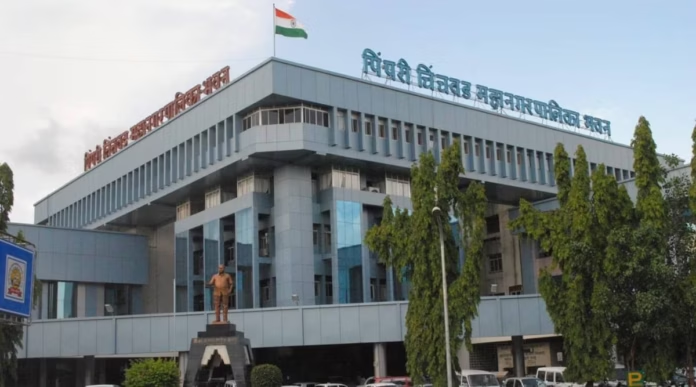
The Pimpri Chinchwad Municipal Corporation has introduced a month-long property tax penalty waiver scheme aimed at accelerating revenue recovery before the close of the financial year. Branded as an amnesty initiative, the programme will run from 1 March to 31 March 2026 and offers a 90 per cent waiver on accumulated penalties for property owners who clear their entire outstanding dues in a single payment.
For a fast-growing industrial and residential hub on Pune’s periphery, propert y tax remains a primary source of municipal income. Officials say the property tax penalty waiver is designed to ease the burden on defaulters while strengthening the civic body’s fiscal position to fund infrastructure and essential services.
More than five lakh property holders have already paid their dues this year, contributing roughly ₹747 crore to municipal revenues. However, civic records indicate that over 2.1 lakh properties continue to have pending arrears. Administrators have deployed recovery teams across 18 ward offices to contact defaulters and facilitate payments through both online and offline channels.
The scheme applies across residential, commercial, industrial properties and open plots. While the principal tax amount remains payable in full, the property tax penalty waiver reduces interest and late fees by 90 per cent, provided the total outstanding amount including arrears up to 2025–26 is settled during the specified window. Partial payments will not qualify for the benefit.
Urban finance experts note that amnesty schemes can provide short-term liquidity to municipalities, especially when timed before budget finalisation. Increased collections may support road upgrades, water supply expansion, drainage works and solid waste management services that are critical in high-density urban regions like Pimpri-Chinchwad. At the same time, policy analysts caution that repeated waivers can create moral hazard if taxpayers delay payments in anticipation of future concessions. Civic officials indicate that regular recovery measures, including enforcement action, will resume after 31 March for those who fail to avail themselves of the opportunity.
From a governance perspective, predictable property tax compliance is essential for long-term planning. Stable revenues enable investment in climate-resilient infrastructure, including flood mitigation, decentralised waste systems and energy-efficient public facilities. In rapidly urbanising corridors, municipal finances directly influence the quality and pace of development. Real estate consultants observe that clarity in tax administration also benefits property markets. Transparent billing, digital records and structured recovery frameworks improve investor confidence and reduce disputes.
As the March deadline approaches, the effectiveness of the property tax penalty waiver will be measured not only in immediate revenue gains but also in whether it strengthens compliance culture. For PCMC, the coming weeks will test how fiscal incentives can align citizen participation with the financial sustainability of one of Maharashtra’s fastest-expanding urban economies.
Pimpri Chinchwad Offers Property Tax Penalty Waiver
Mumbai HC Upholds Dharavi Salt Pan Allotment

The Bombay High Court has dismissed a new public interest litigation challenging the allocation of salt pan lands for the rehabilitation of project-affected persons (PAPs) under the Dharavi redevelopment project, reaffirming the state’s authority to execute urban renewal plans while maintaining procedural integrity. The ruling signals judicial recognition of structured redevelopment efforts amid persistent urban pressures in one of the city’s most densely populated settlements.
A bench comprising the Chief Justice and a sitting judge held that a third party unconnected to the original tender process cannot introduce fresh objections under the guise of a PIL. The petitioner, a senior citizen and technical consultant, had sought to question allotments of Mother Dairy land in Kurla and several salt pan parcels at Kanjurmarg, Bhandup, and Mulund, alleging violations of earlier court orders and undervaluation of government assets. The court emphasised that merely adding new prayers or challenges does not maintain a writ petition in public interest. The plea targeted multiple stages of the redevelopment project, including the 2022 tender notice, Letters of Approval, development agreements executed in 2024 and 2025, and subsequent government resolutions awarding the project to Adani Properties as the lead developer. Advocates for the petitioner argued that government lands had been transferred at rates significantly below market value, potentially compromising public finances.
Responding on behalf of the state, senior legal officials noted that the redevelopment had been classified as a project of “vital public importance,” with rehabilitation plans extending to nearly four lakh ineligible occupants. Officials clarified that bidders had been informed of the possibility of acquiring additional land, including salt pan parcels, as part of comprehensive resettlement measures. Representatives for the lead developer highlighted that the tender explicitly allowed acquisition of both private and government lands to ensure complete rehabilitation. They also underlined that the salt pan properties had been transferred from the Central Government to the State Government, not to private entities, and that premiums were paid to maintain state ownership.
Urban planners and redevelopment analysts observing the case note that the decision reinforces the legal framework for large-scale urban renewal in Mumbai, where land scarcity and dense populations necessitate careful planning and consolidated rehabilitation. The ruling may reduce litigation-related delays, providing clarity for ongoing and future projects in Dharavi and similar high-density zones. While the court’s decision upholds the current land allotments, experts emphasise the need for continued transparency, monitoring of rehabilitation quality, and adherence to sustainable urban development standards. Ensuring equitable resettlement and integrating climate-resilient infrastructure remain crucial for the long-term success of Dharavi’s transformation.
Mumbai HC Upholds Dharavi Salt Pan Allotment
Sonu Nigam’s Father, Agam Kumar Nigam Acquires Mumbai Madh Island Property For Rs 10 Crore

Mumbai’s premium residential market witnessed a notable acquisition as Agam Kumar Nigam, the father of playback singer Sonu Nigam, purchased a 1,197 sq m land parcel along with a mixed-use building on Madh Island for ₹10 crore. The property, registered on February 18, 2026, includes a ground-plus-one-floor commercial and residential structure, reflecting ongoing demand for consolidated, high-value estates in Mumbai’s coastal neighbourhoods.
The transaction, documented with Liases Foras, covers Mango Villa within Suchak Cooperative Housing Society Limited. It comprises a 2,329 sq ft commercial IT structure spanning the ground and first floors, alongside a 725 sq ft residential unit. Stamp duty and registration payments amounted to ₹50 lakh and ₹30,000 respectively. The sellers were identified as Swapna Kak and Rani Doshi (Verma), also known as Rani Amar Verma. Neither the buyer nor the sellers were available for comment at the time of reporting. Local property analysts note that Madh Island has evolved into a niche enclave for high-net-worth individuals and entertainment professionals. “Coastal connectivity, proximity to Andheri, and upcoming infrastructure such as the Bandra-Versova Sea Link are driving premium residential demand,” said a senior real estate broker based in Mumbai. Recent sales activity, including acquisitions by TV producer Rajan Shahi and singer Jubin Nautiyal, signals increasing investor interest in the area.
Over the past three years, residential property rates in Madh Island have doubled, currently averaging around ₹37,000 per sq ft. This surge is largely attributed to improved road access via the Madh Island–Versova bridge and planned integration with Mumbai’s Coastal Road project. Urban planners suggest that these infrastructure developments are redefining the local real estate landscape, enabling both residential densification and mixed-use development while maintaining a coastal identity. Agam Kumar Nigam’s acquisition adds to a growing trend of entertainment industry stakeholders investing in Mumbai’s fringe neighbourhoods. Experts indicate that the purchase reflects not only lifestyle preferences but also the strategic consolidation of land and built assets in zones with long-term appreciation potential. “Madh Island’s unique positioning as a semi-isolated yet well-connected locale offers both privacy and growth potential,” said a property market analyst.
This transaction also highlights the continuing intersection between Mumbai’s residential and commercial real estate markets, where small-scale commercial structures integrated with residential units provide flexible use options. Analysts observe that such mixed-use acquisitions cater to evolving work-from-home and live-work trends, particularly among high-income households. As Mumbai’s western suburbs continue to attract investors from creative and high-income sectors, Madh Island’s premium segment is likely to see further activity, underpinned by infrastructure improvements, limited land availability, and the area’s appeal as a lifestyle-driven residential enclave.
Sonu Nigam’s Father, Agam Kumar Nigam Acquires Mumbai Madh Island Property For Rs 10 Crore
SBI Expands GCC Operations With Airoli Lease

Navi Mumbai’s commercial real estate market has witnessed a significant institutional lease as the State Bank of India (SBI) secured 1.34 lakh sq ft of office space in Airoli for its Global Capability Centre (GCC). The five-year agreement, valued at ₹1.68 crore per month, underscores sustained demand for premium, ready-to-occupy office infrastructure in the Mumbai Metropolitan Region (MMR), particularly in nodes optimised for technology-led operations.
The leased premises cover the ground floor and the fourth through ninth floors of Newa Bhakti Knowledge City, operated by Newa Technocity India Private Limited. The rental rate of approximately ₹125 per sq ft per month includes fit-out costs, while the agreement also mandates a 15% escalation upon renewal after five years. A security deposit of ₹10.11 crore reflects the scale and financial commitment of the transaction. Industry experts highlight that Airoli continues to emerge as a preferred location for GCCs and IT operations, driven by its connectivity, modern infrastructure, and proximity to residential catchments for skilled talent. A senior real estate analyst noted, “Institutional tenants are increasingly consolidating operations in high-quality office spaces that support large-scale digital banking and technology mandates. This lease is indicative of broader trends in office demand across MMR.”
The transaction aligns with SBI’s strategic expansion in Mumbai’s commercial property market. In 2024, the bank’s fund management arm acquired two office units in Bandra Kurla Complex for ₹103 crore, reflecting an ongoing focus on consolidating operational hubs within established business districts. Analysts observe that such investments signal both confidence in long-term urban commercial growth and a preference for durable, climate-resilient office infrastructure. Airoli has recently hosted multiple large-scale leases, signalling robust corporate demand. IT major Wipro leased 1.45 lakh sq ft at Mindspace Business Parks, while HERE Solutions secured 2.08 lakh sq ft within the same precinct. Similarly, Dow Chemicals committed to 1.79 lakh sq ft, demonstrating the area’s appeal as a consolidated hub for technology, financial, and multinational operations. Urban planners note that these concentrated corporate clusters contribute to efficient land use and reduce commuting pressures across Mumbai’s congested corridors.
From a sustainability perspective, institutional leases increasingly prioritise energy-efficient designs, integrated utilities, and digital infrastructure capable of supporting hybrid work models. Market observers suggest that developments in Airoli are shaping a new standard for environmentally conscious, technology-enabled office spaces within the MMR. As the SBI GCC prepares to operationalise its new office, the lease highlights how Mumbai’s emerging business districts are responding to institutional demand, infrastructure upgrades, and long-term urban growth. Strategic planning, tenant consolidation, and adherence to sustainability norms are likely to define the next phase of commercial real estate expansion in the region.
SBI Expands GCC Operations With Airoli Lease
Jet Realty Expands Residential Footprint Andheri West

Mumbai’s residential real estate sector has seen a notable expansion with Jet Realty launching its latest project, Ananta, in Andheri West. The development marks a strategic move into one of the city’s high-demand micro-markets, reflecting broader trends in urban densification, housing affordability, and sustainable infrastructure integration. Industry experts suggest that such projects have the potential to reshape neighbourhood dynamics while addressing pressing housing demand in key suburban corridors.
The Ananta project encompasses a mix of mid- and premium-tier apartments, designed to appeal to both first-time homebuyers and established residents seeking modern urban living. Senior real estate officials involved in the project highlighted the emphasis on sustainable design, incorporating energy-efficient systems, green spaces, and waste management infrastructure. The inclusion of community amenities such as parks, retail areas, and recreational facilities is intended to foster social cohesion and enhance the quality of urban life. Urban planners note that Andheri West has emerged as a focal point for residential and commercial growth, driven by proximity to transport hubs, office clusters, and lifestyle infrastructure. The expansion of metro lines, improved road connectivity, and the presence of established educational and healthcare facilities make the area attractive for long-term urban settlement. Analysts suggest that Ananta’s development aligns with efforts to reduce commuting pressures while encouraging localized economic activity.
Sustainability considerations are central to the project’s planning. Officials indicate that building systems will prioritise energy efficiency, while landscape design aims to maximise green cover within the site. Water conservation measures, including rainwater harvesting and recycling, are also being integrated to support climate-resilient urban living. Experts emphasise that embedding such practices in residential projects is increasingly critical in Mumbai, given the city’s vulnerability to extreme weather events and infrastructure strain. Market observers point out that developments like Ananta reflect a broader shift in Mumbai’s real estate landscape, where private developers are expected to combine economic viability with social and environmental responsibility. Affordable yet well-planned residential spaces in central suburbs are seen as essential to maintaining inclusive urban growth, providing residents with both opportunity and improved living standards.
As the project moves towards construction and eventual handover, officials highlight the importance of phased delivery and robust project management to ensure timelines and quality standards are maintained. Urban development specialists suggest that successful execution could serve as a benchmark for sustainable, community-focused housing in other high-density areas of Mumbai. The Ananta initiative demonstrates how strategic real estate development can support the city’s long-term housing needs while fostering climate resilience, social inclusivity, and local economic vitality. With careful monitoring and civic engagement, the project aims to offer residents a well-connected, sustainable, and livable urban environment.
Jet Realty Expands Residential Footprint Andheri West
Mumbai Plans 20 Year Dharavi Transformation Project

Mumbai is preparing for what officials describe as the world’s largest urban restructuring initiative in Dharavi, targeting comprehensive social and economic transformation over the next two decades. Authorities and project developers emphasise that the initiative goes beyond conventional real estate development, aiming to improve living conditions, enable economic mobility, and empower residents across one of the city’s most densely populated neighbourhoods.
Urban planners and city development experts note that Dharavi, home to approximately one million residents with extensive commercial activity, represents both a challenge and an opportunity for inclusive city planning. The redevelopment strategy incorporates housing, retail, healthcare, and entertainment infrastructure, effectively envisioning a self-contained urban microcosm within Mumbai’s broader metropolitan framework. Senior project officials highlighted that construction work will span seven years, while the full vision—including public amenities, civic spaces, and commercial hubs—will unfold over 15–20 years. Connectivity improvements across Mumbai have been cited as a key enabler of the project’s feasibility. With the expansion of aviation infrastructure, including the development of a second airport, and broader transport upgrades across the city, commuting times have reduced, making integrated redevelopment projects more viable. Urban mobility experts suggest that such connectivity investments are crucial to sustaining long-term economic activity and ensuring equitable access to services for redeveloped communities.
The redevelopment plan is structured to be inclusive, with a focus on the existing residents of Dharavi. Officials stressed that social empowerment remains a central objective, prioritising access to livelihood opportunities, education, and healthcare. A senior urban development consultant observed that by embedding social and economic empowerment within the project design, the initiative aligns with principles of climate-resilient and people-first urban growth. Experts also emphasise the importance of phased implementation to manage disruption. Temporary relocation, stakeholder engagement, and community consultations are expected to be integral components, ensuring that the project preserves the socio-economic fabric while introducing new urban infrastructure. Observers suggest that such long-term, large-scale redevelopment projects can serve as a model for other high-density urban areas, balancing development imperatives with the dignity and welfare of residents.
Analysts note that Mumbai’s unique geography as an island city imposes constraints on expansion, making vertical and integrated redevelopment projects essential. By combining residential, commercial, and civic infrastructure within a single framework, the Dharavi project aims to set benchmarks for urban planning, sustainable infrastructure, and equitable growth in densely populated contexts. The initiative’s success will depend on sustained coordination between municipal authorities, private developers, and local communities, alongside careful monitoring of social outcomes. As Mumbai positions itself for future growth, the Dharavi restructuring project reflects a strategic approach to delivering long-term economic, social, and urban resilience for one of the city’s most iconic neighbourhoods.
Mumbai Plans 20 Year Dharavi Transformation Project
New Delhi ED Conducts Searches Over Illegal Coal Mining In Bengal
