Home Blog Page 92

Mumbai Goregaon Sony Pictures office lease

    0
    Mumbai Goregaon Sony Pictures office lease
    Mumbai Goregaon Sony Pictures office lease

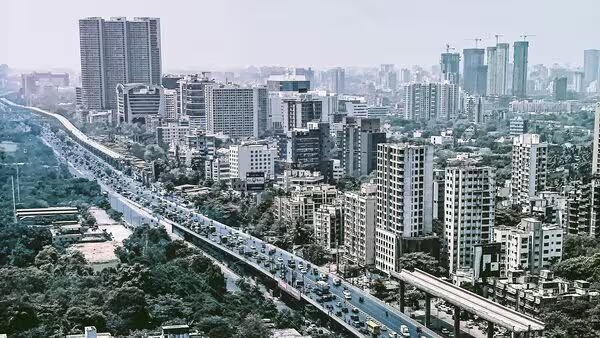
    Sony Pictures has leased approximately 73,000 square feet of office space in Goregaon, committing to a long-term rental outlay exceeding Rs 144 crore, according to property registration data reviewed by Urban Acres. The transaction reinforces Goregaon’s status as a preferred commercial hub for media and entertainment occupiers in Mumbai’s western corridor.

    The lease reflects sustained demand for Grade A office space from content production and distribution companies, even as hybrid work models reshape corporate real estate strategies. Industry consultants note that while some sectors have consolidated footprints, media and technology firms continue to prioritise collaborative work environments equipped with advanced digital infrastructure. Goregaon, home to film studios and post-production facilities, has evolved into a specialised micro-market serving the entertainment ecosystem. Its proximity to residential catchments in Andheri, Malad and Kandivali, along with connectivity via the Western Express Highway and suburban rail network, enhances its appeal for companies seeking accessible yet modern office campuses. Commercial property analysts estimate that premium office assets in the area command competitive rentals relative to central business districts such as Lower Parel or Bandra Kurla Complex. This cost differential, combined with large floor plates and integrated amenities, has driven leasing activity in recent quarters.

    The scale of the Sony Pictures lease signals confidence in Mumbai’s long-term role as India’s content and media capital. As streaming platforms expand and regional language production accelerates, office requirements increasingly extend beyond administrative functions to include creative collaboration zones, editing suites and technology-enabled studios. Urban planners argue that large office commitments must align with sustainable building standards. Energy-efficient HVAC systems, rooftop solar installations and water recycling facilities are becoming baseline expectations in new commercial developments. Given Mumbai’s climate vulnerabilities including flooding risks and rising heat stress resilient design and reliable power back-up systems are critical for data-intensive occupiers. The transaction also underscores the importance of decentralised commercial nodes in easing pressure on traditional CBDs. By distributing employment centres across western suburbs, the city can reduce peak-hour congestion and shorten commute times for workers a key consideration in advancing people-centric urban planning.

    With office leasing momentum gradually stabilising post-pandemic, high-value deals such as this indicate selective but strategic expansion by occupiers. For Goregaon’s commercial market, continued interest from media and technology firms could catalyse further infrastructure upgrades, reinforcing its position within Mumbai’s evolving business geography.

    Also Read: Brigade Enterprises chairman wins industry honour

    Mumbai Goregaon Sony Pictures office lease


    Brigade Enterprises chairman wins industry honour

      0
      Brigade Enterprises chairman wins industry honour
      Brigade Enterprises chairman wins industry honour

      A veteran industry leader from Brigade Enterprises has been conferred a lifetime achievement recognition at the ET Real Estate Awards, held in Mumbai. The honour acknowledges over four decades of contribution to India’s evolving property sector, during a period that has transformed urban skylines across major cities.

      The award, presented at a ceremony attended by developers, policymakers and institutional investors, comes at a time when the Indian real estate industry is undergoing structural shifts from regulatory tightening under RERA to growing emphasis on environmental performance and digital project management. As Executive Chairman, the industry veteran has overseen Brigade Enterprises’ expansion from a regional player to a multi-city developer with a diversified portfolio spanning residential, commercial and hospitality assets. Analysts say leadership continuity has been critical in navigating cycles of credit contraction, policy reforms and demand fluctuations. Over the past four decades, India’s property market has transitioned from fragmented, informal practices to a more transparent and compliance-driven ecosystem. The introduction of the Real Estate Regulation and Development Act, the growth of institutional capital, and the emergence of REIT structures have reshaped governance standards. Sector observers note that long-serving promoters who adapted to these changes played a key role in professionalising the industry.

      Recognition at national industry platforms increasingly factors in sustainability and long-term value creation. Developers are now assessed not only on project scale but also on energy efficiency, green building certifications and community impact. Urban economists argue that leadership in real estate today requires balancing commercial growth with climate resilience, especially as cities confront flooding risks, urban heat stress and infrastructure strain. Brigade Enterprises has been active across southern Indian markets, where integrated townships and mixed-use projects have gained traction amid rising urbanisation. The company’s trajectory mirrors the broader expansion of organised developers into Tier I and Tier II cities, driven by demand for structured housing, Grade A office spaces and branded retail environments. Industry awards, while symbolic, reflect the maturation of India’s built environment sector. As capital markets deepen and governance benchmarks rise, developers are expected to demonstrate stronger financial discipline, transparent disclosures and measurable environmental commitments.

      For India’s urban future, the real test for sector leaders will lie in delivering housing and commercial infrastructure that supports inclusive growth while reducing carbon intensity. As cities continue to densify, experience and institutional memory recognised through lifetime achievement honours remain vital in shaping responsible and resilient development pathways.

      Also Read: Navi Mumbai infrastructure vision takes centre stage

      Brigade Enterprises chairman wins industry honour


      Navi Mumbai infrastructure vision takes centre stage

        0
        Navi Mumbai infrastructure vision takes centre stage
        Navi Mumbai infrastructure vision takes centre stage

        Urban growth pressures, infrastructure financing and climate resilience formed the core of discussions at the News18 Marathi Navi Mumbai Conclave held on 19 February in Navi Mumbai. The gathering brought together senior government officials, planners and private developers to examine how Navi Mumbai and neighbouring Raigad district can balance rapid expansion with sustainable urban design.

        Senior representatives from the City and Industrial Development Corporation and the Navi Mumbai Municipal Corporation outlined the planning framework guiding the region’s next growth cycle. With large infrastructure projects such as the Navi Mumbai International Airport nearing operational readiness and multiple metro and road upgrades under way, officials stressed the importance of integrated land-use planning to prevent unstructured sprawl. Participants from the real estate sector highlighted redevelopment and self-development models as emerging tools for unlocking land in established nodes. In areas governed by industrial zoning under MIDC and older layouts, coordinated redevelopment is seen as essential to modernise ageing stock while increasing density near transport corridors. However, planners cautioned that higher floor space index (FSI) must be matched by investment in water supply, waste management and public transport. A separate session focused on regional connectivity between Navi Mumbai and Raigad, where new highways, suburban rail extensions and port-led industrial growth are expected to reshape settlement patterns. Officials from Panvel Municipal Corporation emphasised the need to align infrastructure rollouts with affordable housing provision to prevent displacement and long commutes.

        The conclave also featured a policy dialogue with a senior state housing department official, who underscored Maharashtra’s emphasis on planned urbanisation. According to government representatives, the next phase of development will prioritise transit-oriented growth, digitised building approvals and environmental safeguards, particularly in coastal and ecologically sensitive zones. Urban economists attending the event noted that Navi Mumbai represents a test case for India’s “next-generation city” model conceived as a planned counter-magnet to Mumbai but now evolving into an independent commercial and residential hub. The challenge, they argued, lies in maintaining its original grid-based planning strengths while accommodating new demand for data centres, logistics parks and high-density housing. Climate adaptation also emerged as a recurring theme. With increasing instances of extreme rainfall across the Mumbai Metropolitan Region, stormwater drainage capacity, blue-green infrastructure and coastal regulation compliance were identified as critical priorities.

        As Navi Mumbai moves into a high-growth decade, discussions at the conclave underscored a shared understanding: infrastructure expansion alone will not define success. The durability of the region’s growth will depend on coordinated governance, inclusive housing supply and the integration of sustainability into every stage of urban development.

        Also Read: ESR expands Mumbai digital infrastructure footprint

        Navi Mumbai infrastructure vision takes centre stage


        ESR expands Mumbai digital infrastructure footprint

          0
          ESR expands Mumbai digital infrastructure footprint
          ESR expands Mumbai digital infrastructure footprint

          ESR has marked its formal entry into India’s digital infrastructure sector with a 60-megawatt hyperscale-ready facility in Rabale, Mumbai, reinforcing the city’s position as the country’s largest data centre hub. The project represents an investment of roughly $100 million and has already been pre-leased to a major technology occupier, signalling sustained enterprise demand for scalable computing capacity.

          The facility, branded as the ESR Rabale MU1 Data Centre, is being developed on a 3.25-acre site within Navi Mumbai’s established data centre corridor. Designed as a multi-storey powered shell, the structure will allow tenants to customise internal fit-outs while benefiting from core infrastructure such as high-capacity power supply, cooling systems and structural resilience. Industry analysts describe Rabale as one of India’s fastest-growing micro-markets for digital infrastructure due to its connectivity to subsea cable landing stations, reliable power access and proximity to financial and corporate districts in the Mumbai Metropolitan Region. As cloud adoption, artificial intelligence workloads and enterprise digitisation accelerate, operators are prioritising scale, redundancy and future expansion potential. The 60 MW capacity places the new facility within the hyperscale category, typically associated with large cloud service providers and global technology firms. Pre-leasing at the development stage indicates that absorption for high-quality capacity remains robust despite rising capital costs and intensifying competition among operators. Urban economists note that data centres have emerged as a strategic real estate asset class in India, sitting at the intersection of technology, infrastructure and energy policy.

          While they generate high-value employment and strengthen digital ecosystems, they also require significant electricity and water resources. This has prompted calls for renewable energy integration, efficient cooling technologies and heat mitigation strategies to align growth with climate goals. In Maharashtra, policymakers have introduced dedicated data centre policies offering infrastructure support and regulatory clarity, recognising the sector’s potential to attract global capital. However, experts emphasise the need for coordinated planning to ensure grid stability, disaster resilience and responsible land use, particularly in coastal and flood-prone zones. ESR’s wider Asia Pacific pipeline reportedly exceeds three gigawatts, positioning the Mumbai project as part of a larger regional expansion strategy. For Mumbai, continued investment in facilities such as the Rabale campus strengthens its status as India’s digital gateway, supporting fintech, e-commerce and enterprise technology growth.

          As demand for computing power deepens, the challenge for operators and city authorities alike will be to scale capacity without compromising environmental safeguards. The evolution of Mumbai’s data centre ecosystem will depend not only on megawatts added, but on how sustainably and efficiently that capacity is integrated into the urban fabric.

          Also Read: Ludhiana AIPL commercial real estate expansion

          ESR expands Mumbai digital infrastructure footprint


          Ludhiana AIPL commercial real estate expansion

            0
            Ludhiana AIPL commercial real estate expansion
            Ludhiana AIPL commercial real estate expansion

            Advance India Projects Limited is preparing to expand its footprint in Ludhiana with plans for a premium commercial real estate project, signalling renewed investor interest in Punjab’s largest industrial centre. While detailed specifications are yet to be formally disclosed, the proposed development is expected to strengthen Ludhiana’s evolving office and retail landscape.

            The planned Ludhiana commercial real estate project comes at a time when Tier II cities are witnessing gradual diversification beyond traditional manufacturing bases. Ludhiana, long known for its textiles, bicycle components and small-scale engineering units, is increasingly seeing demand for organised office spaces, branded retail formats and mixed-use business districts. Industry consultants say that corporate occupiers are beginning to look beyond metro cities for cost efficiencies and talent retention. Improved highway connectivity to Chandigarh and Delhi, alongside upgrades in urban infrastructure, have helped reposition Ludhiana as a viable destination for regional headquarters and service-sector expansion. Although project size, investment outlay and configuration mix remain under wraps, market observers expect the Ludhiana commercial real estate scheme to cater to a combination of Grade A office spaces and high-street retail. Demand for modern workspaces with integrated parking, energy-efficient systems and flexible layouts has grown in recent years as businesses adopt hybrid working models.

            Urban planners note that commercial developments in cities like Ludhiana must integrate sustainability and mobility considerations from the outset. With rising urban heat and air quality concerns across north Indian cities, green building standards, natural ventilation strategies and efficient water management systems are becoming essential rather than optional. Well-planned commercial hubs can also reduce commute distances by bringing employment closer to residential clusters. From an economic standpoint, such projects generate multiplier effects. Construction activity supports local contractors and suppliers, while operational phases create formal employment in administration, retail and facility management. For municipal authorities, increased commercial property taxes expand fiscal capacity to invest in roads, drainage and public transport. However, experts caution that piecemeal commercial growth without integrated land-use planning could strain existing civic infrastructure. Parking demand, traffic congestion and pressure on utilities are recurring challenges in fast-growing secondary cities. Coordinated planning between developers and urban local bodies will be crucial to ensure that the Ludhiana commercial real estate pipeline aligns with long-term development goals.

            As AIPL advances its expansion strategy in Punjab, the success of the proposed Ludhiana project will depend not only on market absorption but also on how well it contributes to a more organised, climate-aware and employment-generating urban ecosystem. For Ludhiana, the next phase of growth may hinge on balancing industrial legacy with contemporary commercial infrastructure.

            Also Read: South Mumbai Malabar Hill redevelopment push

            Ludhiana AIPL commercial real estate expansion


            South Mumbai Malabar Hill redevelopment push

              0
              South Mumbai Malabar Hill redevelopment push
              South Mumbai Malabar Hill redevelopment push

              Lodha Developers has secured development rights for a 17,403 square metre land parcel in Malabar Hill, marking one of the most significant land-linked transactions in South Mumbai this year. The agreement, executed in early January 2026 with the Sorabji Kanga Charity Trust, carries a stated consideration of Rs 106 crore and outlines a revenue and built-up area sharing structure between the parties.

              According to property registration documents reviewed by Urban Acres, the Malabar Hill land parcel spans over four acres a rare scale in one of Mumbai’s most supply-constrained and premium residential enclaves. Under the arrangement, the developer will hold a 57.5 per cent share of the total permissible floor space, while the trust will retain 42.5 per cent. As part of its entitlement, the trust is slated to receive over 5,000 sq m of RERA-defined carpet area along with 150 car parking spaces. Based on prevailing luxury pricing benchmarks in the micro-market, the allocation earmarked for the trust has an estimated value exceeding Rs 1,400 crore. The overall development potential of the Malabar Hill land parcel is projected at approximately Rs 2,800 crore, subject to planning approvals and final design. Industry observers say such structured development-rights transactions are increasingly common in high-value urban precincts, where outright land acquisition is both capital intensive and legally complex. For legacy landowners, including trusts and institutions, partnership-led development enables value unlocking without relinquishing complete ownership control. For developers, it provides entry into marquee addresses that strengthen brand positioning.

              Malabar Hill remains among India’s most expensive residential districts, characterised by low-density layouts, heritage structures and proximity to administrative and commercial hubs in South Mumbai. However, redevelopment in the area must navigate stringent coastal regulation norms, heritage considerations and infrastructure capacity constraints. Urban planners note that as redevelopment gathers pace across Mumbai’s prime neighbourhoods, questions of carrying capacity, traffic management and climate resilience assume greater urgency. High-end residential towers in coastal zones must comply with evolving environmental safeguards, especially given rising sea levels and extreme rainfall patterns. Integrating energy-efficient design, water management systems and resilient building materials will be central to long-term viability. The project timeline is estimated at five years, aligning with typical luxury construction cycles in South Mumbai. The Malabar Hill land parcel acquisition also follows the company’s recent joint development initiatives in central Mumbai, signalling a strategy focused on pipeline expansion through partnership models rather than outright purchases.

              As Mumbai’s land economics intensify, structured development-rights deals are likely to shape the city’s next phase of vertical growth balancing capital efficiency with the need for responsible, infrastructure-aligned urban expansion.

              Also Read: Maharashtra MahaRERA recovery drive intensifies

              South Mumbai Malabar Hill redevelopment push


              Maharashtra MahaRERA recovery drive intensifies

                0
                Maharashtra MahaRERA recovery drive intensifies
                Maharashtra MahaRERA recovery drive intensifies

                The Maharashtra government has announced a statewide enforcement drive to accelerate recovery from defaulting developers, after official data revealed that the state’s real estate regulator has recovered just 34 per cent of outstanding dues ordered in favour of homebuyers. The move could impact thousands of purchasers awaiting refunds or compensation under rulings issued by Maharashtra Real Estate Regulatory Authority.

                Figures placed before the state legislature show that recovery certificates worth more than Rs 792 crore have been issued against errant builders. Of this, roughly Rs 279 crore has been realised through the revenue recovery mechanism, while over Rs 430 crore remains pending. Cases involving about Rs 103 crore are currently under proceedings before the National Company Law Tribunal. The special recovery drive will focus on districts where compliance has been particularly weak. Senior officials indicated that the administration will coordinate with revenue, transport and other departments to trace movable and immovable assets of developers who have failed to honour refund and compensation orders. If necessary, central tax authorities may also be approached to track financial holdings. The enforcement push marks a critical moment for Real Estate Regulation and Development Act, commonly known as RERA, which was enacted in 2017 to improve transparency and accountability in India’s property market. In Maharashtra, the law is administered through MahaRERA, one of the country’s most active state regulators in terms of project registrations and complaint disposal. Urban policy experts say recovery not just adjudication determines the credibility of the regulatory framework. While Maharashtra has been praised for digitising project disclosures and publishing detailed order records, delayed execution of recovery certificates has diluted the impact of favourable rulings for buyers.

                In many cases, consumers must rely on district collectors to initiate revenue recovery proceedings, a process that can be lengthy and administratively complex. Housing advocates argue that stronger enforcement is essential for restoring trust in a sector historically marked by project delays, stalled construction and opaque financial practices. Timely refunds are especially critical for middle-income households that invest life savings into under-construction homes. At the same time, real estate economists caution that aggressive recovery action must be balanced with structured insolvency processes in genuinely distressed projects, to avoid pushing viable developments into liquidation. Maharashtra’s urban centres, particularly Mumbai Metropolitan Region and Pune, continue to see significant redevelopment activity, and regulatory certainty plays a key role in sustaining end-user demand.

                As the state intensifies its drive, the effectiveness of inter-departmental coordination and asset tracing will determine whether recovery rates improve meaningfully. For homebuyers awaiting long-pending refunds, the coming months will test whether regulatory orders translate into actual financial relief a benchmark that ultimately defines the success of RERA’s promise of a more accountable housing market.

                Also Read: Mumbai Lodha Developers seals redevelopment pact

                Maharashtra MahaRERA recovery drive intensifies


                Mumbai Lodha Developers seals redevelopment pact

                  0
                  Mumbai Lodha Developers seals redevelopment pact
                  Mumbai Lodha Developers seals redevelopment pact

                  In a significant addition to its redevelopment pipeline, Lodha Developers has entered into a joint development arrangement valued at Rs 3,648 million to develop a land parcel in Mumbai. The agreement has been executed with Sahana Properties and Resorts and Sahana Builders and Developers, according to regulatory disclosures reviewed by Urban Acres.

                  The transaction, structured as a joint development agreement rather than an outright land purchase, reflects a capital-efficient expansion strategy. Under such models, landowners typically contribute the parcel while the developer undertakes approvals, construction and marketing, sharing revenue or built-up area as per agreed terms. Industry analysts say this reduces upfront land acquisition costs and mitigates balance sheet stress, particularly in high-value urban markets like Mumbai. The Lodha Developers joint development move comes at a time when land scarcity and elevated acquisition costs continue to reshape Mumbai’s residential supply dynamics. Developers are increasingly favouring partnerships with existing landholders to unlock projects in established neighbourhoods without heavy capital outlay. This approach also accelerates project launches in a city where approval timelines and land aggregation can otherwise delay supply. While specific project details such as configuration mix and total development potential have not yet been publicly outlined, market observers expect the parcel to cater to mid-to-premium residential demand, given prevailing absorption trends across Mumbai’s redevelopment corridors. Over the past few years, joint development structures have accounted for a growing share of new launches across the Mumbai Metropolitan Region, especially in land-constrained zones.

                  Urban economists note that such deals are not merely commercial transactions but are closely tied to the city’s broader transformation. As older industrial and low-density plots transition into vertical residential communities, questions of infrastructure readiness, mobility access and environmental resilience become central. Mumbai’s planning authorities have emphasised transit-oriented growth, integration with suburban rail and metro networks, and improved stormwater management following extreme weather events in recent years. For developers, the Lodha Developers joint development strategy signals confidence in sustained end-user demand, even as housing finance conditions tighten and construction costs remain volatile. For the city, it underscores the ongoing shift towards partnership-led urban regeneration, where private capital and landowners collaborate to reshape ageing or underutilised parcels.

                  Going forward, the success of such projects will hinge not only on sales velocity but also on how effectively they align with Mumbai’s long-term sustainability goals from energy-efficient design to equitable access to civic amenities. As redevelopment intensifies, the balance between density, liveability and infrastructure capacity will define the next chapter of urban growth in India’s financial capital.

                  Also Read: Mumbai Deonar sees third Godrej Sky Terraces deal

                  Mumbai Lodha Developers seals redevelopment pact


                  Mumbai Deonar sees third Godrej Sky Terraces deal

                    0
                    Mumbai Deonar sees third Godrej Sky Terraces deal
                    Mumbai Deonar sees third Godrej Sky Terraces deal

                    A senior Indian cricketer’s household has expanded its footprint in Mumbai’s eastern suburbs with the acquisition of a third apartment at Godrej Sky Terraces, a premium residential project in Deonar developed by Godrej Properties. Property registration documents reviewed by Urban Acres show the latest transaction, valued at Rs 7.18 crore, was completed in February 2026.

                    The apartment, measuring approximately 1,500 sq ft, is located on an upper floor of the under-construction tower and includes two car parking spaces. Stamp duty exceeding Rs 35 lakh was paid on the deal. The unit is scheduled for possession in mid-2028, indicating continued buyer confidence in projects with staggered delivery timelines despite rising borrowing costs and tighter liquidity in segments of the real estate market. This is the third purchase by the family within the same development. Two larger units registered last year together span more than 4,200 sq ft of carpet area and were transacted at a significantly higher combined value. Market analysts tracking high-value residential sales note that repeat purchases within a single project often signal long-term investment intent, potential unit consolidation, or intergenerational asset planning. Spread over just over an acre, the Deonar project primarily offers three- and four-bedroom configurations. Data compiled from public registration records indicate steady absorption over the past year, with cumulative transaction values crossing Rs 200 crore.

                    Average ticket sizes and per-square-foot rates in the micro-market place the project firmly in Mumbai’s upper-mid to premium residential bracket. Deonar, located near Chembur in the eastern corridor, has steadily repositioned itself from a peripheral neighbourhood to a sought-after address. Connectivity via the Harbour Line rail network, arterial road links such as the Eastern Express Highway, and proximity to commercial hubs in BKC and Lower Parel have strengthened its residential appeal. Infrastructure upgrades and redevelopment activity across eastern Mumbai have also broadened buyer interest beyond the traditional western suburbs. Urban planners say that while luxury housing transactions draw attention due to celebrity ownership, they also reflect broader capital flows into formal, regulated housing supply. High-value registrations contribute significantly to state revenues through stamp duty, which in turn funds public infrastructure. However, experts caution that balanced urban growth requires parallel expansion of affordable housing, transit integration and climate-resilient design standards.

                    With eastern Mumbai witnessing incremental densification, the long-term sustainability of such micro-markets will depend on mobility planning, green cover preservation and service infrastructure upgrades. For now, repeat transactions at Godrej Sky Terraces underline sustained demand for branded developments in emerging residential clusters a trend likely to shape the city’s evolving housing geography through the decade.

                    Also Read: Delhi Lutyens Zone Anchors Elite Housing Market

                    Mumbai Deonar sees third Godrej Sky Terraces deal


                    Delhi Lutyens Zone Anchors Elite Housing Market

                      0
                      Delhi Lutyens Zone Anchors Elite Housing Market
                      Delhi Lutyens Zone Anchors Elite Housing Market

                      A private residence owned by a leading telecom entrepreneur in Delhi’s Lutyens’ Bungalow Zone has once again drawn attention to the extraordinary land values and policy sensitivities surrounding India’s most tightly controlled residential district. Located on Amrita Shergill Marg, the property sits within a planning enclave where supply constraints, heritage protections and political significance converge to create one of the country’s most expensive housing markets. 

                      The Lutyens’ Bungalow Zone, designed in the early 20th century as part of the imperial capital layout, comprises roughly 1,000 low-density plots spread across central Delhi. Strict development controls limit subdivision, height and structural alteration. Fewer than 100 bungalows are believed to be in private hands, with the rest occupied by senior government functionaries.The businessman acquired the approximately two-acre parcel in the early 2000s in what was then considered one of the capital’s largest residential transactions. Since that acquisition, land values in the Lutyens’ Bungalow Zone have multiplied several times over, according to market analysts tracking ultra-prime sales. Current indicative valuations for comparable plots often range between ₹150 crore and ₹400 crore, depending on frontage, road width and built form.

                      The residence itself reflects a colonial architectural vocabulary consistent with the neighbourhood’s design language: expansive lawns, deep verandahs, high ceilings and restrained façades. While internal specifications remain private for security reasons, luxury homes in this precinct typically incorporate landscaped gardens, multiple reception areas and staff quarters integrated within the compound. Real estate consultants describe the Lutyens’ Bungalow Zone as a market defined less by transaction frequency and more by land scarcity. Transfers are rare and often negotiated discreetly. Urban planners note that regulatory safeguards have preserved tree cover and low built density, contributing to a microclimate that contrasts sharply with denser parts of Delhi.

                      At the same time, the concentration of wealth within the enclave has prompted periodic debate over land use efficiency in a city grappling with housing shortages. Critics argue that such low-density zoning limits broader access to central urban land. Supporters counter that the district’s heritage character and institutional role justify stringent controls. The Lutyens’ Bungalow Zone also illustrates how land policy shapes capital allocation. With subdivision restricted and redevelopment tightly monitored, appreciation is driven largely by location and historical prestige rather than additional floor area.

                      This has positioned the area as a long-term store of value for industrialists and political leaders alike. Urban sustainability experts observe that conservation-based zoning, when managed transparently, can coexist with broader housing strategies elsewhere in the city. The challenge for Delhi’s planners is balancing preservation of historic districts with equitable housing supply across expanding urban corridors. As India’s metropolitan land markets mature, the Lutyens’ Bungalow Zone remains a case study in how scarcity, regulation and symbolism combine to create enduring real estate value beyond conventional metrics.

                      Delhi Lutyens Zone Anchors Elite Housing Market