

Delhi Civic Body Begins Mehrauli Restoration Work

The Municipal Corporation of Delhi has initiated formal steps to conserve a deteriorating pre-Independence civic structure in Mehrauli, signalling a renewed focus on protecting the capital’s built heritage. The Mehrauli Heritage Building, constructed in 1942 and long used for municipal services, will undergo structural assessment and restoration after remaining vacant for over a decade. Civic officials confirmed that the project has entered the execution phase, beginning with the appointment of a conservation consultant.
Engineers will conduct a detailed structural audit to assess extensive cracks, weakened columns and partial collapses reported across sections of the complex. Based on expert recommendations, restoration will use original materials to maintain architectural integrity. The Mehrauli Heritage Building is officially classified as a Grade II heritage structure under Delhi’s heritage regulations. Such classification recognises regional architectural and cultural value, though with flexibility for adaptive reuse. Heritage planners note that Grade II listings allow sensitive redevelopment, provided historical features are preserved. The yellow-hued structure features a prominent entrance porch supported by circular columns, terracotta ventilator screens and decorative ironwork on the upper level. Stone masonry walls, sandstone roofing and early steel elements reflect construction techniques common in late colonial civic architecture. However, years of neglect have left iron grills corroded, terracotta screens fractured and parts of the courtyard filled with debris.
Urban conservation experts say the revival of the Mehrauli Heritage Building could serve as a template for restoring underutilised municipal assets across Delhi. Several pre-1950 civic buildings remain vacant due to shifting administrative needs, yet occupy prime urban land. Restoring such sites not only preserves cultural memory but also reduces the carbon footprint associated with demolition and new construction. Residents in the neighbourhood have raised safety concerns as vegetation growth and structural weakening intensified. Banyan roots embedded within walls have reportedly accelerated deterioration, a common risk in ageing masonry structures exposed to moisture and lack of maintenance.
Officials indicated that conservation work is targeted for completion in the next financial year, subject to technical clearances. Discussions are underway on potential adaptive reuse once stabilisation is complete. Urban planners suggest the site could accommodate community services, cultural spaces or administrative functions aligned with local needs. The restoration aligns with broader efforts to integrate heritage conservation into sustainable urban development strategies. Retrofitting existing buildings conserves embodied energy and supports climate resilience goals, particularly in dense historic precincts such as Mehrauli.
As Delhi continues to modernise its infrastructure, the future of the Mehrauli Heritage Building will test how effectively the city balances growth with stewardship. If executed with care, the project could demonstrate that preserving civic history and delivering contemporary public services are not competing priorities but complementary pillars of inclusive urban renewal.
Delhi Civic Body Begins Mehrauli Restoration Work
Delhi Meerut Corridor Spurs Property Surge
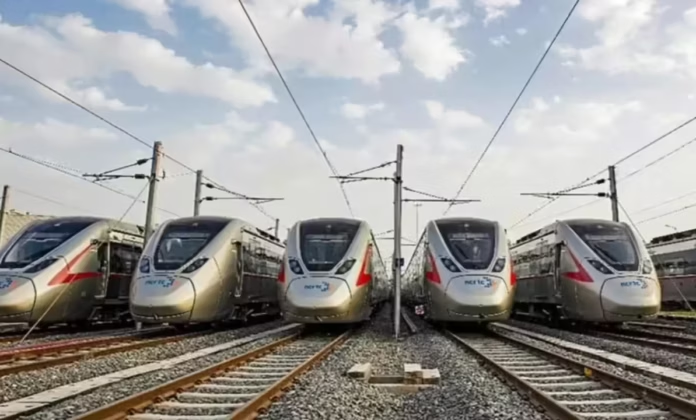
The full commissioning of the 82-kilometre high-speed rail link between Delhi and Meerut is beginning to reshape property markets across western Uttar Pradesh and the eastern edge of the National Capital Region (NCR). With travel time reduced to nearly one hour, urban economists say the operational Delhi Meerut Corridor could accelerate decentralised growth and redraw commuting patterns for thousands of households.
The rapid rail system, implemented by the National Capital Region Transport Corporation, now connects key urban nodes including Ghaziabad, Modinagar and Muradnagar before terminating in Meerut. A parallel intra-city metro network in Meerut shares parts of the infrastructure, further tightening last-mile access.
Property consultants tracking transactions within a two-kilometre radius of stations report residential land values have already risen between 30 and 67 per cent over the past two years. In parts of Meerut, plotted developments that once traded at ₹8,000–12,000 per square yard are now changing hands at significantly higher levels, reflecting infrastructure-led speculation and end-user demand.
The Delhi Meerut Corridor is not merely a transport upgrade; planners describe it as a structural intervention designed to promote polycentric growth. By enabling faster inter-city commuting, the corridor could ease pressure on central Delhi while supporting employment and housing opportunities in peripheral towns. Urban planners note that such corridors often trigger mixed-use clusters, commercial hubs and mid-income housing projects near stations. Developers have begun aligning new projects with Uttar Pradesh’s Transit Oriented Development (TOD) framework. TOD encourages higher-density, walkable neighbourhoods around transit stations, reducing car dependency and lowering transport-related emissions. Industry observers say that if executed responsibly, this could steer the region toward more climate-efficient urban expansion rather than unchecked sprawl.
The corridor’s integration with existing metro and airport-bound routes is also expected to strengthen multi-modal connectivity. Improved regional mobility may encourage reverse commuting, where residents live in more affordable satellite towns while working in larger business districts. For cities like Meerut, this shift could expand the local services economy and formal housing supply.
However, analysts caution that infrastructure-led appreciation must be matched by civic planning. Water supply, waste management, green cover and social infrastructure will need to keep pace with rising population density. Without parallel investments in public amenities, rapid price escalation could strain affordability for lower-income households.
The Delhi Meerut Corridor also reflects a broader financing strategy in Indian urban transport. Authorities are exploring land monetisation and non-fare revenue streams around stations to sustain long-term operations. International lenders have supported such value capture models in other Asian cities, linking transit viability with planned urban development. As the corridor moves into full-scale operations, its long-term impact will depend less on headline property gains and more on how effectively cities translate connectivity into inclusive, low-carbon growth. If governance frameworks hold, the line could become a template for future regional rail investments across India’s expanding metropolitan belts.
Delhi Meerut Corridor Spurs Property Surge
Delhi NBCC DDA Projects Expand Pipeline

State-run construction and project management firm NBCC India Ltd has secured redevelopment contracts worth ₹775 crore from the Delhi Development Authority, reinforcing its role in upgrading ageing government housing stock in the capital. The fresh mandates, focused on staff quarters in central and south Delhi, strengthen revenue visibility for the company while advancing urban renewal in established neighbourhoods.
The projects cover the comprehensive redevelopment of residential units in Old Rajinder Nagar and Safdarjung Development Area. Together, they involve reconstruction of nearly 270 dwelling units with modern layouts and higher built-up area efficiency. Officials familiar with the plans said the schemes will be executed under a self-financing framework, where a portion of newly created real estate will be monetised to fund construction, reducing direct fiscal burden. Urban planners note that such redevelopment models are increasingly central to Delhi’s land strategy. Large tracts of low-rise government housing built decades ago occupy high-value urban land but lack contemporary infrastructure standards. By rebuilding vertically and integrating updated utilities, authorities aim to improve safety, energy efficiency and land use intensity without expanding the city’s footprint.
The new awards take NBCC DDA Projects deeper into the capital’s public asset modernisation pipeline. As of the third quarter of FY26, the company reported a consolidated order book exceeding ₹1.26 lakh crore, spanning project management consultancy, engineering procurement and construction, and real estate development. Its standalone portfolio accounts for the majority share, supported by subsidiary operations in healthcare and infrastructure segments.
Financial disclosures indicate steady growth momentum. Quarterly revenues rose year-on-year, while net profit expanded at a faster pace, reflecting improved execution and margin discipline. The project management consultancy vertical remains the principal earnings driver, though the real estate segment has seen a notable uptick in profitability amid asset monetisation initiatives.
Market participants observed a modest uptick in the company’s share price following disclosure of the orders, reflecting investor confidence in predictable cash flows tied to government-backed redevelopment. From an urban development perspective, NBCC DDA Projects also intersect with broader goals of climate resilience and efficient city form. Redeveloped housing clusters can incorporate improved drainage, upgraded electrical systems and potential rooftop solar integration, reducing long-term operational costs and environmental stress.
Industry experts caution that execution timelines and regulatory clearances will be critical in converting order wins into delivered assets. However, with multiple redevelopment mandates underway across the National Capital Region, NBCC’s expanding pipeline underscores how public-sector asset renewal is emerging as a steady anchor for India’s construction economy. As Delhi continues to reconfigure older residential estates, structured redevelopment could reshape central neighbourhoods balancing density, fiscal prudence and long-term sustainability.
Delhi NBCC DDA Projects Expand Pipeline
Ajmera Realty Introduces Vann Residential Enclave Mumbai

Ajmera Realty has entered Mumbai’s ultra-luxury residential segment with the launch of Vann By Ajmera, a premium enclave in the 7 Bungalows micro-market of Versova, Andheri West. The development comprises 53 high-end 3 and 4 BHK units, priced from Rs. 7 crore to Rs. 12 crore, and is projected to generate a Gross Development Value (GDV) of around Rs. 450 crore. Positioned as a wellness-driven, design-conscious residential destination, the project highlights the growing market for thoughtfully curated luxury homes within the city’s densifying western suburbs.
The enclave occupies approximately 90,792 sq. ft., with over 60% dedicated to landscaped open spaces. Singapore-inspired greenery, a Forest Walk, and integrated amenities such as a clubhouse, gym, swimming pool, and jogging track are central to the project’s emphasis on holistic living. Urban planners note that such high-permeability green areas are increasingly rare in mature Mumbai neighbourhoods, reflecting a shift towards wellness-oriented, low-impact developments in premium segments. Industry analysts suggest that Vann By Ajmera is strategically positioned to cater to households seeking privacy and sustainable urban living while remaining connected to key city nodes. The project integrates eco-conscious infrastructure, including rainwater harvesting, waste management systems, and energy-efficient design principles. Such features underscore a broader trend among Mumbai developers prioritising long-term sustainability alongside luxury and lifestyle offerings.
The development marks the first project under Ajmera Realty’s “Luxury Collective” vertical, signalling the firm’s strategic pivot into ultra-luxury residential offerings. Experts indicate that Mumbai’s western suburbs, particularly micro-markets such as 7 Bungalows, are witnessing increasing demand for high-quality residences that balance open space, wellness amenities, and premium finishes. By limiting unit numbers and prioritising thoughtful spatial layouts, the project seeks to differentiate itself from conventional high-density towers. From a market perspective, Vann By Ajmera reflects both pricing resilience and buyer appetite in Mumbai’s luxury housing sector. With starting prices of Rs. 7 crore for 3 BHK units and Rs. 12 crore for 4 BHK units, the development aligns with expectations of premium-segment buyers seeking well-designed homes with strong investment potential. Real estate strategists note that projects of this scale and positioning can influence nearby land valuations and encourage higher standards of design and amenity integration across the neighbourhood.
As Mumbai continues to densify, Vann By Ajmera exemplifies a model for integrating luxury, wellness, and sustainability within urban infill developments. The enclave is expected to set a benchmark for premium residential planning in Versova, highlighting the importance of open space, lifestyle amenities, and environmentally responsive design in shaping the city’s future residential landscape.
Ajmera Realty Introduces Vann Residential Enclave Mumbai
Rustomjee Launches Cliff Tower Premium Residential Project

Rustomjee Group has unveiled Cliff Tower, a premium residential project strategically located at the highest point of the Mount Mary precinct in Bandra. The development, designed as a low-density, design-led tower, offers expansive 4 and 5 BHK homes with panoramic views of the Arabian Sea, Bandra Bay, and the Mumbai skyline, reflecting a growing demand for high-quality, heritage-sensitive housing in mature urban neighbourhoods.
The project introduces a niche offering in one of the city’s most constrained residential zones, where land scarcity and heritage sensitivities have limited large-scale new developments. With only two residences per floor, semi-private lift lobbies, and floor plans maximising natural light and sea-facing orientations, Cliff Tower emphasises exclusivity and long-term livability. Urban planners note that such low-density configurations are increasingly rare in Bandra, signalling a shift towards proportion-led, quality-focused luxury developments. Architectural and interior design inputs underscore the project’s premium positioning. The building’s form responds to the site’s triangular geometry, enhancing sightlines while maintaining a restrained silhouette that complements the heritage-rich surroundings. Interiors and landscaping have been curated to create open, light-filled living spaces with deep sundecks and private vistas, a feature increasingly valued by high-net-worth urban households seeking privacy without compromising connectivity.
Experts in Mumbai’s luxury real estate market highlight that Cliff Tower’s focus on sea-facing homes and expansive layouts aligns with a broader trend of ultra-luxury apartments targeting both domestic and international buyers. The integration of high ceilings, dedicated service areas, and proportionate living spaces is intended to enhance long-term residential value, reflecting a shift from short-term speculative developments to projects prioritising enduring quality. The project also illustrates the financial dynamics of Mumbai’s premium segment. With Gross Development Value (GDV) estimated at approximately INR 825 crore, Cliff Tower represents a calculated investment in high-margin, design-led properties where scarcity, location, and thoughtful planning converge. Analysts note that developments of this scale and exclusivity are critical in sustaining the upper-tier market and reinforcing Bandra’s reputation as a prime residential node.
Urban observers also point to the project’s alignment with sustainable urban living principles. By emphasising natural light, views, and spatial efficiency over excessive bulk, Cliff Tower exemplifies responsible densification and climate-responsive design in a dense city context. In an environment where mature neighbourhoods face pressure from redevelopment, the project offers a model of integrating modern luxury with cultural and environmental sensitivity. As Mumbai continues to witness rising demand for differentiated luxury residences, Cliff Tower highlights how careful site-responsive design and low-density planning can meet market expectations while preserving the character of historic precincts. Its launch signals the continued evolution of Mumbai’s high-end residential landscape, where exclusivity, quality, and long-term livability are increasingly central to urban real estate strategies.
Rustomjee Launches Cliff Tower Premium Residential Project
Bollywood Actress Shraddha Kapoor Renews Juhu Apartment Lease Paying Upfront

Bollywood actress Shraddha Kapoor has renewed the lease for her Juhu apartment for a period of one year, paying ₹72 lakh upfront, according to recently accessed property registration documents. The renewal, formalised through a leave-and-license agreement on February 25, 2026, maintains a monthly rental rate of ₹6 lakh for the 365 sq. m. (3,929 sq. ft.) unit in the Prime Beach residential complex.
The apartment, previously leased by the actress in October 2024, comes with access to four dedicated basement parking slots. The agreement stipulates a standard interest rate of 18% per annum, compounded quarterly, in case of any payment default. Experts suggest that paying the full annual rent in advance not only secures the tenancy but can also provide leverage for negotiating terms, a practice not uncommon among high-net-worth tenants in Mumbai’s premium housing segment. Real estate analysts note that the Prime Beach locality in Juhu remains one of Mumbai’s most sought-after residential pockets, offering proximity to commercial hubs, schools, and recreational amenities, alongside coastal access. The continued tenancy of prominent figures like Shraddha Kapoor underscores the area’s sustained appeal for both privacy and premium lifestyle convenience.
Industry experts indicate that such long-term, fully paid leases reflect broader trends in Mumbai’s luxury residential market. While rents in the city’s upscale neighbourhoods have been steadily rising, high-profile tenants often opt for upfront payments to mitigate annual inflationary pressures and secure prime units without annual renegotiation. “Leasing strategies in Mumbai’s top-tier properties are increasingly influenced by security of tenure and immediate capital outlay for long-term planning,” said a senior real estate consultant familiar with the transaction.
For the Prime Beach building, Kapoor’s continued occupancy is a stabilising factor in the property’s rental portfolio. Analysts suggest that when celebrity tenants retain high-value units, it not only reinforces the building’s market positioning but also influences rental benchmarks in adjacent premium localities. Urban planners note that such concentrated residential demand in Juhu, coupled with rising rentals, highlights the persistent pressure on western Mumbai’s luxury housing supply. The sustained interest of affluent individuals points to the need for a balance between high-value real estate development and inclusive urban housing planning.
Shraddha Kapoor, daughter of veteran actors Shakti Kapoor and Shivangi Kolhapure, has been an active figure in Mumbai’s entertainment landscape since her debut in Teen Patti and most recently appeared in Stree 2. Her renewed lease in Juhu signals continued confidence in the locality as a residential choice for high-profile city residents, reflecting broader trends in Mumbai’s luxury housing market.
Bollywood Actress Shraddha Kapoor Renews Juhu Apartment Lease Paying Upfront
Apple Launches New Store At Borivali Sky City

Mumbai’s western suburbs have added a new technology retail destination as Apple Inc. inaugurated its second store in the city at Sky City Mall, Borivali. The launch expands the company’s physical footprint in India, complementing its existing presence in the city and signalling sustained interest in high-demand consumer electronics markets in densely populated urban areas.
Industry experts suggest that the new store will help meet growing consumer demand in western Mumbai, where residential and commercial density has surged over the past decade. Borivali, with its blend of housing complexes, offices and retail hubs, offers Apple an opportunity to connect directly with a diverse urban population while easing the logistical pressures of online deliveries. The outlet reflects the company’s global retail design, featuring expansive glass façades, open floor layouts, and product display areas that encourage hands-on interaction. Dedicated zones provide technical support, learning workshops, and personalised guidance, creating an immersive experience aimed at enhancing customer engagement beyond conventional sales.
Shoppers at the Borivali store can explore the full Apple ecosystem, including the latest iPhone models, iPads, MacBooks, Apple Watches, and AirPods. Accessories ranging from protective cases and chargers to Mac peripherals are also available, with trained specialists assisting with product selection and technical guidance. The store additionally supports online purchase collection, offering convenience for consumers who prefer hybrid shopping models. A key aspect of Apple Borivali is its community-focused programming. The “Today at Apple” initiative provides complimentary sessions on photography, coding, music, and art, targeting students, professionals, and families. Experts note that such programmes foster tech literacy, creative skills, and community interaction, aligning retail expansion with educational and social engagement goals in urban environments.
The store operates on 100 percent renewable energy and maintains carbon-neutral operations, consistent with global environmental standards. Analysts suggest that this reinforces the growing trend among multinational retailers to integrate sustainability into urban commercial infrastructure, mitigating environmental impacts while setting benchmarks for responsible business practices in high-density areas. Urban development specialists highlight that the opening also contributes indirectly to local economic activity. By attracting footfall to Sky City Mall, the store strengthens the commercial viability of surrounding enterprises, while offering employment opportunities and supporting logistics networks. Observers also note that strategic location selection in Borivali allows Apple to serve a previously underserved segment of Mumbai’s tech-savvy consumer base.
As Apple continues to expand in India, the Borivali store represents a strategic blend of retail innovation, community engagement, and sustainable operations. It illustrates the potential for multinational retailers to integrate into rapidly growing urban environments while balancing commercial, social, and environmental objectives.
Apple Launches New Store At Borivali Sky City
Mumbai MSRDC Steps Into Slum Redevelopment Role

Mumbai’s long-running effort to eliminate informal settlements is entering a new phase, with a state-run infrastructure agency best known for highways and expressways stepping into large-scale housing redevelopment. The Maharashtra State Road Development Corporation has created a dedicated slum implementation unit to deliver dozens of redevelopment projects across the city, marking a strategic shift in how the state plans to unblock stalled urban housing schemes.
Under the government’s “Slum Free Mumbai” programme, the agency has been tasked with redeveloping nearly 98 acres of slum land covering more than 24,000 households across multiple neighbourhoods, including central, western and eastern suburbs. Officials say the move reflects growing concern that privately driven redevelopment models have struggled to cope with financing gaps, regulatory complexity and beneficiary disputes. For MSRDC, the assignment represents unfamiliar ground. Until now, its engagement with housing was largely limited to rehousing people displaced by road and metro projects. This time, the corporation is responsible for end-to-end delivery—from feasibility studies and land surveys to approvals, construction monitoring and handover of rehabilitation units.
To manage this transition, MSRDC has formed an eight-member core project unit bringing together technical, financial and social expertise. The team includes urban planners, architects, engineers, finance specialists, GIS and land survey professionals, and socio-development experts. Their mandate covers preparing cluster redevelopment proposals, structuring project finance, verifying eligible beneficiaries and coordinating statutory approvals, including real estate regulation compliance. Urban planners say the state’s decision to deploy an infrastructure-focused agency reflects a broader rethink of Mumbai’s housing strategy. “Large slum clusters require the same project management rigour as expressways or flyovers,” said a senior urban development expert. “The emphasis now is on execution certainty rather than speculative redevelopment.”
The initiative also signals deeper inter-agency coordination. Alongside MSRDC, multiple public bodies—including the Municipal Corporation of Greater Mumbai, Mumbai Metropolitan Region Development Authority, Maharashtra Housing and Area Development Authority and City and Industrial Development Corporation—are being aligned to accelerate approvals and funding flows. Some publicly led projects are already underway, including large rehabilitation schemes in eastern Mumbai that aim to deliver thousands of replacement homes within fixed timelines. These projects are being positioned as templates for climate-resilient, higher-density housing with improved access to sanitation, open spaces and public transport.
Economists note that slum redevelopment is not just a housing issue but a productivity and sustainability challenge. Informal settlements often sit on strategically located land close to employment hubs, yet lack basic infrastructure. Redevelopment, if executed responsibly, can unlock land value while improving living standards and reducing environmental stress. The success of MSRDC’s new role will depend on whether engineering-driven execution can adapt to the social and governance complexities of housing redevelopment. If it does, Mumbai’s slum-free ambition could shift from policy intent to measurable urban transformation.
Mumbai MSRDC Steps Into Slum Redevelopment Role
Delhi NCR Supreme Court Orders Coal Industry Shift
