

NMDC and IIT Hyderabad Join Forces for Mining Innovation
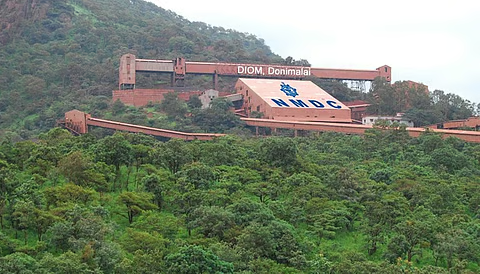
India’s largest state-run iron ore producer has moved to deepen research-driven innovation in the minerals and metals sector through a new collaborative pact with a premier academic institution, signalling strategic alignment between public enterprises and research ecosystems. NMDC Limited’s Research & Development Centre has signed a Memorandum of Understanding (MoU) with the Indian Institute of Technology Hyderabad (IIT Hyderabad) to co-develop technologies across mining, mineral processing and allied domains — a partnership that could shape the future of sustainable resource deployment in India.
The agreement, formalised in Hyderabad this week, was signed by NMDC’s Executive Director (R&D) and IIT Hyderabad’s Dean for Sponsored Research & Consultancy in the presence of the institute’s Director. It marks a deliberate effort to unify NMDC’s field expertise with IIT Hyderabad’s research capacity, focusing on indigenous technology development across the mineral value chain.At a time when global supply chains for minerals critical to clean energy and advanced manufacturing are under pressure, India is prioritising self-reliance — a strategy that this partnership aligns with. Under the MoU, joint research will explore areas such as iron ore beneficiation and agglomeration, green and low-carbon steelmaking technologies, alternate ironmaking using indigenous inputs, as well as advanced modelling and simulation of mining and metallurgical processes.
Crucially, the collaboration also touches on critical and rare earth minerals extraction, targeting both primary ore bodies and secondary sources such as mine waste. This dimension responds to a broader national agenda to strengthen critical mineral security and support the development of downstream sectors including electric mobility, renewable energy systems and electronics manufacturing — all of which depend on reliable access to strategic resources.Industry experts see this partnership as part of a burgeoning ecosystem where traditional mining operations are increasingly integrated with digital and sustainable frameworks. The MoU includes exploration of initiatives in autonomous and AI-enabled mining, Internet of Things (IoT) applications, Mining 4.0 paradigms, and drone-enabled surveying and monitoring — areas that are considered essential to enhancing productivity, safety, and environmental stewardship in modern mining.
For urban and industrial planners, such innovation partnerships promise long-term gains. Efficient mineral processing and sustainable extraction technologies can reduce environmental footprints, optimise land use near mines and improve the economics of infrastructure projects reliant on steel and construction materials. This, in turn, can contribute to broader climate resilience efforts in India’s rapidly urbanising cities.From a talent standpoint, the alliance also opens pathways for students and researchers at IIT Hyderabad to work directly on real-world challenges, while NMDC gains access to cutting-edge academic talent and laboratory facilities. Combined, this industry-academia model supports capacity building and could broaden the pipeline of skilled professionals in mining technology, data science applications for resource management, and low-carbon industrial processes.
As India seeks to balance rapid infrastructure growth with environmental commitments, collaborations such as this one between NMDC and IIT Hyderabad offer a template for how responsible resource management, technological innovation, and academic engagement can intersect to support sustainable development goals.
Also Read: Madhya Pradesh Assembly Tussle Over Coal Mine Land Acquisition
NMDC and IIT Hyderabad Join Forces for Mining Innovation
Madhya Pradesh Assembly Tussle Over Coal Mine Land Acquisition

A charged session in the Madhya Pradesh Legislative Assembly on Thursday spotlighted growing political and social tensions over land acquisition for coal mining in the state’s tribal-dominated Singrauli district, as the opposition raised serious questions about compensation distribution and governance transparency.
During the Budget Session’s Question Hour, the Leader of the Opposition pressed the ruling government on allegations that many affected families — particularly tribal landholders — were not receiving fair compensation under existing acquisition policy, and that funds were instead improperly distributed to individuals outside the affected demographic.According to opposition figures, land in eight villages has been marked for acquisition to facilitate expansion of coal mining operations linked to a major private energy group, with official records listing nearly 13,000 affected households. The opposition’s contention centres on what they describe as “serious irregularities” in payout lists, including examples where relatives of law enforcement officers were reportedly recorded as beneficiaries.
Seeking broader oversight, opposition lawmakers called for an impartial investigation by a joint committee of the assembly to audit the compensation process. They also urged an immediate halt to mining work until an independent inquiry verifies that all eligible landholders have been compensated in full and in accordance with law.The ruling government, represented in the assembly by the state’s Revenue Minister and Rural Development and Panchayat Minister, acknowledged that compensation has been disbursed to over 1,500 families to date, asserting that the process adheres to established policy frameworks. They denied allegations of irregularity, with assurances that any evidence of improper payments would be investigated and action taken against perpetrators.
The political confrontation escalated when the Speaker adjourned proceedings briefly after opposition members raised slogans and continued to challenge the government’s narrative. Despite reassurances from ministers that detailed beneficiary lists could be tabled and scrutinised in the house, the opposition staged a walkout, accusing the government of neglecting tribal interests.Land acquisition for mining and infrastructure projects has long been a sensitive issue in India’s urban and rural planning discourse. The Right to Fair Compensation and Transparency in Land Acquisition, Rehabilitation and Resettlement Act, 2013 mandates clear rules for affected persons; however, implementation has often been contested amid claims of undervaluation, delays and uneven application of social safeguards.
This episode in Madhya Pradesh highlights the broader challenge of balancing economic development goals — such as expanding energy production — with socially inclusive practices that protect the rights and livelihoods of tribal and marginalised communities. Advocates for procedural fairness note that transparent compensation processes are essential not only for social equity but also for maintaining community trust in urban-regional infrastructure expansion. Urban planners caution that unresolved disputes over land and compensation can delay project execution and hinder long-term regional growth strategies.
For the state’s policymakers, the unfolding controversy underscores the need for stronger governance mechanisms, accessible grievance redressal and participatory frameworks that ensure meaningful consent and fair recompense for affected populations. As land acquisition debates increasingly shape India’s growth narrative, how Madhya Pradesh navigates this standoff may offer lessons for other regions balancing resource development with equitable urban and rural livelihoods.
Also Read: India’s SECL Targets Rare Earths In Coal Mine Waste
Madhya Pradesh Assembly Tussle Over Coal Mine Land Acquisition
India’s SECL Targets Rare Earths In Coal Mine Waste

India is increasingly embracing innovative resource strategies as part of its broader push to strengthen domestic supply chains for high-tech and clean-energy industries. In a move that could reshape the nation’s critical minerals landscape, South Eastern Coalfields Limited (SECL) — a subsidiary of Coal India Ltd — has identified seven coal mine overburden dumps for rare earth element (REE) exploration, seeking to unlock strategic resources from mining waste rather than new extraction sites.
The initiative, centred in operational areas across Chhattisgarh and Madhya Pradesh, aligns with the government’s ambitions to reduce India’s dependence on imported rare earths and develop a more resilient raw materials ecosystem for sectors such as electronics, renewable energy, defence and electric mobility. REEs are essential inputs for high-performance magnets, batteries, wind turbines and advanced semiconductors — underpinning the country’s industrial and climate commitments.Officials say SECL has begun a tendering process to appoint specialised agencies to conduct scientific assessments of the identified dumps, with advanced geophysical and geochemical surveys planned over the next year to determine economic viability. If successful, this could pave the way for pilot extraction projects and future commercial operations that transform leftover overburden into valuable resource streams.
Urban and energy analysts characterise this strategy as part of a larger shift in India’s mining and resource policy — one that increasingly values circular economy principles, resource efficiency and sustainability in legacy operations. Turning overburden into a feedstock for advanced materials not only mitigates environmental liabilities from coal waste but also taps into global demand for strategic minerals where supply chains remain heavily concentrated in a few countries.For India’s urban and economic planners, expanding critical mineral capacity is not simply a commodity story but a wider developmental imperative. Cities and industrial hubs rely on a stable supply of REEs to support green infrastructure transitions, from electric public transport to renewable energy grids and microelectronics manufacturing clusters. Domestic availability of these inputs can improve project timelines, reduce price volatility and attract investment into high-tech industrial corridors.
The SECL venture also has implications for the country’s broader resource security strategy under initiatives like the National Critical Mineral Mission, which seeks to develop indigenous capabilities across extraction, processing and value addition for critical minerals. By focusing on overburden — material traditionally viewed as waste — companies and policymakers are beginning to intersect environmental stewardship with economic opportunity.Challenges remain: economics of extraction, refining complexity and infrastructure development will require sustained technological and policy support. Industry stakeholders stress the importance of transparent regulation and collaboration with research institutions to ensure that environmental impacts are managed and community interests are protected.
As the scientific assessments progress over the next year, the SECL approach could offer a blueprint for transforming legacy industrial landscapes into new pillars of India’s urban and technological growth, turning what was once waste into a foundation for resilient, future-focused industry.
Also Read: Haier India Unveils Holi Smart Living Home Offers
India’s SECL Targets Rare Earths In Coal Mine Waste
Haier India Unveils Holi Smart Living Home Offers
As India’s spring festival season peaks, consumer electronics and appliances maker Haier India has rolled out a festival-themed consumer campaign that blends festive spirit with practical incentives for urban home improvements. Leveraging the cultural momentum of Holi, the company’s latest initiative aims to drive both customer engagement and demand for smart home appliances — signalling how major durable goods brands are increasingly tying marketing with seasonal consumer behaviour.
Holi, celebrated nationwide as the festival of colours, is also a key moment for families to upgrade their living spaces. Haier’s campaign positions its range of refrigerators, air conditioners, washing machines and other connected appliances as tools that enhance comfort and convenience amid the festival’s traditional rituals and post-celebration cleanup. As part of this push, the brand is offering “25% Instant Cashback” on select purchases, designed to lower upfront cost barriers and attract aspirational homebuyers and existing owners looking to replace or upgrade appliances.Industry analysts observe that seasonal campaigns — particularly around major festivals — are critical levers for consumer electronics brands in India’s highly competitive market. “Festive periods, including Holi, see a natural spike in home-related purchases, and brands that align offers with cultural occasions can better capture that demand,” says a retail strategist tracking appliance sector trends. This contributes not only to sales velocity but also to longer-term brand sentiment in urban and peri-urban markets where discretionary spends tend to rise during festive windows.
Haier’s Holi push is part of a broader marketing playbook that blends value incentives with lifestyle positioning. In recent years, the firm has deployed tailored offers during other key points of the calendar — including events tied to Valentine’s Day and Onam — combining price incentives with financing options such as low-cost EMIs to make smart home upgrades more accessible to middle-income consumers.This approach reflects a growing shift within the Indian appliance industry towards “experience-centred” marketing. Instead of focusing solely on product specifications, brands are increasingly weaving narratives around how technology enhances daily life — from simplifying chores to creating comfortable family environments year-round. For Haier, that narrative dovetails with its broader “smart living” positioning, which emphasises connectivity, energy efficiency and intuitive user experiences across its product portfolio.
However, driving sales in the consumer durables space isn’t without its challenges. Market competition has intensified as both domestic and international players expand their portfolios and distribution footprints. In this context, promotional campaigns aligned with cultural moments like Holi not only generate short-term demand but also contribute to brand visibility and ongoing consumer engagement — especially important in dense urban centres where households increasingly prioritise smart, connected appliances.Urban development and consumer behaviour experts note that sustained adoption of connected home technologies can also dovetail with broader trends in sustainable living. Appliances designed for efficiency and intelligent control can help reduce energy use and improve resource management in rapidly urbanising households — an outcome that aligns with responsible consumption goals and longer-term sustainability objectives.
As Holi unfolds across Indian cities this week, brands such as Haier are sparking not just colourful celebrations but also renewed interest in smart home living. The campaign’s success will likely be measured not only in immediate sales uplift but in how well it deepens consumer engagement with the evolving narrative of home comfort, convenience and connected living.
Also Read: Asian Paints Prioritises Impact Over Frequency In Media Strateg
Haier India Unveils Holi Smart Living Home Offers
Asian Paints Prioritises Impact Over Frequency In Media Strategy

India’s leading paint and home décor company Asian Paints is recalibrating its marketing approach, emphasising impact over sheer frequency to sharpen brand resonance and customer connection in a fiercely competitive market. Speaking at the India Design ID event in New Delhi, CEO Amit Syngle laid out a strategic shift in how the company allocates its media spends, underscoring a preference for high-reach, culturally significant platforms rather than a broad scatter of smaller media placements.
The company’s media philosophy centres on amplifying “impact, not frequency” — a deliberate prioritisation aimed at clustering investment behind a select set of marquee properties where collective attention is highest. Syngle noted that Asian Paints typically allocates about 6–7% of its total revenue to marketing, and within that, approximately 10–15% is channelled into sports partnerships, particularly cricket — a cultural touchstone that resonates deeply across India’s urban and rural audiences.This refined media strategy reflects broader shifts in consumer media consumption, where digital fragmentation and rising ad clutter are challenging brands to find meaningfully engaging platforms. Asian Paints’ emphasis on “impact properties” seeks to cut through this noise by associating with events and content that naturally draw sustained public attention, rather than repeating messages in less effective formats.
A cornerstone of this strategy is the company’s multi-year partnership with the Board of Control for Cricket in India (BCCI), under which Asian Paints became the Official Colour Partner for Indian cricket across men’s, women’s, and domestic matches. The tie-up, covering more than 110 matches, underscores a long-term commitment to a property that delivers not just visibility but emotional engagement, especially in India’s urbanising regions where cricket remains deeply woven into social fabric.Syngle’s remarks reflect a nuanced understanding of brand dynamics in mature markets, where “surround presence” — or the ability to integrate brand narratives across live events, broadcast moments, and digital touchpoints — can be more effective than repeated exposure in isolated channels. This means investing in integrated campaigns that span television, digital, and on-ground activations to create a cohesive customer experience.
Beyond sports, the company also places strategic advertising bets on marquee television properties, combining legacy media reach with digital amplification to broaden appeal. Syngle highlighted that the goal is not only to retain established customer segments but also to attract younger demographics — including Gen Z — without diluting the brand’s core identity anchored in the long-running “Har Ghar” narrative.This approach aligns with Asian Paints’ broader business priorities as it navigates intensifying competition from rivals such as Birla Opus and JSW Paints, which have been expanding distribution and price competitiveness across regional markets. In this context, marketing investments that emphasise emotional connection and cultural scale become strategic assets in both defending market leadership and fostering long-term customer loyalty.
In an era where media fragmentation and content overload challenge brands to maintain relevance, Asian Paints’ shift toward curated, high-impact marketing signals a wider trend among legacy consumer companies: strategic media partnerships are increasingly valued not for how often they speak, but for how meaningfully they connect.
Also Read: Nagpur Project Jayanti Nagari VII Wins Concrete Excellence Award
Asian Paints Prioritises Impact Over Frequency In Media Strategy
Nagpur Project Jayanti Nagari VII Wins Concrete Excellence Award

A major residential project in Nagpur has been nationally recognised for structural quality and innovative building execution, an achievement that underscores evolving benchmarks in India’s urban development sector. Jayanti Nagari VII, a high-rise township in the Vidarbha region, has been honoured with a Special Award in the Building Category – High-Rise Township (Above 24.0 m height) at the ICI–UltraTech Outstanding Concrete Structures Awards – Vidarbha 2025, held under the auspices of the Indian Concrete Institute (ICI) and UltraTech Cement.
The award ceremony, hosted at a prominent venue in Nagpur, recognised structures that demonstrate excellence in concrete design, construction and integrated planning — criteria increasingly aligned with resilient and sustainable built environment goals. Jayanti Nagari VII’s distinction highlights how large-scale residential developments are beginning to meet rigorous technical and quality standards in India’s rapidly expanding urban markets.The project’s developer described Jayanti Nagari VII as a landmark township featuring 12 residential towers rising up to 26 floors, encompassing 1,256 residential units, and integrating extensive mixed-use spaces including retail and commercial outlets. With one of the largest basement parking facilities in the city, designed to accommodate around 1,300 vehicles, the development reflects a growing trend in urban projects that combine housing density with comprehensive lifestyle amenities.
Urban planners and real estate analysts say such awards are becoming meaningful markers of quality in India’s construction sector, particularly as cities like Nagpur see rapid population growth and higher demand for thoughtful, well-serviced residential space. “Recognition by technical institutions signals to buyers and investors that a project is not just large in scale but has passed stringent industry scrutiny on materials, design execution and construction methodology,” says an independent urban infrastructure consultant.While awards like the ICI–UltraTech Outstanding Concrete Structures spotlight technical achievement, they also point to broader economic dynamics. The Indian concrete and cement sectors are deeply entwined with urban expansion, infrastructure networks, and housing supply. Quality of construction, particularly in high-rise buildings, impacts long-term durability, safety outcomes and life-cycle performance — considerations that weigh heavily on responsible urban development and climate resilience.
Nagpur, as one of the fastest-growing metropolitan areas in central India, has become a testing ground for new models of mixed-use townships that balance density with livability. Projects that integrate commercial services, community spaces and advanced construction practices contribute to more sustainable urban growth patterns. The award signals that developers and technical bodies are increasingly acknowledging these multidimensional priorities.Residential markets across India have faced challenges related to build quality, project delivery timelines, and regulatory compliance — factors that influence buyer sentiment and urban liveability. Recognition from technical forums may provide stakeholders with validated benchmarks to differentiate quality projects and encourage adoption of best practices across the sector.
As cities like Nagpur scale upwards, the intersection of design excellence, material performance and structural reliability will continue to shape how urban communities evolve — with awards serving both as recognition and as a catalyst for industry improvement.
Also Read: Kaushalya Logistics Posts Strong Cement Handling Growth
Nagpur Project Jayanti Nagari VII Wins Concrete Excellence Award
Kaushalya Logistics Posts Strong Cement Handling Growth

Mumbai-based logistics operator Kaushalya Logistics Limited has reported a notable surge in cement handling volumes, reflecting accelerating activity within India’s construction supply chain and reinforcing the growing commercial importance of specialised logistics services in the infrastructure economy. In January 2026 alone, the company handled over 3,01,000 metric tonnes (MT) of cement — a 63% year-on-year increase compared with the same month in 2025.
The uptick underscores not just a shift in operational scale for Kaushalya Logistics but also broader demand dynamics in the cement sector. Cement volumes across India have expanded due to steady infrastructure projects and housing construction, with industry estimates showing volume growth at the national level in the early months of the fiscal year. Logistics firms that specialise in handling bulk materials are increasingly vital to this growth, facilitating timely distribution from manufacturers to regional markets.Kaushalya’s achievement follows a strategic expansion of its client base. Where the company serviced only one or two cement makers in early 2025, it now manages distribution contracts for several leading producers, including UltraTech Cement, Ambuja Cements, ACC, Dalmia Bharat and Shree Cement. This diversification has widened the company’s operational footprint while creating resilience against demand fluctuations from any single producer.
Industry observers say the facility’s rising volumes highlight how logistics firms are key enablers of cement supply chain efficiency, especially in a sector where cost and timing of freight can materially affect profitability and project execution. “The cement cycle is sensitive to demand shifts and infrastructure spend,” notes a supply chain analyst. “Operators that can reliably move volume across geographies are integral to keeping construction-linked sectors fluid.”This performance has commercial implications for Kaushalya’s competitive position. As a logistics provider listed on the NSE (National Stock Exchange), consistent volume growth could strengthen investor confidence and support long-term revenue visibility. It also positions the company to pursue further network and asset expansion, such as expanded depot capacity and integrated multimodal freight solutions that combine rail and road transport — an area some logistics players are exploring to optimize costs and service reliability.
The robust January performance arrives amid a market where cement demand remains healthy but the pace of growth is uneven across regions. Nearly 10 months into the fiscal year, broader industry data shows cement production and movement climbing, although the rate of increase has moderated compared with earlier cycles. Even so, the logistics layer is critical as cement manufacturers and contractors seek to streamline deliveries and limit bottlenecks — a trend that frontline logistics firms such as Kaushalya are capitalising on.Urban planners and infrastructure specialists highlight that efficient material logistics directly impact project timelines, cost inflation, and overall construction sustainability. In India’s fast-urbanising cities, reducing lead times for essential building materials can help lower environmental impacts from idle assets and improve capital utilisation in housing and transport projects.
As Kaushalya Logistics builds on its January milestone, the coming quarters will be telling for how logistics platforms scale in tandem with infrastructure ambitions. Growth in handled volumes, expanded client portfolios, and innovation in freight management will remain key indicators of resilience and competitive strength in the logistics ecosystem.
Also Read: Lucknow Super Giants Secure KEI Industries IPL Sponsorship
Kaushalya Logistics Posts Strong Cement Handling Growth
Lucknow Super Giants Secure KEI Industries IPL Sponsorship

Lucknow’s Indian Premier League franchise has announced a high-profile commercial tie-up with a major industrial brand ahead of the 2026 season, marking a strategic expansion of corporate sponsorship within the sport’s business ecosystem.
In a deal structured for maximum visibility on and off the pitch, electrical equipment manufacturer KEI Industries Ltd. will serve as Principal Partner for the Lucknow Super Giants during the IPL 2026 campaign, starting late March. Under the agreement, KEI’s branding will be featured prominently on the match jerseys and across the franchise’s marketing assets throughout India’s premier T20 cricket league.The arrangement reflects growing interest from industrial and manufacturing firms in leveraging sport sponsorships to build consumer and business-to-business recognition. KEI, which manufactures wires, cables and related infrastructure products, has been broadening its national profile in recent years, and this association brings that effort into one of the country’s most watched entertainment platforms.
Industry analysts say sport partnerships of this scale are increasingly viewed not just as branding tools but as strategic assets in companies’ broader engagement and business-development plans. “With the IPL’s massive audience reach, brands can combine on-ground visibility with digital engagement to deepen market presence,” notes an urban marketing expert tracking corporate-sport collaborations. The deal also allows the sponsor rights to use team and player imagery across communication campaigns, a valuable resource in brand storytelling.For the franchise, diversified sponsorship portfolios are central to financial sustainability and growth. Beyond commercial benefits, these partnerships can help franchises deliver fan experiences—such as regional activations and interactive events that extend city pride and community connections outside the stadium. A senior franchise executive commented that the collaboration is expected to “bring significant engagement opportunities” to supporters across multiple markets.
The outlook for such sports-driven commercial alliances is being shaped by broader shifts in consumer behaviour and media consumption, where live sport remains a premium platform for reaching aspirational, young, and engaged audiences. Analysts also point out that partnerships aligned with environmental or social… initiatives can resonate even more in India’s rapidly evolving consumption landscape, although sponsors typically frame these in terms of quality, innovation, or performance.
As Lucknow Super Giants prepare for the new season—with a revamped team and branding strategy—the sponsorship underscores how Indian sports, particularly cricket, continue to function as major economic drivers in both urban and regional markets. For citizens and businesses alike, such collaborations signal broader opportunities where culture, commerce and community intersect.
Also Read: Mumbai Housing Cycle Turns Infrastructure Led
Lucknow Super Giants Secure KEI Industries IPL Sponsorship
Mumbai Housing Cycle Turns Infrastructure Led

India’s next housing cycle will be shaped less by speculation and more by infrastructure delivery, financial discipline and micro-market precision, senior industry representatives said at a national real estate strategy forum this week. The shift, they indicated, reflects a maturing residential market where execution, not exuberance, will determine long-term viability.
At a session organised alongside the ET Realty Real Estate Conclave 2026, leaders from NAREDCO Maharashtra and CREDAI-MCHI outlined how the housing cycle is entering a structurally different phase after a turbulent decade. Between 2016 and 2020, residential markets across major cities saw prolonged stagnation amid regulatory resets and funding constraints. The post-pandemic rebound from 2021 onwards, supported by lower interest rates, policy clarity and rising household aspirations, restored balance sheets and revived buyer sentiment. However, sector executives now believe the housing cycle is moving into a more calibrated expansion. A senior office-bearer from a national developers’ body said large-scale infrastructure particularly metro corridors, coastal connectivity and inter-city links is permanently altering residential geography in Mumbai and the wider metropolitan region. Areas once viewed as peripheral are becoming viable end-user markets as commute times compress and transit networks expand. This infrastructure-led dispersal is fragmenting cities into sharper micro-markets. Developers can no longer treat Mumbai as a single pricing zone. Instead, product configuration, affordability bands and design choices must respond to hyper-local demand. The housing cycle, industry observers said, will reward those who understand neighbourhood-level economics rather than relying on city-wide appreciation trends.
Rising input costs are also redefining strategy. Land acquisition premiums, redevelopment expenses, labour costs and materials inflation are narrowing margins. In this environment, balance-sheet prudence has become critical. Lenders and institutional investors are prioritising governance standards, transparent cash flows and timely delivery. Executives at the forum noted that capital discipline measured land purchases, calibrated launches and controlled leverage is likely to distinguish sustainable players from overstretched ones. The era of aggressive land banking funded by high debt appears to be receding. Changing consumer behaviour is another structural factor in the housing cycle. Younger buyers are seeking energy-efficient layouts, shared community amenities and improved public realm integration. Sustainability and resilience, once considered value additions, are increasingly central to project positioning. Urban planners say this shift aligns with broader goals of reducing commute intensity and promoting mixed-use, transit-oriented growth.
The consensus emerging from the discussions was clear: the next housing cycle will depend on infrastructure credibility, micro-market insight and financial rigour. For cities navigating rapid expansion and climate vulnerability, this recalibration could support more stable, accountable and inclusive urban growth provided execution keeps pace with ambition.
Also Read: Panvel Township Adds Final Premium Phase
Mumbai Housing Cycle Turns Infrastructure Led