
HomeBricks & MortarCementIndia Blended Cement Market Gains Urban Momentum

India Blended Cement Market Gains Urban Momentum

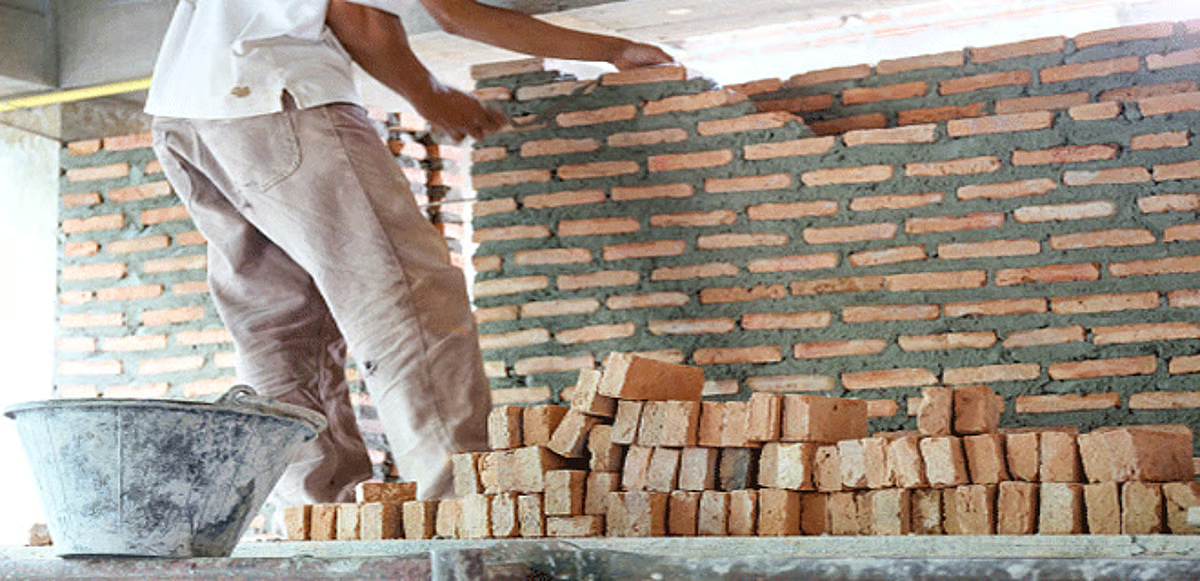
India and several fast urbanising Asian economies are witnessing a sharp rise in demand for blended cement as governments, builders and infrastructure agencies seek lower emission construction materials for expanding cities. The shift is being driven by stricter environmental priorities, rising infrastructure investments and pressure on the construction sector to reduce its carbon footprint while maintaining affordability.

Industry assessments indicate that the blended cement market is gaining traction across India, China and Southeast Asia, particularly in urban housing, transport corridors and industrial development projects. Unlike conventional cement, blended variants incorporate industrial by-products such as fly ash, slag and pozzolanic materials, reducing dependence on energy-intensive clinker production. The transition is increasingly being viewed as essential for cities attempting to balance rapid growth with climate resilience goals.India’s construction sector remains one of the country’s largest contributors to material related emissions, largely due to cement and steel consumption. Urban planners and sustainability experts say the growing use of blended cement could help moderate emissions linked to housing expansion, highway construction and public infrastructure. The material also supports waste reutilisation by diverting industrial residues from landfills into productive use.
The growth of the blended cement market comes at a time when Indian cities are preparing for major urban redevelopment programmes, metro rail expansion and logistics infrastructure upgrades. Analysts tracking the building materials sector note that municipal authorities and public agencies are gradually incorporating sustainability-linked procurement standards into infrastructure tenders, encouraging wider adoption of low-carbon materials.

Construction firms are also responding to rising energy costs and evolving green building regulations. Blended cement generally requires lower clinker content, which can reduce fuel consumption during manufacturing. For developers operating in cost-sensitive urban markets, this offers both environmental and operational advantages. However, experts caution that material performance, quality consistency and awareness among smaller contractors remain key implementation challenges, particularly in tier-two and tier-three cities.China, meanwhile, continues to influence global cement trends through tighter industrial emission policies and large-scale investments in cleaner construction technologies. Regional demand patterns suggest that Asian markets are becoming central to the global transition towards lower-carbon building materials, especially as climate-linked financing increasingly shapes infrastructure investment decisions.The broader expansion of the blended cement market also reflects changing expectations from institutional investors and urban policymakers. Financial institutions funding large infrastructure projects are placing greater emphasis on environmental compliance, lifecycle emissions and resource efficiency. This is gradually reshaping procurement decisions across public works and private real estate projects alike.

Urban development experts argue that the long-term impact of blended cement adoption will depend on stronger regulatory frameworks, better construction standards and improved material testing systems. As India continues to urbanise at scale, the challenge for policymakers will be ensuring that construction growth does not deepen environmental stress or widen inequalities in access to resilient urban infrastructure.With cities expected to absorb millions of new residents over the next decade, the future of the blended cement market may increasingly determine how sustainably India builds its next generation of homes, roads and public spaces.

Also Read : India Cements Recovery Signals Changing Construction Demand
India Blended Cement Market Gains Urban Momentum
RELATED ARTICLES

LEAVE A REPLY

Please enter your comment!
Please enter your name here

- Advertisment -spot_img

Most Popular

Recent Comments

India Refinery Growth Reshapes Bauxite Supply Chain

India Refinery Growth Reshapes Bauxite Supply Chain

India’s growing aluminium refining sector is driving a sharp increase in bauxite imports, signalling deeper structural pressures in the country’s mineral supply chain as...
India Biomaterials Sector Gains Urban Industry Attention

India Biomaterials Sector Gains Urban Industry Attention

India’s growing search for low carbon industrial materials is drawing fresh attention as Bengaluru based startup AltM expands work on bio-based alternatives designed to...
India Power Networks Face New Infrastructure Push

India Power Networks Face New Infrastructure Push

India’s expanding electricity infrastructure and clean energy ambitions came into sharper focus this week as Hitachi Energy India engaged investors on future business strategy,...
India Cotton Import Duty Relief Reshapes Textiles

India Cotton Import Duty Relief Reshapes Textiles

India’s textile manufacturing sector could see a major cost reset after the Union government initiated discussions on removing the existing cotton import duty, a...
Gujarat Steel Sector Gains Global Pipe Milestone

Gujarat Steel Sector Gains Global Pipe Milestone

India’s steel manufacturing sector has entered a new phase of industrial capability after a major integrated steel producer secured international certification for a specialised...
