
HomeLatestIndia Materials Innovation Gains Global Research Momentum

India Materials Innovation Gains Global Research Momentum

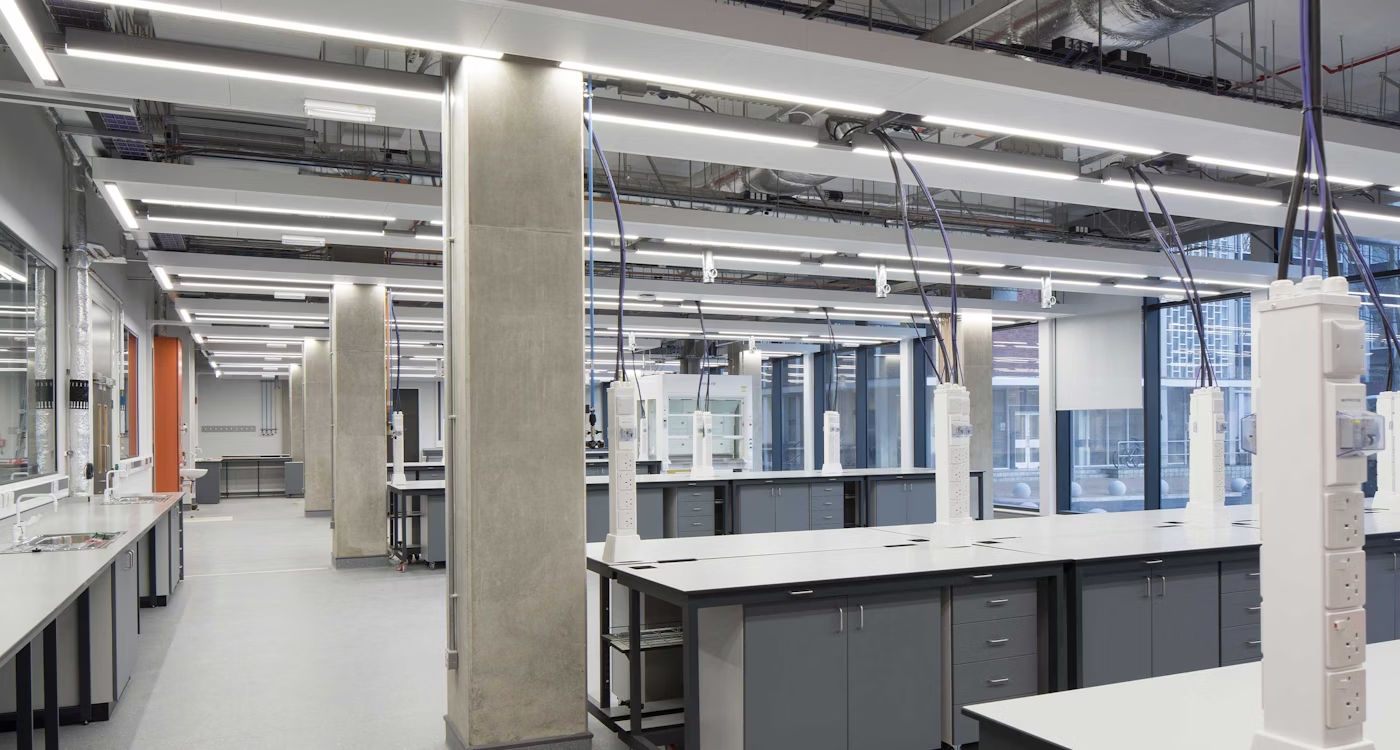
A new international research collaboration focused on advanced materials technologies is drawing attention to the increasingly important role of material science in shaping sustainable infrastructure, resilient cities and next-generation manufacturing. The partnership brings together Indian and Singapore based research capabilities to explore innovations that could influence industries ranging from construction and transportation to energy and urban development.

The initiative centres on joint research into Advanced Materials Technologies, a field gaining strategic importance as governments and industries seek solutions that can improve efficiency, reduce emissions and extend the lifespan of critical infrastructure assets. As urban populations continue to expand and climate pressures intensify, demand is growing for materials capable of supporting more durable, resource-efficient and environmentally responsible development.Experts view the collaboration as part of a broader trend in which scientific research is increasingly linked to economic competitiveness and infrastructure resilience. Advanced materials are being deployed across a wide range of applications, including lightweight construction systems, energy storage technologies, smart manufacturing processes and low-carbon industrial production.
The significance of Advanced Materials Technologies extends well beyond laboratories. Urban planners and infrastructure specialists argue that future cities will require materials that can withstand extreme weather conditions, reduce maintenance requirements and improve energy performance. Such innovations are expected to become increasingly important as governments invest in climate adaptation and sustainable urban growth.

Research institutions worldwide are placing greater emphasis on multidisciplinary approaches that combine engineering, materials science and industrial applications. This reflects a growing recognition that many of the challenges facing cities from energy efficiency and resource scarcity to infrastructure durability cannot be addressed through conventional technologies alone.Industry analysts note that advanced materials have the potential to influence several sectors critical to urban development. In construction, they may contribute to stronger and lighter building systems, while in transportation they can improve efficiency and reduce environmental impacts. Energy infrastructure could also benefit through enhanced storage solutions, grid technologies and renewable energy integration.The partnership further highlights the growing role of international collaboration in accelerating innovation. Scientific cooperation allows institutions to share expertise, research facilities and technical capabilities, helping reduce development timelines and improve the commercial viability of emerging technologies. For countries seeking to strengthen industrial competitiveness, such collaborations are increasingly viewed as strategic investments rather than purely academic exercises.From a sustainability perspective, the development aligns with efforts to reduce the environmental footprint of industrial production and infrastructure expansion. Researchers are exploring materials that require fewer resources, generate lower emissions and perform more effectively over longer operational lifecycles. These characteristics are becoming increasingly valuable as cities seek pathways towards lower-carbon growth.

Policy observers suggest that advances in Advanced Materials Technologies could play an important role in supporting national objectives related to manufacturing, energy transition and urban resilience. However, translating research breakthroughs into large-scale deployment will require continued investment, regulatory support and effective industry partnerships.As infrastructure needs evolve and climate challenges become more complex, the importance of material innovation is likely to grow. The latest collaboration underscores how research-led development is becoming an essential component of building cities that are not only economically productive but also more resilient, efficient and sustainable for future generations.

Also Read : India Pipe Manufacturing Draws Fresh Market Attention
India Materials Innovation Gains Global Research Momentum
RELATED ARTICLES

LEAVE A REPLY

Please enter your comment!
Please enter your name here

- Advertisment -spot_img

Most Popular

Recent Comments

India Steel Emission Targets Put Industry Under Pressure

India Steel Emission Targets Put Industry Under Pressure

India has moved deeper into regulating industrial carbon intensity, with new greenhouse gas emission targets placing the steel sector under a more structured compliance...
Mumbai Adani Property Development Needs RERA Clarity

Mumbai Adani Property Development Needs RERA Clarity

Adani Group’s planned property pipeline of more than 600 million sq ft is set to reshape the scale of private-sector development across Mumbai and...
UltraTech RERA Era Housing Sees Ultravolt Wires Entry

UltraTech RERA Era Housing Sees Ultravolt Wires Entry

India’s expanding housing and infrastructure pipeline is drawing another major construction-linked business into electrical supplies. UltraTech Cement has launched Ultravolt, backed by a ₹1,800...
Hyderabad Tribhuja RERA Registration Targets Premium Demand

Hyderabad Tribhuja RERA Registration Targets Premium Demand

A large residential development has entered Hyderabad’s Kollur housing market, adding 1,730 apartments to the western corridor as demand for higher-value homes continues to...
Mumbai RERA Faces Test From Adani Realty Expansion

Mumbai RERA Faces Test From Adani Realty Expansion

Mumbai is emerging as a major testing ground for one of India’s largest planned real estate expansions, with the Adani Group indicating a development...
