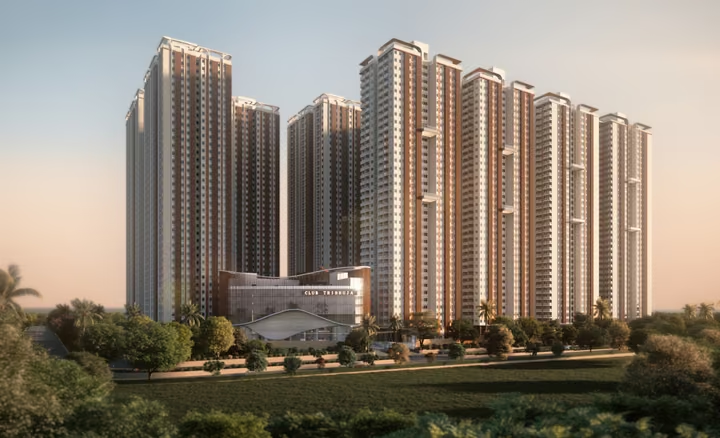
A large residential development has entered Hyderabad’s Kollur housing market, adding 1,730 apartments to the western corridor as demand for higher-value homes continues to reshape the city’s suburban expansion. The project, Tribhuja, is spread across 9.16 acres and carries a stated sales potential of about ₹3,000 crore. Its scale also raises questions about infrastructure capacity and liveability as high-rise development accelerates around the Outer Ring Road.
The project has been registered under Telangana RERA, with three registration numbers listed for its phases: P01100010650, P01100010651 and P01100010652. The developer’s project information identifies Phase 1 as P01100010651. The development comprises nine towers, each planned at G+37 floors, with three- and four-bedroom homes ranging from roughly 1,679 sq ft to 3,126 sq ft. Around 76% of the residences are described as corner units, while the project site is planned with a substantial proportion of open space. Tribhuja’s location reflects a broader shift in Hyderabad’s housing geography. Kollur sits within reach of Gachibowli, the Financial District and other employment centres along the western growth belt. Better road connectivity has helped push residential construction further towards the metropolitan edge, but this expansion also increases pressure on roads, water supply, drainage, public transport and social infrastructure.
Hyderabad’s housing market has remained tilted towards larger and more expensive homes. Knight Frank data shows that 75,222 residential properties were registered across the city in 2025, while registrations of homes valued above ₹1 crore rose 35% year-on-year. Such figures indicate that premiumisation is influencing the composition of new supply, even as overall transaction volumes remain relatively restrained. For the Tribhuja RERA project, the environmental design claims will also matter beyond marketing specifications. The development is pre-certified for a Silver rating under the Indian Green Building Council framework and retains significant open areas. Features such as natural ventilation, daylight access and water management can reduce operational pressures, but their effectiveness will ultimately depend on construction quality, maintenance and actual performance after occupation.
The project includes a clubhouse of about 100,000 sq ft and a wide range of recreational facilities. While such private amenities can improve residential convenience, planners increasingly assess large developments by their relationship with surrounding public infrastructure rather than facilities within the site alone. With Kollur continuing to urbanise, the Tribhuja RERA project illustrates the next phase of Hyderabad’s outward residential growth. The key test will be whether new housing is matched by reliable mobility, utilities, green infrastructure and accessible public services as the western corridor becomes more densely populated.