
HomeLatestMumbai Real Estate Funding Signals Development Continuity

Mumbai Real Estate Funding Signals Development Continuity

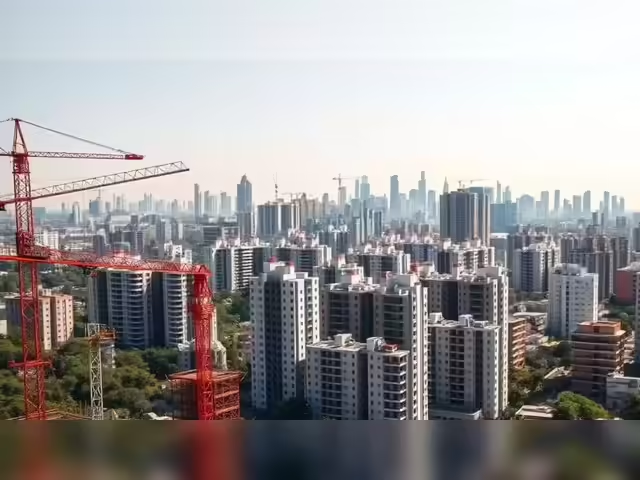
A listed real estate developer has infused nearly ₹4.91 crore into two wholly owned project subsidiaries through rights issues, reinforcing the role of internal capital allocation in advancing residential developments amid a cautious property market. While modest in scale, the transaction reflects how developers are increasingly using equity funding to maintain project execution, improve financial discipline and support long-term urban development.

The capital infusion, disclosed through regulatory filings, has been directed towards subsidiaries responsible for specific real estate projects. Such rights issues enable parent companies to strengthen the financial position of individual project entities without resorting to additional external borrowing. Industry experts note that this approach has become increasingly common as developers seek to manage balance sheets more prudently while ensuring adequate liquidity for ongoing construction activities. The latest real estate capital infusion comes at a time when India’s organised property sector is witnessing greater emphasis on financial transparency and project-level accountability. Following regulatory reforms and tighter lending practices, developers are placing increased importance on maintaining stable funding sources that support timely delivery and reduce execution risks for homebuyers.

Financial analysts suggest that equity-based funding mechanisms can improve project resilience by lowering debt exposure and providing greater flexibility in responding to changing market conditions. Although the investment amount is relatively limited compared with large-scale project financing, it illustrates a broader trend towards structured capital management within the real estate sector, particularly for companies overseeing multiple developments through subsidiary entities. Urban planners argue that sound financial governance has direct implications for city development. Delays arising from funding constraints often leave partially completed buildings, disrupt neighbourhood infrastructure and  affect buyer confidence. Ensuring that projects remain adequately capitalised throughout the construction cycle can contribute to more predictable delivery schedules, efficient land utilisation and improved urban regeneration outcomes.

The real estate capital infusion also reflects the increasing scrutiny placed on corporate governance in the housing sector. Investors, lenders and homebuyers are paying closer attention to how developers allocate resources across projects, particularly in an environment where regulatory compliance and financial disclosures play a larger role in market confidence. Transparent funding structures are viewed as an important element in strengthening institutional trust and improving long-term sector stability. Experts further observe that India’s housing market is gradually moving towards a more disciplined financial model, where equity support, measured borrowing and phased development are replacing highly leveraged expansion strategies. This evolution is expected to reduce systemic risks while encouraging more sustainable patterns of urban growth that align investment decisions with actual market demand. As India’s cities continue to expand, effective project financing will remain a critical component of responsible real estate development. Beyond supporting construction activity, well-managed capital allocation can help ensure that housing projects are delivered with greater certainty, contributing to resilient urban infrastructure, improved buyer confidence and more sustainable communities over the long term.

Also Read: India Residential Market Sustains Robust Buyer Momentum
Mumbai Real Estate Funding Signals Development Continuity
RELATED ARTICLES

LEAVE A REPLY

Please enter your comment!
Please enter your name here

- Advertisment -spot_img

Most Popular

Recent Comments

South India Steel Capacity Could Reshape Industrial Growth

South India Steel Capacity Could Reshape Industrial Growth

South India’s steel industry is entering a period of expansion, with installed crude steel capacity reaching approximately 46 million tonnes and production touching 31...
Shree Cement Earnings Test Its Green Growth Strategy

Shree Cement Earnings Test Its Green Growth Strategy

Shree Cement’s falling profitability has raised fresh questions about whether rising sales, energy efficiency and sustainability investments can deliver stronger returns in India’s cement...
India Cement Industry Sees Uneven Growth Amid Inflation

India Cement Industry Sees Uneven Growth Amid Inflation

India’s cement industry is heading towards a gradual demand recovery, but rising fuel and freight expenses could limit earnings growth in the coming quarters....
Pune Real Estate Sees Shift Towards Plotted Projects

Pune Real Estate Sees Shift Towards Plotted Projects

Pune’s property market is seeing fresh efforts to attract buyers towards plotted developments, with Krisala Developers introducing a new campaign for its 63-acre Land...
M SANVI Expands Housing Choices Amid Changing Demand

M SANVI Expands Housing Choices Amid Changing Demand

Delhi-NCR’s residential market is facing a changing set of buyer priorities, with demand for larger homes running alongside concerns about affordability and household budgets....
